At My Husband’s Funeral, My Son Said, “Stop Crying, Pack Your Bags and Get Out Now
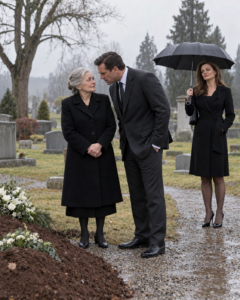
Phân cảnh 1: The funeral betrayal
I am Clara, 68 years old, and I stood in the cold drizzle, watching them lower my husband of 40 years into the ground.
Before the dirt even settled, my own son leaned in close, his breath warm against my ear.
“Stop your fake crying, pack your bags, and be out of my house by tonight, or I will freeze every account you have and lock you in a nursing home.”
I did not scream. I did not beg. I simply smiled—a very small smile—went home, packed a single suitcase, and vanished into the night, leaving my jewelry, my personal papers, and my floor safe behind.
But the next morning, my son received a visitor he never expected.
Phân cảnh 2: The son’s cruel demands
The police were at his door.
The cemetery air was heavy with the smell of damp earth and crushed pine needles. Robert had always hated the rain, and it felt like a bitter irony that the sky opened up just as the priest spoke the final words over his casket.
At 72, my husband had succumbed to an illness that took him far too quickly, leaving a void in my life that I was only just beginning to comprehend. I stood near the edge of the burial plot, my black coat buttoned tight against the chill, watching the groundskeepers waiting respectfully in the distance with their shovels.
The crowd of mourners had already started to disperse, heading toward the warmth of their cars. I wanted just one more minute, one moment of quiet to say a proper goodbye to the man I had built my entire life with.
That was when Marcus stepped up beside me.
My son was 45 years old, tall and imposing, wearing a custom-tailored charcoal suit that repelled the light rain perfectly. He carried himself with the rigid posture of a man who believed he was the smartest person in any room he entered.
For weeks, I had watched him play the role of the devastated heir, shaking hands at the funeral home, accepting condolences with a solemn nod and acting the part of the grieving son to perfection. But standing next to me now, with the last of the guests out of earshot, the mask slipped away completely.
He did not put his arm around my shoulder. He did not offer a word of comfort. Instead, he leaned down, invading my personal space, his voice dropping to a harsh, flat whisper that barely carried over the sound of the falling rain.
“Stop your fake crying, mother. The show is over. You need to pack your bags and get out of my house tonight. If you try to fight me, if you try to take a single dime, I will freeze every account with my name on it, and I will find a doctor to declare you incompetent. You will spend the rest of your life rotting in a state-run nursing home. Do you understand me?”
I slowly turned my head to look at him.
A few feet behind Marcus stood his wife, Sylvia. She was 40, draped in a black designer dress that looked more suited for a cocktail party than a funeral, holding an expensive umbrella over her perfectly styled hair.
Sylvia caught my eye and offered a thin, self-satisfied smirk. She didn’t bother to hide it. She was enjoying this.
She had always resented the fact that Robert and I held the purse strings, and now, with Robert gone, she believed her moment had finally arrived.
I looked back at Marcus, studying the sharp lines of his face. I noted the expensive cut of his Italian wool suit. It was a suit paid for by Bennett Commercial Properties, the real estate empire his father and I had built from absolutely nothing.
Marcus always thought Robert was the sole genius behind our wealth. Robert was the charismatic one, the man who shook hands, charmed investors, and closed the deals over expensive lunches.
But Marcus had completely forgotten, or perhaps willfully ignored, who actually balanced the ledgers.
For over 30 years, I had been the certified public accountant managing the books in the back office. I was the one who structured the tax strategies, audited the acquisitions, and kept the empire from collapsing under its own weight during the recession.
Marcus only saw a 68-year-old woman who liked to arrange flowers in the living room and bake pies for Sunday dinners. He saw an old widow. He saw an easy target.
I did not raise my voice. I did not slap him across the face, even though every maternal instinct I possessed screamed at me to discipline the arrogant boy standing in front of me.
Years of auditing financial records had trained me to recognize patterns, to separate raw emotion from hard facts. The fact standing before me was that my son had not made this decision today. This kind of cruelty required preparation.
As I looked into his cold eyes, I realized he had been planning this while his father was lying in a hospice bed. While I was sleeping in uncomfortable hospital chairs and feeding Robert ice chips, Marcus had been consulting with lawyers and moving pieces on a chessboard I hadn’t even realized we were playing on.
I took a slow, deep breath, letting the cold air clear my lungs. I did not give him the satisfaction of tears. I simply offered him a faint, polite smile, the kind of smile one gives a rude stranger in a grocery store.
I nodded once, turned my back on him, and walked away down the wet gravel path toward my waiting car. I could feel his eyes on me, probably assuming he had just won the easiest victory of his life.
He thought my silence was surrender. He thought I was too broken by grief and too intimidated by his threats to fight back.
Phân cảnh 3: Setting the safe trap
The drive home was quiet. The windshield wipers kept a steady rhythm, sweeping away the rain. I leaned my head against the cool glass of the passenger window and let the memories of the last few months fall into place.
It all made sense now.
The way Marcus had hovered around Robert’s hospital room whenever the doctors discussed the prognosis. The way Sylvia had started walking through my home, taking inventory of the antique furniture and the artwork, pretending she was just admiring the decor.
They had been sizing up the spoils. They felt entitled to the wealth because they shared our last name, completely disregarding the decades of sacrifice, the sleepless nights, and the sheer grit it took to accumulate those assets.
When the car pulled into the sweeping circular driveway of the house Robert and I had shared for 25 years, I thanked the driver and stepped out. The house was enormous, quiet, and deeply empty.
The catering staff from the post-funeral reception had already cleaned up and left. The polished hardwood floors gleamed under the soft hallway lights. I walked slowly up the curved staircase, my hand trailing along the mahogany banister.
I went directly to the master bedroom. I did not wander the halls weeping over old photographs. I did not collapse onto the large king-sized bed I had shared with Robert.
Grief is a heavy thing, but betrayal is a remarkable motivator. The pain of losing my husband was profound, but the calculated cruelty of my son sharpened my mind into something incredibly focused.
I pulled a single sensible leather suitcase from the top shelf of the closet. I opened it on the bed and began to pack. I chose comfortable sweaters, practical slacks, sturdy shoes, and a few toiletries.
I packed like a woman going on a quiet weekend retreat, not a woman being evicted from her own life.
I bypassed the designer dresses and the expensive coats Robert had bought me over the years. I didn’t need them for where I was going, and leaving them behind would feed perfectly into the narrative Marcus was constructing in his head.
Then I walked over to the walk-in closet.
Hidden beneath a heavy oak dressing bench was a thick rug. I pushed the bench aside, rolled back the rug, and looked down at the heavy steel plate of my personal floor safe. It was bolted directly into the concrete foundation of the house.
Robert had it installed for me 15 years ago. I knelt down and rested my hand on the cold steel dial.
Over the years, I had used that safe for diamond jewelry, vintage watches, and important personal documents, and Marcus had seen me open it before. That memory was exactly what made the safe useful now.
The jewelry and papers I was leaving behind were still in the bedroom, but the safe itself held only the manila folder I wanted him to find. Marcus did not know that. He would assume the box still contained the untraceable cash, bearer bonds, and family valuables he had always imagined were hidden there.
If I emptied the safe and left the door open, Marcus would know I had taken assets with me. He would realize I was thinking clearly and acting strategically.
But if I left the safe locked and seemingly abandoned in my haste to flee, the temptation would be absolutely irresistible to him. He would not be able to stand the mystery of what was inside. He would look at that locked steel box and see a treasure chest that he believed rightfully belonged to him.
I stood up, leaving the dial untouched. I rolled the rug back over the steel plate and carefully pushed the oak bench back into its exact original position.
The bait was set.
I carried my suitcase downstairs. The grandfather clock in the foyer chimed softly, marking the hour. The house was completely silent.
I walked to the front door, placed my hand on the brass handle, and stepped out into the cool, damp night air. I did not leave a note. I did not leave a forwarding address.
I locked the heavy front door behind me, knowing I was leaving my son alone with his arrogance and his greed. I walked down the long driveway toward the street where a hired car was already waiting for me.
I slid into the back seat, gave the driver an address, and watched my home disappear into the darkness as we drove away.
Marcus had demanded I leave, and I had complied perfectly. I had given him exactly what he wanted. He thought he had easily swept away a weak, grieving old woman.
He had no idea that I was simply clearing the battlefield, making room for the trap I had just left, waiting for him in the dark.
Phân cảnh 4: The trap is sprung
I woke up before dawn the next morning in an apartment I had leased under a corporate holding name 3 months prior. The space was bright, sparsely furnished, and entirely mine.
There were no ghosts of my marriage here, no echoes of Robert’s booming voice, and certainly no traces of Marcus’ suffocating entitlement.
I made a pot of black coffee, poured a cup, and sat by the window overlooking the city streets. At 68, my body appreciated the quiet, but my mind was already several steps ahead.
I knew my son. I knew his wife. I knew exactly how they would spend their first morning as the self-proclaimed masters of the Bennett estate.
For 15 years, a heavy steel floor safe had rested beneath the oak bench in our master bedroom. Robert had ordered it customuilt for me to store my most valuable personal assets. It was not a company asset, and it was not part of any joint family trust.
Bolted directly to the steel door was a brass plaque that read, “Soulle and separate property of Clara Bennett.”
The distinction was clear enough that even Marcus should have understood it. The safe belonged to me, a living person, and he had no authority to drill it simply because his father had died.
But Marcus had never been one to read the fine print. He had always relied on bluster and intimidation to get what he wanted. He assumed that because he held the keys to the front door, he owned everything inside the walls.
He was about to learn a very expensive lesson in property law.
At exactly 9:00, my cell phone vibrated on the glass dining table. I looked at the screen. It was not a text message from a grieving friend.
It was an automated alert from the private security firm I had contracted weeks ago. The message was simple and precise.
“Silent alarm triggered. Master bedroom floor safe. Perimeter breach in progress. Law enforcement dispatched.”
I did not gasp. I did not rush to put on my coat. I took a slow sip of my coffee, feeling the warm liquid settle my stomach.
I set the mug down, picked up my tablet, and opened a secure application.
When I realized months ago that Marcus had been carelessly pushing his boundaries, and Sylvia had been inventorying my antique vases with her eyes, I had quietly upgraded the house’s internal security.
A single discrete camera sat hidden on the upper bookshelf in the master bedroom, pointing directly at the space where the safe was buried in the foundation. I tapped the screen and the live video feed loaded.
The image was perfectly clear.
There was my son, dressed in a casual weekend sweater, pacing back and forth across my bedroom floor. Sylvia stood near the doorway holding a cup of coffee, looking thoroughly pleased with herself.
Kneeling on the floor between them was a man in a gray work shirt holding a heavy-duty commercial drill—a locksmith.
I watched Marcus point impatiently at the steel plate. I could not hear the audio, but his aggressive body language spoke volumes.
He was likely telling the locksmith to hurry up, spinning some arrogant lie about his mother losing the combination, or his father leaving him the contents in a will. He probably believed he was minutes away from holding stacks of untraceable bearer bonds, thick bundles of emergency cash, and the velvet boxes containing my diamond necklaces.
He desperately needed that cash. I knew his financial habits well enough to know he was overextended, drowning in lifestyle debts he could never support on his vice presidential salary alone.
The locksmith appeared hesitant. He paused his drill and pointed down at the brass plaque on the door. He was a professional, likely questioning the legality of breaking into a safe that clearly bore a living woman’s name.
Marcus waved his hand dismissively, his posture radiating arrogance. He pulled a piece of paper from his pocket, likely the deed to the house, or a copy of Robert’s death certificate, insisting it gave him the absolute right to proceed.
He was using his father’s recent death as a VIP pass to commit burglary.
The locksmith, intimidated by my son’s expensive clothes and authoritative tone, eventually lowered his head and resumed drilling. They had no idea that the moment the drill bit pierced the first layer of the safe’s outer casing, a silent distress signal had bypassed the home’s main alarm system and gone straight to the local police precinct.
It was a priority one alert for a burglary in progress at a high netw worth residence.
It took the locksmith roughly 20 minutes to break the mechanism. I watched the screen with absolute detachment.
Marcus stepped forward, practically shoving the worker aside in his eagerness. He grabbed the heavy steel handle and hauled the door upward. Sylvia moved closer, peering over his shoulder, her eyes wide with anticipation of the treasure they were about to unearth.
I watched Marcus reach down into the dark cavity. He expected his hands to meet velvet and bundled paper.
Instead, his hand emerged holding a single thin manila folder.
He opened it rapidly, his brow furrowing in deep confusion. Inside that folder was a single sheet of heavy stock paper. I had typed the message myself.
It read, “Property of Clara Bennett, not part of the estate.”
Marcus stared at the paper. He turned the folder upside down and shook it. He dropped to his knees and shined his phone flashlight into the empty steel box, refusing to believe that his grand prize was nothing but an accounting trap left by his mother.
Sylvia crossed her arms, her smug expression melting into a scowl of bitter, ugly disappointment.
They did not have time to process their anger.
Through the camera feed, I saw the bedroom door swing open. Two uniformed police officers stepped into the frame, their hands resting cautiously on their duty belts.
The locksmith immediately raised his hands, dropping his tools and backing away from the safe, eager to distance himself from whatever crime was unfolding.
Marcus, however, puffed out his chest. I could see the indignant outrage written across his face. He began gesturing wildly, pointing to the floor, pointing to the paperwork in his hand, acting as though the police were a mere customer service nuisance he could complain his way out of.
The officers remained entirely unimpressed.
One of them stepped forward and examined the brass plaque on the safe door. He then looked at the locksmith, who clearly stated he had been hired by the man in the sweater.
The officer asked Marcus for identification. Marcus handed over his driver’s license. The officer compared the name on the license to the name firmly bolted onto the steel safe.
Marcus Bennett was not Clara Bennett.
Phân cảnh 5: Marcus is arrested
My cell phone rang, breaking the quiet of my apartment. The caller identification displayed the local police department. I answered on the second ring, keeping my voice measured and calm.
“Hello,” I said.
“Mrs. Clara Bennett?” a male voice asked.
“Yes, speaking.”
“Ma’am, this is Sergeant Miller with the local police department. We received a silent alarm trigger from a private safe at your residence. We have officers on the scene right now. Can you confirm your current location?”
“I am perfectly safe, Sergeant,” I replied smoothly. “I am at a secondary residence. I am not at the main house. Can you tell me what your officers have found?”
“We have a forced entry on a floor safe in the master bedroom,” the sergeant explained, his tone shifting into professional caution. “There are three individuals present: a locksmith, a woman, and a man identifying himself as your son, Marcus Bennett. He claims he has legal authority to open this safe as the executive of his father’s estate.
“Ma’am, did you authorize your son to drill this safe today?”
I took a very slow, deliberate breath. This was the moment, the hinge upon which my son’s arrogant reality would break.
“No, Sergeant,” I said, my voice projecting absolute authority. “I absolutely did not authorize that. That safe is my sole and separate legal property, purchased with my own funds long before my husband passed away. It is not part of my husband’s estate. It is not subject to probate. My son has absolutely no legal right to touch it, let alone hire someone to drill into it.”
There was a brief pause on the line. The scratching of a pen on paper echoed through the receiver.
“Understood, Mrs. Bennett. The value of the safe itself, along with the potential contents, elevates this beyond a simple domestic dispute. Do you wish to press charges for the destruction of your property and attempted theft?”
“Yes, I do,” I answered without a single ounce of hesitation. “I want to press full charges for grand theft and destruction of private property.”
“I will relay that to the officers on site. We will secure the premises and take the suspect into custody. We may need you to come down to the station later to sign a formal statement.”
“I will be available whenever you need me, Sergeant. Thank you for your prompt response.”
I hung up the phone and looked back at my tablet screen. The scene playing out in my old master bedroom was a masterclass in the consequences of unchecked greed.
The officer, who had been speaking into his shoulder radio, nodded to his partner. They approached Marcus.
Marcus took a step back, holding his hands up, clearly trying to argue his way out of the situation. He was a wealthy vice president of a commercial real estate firm. He was used to people deferring to his suits and his aggressive tone.
He was not used to being treated like a common criminal.
But the law is remarkably blind to expensive tailoring when there is clear evidence of a felony in progress.
The officers moved in. One of them grasped Marcus by the arm, turning him around. Marcus resisted for a brief second, shock radiating from his posture, before the officer forcefully pinned his arms behind his back.
The glint of metal flashed in the bedroom light as the handcuffs snapped securely around my son’s wrists.
Sylvia was frantic. She hovered near the doorway, waving her arms, her mouth moving a mile a minute.
She was likely screaming about lawsuits and threatening the officers’ jobs, the standard defense mechanism of a woman who had never faced a genuine consequence in her entire privileged life.
The police ignored her entirely.
They marched Marcus, the newly minted head of the family, out of the master bedroom and down the grand staircase.
I sat back in my chair, the tablet resting on my lap, and let the profound silence of my new apartment wash over me. The satisfaction was not a fiery, triumphant joy. It was a cold, clinical relief.
I had spent 40 years managing the liabilities of Bennett Commercial Properties. I knew how to identify a bad investment, and my son had proven himself to be the worst kind of liability.
He believed that his father’s death gave him a blank check to strip away my dignity and my security. He believed I was a frail, weeping widow who would run away and hide.
Instead, I had let him walk blindly into a trap constructed entirely of his own entitlement.
The charge of grand theft was not a minor inconvenience. In our state, the destruction of a high-v value commercial floor safe, combined with the clear intent to steal assets that belonged exclusively to another living person, constituted a serious felony.
The fact that the safe was empty did not magically erase the crime. The intent to commit grand lararseny was fully documented by the presence of a hired locksmith and the destroyed locking mechanism.
Phân cảnh 6: Financial consequences
Later that afternoon, my phone rang again. It was a lawyer I had kept on retainer for years, a sharp, discreet man who handled my personal trusts away from the primary corporate lawyers Marcus usually dealt with.
“Clara,” my lawyer said, his tone carrying a hint of professional amusement. “I just received word from the county courthouse. Your son was booked into the county jail 3 hours ago.”
I poured myself a glass of water, walking over to the window to look out at the afternoon traffic.
“And how is his day going?” I asked.
“About as poorly as one would expect,” he replied. “He was processed, fingerprinted, and placed in a holding cell alongside the usual weekend crowd. He had to surrender his shoelaces and his designer belt. The arraignment judge set his bail at $50,000, considering the felony nature of the charge and the clear evidence of premeditation.”
“Did he post it?”
“He did,” my lawyer confirmed, “but it took several hours. He had to use a bail bondsman because his personal accounts did not have enough liquid cash to cover the full amount without triggering flags at the bank. He walked out of the precinct looking thoroughly humiliated.
“The local neighborhood watch group apparently saw him being escorted out of your house in handcuffs this morning. The gossip is already spreading.”
As the sun began to set over the city skyline, casting long golden shadows across my quiet living room, I opened my laptop. It was time to stop waiting for his next mistake and start actively securing the empire Robert and I had built.
Marcus thought he had inherited a kingdom. He did not realize that the actual architect of that kingdom was sitting miles away, holding the blueprints, ready to dismantle his financial life, brick by brick.
The safe had been empty, but the real consequences were just about to begin.
Phân cảnh 7: A call from the enemy
The morning sun spilled across the polished hardwood floors of the high-end apartment I had leased 3 months ago. I sat at the kitchen island with a cup of Earl Grey tea, watching the city wake up through the floor-to-ceiling windows.
The space was bright, secure, and entirely untraceable to anyone in my family. There were no drafty windows, no creaking stairs, and absolutely no signs of the helpless, impoverished widow my son expected me to be.
I took a slow sip of my tea, feeling the steady rhythm of my own heartbeat. At 68 years old, I had learned that true peace does not come from avoiding conflict. True peace comes from being thoroughly prepared for it.
Across the marble counter sat my grandson, Leo. He was 22 years old, wearing a faded university sweatshirt, his eyes intently focused on the glowing screen of his laptop.
Leo was Marcus’ son from his first marriage. When that marriage dissolved more than a decade ago, Marcus had simply walked away, treating his own child like an expired business contract.
My son had decided that a fresh start with Sylvia was more convenient than the daily responsibilities of fatherhood. He had practically erased the boy from his life.
I had refused to allow that eraser.
While Marcus was busy upgrading his luxury vehicles and taking Sylvia on expensive vacations, I was the one attending Leo’s parent-teacher conferences. I was the one who paid for his braces, celebrated his high school graduation, and quietly funded his university tuition.
I never spoke ill of Marcus to the boy, but children are remarkably perceptive. Leo grew up understanding exactly who his father was. More importantly, he grew up knowing exactly who I was.
He was brilliant, currently completing his degree in auditing and information technology. He had inherited my mind for numbers and possessed a modern understanding of digital systems that I frankly admired.
We shared a quiet, unbreakable bond built on mutual respect and genuine affection. He was not here out of obligation. He was here because he knew what his father was capable of, and he wanted to help me protect the legacy his grandfather had built.
“Grandma,” Leo said, his voice breaking the quiet of the apartment. “I have the preliminary diagnostics running on the secure server. Everything is holding steady, but I am seeing some strange ping requests coming from the main corporate network. It looks like someone is trying to access the administrative overrides.”
I set my teacup down.
“That would be your father,” I replied calmly. “He is likely out on bail by now, and I imagine he is incredibly angry.”
Right on cue, my cell phone began to ring. It sat on the counter between us, the screen lighting up with Marcus’s name.
I looked at the phone for a long moment. I knew exactly what kind of conversation this was going to be.
A cornered animal is always the most dangerous, and Marcus had just spent the night in a county holding cell, stripped of his tailored suit and his arrogant pride. He would be desperate to regain control.
I reached out and pressed the green button, putting the call on speaker so Leo could hear.
“Are you happy with yourself?” Marcus spat before I could even say hello.
His voice was raw, vibrating with a mixture of pure rage and lingering humiliation.
“I spent the night on a concrete bench because of your little security stunt. Do you have any idea how much money I had to pay a bondsman to get out of there this morning?”
I listened to his breathing, heavy and ragged through the phone speaker.
“Good morning, Marcus,” I said, my voice smooth and perfectly level. “I see the county holding facility did not improve your manners.”
“You think this is a game?” he snarled. “You think you can embarrass me in front of the entire neighborhood, get me arrested like some common criminal, and just walk away? You think you are so clever, sitting in whatever cheap motel you ran off to last night?
“Well, the game is over, mother. I went straight to the bank the moment the doors opened this morning. I brought the new will. I brought my corporate identification. I brought everything I needed to cut you off completely.”
I closed my eyes for a brief moment.
The new will.
The mere mention of that document made my chest ache with a profound, quiet sorrow. It brought back the memory of Robert’s final week in the hospice wing.
My husband had been in immense pain, his strong mind clouded by massive doses of morphine and paliotative medications. He barely knew what year it was, often waking up thinking we were still in our 30s, building our first office complex.
Marcus had chosen that exact window of vulnerability to act. He had brought a notary public, a man who clearly asked no questions, into Robert’s hospital room.
I had stepped out to speak with a nurse for barely 20 minutes. When I returned, Marcus was physically holding his father’s frail, trembling hand, guiding a pen across the signature line of a freshly printed document.
It was a vile, predatory piece of paper designed to strip away my authority and grant Marcus sweeping executive powers over the estate.
I could have fought it right then. I could have caused a scene, called the hospital administrators, and challenged the document immediately. But starting a screaming match in a hospital room while my husband was taking his final breaths was a line I refused to cross.
I wanted Robert’s last days to be peaceful. I let Marcus walk out believing he had won, knowing I would challenge that coerced will on my own terms when the time was right.
The bank managers did not know the context of that signature, I thought to myself, listening to Marcus rant. They only saw a well-dressed vice president holding a notorized document and a death certificate.
“I hope you packed lightly,” Marcus continued, his tone turning vicious, dripping with a cruel satisfaction. “Because every single credit card in your name is now dead.
“I froze the joint checking accounts. I locked the savings. You cannot buy a cup of coffee right now without my permission. I even called the corporate benefits provider and canceled your premium health insurance. You have absolutely nothing.”
I looked across the table at Leo. My grandson’s jaw was clenched tight, his hands resting heavily on his laptop keyboard. He looked horrified by the sheer malice in his father’s voice.
Canceling a 68-year-old woman’s health insurance just days after she buried her husband was a special kind of cruelty. It was a calculated move designed to instill sheer panic, to force me into submission out of fear for my own physical well-being.
“Are you quite finished, Marcus?” I asked.
My tone remained conversational, completely devoid of the panic he was so desperate to hear. There was a sudden confused silence on the other end of the line.
This was not the reaction he had scripted in his head.
“You are not listening to me,” he snapped, his frustration leaking through. “You have no money. You have no home. You are completely locked out of the estate.”
“I hear you perfectly, Marcus,” I said, keeping my voice low and steady. “You have locked the personal checking accounts. You have canceled my health insurance. You have proven exactly the kind of man you are. I hope you find that victory comforting today, because it is the last victory you will ever have.”
Before he could utter another word, before he could launch into another tirade, I reached out and tapped the red button on the screen.
The call disconnected, plunging the kitchen back into a calm, comfortable silence.
Phân cảnh 8: Securing the empire
I picked up my teacup and took another sip. Leo let out a long breath, shaking his head slowly.
“Grandma,” he said, his voice tight with concern. “He actually locked your personal accounts, the credit cards, the joint checking. He really thinks he can starve you out.”
I placed my teacup gently on the saucer and smiled at my grandson, a genuine, warm smile.
“Let him have the checking accounts, Leo. Your father is acting like a rebellious teenager who just stole his mother’s purse and thinks he has conquered the world. He believes that controlling my personal daily spending gives him absolute power.”
I stood up from the stool and smoothed the front of my slacks. I walked around the marble island, standing behind Leo to look at his laptop screen.
“Marcus never respected what I did for Bennett Commercial Properties,” I explained, looking at the complex data streams cascading down Leo’s monitor. “He looked at me and saw a housewife who occasionally balanced a checkbook. He completely forgot that I am a certified public accountant.
“I built the tax strategies that kept this company alive through three separate economic recessions. I know where every single penny in that empire comes from, and I know exactly where it goes.”
I placed my hand gently on Leo’s shoulder.
“Personal credit cards mean absolutely nothing when you hold the keys to the corporate fortress,” I said. “Personal wealth is just pocket change compared to corporate liquidity. Your father is busy playing with my grocery budget. We are going to look at the lifeblood of his entire operation.”
Leo looked up at me, a spark of understanding lighting up his dark eyes. He turned his attention fully to the keyboard, his fingers resting over the keys.
“What do you need me to do?”
I leaned in closer to the screen.
“You are operating under my direct authorization as the senior corporate CPA. I need you to bypass the standard executive dashboard. Go directly into the central treasury portal. I want you to check the company’s main operating reserves.”
Leo nodded, his fingers flying across the keys with practiced ease. He was navigating the complex digital architecture of the company network using the administrative credentials I had legally maintained for decades.
The screen flashed as he bypassed the superficial financial summaries Marcus would normally look at, drilling down into the deep foundational accounts that kept the commercial real estate empire afloat.
The data loaded on the screen, bringing up the master ledger for the primary risk reserve accounts. These were the multi-million dollar funds required to cover short-term commercial debts, property taxes, and emergency maintenance for our dozens of buildings.
It was the cash flow that kept the entire company from defaulting.
He thought he had cut his mother off from her money. He was about to discover that his mother had cut him off from the world.
The digital ledger displayed on the monitor illuminated the quiet kitchen with a soft blue glow. I watched the cursor blink next to a column of zeros, and a heavy sigh escaped my lips.
Leo kept his hands hovering over the keyboard, his eyes darting between the empty account balances in my face. He looked bewildered, trying to process the magnitude of the financial maneuver I had just revealed to him.
The main operating reserves for Bennett Commercial Properties, the accounts that held the multi-million dollar safety net for our entire enterprise, were completely drained.
“Grandma,” Leo murmured, leaning closer to the screen as if proximity would change the numbers. “Where did it all go? This is the primary risk reserve. The company cannot function without this capital. If a roof collapses on one of the warehouses tomorrow, or if the quarterly property taxes come due, the business will default.”
I pulled out one of the leather bar stools and sat down beside him, resting my hands on the cool marble counter.
“That is exactly the point, Leo,” I said smoothly. “The money is not gone. It is resting in an impenetrable, secure trust that I established with my personal attorney, a trust your father cannot access, no matter how aggressively he waves that coerced will.”
Leo turned his chair to face me, giving me his full attention. I could see the wheels turning in his analytical mind, trying to piece together the timeline.
“You did this before grandpa died?” he asked softly.
I nodded, letting my mind drift back to a cold Tuesday evening 3 months prior. The memory was sharp and painful, but it was necessary to explain.
Robert had just been moved into the paliotative care stage of his illness. I was spending my days sitting in the uncomfortable hospital armchair, listening to the rhythmic hiss of his oxygen machine.
But in the evenings, when the nurses shued me out to get some rest, I would sit at the large mahogany desk in our home office and find comfort in the one thing that always made sense to me: the company books.
I explained to Leo that for decades, Robert had been the charismatic force behind Bennett Commercial Properties. He shook the hands, scouted the locations, and charmed the local zoning boards.
But a commercial real estate empire is not built on charm alone. It is built on meticulous, unforgiving mathematics.
I had been the silent architect of our financial stability. I held the master certified public accountant credentials. I was the co-founder on every original incorporation document.
While Marcus paraded around the office in his expensive suits, playing the role of the hot shot vice president, he had allowed his arrogance to blind him to a fundamental truth.
I was not just the founder’s wife. I was the chief financial officer of the entire operation.
“Three months ago,” I told Leo, my voice steady, “I was running a routine audit on the quarterly maintenance expenditures. It was busy work, something to keep my mind occupied while I worried about your grandfather, but I noticed a discrepancy in the vendor payments for our logistics centers.”
Leo nodded, understanding the terminology.
“What kind of discrepancy?”
“Sloppy ones,” I replied, feeling a familiar flare of maternal disappointment mixed with professional disgust. “Invoices from contracting companies that did not exist. Inflated billing for HVAC repairs on buildings that had brand new systems installed the year prior. Cash transfers routed through secondary accounts before disappearing completely. It took me less than 3 hours of digging to trace the diverted funds directly to your father.”
Leo looked down at his hands, a shadow passing over his face. He knew his father was a deeply flawed man, but hearing the clinical details of his embezzlement clearly stung.
“He was stealing from the company while grandpa was dying,” Leo stated, his voice flat.
I took a breath, letting the reality of that night wash over me again.
“When I discovered the theft, my first instinct was to confront him, to drag him by his tailored lapels to his father’s hospital bed and demand an explanation. But you do not react to a financial hemorrhage with screaming and tears. You stop the bleeding.
“I realized that if Marcus was reckless enough to steal from his own dying father, he was reckless enough to bankrupt the entire company once Robert was gone. I had to protect the lifeblood of Bennett Commercial Properties from the very man who thought he was going to inherit it.
“So,” I continued, outlining the strategy to my grandson, “I contacted an independent trust lawyer, someone entirely outside the firm Marcus usually dealt with. Over the course of 48 hours, I used my legal authority as the active CPA and co-founder to execute a massive, sweeping transfer. I moved the entirety of the multi-million dollar risk reserve funds out of the corporate treasury and into a blind, irrevocable trust.”
Leo’s eyes widened as the sheer scale of the move truly hit him. He understood the legal mechanics perfectly.
By moving the reserves into an irrevocable trust before Robert passed away, I had legally shielded those assets from probate. More importantly, I had shielded them from Marcus.
“He is sitting on a shell,” Leo whispered, turning back to look at the monitor. “He has the buildings, but he has no liquid cash to operate them.”
“Exactly,” I said.
I poured myself another cup of tea, letting the steam warm my face.
“Right now, your father thinks he is one. He thinks he has frozen my grocery money and established his dominance. But a commercial real estate firm cannot operate on arrogance alone.”
I knew exactly what Marcus’ morning would look like. I could picture it with absolute clarity.
After being stripped of his dignity at the county holding cell, Marcus would have been desperate to reassert his power. The $50,000 bail would have depleted whatever personal liquidity he had left.
Furthermore, Sylvia would be waiting for him at their sprawling, heavily mortgaged house. Sylvia, with her insatiable appetite for luxury, would be furious about the public humiliation of the arrest.
She would be demanding reassurance. She would be demanding money.
Marcus would have driven straight to the corporate headquarters to lick his wounds. He would walk past the reception desk, ignoring the curious stairs of the employees who had undoubtedly heard the rumors of his arrest.
He would march into Robert’s grand corner office, sit behind the massive desk, and try to make himself feel large again. He would open his laptop and log into the executive banking portal, fully intending to transfer a massive sum from the corporate reserves to his personal accounts to cover the bail bondsmen and soothe Sylvia’s bruised ego.
I imagine the moment his eyes hit the screen, the exact moment the numbers failed to appear.
He would click the refresh button, assuming it was a simple network error. He would check his internet connection. He would navigate away from the page and log back in, his frustration mounting with each failed attempt to load the millions of dollars he believed were rightfully his.
And then, slowly, the cold, suffocating reality would begin to set in.
The primary reserve account: empty. The secondary maintenance fund: empty. The property tax escrow accounts: empty.
“He will call the bank,” Leo said, breaking into my thoughts. “He will think there has been a massive security breach.”
“Let him call them,” I replied, a small, grim smile touching my lips. “The bank manager will simply inform him that the funds were legally and properly transferred by the chief financial officer 3 months ago. They will tell him to consult his internal accounting department, which is me.”
Leo leaned back in his chair, shaking his head in quiet disbelief.
“He’s going to panic, Grandma. The short-term debts.”
“Yes.” I nodded, the professional auditor in me taking over the narrative. “The short-term debts. That is where the trap truly closes.
“Bennett Commercial Properties operates on a highly leveraged model. We collect rents, but we also have massive outgoing obligations. In exactly 14 days, the quarterly commercial mortgage payments for our three largest logistics centers are due. That is over $200,000.
“Following that, the quarterly property taxes will be assessed. Add another $400,000. Then there is the payroll for our maintenance staff, the liability insurance premiums, and the utility costs for the common areas.”
“He needs immediate cash,” I said, looking out the window at the distant skyline. “The kind of cash you cannot get by freezing an old woman’s credit card. He needs millions just to keep the lights on and the mortgages from defaulting. And he has absolutely nowhere to get it.”
“But won’t he just take out a loan?” Leo asked, playing the devil’s advocate. “Use the buildings as collateral.”
I shook my head slowly.
“Commercial lending takes weeks, if not months, of underwriting. No legitimate bank will approve a multi-million dollar liquidity loan for a company that just magically lost its entire cash reserve. Especially not when the new president of the company was just arrested for felony grand theft the day prior. The banks monitor legal troubles. His credibility is already destroyed.”
“What do you think he will do?” Leo finally asked, his voice hushed.
I looked at my grandson, seeing the intelligence and the integrity that his father had somehow failed to inherit.
“He will do what desperate, arrogant men always do,” I said softly. “He will look for a shortcut. He will try to find someone willing to hand him a massive pile of cash without asking too many questions. And in his desperation to save his own skin, he will make a mistake that he cannot blame on anyone else.”
Instead, I had simply stepped back and allowed him to inherit the wind. He was the captain of a sinking ship, and I had quietly removed all the lifeboats 3 months before he even knew we were taking on water.
I dried my hands on a soft towel and looked back at Leo, who was carefully closing the secure portal on his laptop.
The real battle was just beginning, but the financial war had already been won. Marcus was about to learn that you never, ever underestimate the woman who keeps the books.
Phân cảnh 9: Uncovering the forgery
The soft hum of Leo’s laptop fan was the only sound in the apartment for a long time. The empty corporate ledgers remained on the screen, a silent testament to the financial quarantine I had placed around Marcus.
But as I watched my grandson’s reflection in the glass of the window, I noticed his brow was still furrowed in deep concentration. His fingers, which had stilled momentarily, began to move across the keyboard again, tracing lines of digital architecture that I could not see.
I did not interrupt him. I simply carried my empty teacup to the sink and waited, trusting the sharp instincts of the young man sitting at my counter.
“Grandma,” Leo said, his voice dropping to a cautious murmur. “When I was doing my internship at the company last summer, I noticed a discrepancy in the server mapping. Dad had requested a partitioned drive separate from the main financial network. He told the IT director it was for confidential executive planning.
“I never looked at it because I lacked the clearance, but with your master administrative credentials, I can bypass the partition.”
“Open it,” I instructed quietly, walking back to stand behind his chair.
The screen shifted from the familiar blue and white of the corporate banking portal to a stark, unbranded directory. Folders began to populate the screen in rapid succession.
They were labeled with ambiguous acronyms and strings of numbers meant to look like mundane back-end system files to anyone casually browsing the network. But I had spent 40 years looking at numbers, and I knew how people tried to hide their sins within them.
Leo opened the first folder, bringing up a complex spreadsheet that spanned hundreds of rows. I leaned in, my trained eyes quickly organizing the chaos of the data.
The breath caught in my throat, not from shock, but from the sheer scale of the financial ruin laid out before me.
These were not company expenses. These were records of massive, sustained hemorrhaging.
Column after column detailed wire transfers to offshore holding accounts in the Cayman Islands and Biz. Marcus had been diverting smaller, less noticeable streams of capital from our secondary properties for years, funneling them into speculative international investments.
There were records of luxury resort developments that never broke ground and maritime shipping ventures that had collapsed entirely. He had been playing the role of a global tycoon, using his father’s hard-earned stability as his personal casino chips.
But the offshore failures were only a fraction of the devastation.
Leo clicked into a second directory, revealing digital copies of wire transfers and bank drafts directed to institutions in Nevada and Macau.
High stakes gambling.
The amounts were staggering. $50,000 transferred on a Tuesday, a h 100,000 wired on a Thursday night.
Marcus was not merely living beyond his means with expensive cars and designer clothes for Sylvia. He had been feeding a voracious, insatiable addiction, pouring millions of dollars into a black hole of ego and adrenaline.
“This explains why he was always so anxious about the quarterly audits,” I said, keeping my voice perfectly level despite the heavy weight settling in my chest. “I had always assumed he was just impatient with the accounting process. I never imagined he was actively trying to steer me away from discovering this level of insolveny.”
Leo did not answer.
He was staring at a PDF document he had just opened from a folder marked simply with the letter P. His face drained of all color, and he pushed the laptop slightly toward me.
“You need to read this,” he whispered.
I focused on the document. It was a scanned copy of a promisory note. The letterhead did not belong to any recognized commercial bank or legitimate lending institution.
I recognized the name from whispers in the industry. It was a private equity firm that operated entirely in the gray areas of the law, lending massive sums of money to desperate individuals at predatory interest rates.
They were not the sort of creditors who sent polite collection notices in the mail. They were the sort of people who ruined lives, seized assets through intimidation, and possessed the means to enforce their contracts through highly dangerous channels.
The principal amount on the loan was $2.5 million.
The collateral listed was a significant portion of Bennett Commercial Properties’ unencumbered assets. I scrolled down to the bottom of the page, my eyes searching for the authorization.
There on the signature line was my husband’s name: Robert Bennett.
I stared at the looping script for a very long time. I knew the exact angle of Robert’s signature. I knew the way he pressed the pen harder on the capital B and the specific elegant curve of the double T at the end of his name.
We had signed thousands of documents together over four decades.
The signature on this screen was a decent imitation, good enough to pass a cursory glance by a loan officer who wanted the deal to go through. But to the woman who had watched him sign every mortgage, every lease, and every anniversary card, the forgery was glaringly obvious.
The slant was too rigid, the pressure too uniform.
Marcus had forged his father’s name.
I looked at the date on the document. It had been executed during the second week of Robert’s stay in the hospice wing, a time when my husband could barely lift a cup of water, let alone negotiate a multi-million dollar private loan.
Marcus had used his dying father’s identity to secure illicit funds from dangerous people, likely in a frantic attempt to cover his mounting gambling debts and offshore losses.
A profound, suffocating silence filled the apartment.
I stepped away from the counter and walked slowly toward the living room window, looking out at the city below without truly seeing it. The grief that washed over me was not the same sharp, tearing pain I had felt when Robert passed away.
This was a deeper, heavier sorrow. It was the mourning of a living child.
I remembered Marcus as a seven-year-old boy sitting on the carpet of our first small office, proudly pressing the buttons on an old calculator, pretending to run the business just like his father.
I remembered the fierce, protective love I had felt when he graduated from college, believing we had raised a capable, honorable man who would carry our legacy forward.
Standing by the window, I realized with absolute clarity that the boy I had raised was gone. He had been entirely consumed by entitlement and greed.
The man wearing his face was a stranger, a coward who would forge a dying man’s signature and invite dangerous predators into our family’s foundation just to save his own skin.
He was not acting out of simple greed yesterday when he demanded I leave the house. He was acting out of sheer terror.
The private lenders were undoubtedly calling in their notes. The loan was likely coming due, and the creditors Marcus had entangled himself with would not care that his father had just died.
They wanted their money, and they would extract it by any means necessary.
Marcus needed the estate’s liquid assets immediately to save his own life, which was why he had been so frantic to break into my personal safe and freeze my accounts. He thought I was hoarding the cash he desperately required to survive.
I pressed my fingertips against the cool glass of the window. The maternal instinct to protect a child is a powerful, almost insurmountable force.
For a brief, fleeting moment, a voice in my head whispered that I had enough personal wealth to pay off the dangerous men. I could clear the illicit loan, cover the gambling debts, and save my son from the violent consequences of his actions.
I could bail him out one last time.
Then I looked back at Leo.
My grandson was sitting quietly at the kitchen island, a young man who had been discarded by Marcus, yet who possessed more integrity in his little finger than his father had in his entire body.
If I paid Marcus’ debts, I would be validating his corruption. I would be using the security Robert and I had built to reward a man who had forged his father’s name and attempted to leave his mother destitute on the street.
The decision crystallized in my mind, cold and rational.
I would not rescue him. I would not sacrifice the true legacy of our family to feed his endless destructive appetite.
Marcus had built his own gallows, and I would step aside and let the trap door fall.
Phân cảnh 10: The boardroom plot
I turned back to the kitchen and walked over to Leo.
“What is his next move?” I asked, my tone purely analytical. “He has no access to the corporate treasury. The safe was empty. He is facing dangerous creditors who want their money right now. How is he trying to liquidate?”
Leo brought his focus back to the screen, shaking off the shock of what we had just discovered. His fingers resumed their rapid dance across the keyboard.
He navigated away from the hidden financial folders and opened a parallel directory containing Marcus’ synchronized corporate communications and calendar applications.
“If he is desperate for immediate cash and cannot access the bank accounts,” Leo reasoned, his eyes tracking the flowing text, “he has to sell an asset. But regular commercial real estate transactions take months to close. Escrow, title searches, environmental audits.
“He does not have months. He needs a buyer willing to bypass standard due diligence for a massive discount. Someone who can wire a non-refundable cash deposit today.”
“Keep looking,” I instructed gently. “Check his calendar for emergency meetings scheduled for this morning.”
Leo filtered the calendar view. He stopped, highlighting a block of time scheduled for 11:00.
We had less than 2 hours.
“He is hosting a meeting in the executive boardroom,” Leo said, reading the details of the digital invitation. “He has invited the acquisition team from the Sterling Group.”
A sharp, unpleasant recognition flared in my mind.
The Sterling Group was our most aggressive competitor. They were a massive corporate conglomerate known for predatory acquisitions, swooping in to buy distressed properties at a fraction of their value when family-owned firms encountered financial trouble.
Robert had despised them. He had spent 10 years successfully blocking their attempts to encroach on our market territory.
“What is the subject of the meeting?” I asked.
Leo opened the attached document within the calendar invite.
“It is a preliminary purchase agreement, Grandma. He is setting up a fire sale. He is offering them building 4. He is asking for a 30% reduction below market value in exchange for a $2 million immediate non-refundable cash deposit to be wired at the conclusion of the meeting.
“He cited emergency executive authority based on the new will he filed this morning to bypass the probate waiting period.”
I closed my eyes, taking a slow, measured breath.
Building 4 was not just another property in our portfolio. It was the crown jewel of Bennett Commercial Properties.
It was a massive, fully tenanted medical and professional complex located in the absolute center of the city’s most lucrative commercial district. It generated a substantial portion of our annual legitimate revenue.
Selling it to our biggest rival at a 30% discount was not just a terrible business decision. It was an act of corporate treason.
Marcus was willing to amputate the strongest limb of his father’s company just to pay off the lone sharks circling his personal life.
I opened my eyes and looked at the digital clock on the microwave. It was 9:45 in the morning.
“Close the laptop, Leo,” I said smoothly, my voice carrying the steady, unyielding authority of a woman who had spent 40 years commanding boardrooms.
Leo looked up immediately, closing the screen.
“What are we doing?”
I walked over to the hallway closet and retrieved my tailored wool coat. I slipped my arms into the sleeves, adjusting the collar with precise, deliberate movements.
“We are going to the office,” I replied. “Your father believes he is conducting a transaction today. It is time to remind him that he does not own the inventory. Get your jacket, Leo. We have a meeting to attend.”
Phân cảnh 11: The boardroom confrontation
The drive into the heart of the commercial district was a journey through my own history. I sat in the back of the hired town car, watching the familiar skyline of the city pass by the tinted glass.
Beside me, Leo sat in quiet solidarity, his posture straight and his eyes focused. On my other side sat Thomas, my personal corporate attorney.
I had called Thomas the moment we discovered Marcus was attempting to liquidate building 4. Thomas was a man of few words and immense legal precision.
I had not brought him along to fight my battles or to argue with my son. I had brought him strictly as a silent, impartial witness to the transaction I was about to interrupt.
As we navigated the busy morning traffic, my mind drifted back to the early days of Bennett Commercial Properties. Robert and I had purchased our first empty lot when we were barely 30 years old.
I remembered sitting at our cramped kitchen table late into the night, balancing the ledger with a mechanical pencil, calculating exactly how many sacrifices we needed to make to afford the commercial zoning permits.
Robert was the visionary who saw a thriving medical complex where others saw a vacant dirt lot, but I was the certified public accountant who figured out how to pay for the concrete.
We built our empire brick by brick, contract by contract, maintaining a pristine reputation in a highly competitive industry. Now my son was preparing to dismantle that legacy in a single morning, motivated by the panicked desperation of a man backed into a corner by illegal lone sharks.
The town car pulled up to the curb outside our corporate headquarters. It was a beautiful, towering structure of steel and reflective glass, a building that Robert and I had completely paid off over a decade ago.
I stepped out onto the pavement, smoothing the lapels of my tailored navy suit. I wore a simple string of pearls and a pair of sensible, elegant heels. I dressed exactly as I had for 40 years of executive board meetings.
I did not look like a grieving, helpless widow who had been chased from her home in the middle of the night. I looked like the chief financial officer of a major commercial real estate firm arriving for a scheduled appointment.
We walked through those revolving doors and entered the grand lobby. The morning rush of employees was in full swing, people moving quickly with briefcases and coffee cups.
When I approached the main reception desk, the head receptionist, a woman named Brenda, who had worked for our family for 15 years, nearly dropped the telephone receiver she was holding.
Her eyes darted from my face to the private elevators, a look of absolute terror washing over her features. Marcus had undoubtedly given strict orders regarding my presence in the building.
He likely told the security staff that I was mentally unstable or legally barred from the premises.
I offered Brenda a warm, reassuring smile.
“Good morning, Brenda,” I said pleasantly.
My voice was calm and steady, betraying none of the tension that coiled tightly in my chest.
“Mrs. Bennett,” Brenda stammered, her voice trembling slightly. “We were told you were unwell. Mr. Bennett instructed us that you were not to be disturbed by corporate matters.”
“I am perfectly well, Brenda,” I replied. “My son is simply prone to dramatic exaggerations. Please do not worry yourself. I am just here to attend the 11:00 acquisition meeting in the executive boardroom.”
Before Brenda could pick up the phone to alert my son, I walked past the reception desk and swiped my master key card at the secure elevator bank.
The digital reader flashed green, confirming what Marcus had been too arrogant to realize: freezing my personal grocery budget did not erase my foundational administrative clearance in the building I co-owned.
The heavy steel doors parted, and Leo, Thomas, and I stepped into the spacious cab.
The elevator bell chimed with a soft, melodic tone. The doors glided open to reveal the executive floor.
The thick, plush carpet absorbed the sound of our footsteps as we walked down the wide corridor toward the double mahogany doors of the main boardroom.
I did not knock. I simply placed my hands on the polished brass handles and pushed the heavy doors open.
The scene inside the boardroom was a masterclass in superficial corporate luxury. An extravagant catered breakfast was laid out on the side buffet, completely untouched. The air smelled of expensive dark roast coffee and tension.
Sitting on one side of the massive custom-built conference table were three executives from the Sterling Group. They wore sharp, aggressive suits and carried the relaxed, confident posture of men who knew they were getting the absolute bargain of a lifetime.
They were leaning back in their leather chairs, their pens resting next to a thick stack of printed contracts, waiting for the final signatures to be executed.
On the opposite side of the table sat Marcus.
He was wearing his best charcoal suit, but no amount of expensive tailoring could hide the profound desperation radiating from his body. His face was pale, his posture rigid, and a thin sheen of nervous sweat coated his forehead.
He was leaning forward, his hands clasped tightly together on the polished wood, trying desperately to project the image of a confident president making a strategic business maneuver.
Sitting directly beside him was Sylvia. She was draped in a designer dress that was far too flashy for a morning business transaction, her wrists heavy with gold bracelets that clinkedked against the table.
She was looking at the Sterling executives with a wide, expectant smile, clearly calculating how many luxury vacations and designer handbags the 2 million dollar wire transfer would buy them once Marcus paid off his illicit debts.
When the mahogany doors swung open, the low murmur of conversation in the room stopped instantly. It was as if someone had pulled the plug on a television set.
Marcus turned his head, his annoyance at the interruption quickly transforming into an expression of absolute, unadulterated horror.
He stared at me, standing in the doorway, his mouth falling open slightly. He looked at the pristine cut of my navy suit, at the calm expression on my face, and then at Thomas and Leo standing silently behind me.
“What are you doing here?” Marcus finally demanded.
His voice cracked slightly on the last word, betraying the sheer panic bubbling up in his chest. He pushed his chair back and stood up, trying to physically dominate the room.
I stepped fully into the boardroom, allowing the heavy doors to close softly behind me.
Thomas remained near the entrance, his hands folded patiently in front of him, observing the room with the detached professionalism of a seasoned corporate litigator. Leo stood beside him, watching his father with a mixture of pity and disgust.
“I am here to attend the acquisition meeting, Marcus,” I said, my voice carrying clearly across the long expanse of the mahogany table. “I understand you are attempting to negotiate the sale of building 4.”
Sylvia stood up, her chair scraping harshly against the floor. She pointed a manicured finger at me, her face twisting into an ugly mask of indignation.
“You have no right to be here,” she hissed, looking desperately at her husband to take charge of the situation. “Marcus tells security to remove her immediately. She is trying to ruin the deal.”
Marcus slammed his hand down on the table, trying to project strength for the benefit of the Sterling executives, who were watching the exchange with growing curiosity.
“You need to leave right now, mother,” he shouted, his voice echoing off the glass walls. “You have absolutely no authority in this building anymore. I am the sole executive officer of Bennett Commercial Properties. I have the new legally binding will. I have the notorized documents. You have no power here.”
I did not flinch at his shouting. I did not raise my voice to match his frantic energy.
40 years of corporate negotiations had taught me that the person who shouts is always the person who is losing control.
I slowly walked toward the center of the room, my sensible heels tapping a steady rhythm on the hardwood floor.
“I am warning you,” Marcus warned, stepping out from behind his chair, his hands baldled into tight fists at his sides. “If you do not turn around and walk out those doors this second, I will call the police and have you arrested for trespassing. You are interfering with a multi-million dollar corporate transaction.”
I stopped walking when I was directly across from the lead executive of the Sterling Group. I knew the man by reputation, and he certainly knew me.
I ignored Marcus completely, turning my attention to the older man in the sharp gray suit sitting across the table.
“Good morning, Richard,” I said, offering him a polite, thoroughly professional nod. “It has been quite some time since we crossed paths at the Commercial Developers Association gala.”
Richard Sterling sat up slightly straighter in his chair, a look of genuine respect crossing his face. He knew exactly who I was. He knew that while Robert shook the hands, I was the one who structured the acquisitions.
“Good morning, Clara,” he replied cautiously, his eyes darting between me and my increasingly frantic son. “We were under the impression that you had stepped back from corporate operations following Robert’s passing.”
“That was a very convenient narrative created by a man who is currently in a great deal of trouble,” I said smoothly, not taking my eyes off the rival executive. “I understand you are here to finalize the purchase of building 4 at a 30% market reduction, contingent on an immediate cash deposit.”
Richard shifted uncomfortably in his leather chair. He was a ruthless businessman, but he was also pragmatic.
He smelled a legal complication, and men like Richard Sterling did not hand over $2 million in non-refundable cash unless a title was absolutely clean.
“Marcus assured us that he has full executive authority to execute the sale,” Richard said, tapping his expensive pen against the contract. “He provided the necessary probate bypass documentation.”
“He is lying to you, Richard,” Sylvia interjected loudly, moving around the table to stand next to Marcus. “She is a bitter, confused old woman who cannot accept that my husband is running the company now. Do not listen to her. We are ready to sign the papers right now.”
Marcus reached out and grabbed the contract, practically shoving it across the table toward Richard Sterling.
“Ignore her, Richard,” Marcus pleaded, the desperation completely overriding his professional facade. “The paperwork is perfect. The building is unencumbered. We can finalize the transfer right this minute.”
I unclasped the small leather portfolio I carried under my arm. I did not rush. I opened it with slow, deliberate precision.
I reached inside and retrieved a single thick document printed on heavy legal paper. The document was bound with a blue backing cover, indicating it was an officially recorded county deed.
The room fell absolutely silent again as everyone watched my hands. Even Marcus stopped shouting, his eyes fixed on the document in my grasp.
I walked to the edge of the table and placed the document gently onto the polished mahogany wood, sliding it precisely to the center of the table where Richard Sterling could easily read the bold text printed across the top page.
The heavy blue backing of the county deed rested against the polished mahogany, looking completely out of place among the glossy corporate prospectuses Marcus had arranged.
I kept my hand resting lightly on the cover page, allowing the silence in the boardroom to stretch.
Richard Sterling, a man who had spent his entire life reading the fine print of commercial real estate deals, leaned forward. He did not reach for the document immediately.
He looked at my face, searching for a bluff, but he found absolutely nothing but the quiet certainty of a woman who held all the cards.
Marcus, however, could not handle the silence.
He pushed away from the table, his chair scraping violently against the floor. He marched toward me, his face flushed with a desperate, frantic anger.
He reached out to snatch the folder away, but Thomas, my attorney, smoothly stepped forward, positioning himself just enough to block my son’s physical approach.
Marcus stopped, breathing heavily, forced to address me over Thomas’s shoulder.
“Whatever piece of paper you printed out this morning does not matter,” Marcus sneered, though the tremor in his voice betrayed him. “I have the updated will. I have the executive authority of Bennett Commercial Properties. You cannot walk in here and stop a legally binding corporate transaction just because you are upset.”
I did not look at my son. I kept my gaze fixed entirely on Richard Sterling.
“Go ahead and read it, Richard,” I said softly. “I think you will find it highly relevant to the wire transfer you were about to authorize.”
Richard adjusted his glasses, picked up the document, and opened the cover. The room remained perfectly still as his eyes scanned the first page.
I watched his expression carefully.
First came the slight narrowing of his eyes, the hallmark of a seasoned executive processing unexpected information. Then the subtle tightening of his jaw.
Finally, he looked up, his gaze shifting from the paper to Marcus. And the look he gave my son was one of profound, unadulterated pity mixed with professional disgust.
“Is there a problem, Richard?” Sylvia asked.
Her voice was shrill, completely lacking the practiced elegance she usually tried to project. She clutched her expensive leather handbag, sensing the $2 million lifeline slipping away.
“Just sign the agreement. We are ready to close.”
Richard ignored her. He carefully set the document back down on the table and folded his hands over it.
“Clara,” he said, his tone shifting from corporate formality to deep, respectful caution. “This is a recorded county land deed. It lists you as the sole and exclusive owner of the physical acreage located at West Market Street, the exact parcel where building 4 currently sits.”
“That is correct,” I replied smoothly.
Marcus let out a sharp, dismissive bark of laughter.
“That is impossible. Bennett Commercial Properties owns building 4 free and clear. It is our most valuable asset. I checked the corporate ledgers myself yesterday morning. The building is listed right there under the primary asset column. You are trying to pull some kind of desperate scam.”
“You check the corporate ledgers, Marcus,” I said, finally turning to look at the boy I had raised. “But you never bothered to check the county property records. You only look at what is sitting on the surface. You never look at the foundation.”
I took a slow, deliberate breath, letting the history of that document fill the space between us.
“20 years ago, for our 20th wedding anniversary, your father and I decided we wanted to build the premier medical complex in this city. But Robert knew how volatile the commercial real estate market could be. He knew companies could be sued, assets could be leveraged, and corporate structures could fail.
“He wanted to make absolutely certain that no matter what happened to Bennett Commercial Properties, I would always have an impenetrable layer of security.”
I gestured gracefully toward the document on the table.
“So, when we purchased the vacant dirt lot on West Market Street, we did not buy it through the corporation. Robert bought the land using his personal post-tax funds, and he deeded the physical dirt entirely to me. Sold in separate property, unencumbered and completely isolated from the business.
“Bennett Commercial Properties paid to pour the concrete, erect the steel, and build the medical complex. The company owns the bricks, the glass, and the elevators, but I own the earth beneath it.”
Marcus stared at me, his mouth opening and closing as his brain struggled to process the devastating reality of my words. He looked like a man who had just stepped off a cliff and was waiting for gravity to take hold.
“To make the arrangement legally compliant,” I continued, speaking clearly so the rival executives could hear every word, “I executed a standard commercial land lease with the company. I allowed Bennett Commercial Properties to operate building 4 on my land in exchange for a nominal monthly ground rent. It was a 20-year lease.”
Richard Sterling let out a slow, heavy breath. He understood exactly what was happening. He leaned back in his chair and looked at his two junior executives, who were already closing their briefcases.
“And that 20-year lease,” Richard said quietly, “expired yesterday.”
“Exactly at midnight,” I confirmed.
Marcus gripped the edge of the mahogany table, his knuckles turning stark white. He looked wildly between me and the document.
“So what?” he demanded, his voice cracking. “So you own the dirt. We still own the building. We are still selling the building to the Sterling Group today. We will just renew the land lease with them. It changes nothing.”
“It changes absolutely everything,” I corrected him, allowing a trace of cold steel to enter my voice. “As the sole owner of the land, and with the previous lease now officially expired, I am well within my rights to dictate the terms of any new agreement. I have decided to raise the ground rent.”
Sylvia stepped forward, her face flushed with angry panic.
“You cannot do that. You cannot just hold our company hostage. We will take you to court. We will fight the rent increase.”
“You are welcome to challenge it,” I said before Thomas could speak.
He was there to witness the meeting, not to rescue me.
“Commercial ground leases are not protected by residential rent control rules. I own the parcel, and with the prior lease expired, I am entitled to set the terms of any new commercial ground lease.”
Thomas remained silent beside the door, exactly as I had asked him to.
“And what is the new rent?” Richard Sterling asked, his eyes never leaving my face.
I looked directly at Marcus as I delivered the final blow.
“I am raising the ground rent by 500%, effective immediately. If the holding company cannot meet the new monthly obligation, the terms of the original agreement are quite specific. The tenant must restore the land to its original condition.
“That means Bennett Commercial Properties will be legally required to demolish the medical complex, clear the debris, and return a vacant dirt lot to me at the company’s own expense.”
A profound, suffocating silence descended upon the boardroom.
The trap had not just sprung shut; it had locked completely.
Marcus was trying to sell a building to secure a $2 million deposit, but the building was now entirely worthless. Without an affordable land lease, building 4 was not an asset. It was a massive, radioactive liability.
Whoever owned the bricks would either have to pay an extortionate monthly fee to me or spend millions of dollars to tear down a perfectly functional medical center.
Richard Sterling did not hesitate. He was a predator, but he was a highly intelligent one.
He stood up, buttoned his suit jacket, and reached across the table. He picked up the preliminary purchase agreement that Marcus had so desperately pushed toward him minutes earlier.
With calm, methodical precision, Richard tore the thick stack of papers directly in half, and then in half again. He dropped the shredded pieces onto the polished mahogany.
“We are withdrawing our offer, Marcus,” Richard said, his voice entirely devoid of emotion. “We have no interest in acquiring a structure trapped in a hostile ground lease. Nor do we have the appetite to engage in a demolition project. This asset is toxic.”
“No, please,” Marcus begged, stepping around the table, holding his hands out toward the older executive. “You cannot back out now. We had an agreement. We shook on it. I will fix this. I will challenge her in probate court. I will get the deed nullified. Just wire the deposit today as we agreed. Please, Richard, I need that capital.”
Richard looked at my son with cold indifference.
“We shook hands based on the assumption that you actually owned what you were selling. You failed to conduct basic due diligence on your own portfolio. The Sterling Group does not wire $2 million to cover the mistakes of an amateur. Good day, Clara.”
Richard offered me a respectful nod, turned on his heel, and walked out of the boardroom. His two junior executives followed closely behind him, not making eye contact with anyone.
The heavy mahogany doors clicked shut, leaving a terrible ringing quiet in their wake.
I stood in my place, watching the absolute destruction of my son’s arrogance.
Marcus stumbled backward, hitting the edge of the conference table. He braced himself against the wood, his chest heaving as he struggled to pull air into his lungs.
The reality of his situation was crashing down on him with crushing force. The $2 million he had been counting on to save his life had just walked out the door.
The company treasury was completely empty, locked safely away in the irrevocable trust I had established. And now the dangerous private equity lenders he had defrauded by forging his father’s signature would be coming to collect their $2.5 million.
He had no cash. He had no sellable assets. He was entirely exposed.
Sylvia stared at the shredded contract on the table, her hands trembling. She looked at Marcus, her eyes wide with a sudden dawning terror. The luxurious life she had assumed was her birthright had just evaporated in the span of 10 minutes.
“Marcus,” she whispered, her voice tight with panic. “Marcus, what are we going to do? The lenders? They said they would not wait another day.”
Marcus did not answer her.
He slowly raised his head and looked at me. The arrogance was completely gone, replaced by the raw, unadulterated fear of a man who realized he was standing at the bottom of a very deep grave he had dug with his own two hands.
He had thought I was a naive, grieving widow he could easily discard. He had never once considered that the quiet accountant who balanced his father’s books might also know how to destroy a thief.
Leo stepped forward, standing shoulder-to-shoulder with me. My grandson looked at his father with a quiet, sorrowful dignity.
“You should have just walked away, Dad,” Leo said softly. “You should have just let grandpa rest.”
I picked up the blue-backed county deed from the table and carefully placed it back into my leather portfolio. I smoothed the lapels of my navy suit, feeling the profound, steady calm that comes from knowing you have perfectly executed a necessary defense.
I had not screamed. I had not thrown accusations. I had simply presented a piece of paper that forced my son to reap exactly what he had seown.
I turned away from the conference table, signaling to Thomas and Leo that our business here was concluded. We walked toward the heavy mahogany doors, leaving Marcus and Sylvia alone in the grand boardroom.
They were surrounded by an untouched catered breakfast, a shredded contract, and the suffocating realization that they were completely bankrupt.
I pushed the doors open and walked out into the bright, busy corridor, leaving the darkness of their greed far behind me.
Phân cảnh 12: A desperate conspiracy
The ride back to my secure apartment was conducted in a heavy, contemplative silence.
Thomas requested the driver pull over near the courthouse, his role as an impartial witness fulfilled perfectly for the day. He offered me a respectful nod before stepping out onto the pavement, leaving Leo and me alone in the spacious backseat of the town car.
I watched the city streets blur past the tinted windows, feeling the adrenaline of the boardroom encounter slowly drain away, replaced by a cold, sharp reality.
We had won a significant battle by blocking the sale of building 4. But I knew my son’s temperament better than anyone.
Marcus was entirely bankrupt, and a bankrupt man owing $2.5 million to ruthless private lenders does not simply accept defeat and apologize. He becomes unpredictable, and desperate men are always the most dangerous.
When we returned to the apartment, I moved methodically through my evening routine. I hung my navy suit in the closet, changed into a comfortable knitted sweater and soft trousers, and walked into the kitchen to brew a fresh pot of chamomile tea.
The late afternoon sun was casting long golden shadows across the polished hardwood floors, painting the room in a false sense of peace. Leo sat at the large marble island, his laptop already open and humming quietly.
I placed a steaming mug next to his keyboard and took a seat across from him. I could see the tension radiating from his young shoulders.
He understood the gravity of the situation just as clearly as I did. Marcus was completely out of cash, and the illegal creditors he had defrauded by forging his father’s signature would not care about expired land leases or probate law.
They wanted their money, and they would extract it by any means necessary.
“Grandma,” Leo said, his voice hesitant, breaking the quiet of the room. “When I was completing my information technology internship at the company last year, Grandpa Robert asked me to update all the executive data retention policies. He was incredibly meticulous about corporate records and wanted to ensure that no important communications were ever accidentally deleted or lost if a physical computer crashed.”
I nodded, remembering Robert’s absolute insistence on maintaining a perfect digital paper trail for every transaction.
“I remember,” I replied smoothly. “He always believed that proper documentation was the best shield against corporate liability.”
Leo looked down at his keyboard, his fingers tracing the edge of the trackpad.
“I set up an automatic cloud backup protocol for all executive devices,” he explained. “It synchronizes continuously in the background, capturing documents, calendar appointments, and audio dictation files. Dad never paid attention to the IT protocols. He just liked having the newest phone and the most expensive tablet.”
Leo looked up, meeting my eyes with a mixture of fear and profound disgust.
“The backup system captures voice memos and ambient audio if the dictation software is left running on the device,” he continued. “Dad uses the dictation application constantly to record his meetings so his assistant can transcribe them later. He was so panicked when you presented the landl today that he forgot to turn it off.
“He left the application running on his tablet after you walked out of the boardroom. He went straight back to his private office with Sylvia, and the security system synchronized their entire conversation directly to the company cloud.”
I set my teacup down, the ceramic clinking softly against the saucer. The silence in the apartment felt suddenly dense.
“Play the recording, Leo,” I instructed quietly.
I needed to know exactly what kind of desperate corner my son had backed himself into.
Leo pressed a key, and the audio began to play through the laptop speakers. It was slightly muffled at first, capturing the heavy thud of the mahogany office door clicking shut, followed immediately by the frantic, heavy pacing of expensive leather shoes on a hardwood floor.
Marcus sounded completely unhinged.
“$2.5 million.”
He was hyperventilating, the words tumbling out of him in a panicked, breathless rush.
“The loan is due this week, Sylvia. Those men do not care about commercial land leases or probate delays. They want their money, and they know exactly where we live. They know where you sleep.
“We have no cash. The corporate reserves are locked in her trust. The building sale is dead. We are entirely ruined.”
Then Sylvia’s voice cut through the recording, slicing through his panic with chilling precision. It was not the voice of a supportive wife trying to comfort a terrified husband. It was the cold, calculating tone of a predator assessing a wounded animal.
“Stop pacing,” she commanded sharply. “Panicking is not going to pay the debt.
“We just need to remove your mother’s legal authority. If she does not have the legal capacity to manage that trust or enforce that land lease, all of those assets revert back to the estate’s control. They revert directly to you.”
I leaned closer to the laptop, my blood turning to ice water as I listened to my daughter-in-law orchestrate my absolute destruction.
“How exactly do we do that?” Marcus demanded, his voice cracking under the strain. “She just humiliated us in front of Richard Sterling. She had the county deeds perfectly organized. She was completely coherent.”
Sylvia let out a harsh, dismissive scoff that echoed through the small computer speakers.
“She is a grieving widow, Marcus. Her husband just died only days ago. Grief does terrible things to an older mind. It creates severe paranoia. It causes terrible delusions.
“We just need a medical professional to officially document that she has lost her grip on reality, that she is suffering from a rapid cognitive decline.”
Marcus hesitated on the recording.
“No legitimate doctor is going to sign off on a diagnosis like that without examining her thoroughly. She is a certified public accountant. Her mind is perfectly sharp.”
“My friend Dr. Aerys is a licensed psychiatrist,” Sylvia replied smoothly, the malicious confidence rolling off her tongue. “He owes me a very large favor from a commercial real estate deal we helped him quietly finance last year. He has his own private practice.
“He can write a comprehensive medical evaluation stating that Clara is suffering from advanced rapid onset dementia and severe paranoid delusions. He will state that her decision to hide the corporate reserves was a frantic, dementia-driven mistake.”
I closed my eyes as the sheer magnitude of their malice filled my quiet kitchen.
Sylvia was not just suggesting fraud. She was outlining a strategy to completely erase my legal existence.
“With a diagnosis of advanced dementia signed by a licensed psychiatrist,” Sylvia explained to her husband, “we can bypass standard probate entirely. We take that medical file straight to a sympathetic judge and file for an emergency conservatorship.
“We tell the court that your mother is a profound danger to herself, that she is suffering from paranoid delusions about you stealing from her, and that she needs immediate intervention for her own safety.”
“Once the judge signs the emergency conservatorship order,” Sylvia continued, “you are appointed as her legal guardian. You will have absolute control over every medical and financial decision in her life. The trust she set up will be invalidated due to mental incapacity.
“You can access the corporate reserves, pay off the private equity loan, and put her in a secure memory care facility where she belongs. She will not be allowed to make phone calls. She will not be allowed to hire an attorney. She will be entirely under your control.”
A heavy, sickening silence fell over the audio recording.
I waited, hoping against hope that my son would draw a line. I waited for the boy I had raised, the boy who used to hold my hand while crossing the street, to say that this was going entirely too far.
I waited for him to refuse to falsely imprison his own mother in a medical nightmare just to cover his gambling debts.
Instead, Marcus simply took a shaky breath and asked, “How quickly can Dr. Aerys get the paperwork drawn up? The Lone Sharks are not going to wait a month. We need that conservatorship filed by the end of the week.”
The recording ended with the sharp sound of Sylvia picking up her cell phone to dial her corrupt friend.
Leo hit a button to stop the playback and push the laptop away, looking physically ill.
“They are trying to put you in a conservatorship,” Leo whispered, his voice trembling with a mixture of profound outrage and genuine fear. “They want a judge to strip away all your basic human rights. They want to make Dad your legal guardian so he can seize the trust and lock you away.”
For a brief moment, a wave of immense, suffocating sorrow threatened to pull me under. The betrayal was so deep, so fundamentally evil that it defied comprehension.
Marcus was willing to destroy my mind and my freedom on paper to avoid taking responsibility for his own crimes. He was willing to bury me alive.
But the sorrow passed quickly, burning away under the heat of a cold, rational survival instinct. I was not a frail, confused woman, and I refused to become a victim of a corrupt legal maneuver.
Leo was watching me carefully, waiting for my reaction.
“Grandma, we have to call the police right now,” he urged. “We have the audio. We can prove conspiracy.”
I shook my head slowly, keeping my voice steady.
“No, Leo. If we take this audio to the police right now, Marcus and Sylvia will simply claim they were venting out of frustration and never intended to go through with it. A smart defense attorney could argue that it was just an emotional conversation, not an actionable crime.
“We cannot stop them while they are just talking. We have to let them commit to the action.”
“What do you mean?” Leo asked, confusion pulling at his features. “They are going to bring a doctor to evaluate you. They are going to ambush you with medical authorities.”
I offered my grandson a small, determined smile.
“Let them bring their corrupt doctor,” I replied. “Let them file their fraudulent paperwork with the court. Let them walk right up to my front door believing they have won.
“I have spent my entire life preparing financial audits, ensuring that every claim is backed by irrefutable proof. I am going to treat my own sanity the exact same way.
“Marcus thinks I am sitting here completely unaware of his sinister scheme. He has no idea that I am about to construct a medical defense so absolute, so thoroughly documented that it will send his corrupt psychiatrist straight to federal prison.”
Phân cảnh 13: The medical fraud defense
The following morning arrived with a quiet, crisp stillness that felt entirely disconnected from the malicious machinery grinding against my life. I woke at my usual time, long before the city traffic began to hum outside my high-rise windows.
I knew the legal and medical threshold Marcus and Sylvia were attempting to cross required swift action. A fabricated emergency conservatorship petition relies heavily on the element of surprise.
They needed to catch me off guard, to document me in a state of natural domestic disarray, perhaps wearing a bathrobe, looking startled and defensive. They needed the authorities to see a frail, frightened older woman who matched the clinical profile of rapid cognitive decline.
I refuse to give them a single frame of that desired narrative.
Then I turned my attention to my own appearance. The way an older woman is perceived in a medical or legal setting is heavily influenced by her presentation.
A missed button, a smudge of makeup, or a hair out of place can be unfairly weaponized as evidence of failing faculties.
I chose my wardrobe with deliberate strategic intent. I wore a tailored charcoal gray wool skirt suit paired with a crisp cream-colored silk blouse.
I fastened a simple classic pearl brooch to my lapel. I styled my hair flawlessly and applied a light, dignified touch of makeup.
When I looked in the hallway mirror, the woman looking back was not a vulnerable target. She was the chief financial officer of Bennett Commercial Properties, a woman entirely in command of her faculties and her domain.
Leo was in the guest bedroom, working quietly on his laptop. I had instructed him to keep the door securely closed and to remain completely out of sight until I gave him the signal.
This was my stage to set.
If I appeared to rely on my young grandson to answer the door or handle the conversation, the corrupt psychiatrist could easily twist that dependency into proof that I was unable to manage my own affairs.
I needed to stand alone at the threshold.
At precisely 10:15 in the morning, the soft melodic chime of my apartment’s front security system broke the silence.
I did not rush. I walked smoothly to the entry hall and tapped the display screen mounted on the wall to activate the exterior camera feed.
The digital image resolved clearly, revealing two strangers standing on the plush carpet of the corridor.
The man stood slightly in front, holding a thick leather portfolio. He wore an expensive, fashionable suit and possessed a slick, arrogant posture.
This was undoubtedly Dr. Era, Sylvia’s corrupt connection. He looked impatient, shifting his weight from side to side, already preparing to bulldoze his way through whatever resistance he expected an elderly woman to offer.
Slightly behind him stood a woman in practical, sensible clothing, holding a standardisssue clipboard. She looked uncomfortable, her eyes darting toward the floor.
This was the social worker, an unwitting participant pulled from the county’s adult protective services division. Marcus and Sylvia needed her presence to legitimize the emergency medical evaluation and secure the court order.
My gaze shifted to the upper left corner of the camera feed, looking deep into the shadows near the elevator bank.
There, lingering safely out of direct view of my peepphole, stood Marcus and Sylvia.
My son had his arms crossed tightly over his chest, his posture rigid with anxious anticipation. Sylvia was leaning against the wall, checking her phone, likely waiting for the moment the doctor signaled that I had been restrained or deemed a danger to myself.
They had come to watch the execution of my independence. They wanted the deep, perverse satisfaction of seeing me dragged away from my sanctuary in a state of helpless confusion.
A profound, heavy sorrow settled briefly in my chest. A mother never stops loving her child. But standing there, looking at the man Marcus had chosen to become, I accepted that love could not stop me from protecting my own life.
I took one final steadying breath, letting the sorrow dissolve into pure, cold professionalism.
I reached out and turned the deadbolt. I opened the door smoothly, pulling it wide to stand in the center of the threshold.
“Good morning,” I said.
My voice was warm, resonant, and entirely pleasant.
Dr. Aerys had already raised his hand to knock again. He froze, his hand hovering in midair, clearly thrown off balance by the prompt, dignified reception.
He quickly lowered his hand and puffed out his chest, attempting to reclaim the authoritative upper hand he felt he deserved.
“Clara Bennett?” the doctor asked, his tone brisk and entirely devoid of basic courtesy.
He spoke loudly, employing that specific patronizing volume people often use when they assume a senior citizen is hard of hearing or slow to comprehend.
“I am Dr. Aris. This is Ms. Gable from Adult Protective Services. We are here to conduct a mandatory emergency medical and environmental evaluation based on deeply concerning reports regarding your cognitive state and your ability to live independently. We need to come inside immediately.”
“Dr. Aerys, Miss Gable,” I replied, offering them a gracious, welcoming smile.
I stepped back and extended my hand in a polite gesture, inviting them into the foyer.
“Please come right in. The morning air is quite chilly in the corridors. I was actually just brewing a fresh pot of Earl Grey tea. You both look like you have had a busy morning.”
The social worker, Miss Gable, blinked in sheer confusion. She clutched her clipboard tightly against her chest as she stepped over the threshold, her eyes immediately scanning the apartment.
She was trained to look for the classic signs of elder neglect and severe cognitive decline. She was looking for weeks of unwashed dishes, spoiled food, piles of hoarded newspapers, neglected personal hygiene, and a lingering smell of decay.
Instead, she walked into a stunningly bright, meticulously organized high-rise apartment.
The air smelled of expensive tea and fresh lemon. The hardwood floors were gleaming, and the natural light pouring through the massive windows illuminated a space that was elegant and perfectly maintained.
She looked at me, taking in my tailored suit, my perfectly arranged hair, and my calm, welcoming demeanor.
The profound mismatch between the frantic, desperate reports Marcus had filed and the polished reality standing before her was already causing severe cognitive dissonance in her professional mind.
Dr. Aerys, however, was not there to observe reality. He was there to fulfill a transaction.
He scowlled, clearly annoyed that his ambush had been transformed into a polite social call. He marched into the center of the living room, opening his leather portfolio with aggressive snapping motions.
“Mrs. Bennett, we are not here for a social visit,” the doctor stated, keeping his voice loud and condescending. “Your son, Marcus, holds severe documented concerns about your mental stability.
“He reports that you have been experiencing significant paranoid delusions, that you have been locking yourself away, and that you are making completely irrational financial decisions that threaten your own livelihood. We need to begin the cognitive assessment right now.”
“Of course, doctor,” I said smoothly, refusing to absorb his hostile energy. “Please have a seat on the sofa. Miss Gable, please make yourself comfortable in the armchair.”
I walked to the kitchen and retrieved the heavy silver tray I had prepared earlier. I carried it back to the living room with steady hands, the fine porcelain teacups rattling not even a fraction of an inch.
I set the tray gently onto the glass coffee table, poured the steaming tea into two cups, and offered them to my uninvited guests.
Miss Gable accepted the cup with a quiet, bewildered murmur of thanks. Dr. Aerys ignored the tea entirely, clicking his pen with impatient, jagged strokes.
“Now,” I began, seating myself across from them, maintaining a posture of relaxed, attentive authority. “I understand my son has raised concerns about my financial decisions. I imagine it must be quite jarring for him, but I assure you my decisions have been entirely rational, albeit highly disappointing to Marcus.”
Dr. Aerys leaned forward, trying to pin me down with an intense diagnostic stare.
“Your son reports that you have been hallucinating theft. He states that you became convinced he was stealing from you and, in a state of severe dementia-driven paranoia, you engaged in erratic banking behavior. Do you believe your son is trying to harm you, Mrs. Bennett?”
It was a classic leading question. If I launched into a tirade about Marcus forging signatures and stealing millions, I would sound like a classic paranoid patient spinning wild conspiracy theories.
Instead, I answered him with the precise, measured vocabulary of a corporate auditor.
“I do not suffer from hallucinations, Dr. Aerys,” I replied calmly, looking him directly in the eyes. “I rely on documented financial ledgers.
“As the chief financial officer of Bennett Commercial Properties, a position I have actively held for over 30 years, I recently conducted a standard quarterly review of our primary risk reserve accounts. During that audit, I uncovered significant unauthorized capital diversions directed toward speculative offshore entities and private gaming institutions in Nevada.”
Miss Gable stopped taking notes. She looked up from her clipboard, her eyes wide.
She was not listening to a confused elderly woman rambling about missing pocket change. She was listening to a highly educated executive delivering a corporate financial summary.
“When I identified these severe irregularities,” I continued, keeping my tone perfectly conversational, “I recognized that the company’s liquidity was at imminent risk. Therefore, acting within my full legal fiduciary duty as a corporate co-founder, I executed a secure transfer of the remaining operational reserves into a protected trust to shield our assets from further unauthorized depletion.
“I did not act out of paranoia, doctor. I acted out of fundamental accounting compliance.”
Dr. Aerys’s face tightened. He was completely out of his depth.
He had come prepared to bully a frightened, confused widow, and instead he found himself sitting across from a woman who was dismantling his entire narrative with cold, undeniable logic.
He tried to pivot, grasping for another angle to justify his presence.
“That does not explain your sudden isolation,” the doctor pressed, his voice losing some of its loud arrogance. “Your son states you abandoned your family home in the middle of the night and fled here without warning. That is highly erratic behavior indicative of a psychological break.”
I took a slow, elegant sip of my tea, placing the cup back onto its saucer with a soft, definitive click.
“My husband of 40 years was buried just a few days ago, Dr. Aries. On the very afternoon of his funeral, my son approached me at the cemetery and aggressively demanded that I vacate the family residence immediately, threatening to place me in a state facility if I refused.
“I simply chose to deescalate a highly volatile domestic situation by peacefully relocating to a secondary property I had leased for exactly this type of contingency.”
I turned my gaze toward the social worker, addressing her with quiet woman-to-woman sincerity.
“Miss Gable,” I said gently, “when a grown man becomes financially desperate, he often becomes unpredictable and hostile toward the very people he believes should rescue him. I removed myself from a hostile environment to protect my own peace during my period of mourning. Surely preserving one’s own safety and dignity is not a symptom of cognitive decline.”
Miss Gable swallowed hard. She looked at her clipboard filled with the frantic, exaggerated claims Marcus and Sylvia had filed, and then looked back at the reality of the woman sitting in front of her.
The social worker was not corrupt. She was simply doing her job, and her job required her to recognize the truth.
I could see the profound realization settling over her features. She recognized that she was not conducting a medical welfare check. She was being used as an unwitting pawn in a malicious financial shakeddown orchestrated by a greedy son.
Dr. Aerys recognized the shift in the room’s dynamic as well. His fake evaluation was completely falling apart.
He realized that none of his leading questions were going to elicit the confused, frightened responses he needed to justify signing the emergency conservatorship papers. If he submitted a diagnosis of advanced dementia based on this interview, any competent judge would instantly see through the perjury.
He needed something else. He needed to prove that I was medically compromised regardless of my vocabulary.
He reached into his portfolio and pulled out a standard, widely used cognitive assessment worksheet, a test designed to check for basic memory retention and spatial awareness in severe dementia patients.
“Mrs. Bennett,” Dr. Aerys said, his voice hard and defensive. “Despite your articulate explanations, I am medically mandated to conduct a formal cognitive screening before I can clear you. I need you to draw a clock face, place the numbers in the correct positions, and set the time to 10:11.”
I did not take the paper. I did not take his pen. I simply sat back in my armchair, folded my hands, and allowed a very long, perfectly controlled silence to fill the room.
The trap had been fully set. The bait had been taken, and it was finally time to show the corrupt doctor exactly how thoroughly he had underestimated his target.
“Mrs. Bennett,” the doctor finally said, his voice tightening with a mixture of irritation and rising anxiety. “I must insist that you complete the cognitive exercise. If you refuse to participate in this evaluation, I will be forced to note your lack of cooperation in my official report to the court. Non-compliance is often a strong indicator of advanced cognitive impairment.”
“I am not refusing to cooperate with a legitimate medical inquiry, Dr. Aris,” I replied, my voice smooth and perfectly modulated. “I am simply refusing to participate in a theatrical performance designed to validate a diagnosis you have already decided upon.”
The doctor flushed, an ugly dark red creeping up his neck above his expensive silk tie.
“I am a licensed psychiatric professional,” he snapped, entirely losing his bedside manner. “I do not fabricate diagnosis. Your son filed a sworn affidavit detailing your severe paranoia and sudden inability to manage your own life. I am here to determine the extent of your dementia.”
“You are here to repay a financial favor to my daughter-in-law, Sylvia,” I corrected him gently.
The words landed in the center of the living room like a physical weight.
Dr. Aerys froze completely. His eyes widened, and the aggressive bluster evaporated from his face, replaced instantly by the stark, hollow look of a man who suddenly realizes he has walked onto a battlefield without a shield.
He opened his mouth to speak, to deny the accusation, to demand how I knew that name, but no sound came out.
I did not give him the opportunity to recover.
I stood up from my armchair, my movement steady and deliberate. I smoothed the front of my wool skirt and walked unhurriedly across the living room toward a heavy oak console table near the hallway.
I opened the top drawer of the console table and retrieved a thick, beautifully bound leather dossier. It was heavy, filled with high-quality watermarked paper.
I carried it back to the sitting area, but I did not hand it to Dr. Aerys. He had already proven himself to be a compromised actor in this scenario.
Instead, I bypassed him completely and handed the heavy dossier directly to the social worker.
Miss Gable looked down at the leather binder in her hands, entirely bewildered.
“What is this, Mrs. Bennett?” she asked softly.
Dr. Eris swallowed hard, the sound audible in the quiet room. He was staring at the dossier in the social worker’s lap as if it were an explosive device.
“Anticipating this exact predictable maneuver,” I continued, “I decided to establish a medical baseline that no corrupt practitioner could ever challenge. Over the past four weeks, I proactively scheduled and underwent comprehensive neurological and psychological evaluations.
“I did not visit a single local clinic. I sought out three of the most prestigious board-certified specialists in the state.”
I nodded toward the dossier in Miss Gable’s hands.
“Please open it,” I invited her.
The social worker opened the thick binder. Her eyes rapidly scanned the first page, taking in the official letter heads and the embossed seals of the medical institutions.
“The first section contains the results of a complete neurological workup conducted by Dr. Harrison, the chief of neurology at the state research hospital,” I recited from memory, knowing every word in that file. “It includes a high-resolution magnetic resonance imaging scan of my brain.
“You will find his official sworn statement concluding that there is absolutely no evidence of cerebral atrophy, vascular disease, or any physical marker associated with Alzheimer’s disease, or any form of dementia. My brain is physically pristine.”
Miss Gable turned the page, her finger tracing the lines of the detailed medical summary.
“The second section,” I went on, “is a comprehensive psychological evaluation performed by Dr. Evelyn Chen, a senior geriatric psychiatrist who specializes in elder capacity assessments for the federal courts.
“She subjected me to 4 hours of rigorous cognitive testing, far beyond drawing a simple clock face on a piece of scrap paper. Her evaluation concludes that my memory retention, spatial awareness, and executive functioning skills rank in the 99th percentile for my age demographic.”
Dr. Aerys was gripping his knees, his knuckles white. He was staring at the floor, breathing in shallow, rapid increments.
He knew the names of the doctors I was listing. They were giants in his field, medical professionals whose integrity and expertise were absolutely unassalable.
He knew that his planned diagnosis of rapid onset dementia was now completely legally useless. If he presented his fraudulent paperwork to a judge, my attorneys would present this dossier, and his medical career would be instantly annihilated.
“And finally,” I said, leaning slightly forward, “the third section contains a sworn affidavit from my primary care physician of 20 years, testifying to my long-standing mental acuity and completely discrediting any claim of sudden paranoid delusions.
“The financial decisions I have made over the past few weeks are thoroughly documented, rational choices made by a competent corporate officer protecting her assets.”
Miss Gable looked up from the dossier. Her expression had transformed entirely.
The confusion and discomfort were gone. In their place was a profound, righteous professional anger.
She looked at Dr. Aerys, recognizing exactly what he had tried to make her a party to. She had been brought into my home to act as the official witness to a medical kidnapping orchestrated by a greedy family and facilitated by a corrupt doctor.
“Dr. Aerys,” the social worker said, her voice shaking with barely suppressed fury. “This medical dossier is irrefutable. Mrs. Bennett is displaying perfect cognitive function. The reports you filed with the county claiming she was a danger to herself were completely fabricated. You lied to Adult Protective Services.”
The doctor held up a trembling hand, trying desperately to salvage some fragment of his professional standing.
“Now hold on, Miss Gable,” he stammered, his slick arrogance entirely broken. “I was simply acting on the deeply concerning reports provided by the family. The son was very convincing. I have not made a formal diagnosis yet. I am merely conducting a preliminary inquiry based on third-party concerns. I am a victim of the family’s exaggerations.”
“You are not a victim of my son’s exaggerations, Dr. Aerys,” I said softly. “You are a willing, active co-conspirator in a coordinated attempt to commit medical fraud.”
I turned my head toward the hallway leading to the guest bedrooms.
“Leo,” I called out, my voice clear and steady. “Please come in.”
The door to the guest room opened, and my grandson stepped out into the hallway.
Leo walked into the living room holding his silver laptop. His face was set in a mask of quiet, determined disgust. He did not look at the social worker.
He locked his eyes directly on the corrupt psychiatrist sitting on my sofa.
Dr. Aerys looked at the young man, his confusion returning for a brief moment. He had no idea who Leo was or why he was in the apartment.
“Ms. Gable,” I said, addressing the social worker. “My grandson is an information technology auditor. While evaluating the security of our corporate network, he uncovered evidence regarding the true nature of this medical visit. I believe it is vital that you hear this evidence before you file your official report with the county.”
Leo set his laptop gently onto the glass coffee table, right next to the blank piece of paper and the cheap plastic pen. He tapped the space bar, and the audio recording we had listened to the night before began to play.
The sound of Marcus’ panicked voice filled the pristine living room.
“$2.5 million. The loan is due this week, Sylvia. Those men do not care about commercial land leases or probate delays. They want their money, and they know exactly where we live.”
Miss Gable gasped softly, bringing a hand to her mouth as the reality of the financial motive was laid bare. But it was the next voice on the recording that completely dismantled the doctor’s defense.
“We just need a medical professional to officially document that she has lost her grip on reality,” Sylvia’s recorded voice echoed clearly. “My friend Dr. Aris is a licensed psychiatrist. He owes me a very large favor from a commercial real estate deal we helped him quietly finance last year. He can write a comprehensive medical evaluation stating that Clara is suffering from advanced rapid onset dementia and severe paranoid delusions.”
Dr. Aerys squeezed his eyes shut. His face had drained of all color, leaving his skin a sickly ashen gray. He slumped back against the sofa cushions, looking like a man who had just been handed a terminal diagnosis of his own.
The audio continued, capturing Marcus asking how quickly the fraudulent paperwork could be drawn up, capturing Sylvia explaining the mechanics of the emergency conservatorship, outlining exactly how they would use the doctor’s fake diagnosis to strip away my basic human rights, seize my protected trust, and lock me away in a secure memory care facility.
Dr. Aerys did not try to speak. There was no defense left to offer.
He had just listened to his own name being used as the primary weapon in a massive criminal conspiracy. He knew that the audio recording, combined with his physical presence in my home under false pretenses, constituted irrefutable proof of medical fraud, conspiracy to commit elder abuse, and severe ethical violations.
His medical license was gone. His career was over. And given the financial scale of the attempted theft, he was looking at a very real, very lengthy sentence in a federal prison.
Miss Gable stood up abruptly. She did not look at the doctor. She looked entirely at me, her face reflecting a mixture of deep apology and rigorous professional duty.
“Mrs. Bennett,” the social worker said, her voice shaking with adrenaline. “I am a mandated reporter for the state. What I have just witnessed and heard goes far beyond a fraudulent medical evaluation. This is an organized criminal attempt to deprive a vulnerable adult of their liberty and their assets. I am required by law to contact law enforcement immediately.”
“Please do, Miss Gable,” I replied calmly.
She reached into her pocket, pulled out her cell phone, and immediately dialed the emergency dispatch number. She walked toward the large windows, turning her back on the ruined doctor as she began explaining the situation to the police operator, requesting immediate officers to the apartment to take a suspect into custody for attempted medical fraud.
I remained seated in my armchair, watching the doctor stare blankly at the floor. He had traded his medical oath and his entire future for a favor in a real estate deal.
He had believed he was untouchable, protected by his credentials and the assumed frailty of his target. He had gambled his life on the arrogance of my son, and he had lost everything.
I turned my attention to the digital display screen of the security system mounted on the wall near the entryway. I tapped the screen, bringing up the live camera feed of the exterior corridor.
Marcus and Sylvia were still standing near the elevator bank. They had been waiting for the door to open, waiting for the doctor to usher me out into the hallway in a state of medicated confusion.
But as the minutes ticked by, I watched their confident posture begin to crumble. They saw no movement. They heard no shouting.
The absolute, prolonged silence emanating from my apartment was breaking their nerve.
Then Marcus’ cell phone must have vibrated in his pocket. He pulled it out, looking down at the screen.
I knew what the message was. The building concierge downstairs was likely alerting him that two marked police cruisers had just pulled up to the front entrance of the high-rise with their lights flashing.
I watched the color drain from my son’s face on the small security monitor. He looked at Sylvia, panic overriding every other emotion.
He did not walk down the hallway to check on his hired doctor. He did not attempt to breach the apartment. He knew the plan had failed catastrophically.
The trap had snapped shut, and he realized he was standing far too close to the teeth.
Marcus grabbed Sylvia by the arm. They did not wait for the elevator.
They turned and practically ran toward the emergency stairwell, shoving the heavy fire door open and disappearing into the concrete shaft, fleeing like cowards before the police could reach our floor.
I watched the heavy fire door swing shut on the monitor, signaling the retreat of the people who had tried to bury me alive.
I felt no triumph watching them run. I only felt a cold, quiet satisfaction.
They had tried to take my mind and my freedom. Instead, I had systematically stripped them of their accompllices, their corporate cover, and their arrogant illusion of power.
They were running now, but they had absolutely nowhere left to hide.
Phân cảnh 14: Final justice served
I did not have to wait long.
Less than 2 hours after Marcus fled my building, my cell phone vibrated against the glass coffee table. It was not a call.
It was a high priority automated text message from the corporate banking portal, a system I had legally integrated with my personal devices decades ago when Robert and I first established the employee pension accounts.
The message was tur and urgent. A tier 1 authorization request had been initiated for an international wire transfer.
The destination was an offshore holding account in the Cayman Islands, a jurisdiction notorious for its impenetrable banking secrecy. The amount requested was $3.8 million.
I picked up the phone, my thumb hovering over the screen.
$3.8 million was not petty cash. It was not even the operational reserves I had already secured in the trust.
That specific amount represented the entirety of the Bennett Commercial Properties employee pension fund. It was the retirement security of the maintenance workers, the administrative staff, the receptionists like Brenda, who had dedicated 15 years of their lives to our company.
Marcus was not just trying to save himself anymore. He was attempting a final scorched earth heist.
He intended to strip the dedicated employees of their futures, secure the funds in an untraceable account, and likely flee the country with Sylvia before the private equity lenders or the police could find him.
I opened the banking application, my face reflecting back in the dark screen of my phone.
40 years ago, when I structured the company’s foundational financial bylaws, I instituted a rigid, unalterable safeguard specifically for the pension accounts. No single executive, not even Robert himself, could authorize a transfer of that magnitude out of the country without the secondary cryptographic approval of the master certified public accountant on record.
That was me.
Marcus had initiated the transfer, but the bank’s automated security matrix immediately froze the funds in a holding pattern, demanding my final digital signature to release the wire.
I did not decline the transfer immediately. Declining it would return an error code to Marcus, giving him time to try another route or run.
Instead, I left the authorization request suspended in the bank security queue, keeping him at his screen while the system waited for my approval.
Then I called the federal agent I had first contacted 3 weeks earlier when my audit had uncovered Marcus’ embezzlement.
“Special Agent Reynolds,” I said when he answered, “Marcus has just attempted the unauthorized international transfer we discussed. He is trying to drain the employee pension fund.”
There was a brief pause, the sound of typing echoing through the line.
“We see the flag transaction on our end, Mrs. Bennett,” the agent confirmed. “The asset freeze you placed is holding. We have units mobilizing to his corporate office now.”
“He is not at the office,” I corrected smoothly. “He fled a failed medical fraud attempt at my residence 2 hours ago. I suspect he is attempting this transfer from a remote terminal, likely a laptop in his vehicle or a secondary location.
“However, when the bank system eventually times out and demands my physical authorization token, he will realize he cannot complete the theft without me. He will come here. He has nowhere else to go.”
“Understood,” the agent replied, his tone shifting into tactical urgency. “Keep your doors locked. Do not engage him physically. We are redirecting federal units and local law enforcement to your apartment complex immediately.”
It took exactly 45 minutes.
The heavy, frantic pounding on my front door started without warning, shaking the frame and rattling the small decorative mirror hanging in the hallway.
It was not a knock. It was the desperate, unhinged hammering of a man who realized his final avenue of escape was rapidly closing.
“Mother!” Marcus shouted, his voice muffled by the thick wood and steel of the door. “Mother, open the door right now. I know you are in there. I need you to authorize the transaction. The portal is frozen, and it requires your key. Open the door.”
I did not step back. I moved closer to the door, placing my hand flat against the cool wood.
I could hear his rapid, ragged breathing on the other side. I could hear Sylvia’s voice further down the hall, sharp and anxious, urging him to hurry.
“Marcus,” I said, my voice carrying clearly through the door, perfectly steady and entirely devoid of the panic he was exhibiting. “I am not opening this door, and I am certainly not authorizing the theft of our employees’ retirement funds so you can flee to the Cayman Islands.”
There was a sudden violent thud against the door, as if he had thrown his shoulder against the wood.
“Mother, you do not understand!” he screamed, the sound tearing from his throat in absolute desperation. “You have to sign it. They are going to kill me. The lenders, the men from the private equity firm—they called me.
“They know the building sale fell through. They know the trust is locked. If I do not wire them the money by tonight, they are going to find me. You have to give me the pension money.”
“You forged your father’s signature to secure that loan, Marcus,” I stated calmly. “You invited those dangerous men into your life. You chose to fund your gambling debts with illegal capital. The employee pension fund does not exist to serve as your personal ransom payment.”
“Please,” he sobbed, the sound pathetic and entirely hollow. “Please, Mom. I am your son. I am your flesh and blood. You cannot just leave me out here to die. Dad would not want this.
“Dad always pushed me too hard. He expected too much from me. He made me feel like I was never enough. That is why I made mistakes. It is not my fault. You have to protect me. You are my mother. You have to save me.”
I closed my eyes, absorbing the profound, toxic manipulation of his words. He was trying to weaponize my maternal instinct, trying to use the memory of his father to excuse his own profound moral failures.
He wanted me to believe that his decades of deception, his theft, his gambling, and his attempt to lock me in a psychiatric facility were somehow Robert’s fault.
He wanted me to save him from the fire he had intentionally set.
I opened my eyes, the last lingering thread of maternal obligation snapping cleanly, leaving behind only the cold, hard truth of justice.
“I am not saving you, Marcus,” I said, my voice dropping to a low, quiet intensity that easily penetrated the heavy door. “Because the danger you are facing right now is not from the men who loaned you the money. The danger you are facing is already here.”
“What are you talking about?” he demanded, his voice pitching higher in sudden, fresh panic.
“I did not just block the wire transfer,” I explained methodically. “I opened a case with the Federal Bureau of Investigation 3 weeks ago when I first uncovered your embezzlement.
“Since then, I have supplemented that file with every piece of evidence as it emerged: the forged private loan documents bearing Robert’s name, the recordings of you and Sylvia conspiring with Dr. Aris to manufacture a dementia diagnosis, and now the digital logs of your attempt to drain the employee pension fund. The agents already have everything they need.”
“Mother,” Marcus whispered, the word barely more than a ragged exhalation of air. “You gave them everything.”
“You gave me no other choice,” I replied simply.
It started then, faint at first, but growing rapidly in intensity: the distinct rising whale of sirens echoing off the glass and steel of the surrounding buildings.
The sound multiplied, overlapping, creating a chaotic chorus of approaching authority.
Marcus must have realized what the sound meant. I heard the sharp scuffle of expensive leather shoes on the corridor carpet. I heard Sylvia let out a short, terrified scream as she recognized the inevitable conclusion of their grand scheme.
“Run,” Marcus hissed.
But there was nowhere left to run.
I stepped to the large window in my living room and looked down at the street level. Four dark SUVs, the kind preferred by federal agents, screeched to a halt, blocking the main exit of the apartment complex.
Six local police cruisers swarmed the perimeter, their red and blue lights painting the pristine landscaping in chaotic, urgent colors. Doors flew open, and armed agents poured out, moving with coordinated tactical precision toward the main lobby doors.
I stood by the window, watching the scene unfold below with absolute, unwavering calm.
I did not feel a sense of triumphant joy. I did not smile. This was the tragic, necessary consequence of unchecked greed.
Within minutes, I saw them emerge from the glass doors of the lobby.
Marcus was not walking with the confident stride of a corporate executive. He was being frog marched by two federal agents, his hands firmly cuffed behind his back, his head bowed in absolute defeat.
His tailored suit looked ridiculous, a cheap costume on a man who had entirely lost his substance.
Sylvia followed closely behind him, escorted by a female officer. She was crying real tears this time, her face pale and her expensive designer bag abandoned somewhere in the lobby.
She looked up, her eyes scanning the high-rise windows, perhaps looking for me, perhaps looking for anyone to blame other than herself.
I did not step back from the glass. I allowed her to see me standing there, secure, independent, and entirely untouched by the ruin they had brought upon themselves.
The agents guided Marcus toward the back of a waiting vehicle. Before they pushed him into the rear seat, he looked up, mirroring Sylvia’s gaze, searching the building until he found my window.
The distance was too great to see the specific expression in his eyes. But I did not need to. I knew what he saw.
He saw the mother he had tried to erase standing tall, having protected the legacy his father built from the very son who tried to destroy it.
The heavy doors of the federal vehicle slammed shut, the sound carrying faintly up to my apartment. The sirens engaged once more, a brief burst of sound as the convoy pulled away from the curb, merging into the afternoon traffic, taking my son away to face the profound, unavoidable consequences of his choices.
I watched the tail lights disappear into the distance. The street below slowly returned to normal, the flashing lights gone, leaving only the quiet reality of a Tuesday afternoon.
I turned away from the window, walked into my kitchen, and finally poured myself a hot, fresh cup of tea.
The silence in my apartment—no longer heavy, but deeply, truly peaceful.
Phân cảnh 15: Legacy and peace
A full year has passed since that Tuesday afternoon.
Time possesses a remarkable ability to separate the heavy, suffocating weight of grief from the sharp, undeniable clarity of truth. The federal justice system moves with a slow, grinding, methodical precision, functioning much like a meticulous financial audit, and the results of my son’s choices were ultimately set in stone.
Marcus was tried and convicted on multiple felony counts of wire fraud, forgery, attempted medical fraud, and conspiracy to commit elder abuse.
When the judge finally brought the gavl down, handing him a seven-year sentence in a federal penitentiary, I was not sitting in the gallery of the courtroom. I had already said my quiet final goodbyes to the boy I had raised long before that gavel fell.
I spent that afternoon sitting in my apartment, drinking tea and watching the city below, feeling the final heavy threat of obligation snap and fall away.
I deleted his contact information from my phone that evening. It was a simple digital action, but it represented a profound, permanent severance. I felt absolutely no need to sit on a wooden bench and watch the deceitful stranger he had become be led away in handcuffs.
People in my social circle sometimes ask if I visit him, projecting the societal expectation that a mother must offer unconditional enabling forgiveness regardless of the offense.
I do not visit him. I do not call.
I chose to step back and allow him to experience the unshielded, unmititigated reality of his actions. Shielding him from his punishment would only be a continuation of the very enablement that fed his arrogance.
Sylvia, predictably, did not stand by him. Loyalty born entirely of greed evaporates into thin air the very moment the bank accounts run dry.
She filed for divorce before Marcus even reached the trial phase, desperately scrambling to distance herself from his overwhelming criminal and civil liabilities.
But her active complicity was fully documented on those audio recordings, and the massive financial ruin they had built together swallowed her whole. With her reputation destroyed and the illicit loans crashing down upon her, she was forced to declare complete, unreoverable bankruptcy.
The woman who once stood in my hallway wearing expensive designer dresses, tapping her manicured nails while calculating the value of my antique furniture, and plotting to lock me in a psychiatric ward, now lives a starkly different reality.
She currently works a minimum wage job at a fast food drive-thru on the industrial outskirts of the city.
I do not take malicious joy in her downfall. I do not gloat over mere poverty, but I do recognize the profound, undeniable, and poetic symmetry of her situation.
She sought to strip an older woman of her dignity, her home, and her freedom, and the universe answered her malice by stripping away every ounce of her false prestige.
With the immediate toxic threat of Marcus and Sylvia permanently removed from my life, I returned my absolute focus to the salvation of Bennett Commercial Properties.
Walking back into the corporate headquarters on that first Monday morning felt like reclaiming a piece of my own soul. The familiar smell of polished marble and dark roast coffee filled the lobby.
I moved back into the executive offices on the top floor. However, I did not sit in Robert’s grand, imposing leather chair behind the massive mahogany desk.
I chose to sit at the large, functional drafting table in the adjoining room, the exact place where I had always done my most focused, critical work.
The company had sustained significant structural damage during Marcus’ brief, destructive tenure. But the foundation Robert and I had poured over 40 years was thick, deep, and remarkably resilient.
My very first priority, before any new acquisitions or lease negotiations, was the employee pension fund. I spent months manually auditing every single ledger, tracing every diverted scent, and fortifying the cryptographic security protocols surrounding the retirement accounts.
The satisfying click of the calculator keys and the perfect alignment of the spreadsheets brought a deep sense of order back to my life.
I will never forget the morning I called a companywide meeting in the main lobby.
Hundreds of our employees gathered, their faces tight with anxiety, having read the news reports about Marcus’ arrest and the attempted wire transfers. I stood before the maintenance staff, the administrative assistants, the property managers, and the receptionists.
I looked directly at Brenda, who had been so terrified the morning I walked into the building, and I announced that their retirement accounts were fully secured, audited, and permanently isolated from any singular executive reach.
The collective heavy sigh of relief that swept through the lobby was palpable, a physical wave of release tension.
Brenda approached me afterward, her eyes shining with unshed tears, and simply thanked me for protecting the futures they had worked so hard to build.
That moment alone validated every difficult decision I had made.
Cleaning up the remaining corporate shell companies and untangling the offshore messes Marcus had created took long, grueling hours. It was complex, demanding, and utterly unforgiving accounting work.
Yet, it was the exact kind of work that always grounded me. It reminded me of those early quiet nights at the kitchen table with Robert, building our commercial empire—one building permit, one loan application, and one zoning meeting at a time.
I worked directly with the regional banks to settle the legitimate outstanding debts. I personally restructured our commercial leases, negotiating fair but firm terms with our tenants, and steadily returned the company to a state of robust, undeniable liquidity.
The industry watched closely, expecting the firm to collapse after the scandal. Instead, I proved to the entire commercial real estate market that a 68-year-old widow was not a liability to be managed, but the very anchor that kept the ship from sinking into the abyss.
I did not accomplish this monumental restoration work alone. Leo remained steadfastly by my side every single day.
Over the course of that grueling year, I formally took my grandson under my wing. I mentored him with the exact same rigor, discipline, and high expectations I applied to my corporate audits.
I did not coddle him because he was family. I demanded excellence because the legacy demanded it.
And Leo proved to be an absolutely exceptional student. He possessed a naturally sharp analytical mind for numbers, effortlessly grasping the complex tax strategies and risk-management protocols I taught him.
But more importantly than his technical aptitude, he carried a deep, unshakable integrity in his heart.
During our late nights at the office, pouring over Robert’s old blueprints and balancing the quarterly projections, I watched him closely. He never looked for a lazy shortcut. He never viewed the company’s vast assets as his personal playground or a means to fund a flashy lifestyle.
He treated the business, the tenants, and the employees with the profound, humble respect they deserved.
Watching Leo grow into his responsibilities, navigating boardroom discussions with a quiet, observant confidence, I saw the very best parts of my late husband living on.
Robert had possessed the grand vision to build, and Leo possessed the discipline and the moral compass to sustain it.
On the morning of my 69th birthday, a quiet, sunny Tuesday, I called a final executive meeting. I sat at the head of the mahogany conference table, looking at the faces of our senior staff, and officially stepped down as the active chief financial officer.
I handed the day-to-day operations and the executive leadership of Bennett Commercial Properties entirely over to Leo.
The moment I handed him the master access keys, I looked into his eyes. He did not boast or gloat. He simply nodded, accepting the heavy weight of the responsibility with quiet grace.
I elevated him to the role he had earned, not through birthright, but through hard work, fierce loyalty, and unwavering moral courage during our family’s darkest hour.
I did not give him the keys to the company simply because he shared my blood. I gave the empire to him because he shared my values.
As I signed the final transfer documents, passing the torch to the next generation, I felt a deep, profound certainty. I knew that the legacy Robert and I had sacrificed so much to build was finally resting in safe, capable, and honorable hands.
With the company completely secure and the trauma of the past year firmly behind me, I made one final deeply personal decision for myself. I officially and permanently retired from the corporate world.
I did not return to the massive echo-filled house in the city, nor did I choose to remain in the high-rise apartment that had served as my secure fortress during the battle.
I placed the large estate on the market, closing the heavy wooden door on those specific, complicated memories, and purchased a small, quiet, beautiful house situated on the edge of a peaceful, secluded lake.
It was located hours away from the noise of city traffic, the sharp angles of commercial real estate, and the suffocating expectations of high society.
My days are no longer dictated by urgent board meetings, financial emergencies, or the relentless ringing of corporate telephones.
I wake up early now, just as the morning mist begins to clear over the water, listening to the gentle rhythmic sound of the waves lapping against the rocky shore.
I spend my mornings out in the fresh, crisp air, working deep in the rich soil with my own two hands. The physical labor is grounding, a stark and welcome contrast to the cold, sterile environment of the corporate boardroom.
I planted a massive, sprawling garden, stretching down the gentle slope toward the water’s edge. I spent weeks carefully filling the beds with the vibrant hydrangeas and the climbing wild roses that Robert always loved so much.
When the flowers bloom in the late spring, the air smells incredibly sweet and earthy. I sit on my wooden back porch in an old rocking chair, feeling the warm sun on my face, completely free from the need to be constantly on guard.
In those quiet moments when the breeze rustles through the leaves, I can almost feel Robert’s hand resting gently and proudly on my shoulder.
I have found a profound, abiding, and unshakable peace. It is not the fragile, uneasy, nervous quiet of simply avoiding conflict, but the deep, resonant stillness of a woman who stood her ground when it mattered most and protected everything she held dear.
Sometimes the most profound act of love a mother can perform is not to shield her child from the consequences of their actions, but to step aside and let those consequences fall.
For decades, we are taught that family loyalty means endless forgiveness and infinite financial bailouts. But when greed replaces love, and when entitlement erodess respect, unconditional support simply becomes a weapon used against us.
Clara’s journey teaches us that our dignity, our life’s work, and our peace of mind are not meant to be sacrificial offerings on the altar of our children’s greed.
We spend our lives building a foundation, a home, a business, a legacy, not for it to be squandered by deceit, but to provide stability and honor.
True strength in our later years does not require shouting or bitter vengeance. It requires observation, patience, and the quiet courage to enforce boundaries.
By refusing to be a victim, Clara protected the legacy she and her husband built, ensuring it passed only to the generation that truly respected its value.
I protected my husband’s legacy. But to do so, I had to let my own son go to prison for the crimes he committed against us.
If you were in my place, would you have done the same? Let me know in the comments, and subscribe for more stories.