“You’d Embarrass Us!” My Sister Banned Me From Her Engagement—Then 3 SUVs Arrived…
The text message arrived at 8:14 in the morning, exactly four hours before my sister’s engagement party was set to begin. I read it twice before I understood it wasn’t a mistake.
“Don’t come. It’s for important people. You’re an embarrassment.”
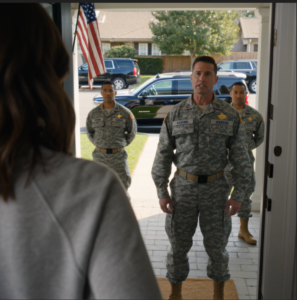
I set my phone face down on the kitchen counter and stood there in the quiet of my own home, coffee going cold beside me. What I didn’t know yet, what none of us knew yet, was that by nightfall, three black SUVs would be parked outside my door, sent by a two-star general who had been looking for me for a very different reason than my sister could have imagined.
I didn’t cry. I want to say that first because people expect tears when I tell this story, and there weren’t any. I picked the phone back up, read the message a third time, and felt something colder than sadness settle into my chest.
It wasn’t shock, either. Shock would have meant I didn’t see it coming. And the truth is, I’d been watching this exact moment build for years, the way you watch a storm gather on the horizon and know somewhere in your gut that it’s headed straight for your house.
My name is Terresa Caldwell. I’m forty-two years old, and I’ve spent most of my adult life in the United States Army. I don’t say that to impress anyone. I’ve learned the hard way that in certain rooms—my mother’s kitchen, my sister’s world of country clubs and catered brunches—saying it out loud only makes people uncomfortable.
So I stopped saying it. I let people assume whatever they wanted about the woman who missed Thanksgiving because she was stationed somewhere she couldn’t talk about, who showed up to family functions in slacks and flats instead of the dresses everyone else wore, who never had a husband to bring, never had children to brag about, never had the kind of life that fit neatly into a Christmas card photo.
My sister’s name is Melissa. She’s thirty-six, years younger than me, and for as long as I can remember, she’s measured her worth by the company she keeps. Growing up, we weren’t wealthy. Our father worked in a hardware store for thirty-one years, and our mother cleaned houses on the side to help cover the bills.
It was an ordinary childhood, the kind millions of Americans had. Not glamorous, but not without love, either. Except somewhere along the way, Melissa decided that ordinary wasn’t something she was willing to accept for the rest of her life.
I was the one who stayed close to home longer. I helped our parents when their health started to slip. I tutored Melissa through two years of failing math grades so she could graduate on time. When she needed money for a security deposit on her first apartment, I wired it to her without asking when she’d pay it back, because that’s what family does.
Or at least that’s what I believed family was supposed to do. She took it. She always took it. And somewhere in that taking, she stopped seeing it as something to be grateful for and started seeing it as something she was owed.
Then I enlisted, and the distance between us stopped being just physical.
“You always have to make everything about duty and sacrifice,” she told me once, not long after I finished my first deployment.
I remember the exact tone of her voice. Not angry, just tired, like I was an inconvenience she had to manage.
“You think that makes you better than the rest of us?”
I never thought that. I never once believed my uniform made me superior to anyone. But I stopped trying to explain myself to her after a while. Some people don’t want an explanation; they want a villain, someone to measure their own choices against so they can feel justified in the ones they’ve made.
Melissa met Ethan Hail two years ago at a charity gala her company sponsored. Within a week, she knew his father was a major general in the United States Army: Richard Hail, a man with three decades of distinguished service and a reputation that preceded him into every room.
She didn’t fall for Ethan first. I don’t say that to be cruel. I say it because I watched her face the first time she mentioned the Hail name, and it wasn’t the face of a woman describing a man she loved. It was the face of a woman describing an opportunity.
“Their family knows everyone, Teresa,” she told me over the phone, breathless with excitement. I hadn’t heard from her in years. “The wedding is going to be enormous. Senators, generals, people who actually matter.”
And then, almost as an afterthought, like she was tucking a warning inside the good news: “Just don’t talk about the Army stuff around them, okay? They don’t like people who show off.”
I remember laughing quietly at that, though there was nothing funny about it. I had never once shown off about my service in my entire life. If anything, I’d spent years making myself smaller so the people around me could feel bigger.
Ethan himself seemed decent enough on the two occasions I’d met him. Polite, a little reserved, clearly devoted to Melissa in the uncomplicated way young men in love often are. But I noticed something in those brief meetings, something I filed away without fully understanding why: he didn’t know me. Not really.
Melissa had never once given him the chance to.
A week before the engagement party, she called and told me flatly that I didn’t need to come. I asked her why, genuinely confused, and she said the party wasn’t really the kind of event for someone like me. I didn’t fully understand what that meant until the final message arrived that morning, blunt and final—or, in her mind, kind, as if telling me I was unwelcome in fewer words somehow made it hurt less.
I sat at my kitchen table for a long time after reading it. I thought about calling her back, demanding an explanation, forcing the kind of confrontation Melissa had always avoided with me. But I didn’t.
I decided in that quiet, aching moment that I would simply stay home. If I wasn’t wanted at her table, I wouldn’t force my way into a seat that had never really been offered. I had no idea that three hours later, a very different kind of invitation would be waiting at my front door, one that had nothing to do with my sister at all.
The morning after I made my decision felt strange in a way I couldn’t fully name. I made coffee like I did every Saturday. I put on jeans and an old university sweatshirt. Nothing special, nothing meant to be seen.
I hadn’t planned a grand statement by staying home. I wasn’t trying to make Melissa feel guilty from a distance, wasn’t hoping she’d realize her mistake mid-ceremony and call me crying. I told myself quietly and honestly that if I wasn’t wanted somewhere, the healthiest thing I could do was simply not go. No speeches, no drama, just absence, plain and unremarkable.
Across town, the private club where Melissa’s engagement party was being held had already begun filling with valet-parked cars and women in pastel dresses carrying gift bags wrapped in ribbon. I knew this because my mother had described the venue to me weeks earlier with the kind of breathless pride she usually reserved for church announcements.
“It’s the nicest place in the city, Teresa. You should see the chandeliers.”
I’d smiled and said that sounded lovely. I meant it, too. I never wanted to deny Melissa her happiness. I only wanted, somewhere in the quiet corners of my heart, to be allowed to witness it.
My phone buzzed around ten that morning. My mother, twice. I let both calls go to voicemail, not out of spite, but because I didn’t trust my voice yet to sound as calm as I wanted it to. Around ten-thirty, Melissa called, and I picked up on the third ring.
“Don’t do anything today that embarrasses me,” she said without so much as a hello.
“I’m at home, Melissa,” I said. “I’m not going anywhere.”
There was a pause on the line, just long enough for me to hear the murmur of a room full of people behind her: laughter and clinking glasses and someone testing a microphone.
“Good,” she finally said. “That’s for the best.”
And then she hung up the way she always did, like conversations with me were tasks to be checked off a list rather than moments to be lived in. I sat with that feeling for a while after the call ended.
I want to be honest about something here because I think it matters. I wasn’t angry. Not yet. I was something closer to hollow, the particular kind of tired that comes from spending your whole life proving your worth to people who’ve already decided not to see it.
It was almost eleven-thirty when I heard the first engine outside my house. I want to describe that sound the way I remember it because it’s stayed with me ever since. Not loud, not aggressive, just the low, controlled hum of vehicles built for precision rather than speed.
I looked out my front window and saw them: three black SUVs, government issue by the look of the plates, pulling up along the curb of my quiet residential street with a kind of synchronized discipline that immediately told me this wasn’t a coincidence, wasn’t a delivery, wasn’t anything ordinary at all.
Doors opened. Four people stepped out, dressed sharply, moving with the kind of purposeful calm I recognized instantly from years around military personnel. No sirens, no chaos, just quiet, deliberate authority walking up my driveway. I opened the door before they reached it.
The man in front, mid-thirties, close-cropped hair, posture like a plumb line, held up identification and spoke before I could say a word.
“Ma’am, General Hail requests your presence immediately.”
For a moment, I genuinely thought I’d misheard him.
“General Hail?” I repeated.
“Yes, ma’am,” he confirmed, his tone steady, professional, giving nothing away.
My mind raced through possibilities, none of them making sense. I barely knew the man. I’d shaken his hand once, briefly, at a dinner Melissa had orchestrated months earlier, the kind of introduction where you exchange pleasantries and nothing more.
“Did he say why?” I asked.
“He said you would understand when you arrived,” the officer replied.
I felt something shift low in my stomach, the particular unease of stepping into a situation with no map and no context.
“I wasn’t invited to today’s event,” I said carefully, watching his face for any flicker of reaction.
“The general is aware of that, ma’am,” he said.
That single sentence did more to unsettle me than anything else that morning. He knew I hadn’t been invited. He knew, and he’d sent three vehicles and four people to collect me anyway.
Whatever this was, it wasn’t about smoothing over a family slight or making a symbolic gesture toward inclusion. It was something else entirely, something with weight behind it, something that had nothing to do with sentiment and everything to do with necessity.
I asked for five minutes to change. He nodded, and I closed the door gently, my hands steadier than I expected them to be, given the strange gravity building in my chest. I didn’t put on my uniform. Some instinct told me this wasn’t the moment for that, not yet.
I chose a simple gray dress instead, low heels, hair pulled back the way I always wore it when I needed to think clearly. I looked at myself in the mirror for exactly one second before deciding it would have to do. When I stepped back outside, the second vehicle’s door was already open for me.
I paused on my own front step for a moment, looking back at the small house I’d bought with my own money after my third deployment, the home no one in my family had ever bothered to visit. Something told me that whatever waited for me across town, I would not be walking back through this door the same woman who’d walked out of it.
I climbed into the SUV. The door closed with a soft, final click, and we pulled away from the curb, leaving my quiet street behind.
The ride across town took almost twenty-five minutes, and for most of it, I sat in silence, watching the familiar streets of my own city slide past the tinted windows like scenery in a film I hadn’t agreed to star in. I tried asking the officer beside me once more what this was about. He glanced at me with something that might have been sympathy and said only, “Nothing, ma’am. You haven’t done anything wrong.”
That should have comforted me. Instead, it deepened the knot forming beneath my ribs, because if I hadn’t done anything wrong, then someone else had, and I had a growing, uneasy suspicion about who.
The club where the party was being held looked exactly the way my mother had described it. Soaring windows, white tablecloths, a string quartet playing softly near a wall of fresh peonies. Through the glass doors, I could see the room glittering with exactly the kind of people Melissa had always dreamed of surrounding herself with.
Decorated officers in dress uniforms. Silver-haired men who carried themselves like they’d spent decades being listened to the moment they opened their mouths. Women in pearls discussing charity boards and vacation homes. It was, I understood immediately, precisely the world my sister had spent her whole life trying to earn a permanent seat in.
I saw Melissa before she saw me. She was radiant, laughing at something a woman beside her had said, one hand resting on Ethan’s arm, the other gesturing gracefully with a champagne flute. She was, for that fleeting moment, exactly the person she’d always wanted to become.
And then her eyes drifted toward the entrance, toward me, and I watched every ounce of that radiance drain out of her face in real time.
“Teresa,” she said, crossing the room quickly, her voice pitched low and furious even as her smile stayed frozen in place for the benefit of everyone watching. “I told you not to come.”
“I didn’t come on my own,” I said quietly. “I was brought here.”
Her eyes flicked past me toward the entrance, toward the four people who had escorted me in and now stood at a respectful distance near the doorway. Something crossed her face I hadn’t seen before. Not embarrassment this time, but fear.
Across the room, I noticed Ethan watching the exchange with visible confusion, and beside him, a tall man in a dark suit whose bearing I recognized instantly, even out of uniform: Major General Richard Hail.
I had met him only once, briefly, and even then his presence had commanded the room without him raising his voice. He was doing the same thing now, moving toward us with unhurried purpose while the string quartet faltered slightly, sensing the shift in the room before most of the guests did.
“Dad,” Ethan said quietly as his father approached. “What’s going on?”
“Your fiancée’s sister is coming,” the general had told him earlier, according to what Ethan later relayed to me.
Ethan had been baffled. “Teresa?” he’d asked.
His father had simply nodded and said nothing more, the way men trained for decades to withhold information until the precise necessary moment tend to do.
Now, standing a few feet from me, General Hail looked at me directly, and something in his expression made the noise of the entire room seem to fall away.
“Captain Caldwell,” he said.
I felt my spine straighten before I’d consciously decided to move. Years of training don’t disappear just because you’re standing in a ballroom in a gray dress instead of a uniform.
“Sir,” I answered, my voice steadier than I felt.
Melissa’s face went white. I watched the exact moment the words landed on her. Captain. Not just “in the Army,” not some vague, embarrassing job she’d spent years downplaying to people like the Hails, but a rank, an earned title spoken aloud by a two-star general who clearly knew precisely who I was.
She had never asked. In all our years as sisters, she had never once asked what I actually did, what rank I held, what any of it meant. She had simply decided long ago that whatever it was, it wasn’t impressive enough to mention at a party like this.
“We need to talk about what happened before this ceremony,” General Hail said, his voice pitched just low enough for those nearest us to hear, but not so low that it read as secretive. Then he turned to his son. “And I believe you deserve to hear it, too.”
Ethan stepped closer, his expression shifting from confusion to something more alert, more serious.
“Hear what?” he asked.
The general didn’t answer immediately. Instead, his eyes moved briefly to Melissa, then back to me. And in that silence, I understood, with a cold certainty settling into my chest, that whatever this was about, it wasn’t really about me being excluded from a party at all.
It was something Melissa had done, something involving me, something I hadn’t yet been told about, and something serious enough that a major general had sent three SUVs across the city to make sure I was standing in this room when the truth came out.
I looked at my sister. She wasn’t looking at me anymore. She was looking at the general, and for the first time in longer than I could remember, I saw real fear behind her eyes.
General Hail didn’t raise his voice. That was the thing I noticed most in that moment, how a man with that much authority never needed volume to hold a room. He simply turned slightly, addressing both Ethan and me while the party around us pretended not to listen and failed entirely.
“I didn’t come to know your name through my son’s engagement, Captain Caldwell,” he said. “I knew it long before that.”
I felt my brow furrow, genuinely confused now. “Sir, I don’t understand.”
“Eight years ago,” he said, “a joint operation went sideways in a way that isn’t public record and isn’t going to become public record today. A young officer in a forward unit found himself and three of his men cut off from support longer than anyone wanted to admit out loud. The extraction team that got them out was led by a captain whose name I’ve never forgotten, because I read the after-action report personally.”
He paused. “That captain was you.”
The room seemed to tilt slightly. I remembered that operation, of course. I remembered every operation I’d ever led, remembered the particular texture of fear and adrenaline that never fully leaves you, no matter how many years pass.
But I hadn’t known, hadn’t ever connected the pieces, that one of the men I’d helped pull out of that situation was standing eight feet away from me now in a tailored suit, holding a champagne flute he’d forgotten he was still gripping.
Ethan’s face had gone pale. I watched the memory surface behind his eyes, watched him travel backward through years of trying not to think about those particular hours of his life.
“That was you?” he said slowly, not quite a question. “The extraction lead. I never knew the name. I never…”
He stopped, shook his head. “I was told a captain from another unit got us out. I never learned who.”
“I was doing my job,” I said quietly, because it was true and because I genuinely didn’t know what else there was to say.
I had never once used that mission, or any mission, as currency in my personal life. I didn’t believe in trading danger for social standing. That had never been who I was.
General Hail studied me for a long moment, and something in his expression softened just slightly, the way stone softens under years of weather.
“I sent those vehicles because when your name appeared on a document connected to this family recently,” he said, “I recognized it immediately. And what I found troubled me enough that I needed you here in person before the ceremony went any further.”
That sentence pulled the air out of my lungs in a way the earlier revelation hadn’t.
“A document?” I repeated. “Connected to this family? Sir, I haven’t signed anything for anyone in this room.”
“That’s precisely the problem,” he said.
He nodded to an aide standing near the edge of the room, who produced a manila folder and handed it to him. General Hail opened it and turned it toward me. I scanned the top page quickly: a financial reference document, the kind used in certain background verifications for security-adjacent family connections, listing me as a personal and professional contact for verification purposes.
My name. My old address, one I hadn’t lived at in nearly six years. And at the bottom, a signature that was unmistakably meant to be mine, in handwriting that was close, unsettlingly close, but not quite right in the way only someone who has actually signed their own name ten thousand times can detect.
“I didn’t sign this,” I said, my voice flat and certain.
“I didn’t think you had,” General Hail said, “which is why I needed you here before anyone signed anything else today.”
I felt the room narrow around me, the peonies and champagne and string quartet all fading into a kind of white noise while my attention sharpened onto the folder in my hands. I turned the pages slowly. A second document listed a false employment verification, describing me in a role I’d never held, at a rank inflated two grades above my actual standing at the time.
A third referenced an address that connected unmistakably to a P.O. box I recognized, one my mother had once used for forwarding Melissa’s mail during a period when she’d been between apartments.
I looked up. I looked very deliberately at my sister. Melissa’s hands were trembling slightly around the stem of her glass.
“I don’t know anything about that,” she said quickly.
Too quickly, the words tumbling out before I’d even asked a question. I didn’t raise my voice. I didn’t need to. Years in rooms far more hostile than this one had taught me that the quietest response is often the one that lands hardest.
“Then you shouldn’t be worried about proving it,” I said.
Something flickered across her face. Not innocence, not indignation, but the particular, unmistakable panic of someone who has just realized the ground beneath her has shifted permanently.
Around us, the party had gone almost entirely silent now, the string quartet trailing into nothing. Dozens of well-dressed guests were suddenly very interested in their drinks, their shoes, anything but the tableau unfolding in the center of the room.
I wasn’t seeking revenge in that moment. I want to be honest about that, because it would have been easy to feel a surge of righteous anger, to raise my voice, to demand an apology in front of everyone who’d once called me an embarrassment. But I didn’t. I simply held the folder a little tighter, and I let the silence in the room do what silence does best: it made people listen.
General Hail closed the folder gently, the small sound of the manila cover somehow louder than anything else in the room. He looked around at the assembled guests—the senator’s aides, the retired colonels, the women in pearls who had come expecting champagne toasts and photographs—and then he spoke in a voice that carried without straining.
“There will be no ceremony proceeding today until I understand exactly what was done here,” he said.
A murmur rippled through the crowd, the particular sound of a hundred people trying to whisper at once. Melissa’s composure, the careful architecture of poise she’d spent the entire morning constructing, finally cracked wide open.
“You’re ruining everything,” she said, turning on me, her voice climbing toward something close to hysteria. “This was supposed to be my day, and you had to make it about you again.”
I felt the old, familiar sting of that accusation, the one she’d been leveling at me since we were teenagers: the idea that my mere presence in a room somehow stole attention from her. But something had shifted in me since I’d walked through those doors. I no longer felt the need to shrink myself to make her comfortable.
“I didn’t stop your ceremony, Melissa,” I said evenly. “Your choices did.”
Ethan stepped closer to his fiancée then, and I watched something in his expression harden into the kind of clarity that only comes when a person finally sees clearly something they’d spent months refusing to look at directly.
“Melissa,” he said, “why was Teresa left off the guest list?”
She didn’t answer.
“Why does a document with her name on it exist at all?” he pressed. “Who had access to use her information like that?”
“I told you I don’t know anything about it,” she said again.
But her voice had lost its earlier conviction, thinning into something brittle and unconvincing.
“Then why,” Ethan asked quietly, “did you know weeks ago that she wouldn’t be here today, before any of this ever came up?”
The question hung in the air unanswered, and I watched my sister’s eyes dart toward our mother, who stood near the edge of the gathered crowd with her hand pressed flat against her chest, looking suddenly much older than she had an hour earlier.
“Teresa, please,” my mother said, moving toward us now, her voice pleading in the particular register she’d always used to smooth over Melissa’s messes. “This has gone far enough. Can we just… can we handle this privately later?”
I turned to her, and for the first time in longer than I could remember, I didn’t soften my response to spare anyone’s feelings.
“Mom, this went too far the moment my name was used on a legal document without my permission. That’s not something we handle quietly over coffee next week.”
General Hail, watching this unfold with the measured patience of a man who had spent thirty years learning to let silence do the interrogating, finally gestured to a woman standing near him. His family’s longtime attorney, it turned out, who had been quietly reviewing the folder’s contents on a tablet since the moment it was handed to me.
She looked up and gave the general a small, confirming nod.
“There’s more,” the attorney said. “Ms. Caldwell’s sister used the identity references across at least three separate documents over the past fourteen months. Two related to background verifications for events connected to this family, and one tied to a financial reference used in securing a private loan.”
The room went utterly still. I felt the weight of every eye shift toward Melissa, and for the first time in the entire encounter, I saw genuine terror replace the indignation on her face.
“I never took money from you,” she said quickly, turning to me, her voice cracking. “I never, Teresa. I never stole from you directly. I swear.”
“No,” I said quietly. “You didn’t steal my money. You stole my name, my rank, years I spent earning something you decided was only useful to you as long as no one actually had to look at it too closely.”
The attorney continued, her tone clinical, almost gentle in its precision, which somehow made it worse.
“There’s also an email exchange recovered during the document review, sent from Ms. Melissa Caldwell’s personal account to a friend, dated several months ago.”
She read it aloud, not because she wanted to humiliate anyone, but because General Hail had asked her to, because he believed, correctly, I think, that some truths only land when spoken directly into a room full of witnesses.
The email was brief. Melissa had written that I was, in her words, “useful on paper,” but would “embarrass the family in person.”
I didn’t cry. I want to be honest about that, too, because I think people expect a breaking point in stories like this, a moment where the wronged party finally collapses under the weight of it all. I didn’t collapse. I simply stood there absorbing words my own sister had written about me, feeling something settle and harden quietly in my chest, less like heartbreak and more like clarity.
Ethan turned to me, his face full of something between guilt and disbelief.
“I’m so sorry,” he said. “I should have known who you were. I should have asked.”
“You didn’t know,” I said. “That’s different from choosing not to see.”
I paused, watching him carefully. “But now you do.”
General Hail looked at his attorney, then at the folder still resting in my hands, then finally at Melissa, who stood alone now in the center of a room full of people who only twenty minutes earlier had been raising glasses in her honor.
“This engagement,” he said, his voice quiet but absolutely final, “is no longer the most important matter in this room.”
Melissa didn’t respond. She simply stood there watching the careful, glittering world she had built for herself begin, piece by piece, to come apart in front of everyone she had ever wanted to impress.
In the hour that followed, the party didn’t end so much as it dissolved, guests drifting toward the exits in small, uncomfortable clusters, murmuring the kind of polite excuses people offer when they’ve witnessed something they know they’ll be gossiping about for months. The string quartet packed up their instruments in silence. Waiters cleared champagne flutes that had never been raised in toast. And in the center of it all, my family stood in the wreckage of a day that had started with me being told I wasn’t important enough to attend.
General Hail’s attorney asked me, quietly and directly, what I wanted to do next. The family had resources, she explained. If I wanted to pursue legal action against Melissa for the unauthorized use of my identity and military record, the general would support it fully, would put every resource the family had behind ensuring it was handled properly.
I sat with that offer for a long moment. Part of me, the part that remembered every dismissive comment, every holiday I’d spent alone while Melissa built her glittering life, every time she’d introduced me to someone as simply “my sister” without a single other word attached—that part of me understood the appeal of making her answer for it in a courtroom, in front of judges and consequences she couldn’t charm her way around.
But that wasn’t who I wanted to become.
“I don’t want to punish her,” I told the attorney. “I want my name removed from every document it appears on. I want assurance my information can’t be used again, and I want her to say out loud what she did, not to a judge, but to this family.”
The attorney nodded slowly, something like respect crossing her expression.
“That’s a more difficult request than the legal route. You understand? Courts deal in evidence. People deal in accountability. The second one is harder to enforce.”
“I know,” I said. “I’m not asking for it to be enforced. I’m asking for it to be true.”
Across the room, Ethan had pulled his father aside, and I watched the two of them speak in low, urgent tones for several minutes. When Ethan finally turned back toward the room, his face had the settled look of a man who had made a decision he wasn’t going to unmake.
“I can’t marry someone I don’t trust,” he said, loud enough for the remaining guests to hear, though he wasn’t performing for them. He was simply done pretending otherwise. “This isn’t about Teresa. This is about what you did, Melissa, and what you were willing to let happen to someone who once saved my life just to make yourself look better in a room full of strangers.”
I want to be clear about something here because it matters to how this story ends. Ethan didn’t call off the engagement because of me. He called it off because of what Melissa had done and because he could no longer unsee it. I never once asked him to make that choice.
I never wanted to be the reason a relationship ended, even one built on foundations I now understood to be cracked long before I ever walked through those doors.
Melissa’s composure finally gave way completely. She sank into one of the empty chairs near the head table, mascara streaking down her face, and when she spoke, her voice came out raw and childlike in a way I hadn’t heard since we were young.
“You always got everything,” she said, looking up at me. “Mom and Dad were always prouder of you. Even when you weren’t around, you were somehow still the one everyone respected more.”
“No, Melissa,” I said, and I kept my voice gentle because there was no satisfaction in cruelty. Not really, not even now. “I earned what I have.”
I sat down across from her, ignoring the small, curious audience still lingering near the edges of the room.
“You don’t know what those years cost me,” I said. “You don’t know what it’s like to spend Christmas on a base halfway across the world, or to write letters home not knowing if they’d be the last ones. You don’t know the names of the people I’ve lost because I never told you, because I didn’t want you to see me as someone who needed pity or admiration. I just wanted to do the work.”
Melissa’s face crumpled further.
“I was embarrassed,” she finally admitted, the words coming out broken, involuntary, like something she’d been holding underwater for years and could no longer keep submerged. “You didn’t look like the family I wanted people to see. You didn’t fit the picture.”
“And what picture was that?” I asked quietly.
“A powerful one,” she said. “A family that belonged with people like the Hails. And you…”
She stopped, wiping at her face with the back of her hand.
“You always seemed like you didn’t care about any of that. Like you didn’t need it. And I hated how much I needed it next to how little you seemed to.”
I let that sit between us for a moment because I think it was, in its own broken way, the most honest thing my sister had said to me in years.
“You didn’t exclude me because I was an embarrassment,” I said finally, watching her eyes lift to meet mine. “You excluded me because you were afraid that if people really looked at me, they’d see the truth: that the version of this family you wanted them to believe in wasn’t real. And that truth scared you more than losing me ever did.”
Melissa didn’t answer. She didn’t need to. Her silence, for the first time in longer than I could remember, said more than any of her words ever had.
Several months passed before I felt like I’d fully returned to the rhythm of my own life. I went back to work the following Monday, back to briefings and paperwork and the quiet discipline of a job that had never once asked me to explain myself to anyone. I didn’t tell my unit what had happened at that party.
It wasn’t shame that kept me quiet. It was simply that the story belonged to a part of my life I’d never let bleed into the other, and I intended to keep it that way. I didn’t need sympathy from people who already respected me for reasons that had nothing to do with my family.
Melissa faced consequences that were entirely her own to carry. The engagement ended that same afternoon, quietly, without the second act of reconciliation some families manage to script for themselves.
Ethan reached out to me exactly once in the weeks that followed, not to rekindle anything with Melissa, but simply to apologize again, more fully this time, for the years he’d spent standing beside her without ever really asking who I was.
“I thought I was marrying into a family that valued honor,” he told me over coffee one gray afternoon, turning his cup slowly between his hands. “I didn’t realize how little I actually knew about what honor even meant to the people around me.”
“Honor isn’t something you inherit,” I told him. “It’s something you practice every day, even when no one’s applauding you for it.”
He nodded slowly, and I think in that moment, he finally understood something about the mission eight years earlier that had first connected our lives without either of us knowing it: that the extraction wasn’t a story I’d carried around as proof of my worth. It was simply something I’d done quietly because it needed doing, the same way I’d tried to live my whole life.
Melissa, for her part, had to deal with the legal fallout of the documents on her own terms. I never pursued criminal charges, though the family’s attorney made sure every trace of my identity was scrubbed from every file she’d touched, and safeguards were put in place to ensure it could never happen again.
My mother finally apologized to me weeks later, sitting across from me at my own kitchen table for the first time in years, her voice trembling as she admitted she’d spent too long measuring her daughters against each other instead of simply loving us both for who we actually were.
I forgave her, not because the years of feeling unseen didn’t matter, but because carrying that weight forward would have cost me more than it would have cost her. I’ve buried too many people who ran out of time to make peace with the ones they loved. I wasn’t going to let bitterness steal what time I had left with my own mother.
I saw General Hail one final time, several weeks after everything had settled. He requested a brief meeting. No aides, no folders, just the two of us in a quiet office overlooking a parade ground I’d walked a hundred times over the years without ever imagining I’d stand there under these particular circumstances.
“The reason I sent those vehicles that day,” he told me, “wasn’t because you were about to become my son’s sister-in-law.”
“I figured that out eventually,” I said.
“I sent them,” he continued, “because the moment your name appeared on that document, I knew exactly who I was asking for. I’d read your file years before I ever met you in person. I knew what kind of officer would run toward danger to bring my son’s men home. And I knew that same officer wouldn’t tolerate her name being used to build a lie.”
I didn’t need the praise, though I won’t pretend it didn’t mean something coming from a man who had spent his entire career learning not to hand out compliments carelessly.
“Thank you, sir,” was all I said.
That evening, I sat on the front steps of my own house, the same house those three SUVs had once idled in front of, and I scrolled back through an old text thread on my phone until I found it: Melissa’s message from that morning months earlier.
“Only important people are welcome.”
I read it once more, slowly, letting myself feel whatever there was left to feel. Then I deleted it. Not because I wanted to forget what had happened. I don’t think I ever will, not fully.
I deleted it because I no longer needed it to prove anything. Not to her, not to my mother, not even to myself. I stood up and walked out onto the small patch of grass in front of my house, where an American flag hung from a bracket by the door, moving gently in the evening breeze.
I thought about all the years I’d spent believing my uniform made me difficult to love, believing my silence about my own service was a kind of humility rather than a wound I’d never let myself name. I understood now that I had been wrong. My uniform never made me hard to love. It simply taught me, slowly and completely, that respect is never something you should have to beg for at anyone’s table.
And when someone tells you that you don’t belong there, sometimes the strongest answer isn’t an argument at all. Sometimes it’s building a life so steady, so honest, and so entirely your own that you never need their table again.
I want to know where you think this story would have gone if Melissa had never sent that message. Leave a comment below and let me know what part of Teresa’s story stayed with you the most. We share stories like this every single day, about family, about pride, about the quiet strength it takes to walk away from people who never valued you the way you deserved. So subscribe if you don’t want to miss the next one.