I Watched My Husband Erase Me Live From 12,000 Miles Away… What I Did Next Destroyed Him
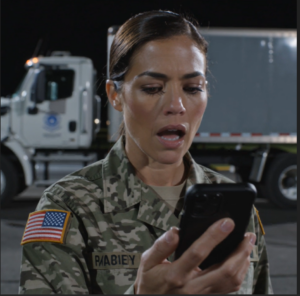
My husband carried the third box out of our house at 2:00 in the morning, whistling like a man loading groceries into a trunk. I was 12,000 m away, standing in the dark in my uniform, watching every second of it on a phone screen. I didn’t scream. I didn’t call him. I just kept watching because I had finally understood something that turned my blood to ice.
He wasn’t leaving me. He was erasing me. And what I did over the next 14 days, quietly and patiently and by the book, is something Daniel Reed will remember for the rest of his life.
I landed at Kadina Air Base a little after 9 in the evening, local time, with 18 hours of recycled air in my lungs and a duffel strap that had worn a groove into my shoulder. The heat hit me the moment the cargo door opened. Okinawa in late summer wraps around you like a wet towel, thick with salt and jet fuel. And for a few seconds, I stood on the tarmac and simply let it.
Two weeks of joint exercises, 61 people under my coordination, and the quiet satisfaction of having left everything at home in perfect order. I was beside a transport truck, checking a manifest, when my phone buzzed in my chest pocket. A text from Linda Harper, the neighbor across the street.
“Charlotte, please don’t hang up if I call. Look at your back entrance camera right now.”
Linda is 67 years old. She signs every text like a letter, “Love, Linda,” even when she’s only asking about her recycling bin. This one had no signature. That was what made me lower the clipboard.
I assumed it was the house. A burst pipe, maybe, or a raccoon in the garage. I opened the camera app, and the screen filled with the gray-green picture I knew by heart: the back driveway, the maple tree Daniel and I planted the year we bought the place, the brick steps, the porch light burning yellow.
For a moment, nothing moved. Then headlights swept across the fence. A black SUV rolled in and stopped beside the garage. The driver’s door opened, and Daniel stepped out in the navy quarter-zip I’d given him last Christmas. And for one ridiculous second, my chest went warm the way it always had when I saw him, as though he might be coming to surprise me.
Then the passenger door opened. A woman got out. Tall, blonde hair twisted into a loose knot, a leather tote hanging from her arm. She said something and laughed, and Daniel set a hand on the small of her back like it was a place his hand had been many times before. He glanced up the street and down it, the way a person does when he’s done something before and is checking for witnesses.
Then he unlocked my back door with my key.
I don’t remember the next 10 seconds. I remember the diesel rumble of the truck behind me and the way every sound slid away as if I’d gone underwater. The woman was not what turned my stomach. What did it was what came next, when the two of them walked out carrying white banker’s boxes.
Daniel stacked them in the cargo area and went back in for more. And I realized I was looking at pieces of my own house, my files, my closet. Nine years of a life I’d built on the assumption that someone was guarding it.
My phone rang. Linda.
“Are you watching?” Her voice was low and not quite steady.
“I’m watching.”
“I didn’t want to scare you, honey, but this has been happening for three nights.”
“Three nights?” I said.
“After midnight every time. I thought maybe you knew. Then I thought, no, Charlotte would have told me.”
“I didn’t know.”
I should tell you about Daniel so you understand what this cost me. I met him nine years ago when I was a newly promoted captain with a torn ligament in my knee. He drove me to every physical therapy appointment for two months and never once made me feel like a burden. When I told him the army would send me away for weeks at a time for the rest of my career, he didn’t flinch.
He took my hands across a restaurant table and said, “Your job is to protect the country. Let me protect the home.”
I cried in that restaurant. I thought I had found the rarest thing a woman in uniform can find: a man who wasn’t threatened by her absence. So I gave him the home. The keys, the mortgage, the bank login, the filing cabinet. Every deployment, I told myself the same thing: He’s got it.
I was grateful, and I was tired, and I stopped checking.
Looking back, there were signs, though that’s a generous word. They were small enough to explain away. Daniel started saying the real estate market was soft, though he’d always been the optimist. He asked me not to worry about the joint account. He slid papers across the kitchen island.
“Just some paperwork for taxes, babe.”
And I signed where he pointed because I was packing a rucksack and he was smiling.
“Linda,” I said, “send me the footage. All of it.”
“I’ve been saving it. I just kept pressing that little button you showed me for the porch packages.”
“You did exactly right.”
The first clip arrived while we were still on the phone. I watched it at the edge of a runway on the other side of the world. It was from the night before. Daniel led the blonde woman through my kitchen, down the hall, and into the study.
I watched him crouch in front of the closet and work the dial on the safe. A safe whose code I had set myself, and which I suddenly understood he had changed without telling me. The door swung open. The woman reached inside and took out a flat blue box, the color of faded denim, edges soft from years of handling.
I would have known that box blindfolded. My mother kept it in her bedside table for 30 years. After she died, I carried it home in my lap on the plane, and I never showed it to anyone but my father. Inside were the deeds and papers of a woman who always told me, “Keep something that’s only yours, Charlotte.”
The stranger held it against her chest. Daniel kissed her on the forehead. A plane lifted off behind me, loud enough to shake my ribs, and I didn’t flinch. That was the moment I realized this wasn’t an affair I had accidentally discovered. Someone had been planning something behind my back.
I did my job for the next three hours. People assume something like this would break you in half on the spot. It didn’t. I signed for equipment, briefed my section leads, and shook hands with a Marine colonel who’d heard good things. My face did what it was trained to do.
Only later, alone in billeting with a narrow bed and a humming air conditioner, did I sit on the edge of the mattress and let my hands start to shake. I played the clip again. Then again. I was looking for the version where I’d misunderstood.
Daniel was never a man who looked like a betrayal. That’s the part people don’t tell you. If he had been cold or careless or cruel, I would have seen it years ago. Instead, he was the one who made soup when I came home from the field with a fever.
When I pinned on my gold oak leaf, I walked out of the ceremony and found him standing by the parking lot with a bouquet of yellow roses, grinning like it was his own promotion.
“Major Reed,” he said, and bowed.
I laughed so hard I had to hold on to his arm. That man existed. I won’t pretend he didn’t because it would make this easier. The man on the camera and the man with the roses were the same man. And I sat there trying to work out which one had been the performance.
Slowly, the way a photograph develops in a tray, the little things started surfacing. Three months earlier, Daniel had changed the code on the safe. He said a burglary had been reported two streets over, and I’d said, “Sure, whatever keeps us safe,” and never asked for the new numbers.
In the spring, a few utility bills had stopped showing up in the mail, and when I asked, he said he’d switched everything to paperless. The folder where we kept the deed and the mortgage papers, which for years had lived in the second drawer of the file cabinet, had moved to a shelf I couldn’t reach without a stepladder. I had noticed, and I had thought, Huh. Then I’d gone back to my packing list.
And the questions. God, the questions. Daniel had always asked about my schedule, but lately he’d gotten particular.
“What day exactly are you flying out? Will you have your phone? How often can you call?”
I’d found it sweet. I thought he was missing me ahead of time.
The night before I left, he drove me to the airfield himself. He kept one hand on the wheel and one on my knee. And when I said I hated leaving him alone with the leaky gutters and the lawn, he squeezed once and said, “Two weeks isn’t that long. I’ll have plenty of time to take care of things.”
I had smiled at him. I remembered it exactly. The dashboard lights on his face. Plenty of time to take care of things.
My first instinct was to call him. I had the phone in my hand, and his name was right there at the top of my favorites, a little photo of the two of us on a lake in Michigan. I could picture how it would go. He’d go quiet, and I’d hear him doing the math. Then he’d say my name softly, the way he did when he wanted me to believe I was overreacting, and by the end I’d be apologizing for something.
I put the phone face down on the blanket. Here’s what I knew: I was an ocean away from my own front door. I had a mission I couldn’t walk off, 61 people depending on me, and a husband who had planned this carefully enough to choose his window. And a man who has spent months building something doesn’t stop when he’s confronted. He works faster.
I picked the phone back up and texted Linda.
“Don’t confront him. Don’t tell him I know. Please don’t let him see you watching.”
The dots appeared at once. She must have been sitting at her kitchen window with the phone in her lap.
“I wouldn’t dream of it, honey. I wave at him every morning like always.”
I stared at the small, steady courage in that message. Linda was 67 years old, and she had been waving at a thief every morning for three days.
“Can you save every recording from the last 30 days?” I typed. “Not just the nights. Everything.”
“Already doing it.”
Of course she was. When my mother died, it was Linda who showed up with a casserole nobody asked for and sat in my kitchen for two hours without saying anything profound. I’d spent years carrying her groceries and changing her smoke detector batteries, and I had thought of it as simply being a good neighbor.
The phone buzzed again.
“There’s something else,” she wrote. “Maybe it’s nothing.”
“Tell me.”
“A few days before you left, Daniel came across the street to borrow my ladder. Then he stood in my driveway for 10 minutes chatting. He asked me, and I remember because it struck me as odd, ‘Has Charlotte said anything to you about selling the house?’”
I read it three times.
“I told him no,” Linda added. “I said you love that house.”
I did love that house. The maple tree, the creaky stair, the window seat where I waited for his headlights. I’d have told you in a heartbeat that nobody could take it from me, which meant that Daniel hadn’t been asking out of curiosity. He had been asking because he needed to know whether I would see it coming.
I opened my banking app. I told myself I was only checking, the way you press on a bruise to see if it’s still there. My fingers were steady, which surprised me. The login screen thought for a moment, then loaded the account I hadn’t looked at in weeks.
The joint savings balance was a fraction of what it should have been. At the top of the transaction list, dated four days ago, was a single outgoing transfer I had never made, to an account I didn’t recognize, for an amount that made the room go very quiet.
I didn’t sleep. Around 4 in the morning, with the base gray and quiet outside, I sat cross-legged on that narrow bed with my laptop open on a pillow and did what I do best. I made a list.
Military life teaches you to keep a file of phone numbers for the moments you can’t be in two places. I called the bank’s secure line, verified my identity three different ways, and asked a patient young woman named Denise to walk me through the last 60 days of activity on every account with my name on it.
She read it out slowly. I wrote it down by hand. The transfer I’d seen was real and large, sent to an account held by Ellison Property Holdings. Mark Ellison, Daniel’s oldest friend, the best man at our wedding, the man who had cried during his toast.
Beyond that, Denise told me a new line of credit had been opened against our home equity three weeks earlier. A payment had gone out to a firm that, when I looked it up, handled residential closings. And a stack of documents bearing my electronic signature had been submitted in the last month, on dates when my phone was off, when I was in the field with no signal at all.
“Ma’am,” Denise said carefully, “do you recall authorizing any of this?”
“No,” I said. Then, because I’m an honest person even at 4 in the morning, “I don’t know.”
That was the problem. I refused to say something untrue, not even to myself, not even about him. So I did what I’d have told any lieutenant to do. I stopped drawing conclusions and went back to the source.
I searched my email for Daniel’s name and scrolled until I found it. A message from the previous winter, sent on a Sunday with a subject line so dull I’d almost forgotten it: “Asset restructuring packet. Needs your signature. Easier for taxes.”
I had signed it at the kitchen island before a Monday flight, Daniel rubbing my shoulders. I hadn’t read past the first page. Reading it would have meant I didn’t trust him. It wasn’t proof of anything yet, but I understood, with the cold clarity that comes after exhaustion, that a signature I’d given freely could have been turned into a key.
I called my father. It was evening where he was, and he picked up on the second ring, the way retired army men do. David Reed has a voice like a gravel road. I told him everything, my own voice level, and he didn’t interrupt once. When I finished, I heard him set down a coffee cup.
“Okay,” he said. “First, are you safe?”
“I’m fine, Dad.”
“Second, you want to drive home, climb in his face, and tell him you know.”
“That’s exactly what I want.”
“Don’t.” His voice was gentle, but there was iron in it. “Charlie, listen to an old man. Don’t give a dishonest man the one thing he needs most. Warning.”
Of course he was right. A confrontation would only give Daniel a reason to work faster.
“Now,” my father said, “what did your mother leave you?”
“The papers. The blue box.”
“No. What did she leave you in the trust?”
“The house in Arizona.”
“Pull up the paperwork, sweetheart. Not the box. The filings.”
My mother, Eleanor, had been a county clerk for 31 years, and she trusted exactly three kinds of people: those who wrote things down, those who made copies, and those who kept the copies somewhere else. Eight years ago, dying slowly, she had put a small adobe house outside Tucson into a private trust. My name was on it. Daniel’s was not.
She’d explained it only once, from her porch, an oxygen line in her nose.
“Everybody deserves one door that only opens from the inside, Charlotte.”
I found the trust documents in a cloud folder where I’d scanned them years earlier and forgotten them. They were clear. Daniel had no ownership of that property. None. And he could not sign for it, sell it, or borrow against it.
But the trustee’s office had left a note on the file. Six weeks earlier, someone had called asking about access to the trust’s operating account. The caller had my husband’s name. He had gotten as far as a phone call before somebody told him no.
Then Linda’s name lit the screen again. A video timestamped two nights ago.
“I thought you should hear this one,” she wrote. “The audio’s good. I’m so sorry, honey.”
I pressed play. It was the kitchen camera, wide and grainy. Daniel stood at the counter with a glass of my good bourbon. The blonde woman sat on a stool across from him, her shoes off, the blue box on the counter between them.
“Rachel, relax,” he said. “Once Charlotte’s gone for two weeks, everything will be finished.”
So she had a name. Rachel turned the glass in her fingers.
“And the house?”
Daniel smiled. It wasn’t the smile I knew from the lake in Michigan or from the parking lot with the roses. It belonged to someone I had never met.
“By the time she comes back,” he said, “she won’t have a house to come back to.”
The video ended. The air conditioner kept humming. I didn’t cry. For a long moment, I felt nothing at all, a clean, ringing quiet like the second after an explosion. What I finally understood was the shape of it. Daniel hadn’t planned to leave me. He’d planned to take my life apart while I was away so I’d come home and stand in the wreckage by myself.
I sat there until the sun came up over the East China Sea. And somewhere in that silence, I remembered something Daniel didn’t know I had. Years ago, before the house, before the promotion, my mother had pressed me to open one account in my name alone. Savings, a slice of my inheritance, a few investments I’d mostly forgotten. Daniel had never asked, and I had never offered. Another door that only opened from the inside.
I closed the laptop. I washed my face. I put on my uniform. I wasn’t going to tell him. Not yet.
I called Daniel on the third evening, after the day’s briefings were done and the sun had gone orange over the flight line. I sat on an overturned equipment crate behind the hangar, where the signal was best, took a long breath, and pressed his name. He answered on the fourth ring.
“Hey, beautiful.”
I closed my eyes. For nine years, that phrase had landed in some soft place in my chest. Now it landed like a coin dropped into an empty well, and I listened for the splash.
“Hey, you,” I said. “Did I wake you?”
“Nope. Just catching up on some paperwork. How’s Okinawa?”
“Hot. Loud. Sixty-one people who all need something at the same moment.”
He laughed, warm and easy. “That’s my girl.”
The next 10 minutes were the hardest thing I did in that entire stretch. I asked about the gutters. I asked whether he’d watered the hydrangeas, which he’d never once remembered in nine years. He said he’d handled it, and I said I was grateful. He told me a long story about a plumber who showed up two hours late, and I made the right sounds in the right places.
Somewhere in the middle, I looked down and realized I’d pressed my thumbnail into my palm hard enough to leave a crescent.
“I hate being gone,” I said.
And it wasn’t entirely a lie. I did hate it. Just not for the reason he thought.
“Hey, don’t,” Daniel said, gentle as anything. “You focus on your exercise. I’ll take care of everything here.”
I looked out over the runway, where a C30 was turning slowly in the dusk.
“I know you will,” I said.
There was a pause on the line, a tiny one, the length of a held breath. I couldn’t tell if he’d heard something under my words. Then he said, “Love you, Char,” and I said it back, and the call ended.
I sat there for a while. I did not cry. I wiped my palm on my trouser leg and went to find a lawyer.
Her name was Helen Brandt. She had handled my mother’s estate, and she had a way of speaking that made even the worst news sound like a problem with a solution. I reached her at her office at 7:00 in the morning, her time, on a secure line, and I laid it all out. She didn’t gasp. She asked me to repeat the names, and I heard her pen scratching.
“Charlotte,” she said when I finished, “I need you to hear me clearly. Nothing we do from here on will resemble anything he did. We are going to be boring and legal and thorough. Boring wins.”
Over the next several days, that’s exactly what we were. Nobody swooped in. The army had nothing to do with my marriage, nor should it have. There were emails with scanned documents. There were calls to the county recorder’s office. A paralegal named Tomas spent two days pulling records and flagging inconsistencies in yellow.
Helen asked the bank to freeze new activity on my personal accounts and to log every access attempt. My separate account, the one my mother had told me to open, turned out to be untouched, exactly as I’d left it, which Helen confirmed twice because she knew how badly I needed to hear it. Every morning, I put on my uniform and gave my briefings in the same voice I’d always used.
On the sixth day, Helen called me back with something that made me stand up.
“Your husband has met with a real estate broker,” she said. “Twice. Once the week before you left, once two days after. The listing agreement is drafted. He intended to put the house on the market as soon as you were out of the country, and he’s counting on your signature from last winter to move it.”
I looked at the wall. “Can he?”
“Here’s where it gets interesting.” I could hear her smile, small and dry. “The documents he’s relying on contain a requirement he evidently skimmed past. A transfer of this kind needs your notarized signature, in person, with identification. Not an electronic one. Not a scan. He’s been moving fast, and he’s been careless where it matters.”
“So he can’t sell?”
“I’m not telling you it’s airtight. Judges surprise me. But he’s built a staircase with a missing step, and he doesn’t know it. I’d like to keep it that way until we’re ready.”
I thanked her and sat back down. For the first time in six days, something in me unclenched, like a fist I’d forgotten I was making.
The last thing Tomas flagged was a name I’d been circling since the second video. Rachel Foster, 35 years old, licensed in real estate, formerly a project coordinator for a development firm Daniel had partnered with two years earlier. She’d worked on the same spreadsheets and sat in the same meetings. She understood exactly what was in that blue box.
I lay awake asking whether she was a partner in this or another person Daniel had lied to. I didn’t know. I decided to keep watching.
On the 11th night, Linda sent the clip.
“Don’t know if it helps,” she wrote. “They’ve been arguing for half an hour. I could hear it from the street.”
The camera caught them on the back patio under the yellow porch light. Rachel stood with her arms crossed, rigid. Daniel had both hands up, palms open in that placating way I knew so well.
“You told me she had no idea,” Rachel said.
“She doesn’t,” Daniel said. “That’s why this works.”
Rachel was quiet for a moment. When she spoke again, her voice had lost its edge. It sounded like something much more tired.
“If you lied to her about the house,” she said, “what makes you think you won’t lie to me?”
Daniel opened his mouth, and on my tiny screen, for the first time, I watched him fail to find an answer.
The flight home took 19 hours, and I spent most of it rehearsing nothing. Helen had told me not to prepare lines.
“Prepared people sound prepared,” she’d said. “Just tell the truth in the order it happened.”
So I slept in pieces, ate a bad sandwich over the Pacific, and landed on a gray Tuesday afternoon with my face arranged the way I’d been arranging it for two weeks.
Daniel was waiting past the security doors. He held a paper cup in each hand, my usual order, extra hot, no foam, and when he saw me, his whole face lit up. It was a good performance. For one strange second, I almost believed it.
“Charlie.”
He set the cups on a ledge and wrapped me in his arms, and I stood inside them, smelling the cedar soap he’d used since college.
“God, I missed you.”
I let my arms come up and settle around his back. My body knew exactly how to do it. That was the cruelest part.
“I missed you, too,” I said.
He pulled back to look at me, and I held his gaze and kept my face soft. Something flickered in his eyes, the look of a man checking a lock he’s already sure is closed. Then he smiled, picked up my duffel, and walked me to the car.
The house looked the same from the street. But I noticed everything now, the way you notice a room after someone has moved the furniture an inch. The shelf in the front hall where my mother’s photographs had stood was bare, a clean rectangle in the dust. The study door was shut, which it never was. In the kitchen, a pile of mail sat squared at the corner of the island, too neat.
I set down my bag. I put the kettle on because my hands needed something to do.
“Sit down for a second,” Daniel said. “There’s something we need to talk about.”
I turned to face him, and he did what he always did when he wanted me to feel safe, lowering his voice and putting a hand on my forearm. I let him. I let worry settle over my face like a borrowed coat.
“It’s the money,” he said. “I should have told you months ago. The market’s been brutal, Charlotte. A couple of deals went sideways. I covered the gap with the credit line, and then the roof estimate came in.”
He rubbed his eyes.
“I think we have to sell the house.”
The kettle began to tick as it heated.
“Sell the house,” I said.
“I know what it means to you. It kills me.” He shook his head, a man in real pain. “But there’s no other way. And honestly, babe, some of this is on you. You’ve been so far away. You’ve signed off on things without really looking. These aren’t decisions you understand the way I do.”
It was a clever sentence. An accusation wrapped in kindness, slid across the island in the hope that I’d apologize. I looked at his hand on my arm and then at him.
“Why didn’t you tell me?” I asked.
He blinked. “I just did.”
“No. Before. When it started.” I kept my voice quiet and even. “I called you from Okinawa. We talked for 20 minutes. You told me you’d take care of everything.”
“I didn’t want to worry you on a deployment.”
“It was an exercise, Daniel. And you had two weeks.”
The kettle clicked off. In the silence, I heard the refrigerator hum, a lawn mower starting down the street, and the small, dry sound of a man swallowing.
“You’re upset,” he said. “That’s fair. You’ve been traveling.”
“I’m not upset.” I realized as I said it that it was true. “I’m just curious how long you were going to wait.”
He studied me. I watched him decide that I was tired or hurt or afraid, anything but what I was. He went to the counter and picked up a manila folder from the mail pile, thick with tabs, and he placed it in front of me with the gravity of a man laying down a winning hand.
“Everything’s in there,” he said softly. “The restructuring documents. Your signatures. You agreed to all of it, Char. I’m not trying to hold that over you. I just need you to understand it’s already done. It’s legal. We just have to follow through.”
I looked at the folder. I recognized the cover page.
“Thank you,” I said. “May I show you something?”
I took my carry bag from the chair and unzipped the front pocket. Helen had sealed the envelope herself, and I’d held it on my knees the entire flight. I slid out a second folder and set it beside his.
“You mean this one?” I said.
Daniel looked at it. He didn’t open it at first. He didn’t need to. His eyes went to the tabs, the colored flags, the bank’s letterhead, and I watched the color start to leave him slowly, from the forehead down.
“What is that?”
“The originals,” I said, “verified by my attorney. Along with the access logs for the electronic signatures. There are 11 of them. Do you want to know when they were made?”
He didn’t answer.
“Four of them are from nights I was in the field with my phone in a locker. Two are from a command briefing when I was in a room with 40 officers and a stenographer. One was submitted from your office computer at 2:00 in the morning while I was on the other side of the Pacific.”
“Charlotte,” he said.
His voice cracked on the second syllable.
“Somebody must have used my—”
“Don’t.”
I said it gently. That was what undid him. If I’d screamed, he’d have known what to do. He’d never prepared for gentle. He sat down heavily. The late sun came through the window over the sink and landed between the two folders, and I noticed that his hands were shaking.
“I want you to understand something,” I said finally. “You didn’t betray me because you fell in love with someone else. I could have survived that. People do.”
He didn’t look up.
“You betrayed me because you thought I was too far away to notice.”
Daniel recovered faster than I expected. He had spent years talking his way through rooms, and I watched him reach for the old tools one at a time. First came confusion.
“Char, this is a misunderstanding. Anyone could have spoofed those logs.”
Then hurt.
“I can’t believe you had a lawyer investigate me.”
Then, when neither worked, he lowered his voice and came around the island with his hands out.
“Listen to me. You’re exhausted, and I think somebody has been filling your head with—”
The doorbell rang. We both turned. It rang again. Two short presses, polite and unsure, the way a person rings a bell they’re afraid to ring.
“Don’t answer that,” Daniel said too quickly.
“It’s my house,” I said, and I went.
Rachel Foster stood on the porch with her arms wrapped around a canvas tote bag. Up close, she was younger than she’d looked on camera, or perhaps just more tired. Her hair was pulled back, her eyes red-rimmed, with no easy laugh this time. She looked at me and then at the uniform jacket on the hook behind me and took a breath that seemed to go all the way down.
“Mrs. Reed,” she said. “Major. I’m sorry. I don’t know what to call you. I’m Rachel. I think you know who I am.”
“I do.”
“Your attorney said you’d be home by 4.” She swallowed. “I emailed her office two nights ago. I wasn’t sure you’d want to see me. I wouldn’t blame you.”
I stepped back and held the door open. I had known she might come. Helen had told me on my layover, in the careful tone of a woman handing over something fragile. Standing there, I found that I felt tired and curious and oddly steady.
Daniel was already on his feet.
“Rachel, what are you doing here? This isn’t—”
“Sit down, Daniel,” she said.
She didn’t raise her voice. It was the same calm I’d used on him an hour earlier, and I saw him recognize it. He didn’t sit, but he stopped moving.
“This is her idea,” he said, turning to me, pointing a finger at Rachel the way you’d point at a fire. “Charlotte, she’s the one who started all of it. She came to me with the plan. I was trying to talk her out of—”
“That’s a lie,” Rachel said. “And you know it.”
“You were the one who—”
“I thought you were leaving her,” Rachel said.
She wasn’t talking to him anymore. She was looking at me, and her voice shook, though her eyes didn’t.
“That’s what he told me for eight months. He said you two had been finished for years. You were never home. You didn’t care about the house. You had your own money, your own life. He said you’d asked for a divorce, and he was trying to get everything settled before you left so it wouldn’t be ugly. He said he was protecting you.”
I felt something turn over in my chest. A small, cold stone.
“He showed me papers,” she went on. “Signed ones. They looked real. I thought I was helping two people end a marriage cleanly.”
She pulled a flash drive and a thick manila envelope from her bag and set both on the hall table.
“I didn’t know he was taking your property. I didn’t know until I heard him say it on the patio that night. That you had no idea.”
She turned and looked at Daniel for the first time.
“You stood in front of me and told me she wanted this.”
“Rachel,” Daniel said hoarsely.
“There are 400 messages on that drive. Texts, emails, voicemails, the transfer confirmations, the listing agreement, everything Mark sent you, because you forwarded it all.”
She pushed the envelope an inch toward me.
“I gave a copy to your lawyer. This one’s for you.”
I looked at her. This woman had stood in my kitchen, carried my mother’s box out of my study, and been kissed on the forehead by my husband. I wanted very badly to hate her. It would have been simple. But I had spent 12 years watching what people look like when they tell the truth at great cost to themselves, and I knew what I was seeing.
“Thank you,” I said.
Her face crumpled, only for a moment. She pressed her lips together and nodded. I turned back to my husband. He looked at the drive, then at Rachel, then at me, and I understood that the person he’d feared for two weeks had never been me. It was the truth, and it was in the right hands now, and the hands were not his.
“Everything Helen has gets filed Monday,” I said. “The bank’s fraud department will have the logs. The county will have the recorded filings. And whoever has the authority to read what Mark moved through his company can read it. I’m not going to do anything with it myself, Daniel. I don’t have to. It’s just going where it’s supposed to go.”
He sank onto the kitchen stool, much smaller than he’d been at the airport.
“What do you want?” he asked.
The voice was almost unrecognizable now, hollow and thin.
“Tell me. Whatever it is, I’ll do it.”
“The truth,” I said.
He laughed once, a cracked, bitter sound, and looked at the ceiling.
“That’s it? That’s all?”
“No.” I took a step toward him. “I want my life back. Do you know what it’s like,” I said quietly, “to lie in a tent in the dark, a long way from anything, and think about the porch light? Every deployment, I’d picture you in the kitchen with the radio on. I’d remember what you said at the airfield. ‘Be safe.’ And I did. I came home safe every single time because I thought somebody was keeping the light on.”
His jaw worked. No words came out.
“I spent years protecting our home,” I said, “because I thought you were protecting it, too.”
He put his face in his hands. And for the first time since I’d known him, Daniel Reed had nothing to say.
Daniel moved out that weekend. He took two suitcases and the black SUV. He didn’t say goodbye, and I didn’t expect him to. From the front window, I watched him back down the driveway past the maple tree, and I waited for the grief to hit like a wave. It didn’t. What came instead was a long, quiet exhale, as though I’d been holding my breath for a year.
The rest was paperwork, and paperwork is slow. Helen was right that boring wins. Over the following months, the bank reversed what it could and flagged what it couldn’t. The listing agreement was voided. The fraudulent signatures were documented, and the county recorder sealed the file.
The divorce was uncontested in the end because there was nothing left for Daniel to contest. Mark Ellison’s company came under review by the people whose job it is to review such things, and I made a point of not asking how that was going. It wasn’t mine to carry anymore.
I didn’t win anything dramatic. There was no courtroom scene where someone gasped. I kept what was already mine, which turned out to be everything that mattered. The house stayed standing. The trust in Arizona stayed closed. My mother’s blue box came back to me through Helen’s office, a little scuffed, with every paper still inside.
Rachel sent a card two weeks later. It said only, “I’m sorry, and thank you for letting me be sorry.”
I wrote back one line. I’ve never regretted it.
I could have kept the house exactly as it was. Instead, one Saturday in October, I hired contractors to take out the closet in the study, the one with the safe in it, and patch the wall so smoothly you could never tell. I painted over the gray with a warm color my mother would have called buttercream. I hung her photograph where the safe had been, the one of her on the courthouse steps, 30 years old, laughing at whoever held the camera.
By the front window, I kept one chair. It’s an old wooden armchair, nothing special. And for nine years, I had sat in it, watching the street, waiting for headlights. I thought about throwing it out. In the end, I turned it to face the room instead of the road. Some days I sit in it with my coffee. Some days I let it stay empty. It’s mine either way.
Linda came across the street on a Sunday in November with a pound cake and her reading glasses on a chain. We sat in the kitchen, and she turned her mug around in her hands for a while before she spoke.
“You know,” she said, “I almost didn’t send you that message.”
I set my fork down. “Why?”
“I didn’t want to be the one. I’ve lived on this street 41 years, and I’ve watched what it does to people.” Her eyes were wet. “I kept thinking, maybe she’s happier not knowing.”
“Linda—”
“But then I thought about your mother.”
I didn’t say anything.
“Eleanor never lied to me once in 30 years,” Linda said. “And she’d have wanted somebody to tell you.”
She reached across the table and patted my hand.
“Because I knew you’d rather know the truth than live comfortably inside a lie.”
I turned my hand over and held hers.
“You saved my life.”
“Oh, honey. I just clicked a button.”
“No,” I said. “You looked up. Most people don’t.”
She waved that off and cut me another slice of cake. That night, after she left, I stood at the sink and thought back to that tarmac in Okinawa, the salt heat, the truck idling behind me, the phone in my hand. I’d believed in that moment that my life was ending. I’d had it wrong.
The moment hadn’t destroyed my life. It had only destroyed a lie I’d been living inside. And the lie had been so well furnished, I’d mistaken it for a home.
In March, the army sent me back to Okinawa for another exercise. I stepped off the plane into the same thick air, the same salt and jet fuel, and I stood on the same stretch of tarmac and let myself feel all of it.
On the last morning, before dawn, I walked out past the perimeter and watched the sun come up over the water, pink and gold and enormous. A young captain from my section had followed me out, two coffees in his hands. He handed me one.
“You okay, Major?”
“I’m better than okay,” I said.
“Can I ask what changed? You seem different. Lighter.”
I looked at the sea for a while. The light moved over it like something breathing.
“I finally stopped confusing loyalty with blindness,” I said.
He nodded slowly, and we drank our coffee in silence and watched the day arrive.
People ask me sometimes if I wanted revenge. I used to think revenge meant making someone hurt the way they hurt me. Now I know better. The greatest revenge isn’t destroying the person who betrayed you. It’s building a life they no longer have any power over.
Daniel thought he was emptying my house while I was 12,000 m away. He didn’t realize that, for the first time in nine years, I was finally coming home to myself.
If this story stayed with you, I’d love to hear from you. Leave a comment below and tell me where you’re watching from and what you would have done if that message had lit up your phone. And if you’ve ever had someone like Linda in your life, a person who looked up when everyone else looked away, tell them thank you today.
We share stories like this every single day. So please subscribe and hit the bell so you never miss one. Thank you for staying with me until the end. Take care of yourselves, and I’ll see you in the next.