I Hid My $50M Inheritance—3 Days After Dad’s Wedding, His New Wife Came With a Lawyer
Three days after my father’s wedding, his new wife showed up on my doorstep with a lawyer standing beside her. She wanted something she shouldn’t have even known existed. I hadn’t told a single soul the real number—not my father, not my closest friend, not the man who mowed my lawn twice a month. Just one name: Margaret Hail.
And yet there Vanessa stood, in a cream-colored coat that cost more than my monthly mortgage, asking me to talk about the estate. I remember gripping the edge of my own front door and thinking, How does she know? But to understand how I got there, you have to go back to the spring, back before the wedding, back before I learned that grief and greed can wear the exact same smile.
My name is Paige Bailey. I’m thirty-one years old, a captain in the United States Army. And if there is one thing twelve years of service taught me, it’s that the most dangerous threats rarely announce themselves. They come in slow, wrapped in politeness, disguised as concern.
I didn’t learn that lesson on some deployment overseas. I learned it in my grandmother’s kitchen and later in my father’s living room, from a woman who called herself family before she’d earned the right to.
My grandmother, Eleanor Bailey, died in early March. She was eighty-four, sharp until the very end, the kind of woman who balanced her own checkbook by hand because she said computers hide their mistakes better than people do. She built what she had from nothing: decades of careful real estate purchases, patient investments, properties she managed herself well into her seventies.
When she passed, the number attached to her estate was somewhere around $50 million. Not sitting in a single account, not some fantasy of gold bars in a vault, but spread across trusts, securities, land, and cash reserves that had been growing quietly for forty years. And she left almost all of it to me. Not to my father—to me.
I remember sitting in Margaret Hail’s office, the lawyer who had handled Eleanor’s affairs for over twenty years, and feeling the air leave the room when she read the terms aloud. The trust was structured so that I had full and independent control. No co-signers, no family committee, no strings tied to anyone else’s approval. Eleanor had thought of everything, right down to who could and could not access information about it.
Before she died, she took my hand, her grip still strong for a woman her age, and said something I’ve turned over in my mind almost every day since.
“Money doesn’t change people, Paige. It just removes their reason to hide who they already are.”
At the time, I thought she was talking about the world in general. I didn’t know she was handing me a warning. I made one decision in the weeks after the funeral, and it’s the decision that ended up saving me: I told no one the real number. Not my father. Not anyone.
As far as Robert Bailey knew, his mother had left Paige “something.” That was the phrase I used, deliberately vague, and he never pushed for more. My father has never been a man who chases numbers. He’s a man who chases peace, sometimes at the cost of asking the right questions, which is, I think, exactly why Vanessa Cole found him so easy to love.
I want to be fair here, because fairness matters to me even now. Vanessa wasn’t cruel when I met her. She was elegant, quick with a compliment, the kind of woman who remembered how you took your coffee after only one visit.
My father had been alone a long time. My mother died when I was nineteen—cancer, fast and merciless—and for years after that, the loneliest man I knew was my own father. So when he told me, six months after Eleanor’s funeral, that he was going to marry Vanessa, I didn’t argue. I wanted him happy.
God, I wanted that so badly I ignored the small warning bells starting to ring in the back of my head. The first bell rang at a dinner before the wedding: candlelight, white tablecloth, my father laughing in a way I hadn’t heard since before my mother passed. Vanessa turned to me between courses, swirling her wine, and asked almost lazily, “Eleanor must have left you something significant, didn’t she?”
I felt my whole body go still, the way it used to before a briefing I knew was going to go badly.
“She left me what she wanted me to have,” I said, keeping my voice light, giving nothing away.
Vanessa smiled and let it go. But I noticed something in that smile. She hadn’t asked out of politeness. She hadn’t asked to make conversation.
She was gathering information, filing it away the way you’d case a building before deciding how to get in. I told myself I was being paranoid. Grief makes you suspicious of everyone, I reasoned. My father deserved a chance at happiness, and I wasn’t going to be the daughter who poisoned it with speculation.
So I said nothing. I smiled through the toasts. I watched my father dance with his new wife under string lights in a backyard full of people who loved him. And for one evening, I let myself believe I was wrong.
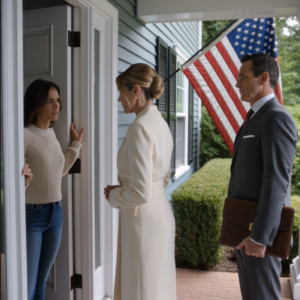
Three days later, the doorbell rang. I opened the door, already knowing somehow that this wasn’t a social call. Vanessa stood there in that cream coat, her hair perfect despite the wind, and beside her was a man I’d never seen before.
Mid-fifties, gray suit, leather portfolio tucked under one arm like a weapon he was waiting to draw. He had the practiced calm of someone who got paid by the hour to look unbothered.
“Paige,” Vanessa said, and there was no hello, no small talk, none of the warmth she’d shown me at that dinner table. “We need to talk about Eleanor’s estate.”
I didn’t move from the doorway. Years in the Army teach you that the first move in any confrontation is deciding what you’re not going to give away. And I wasn’t about to give her an inch of my house or my composure.
“Who’s this?” I asked, my eyes on the man beside her.
“Daniel Mercer,” he said, extending a hand I didn’t take. “I represent Mrs. Bailey.”
Mrs. Bailey. Not my mother. Not Eleanor. Vanessa, wearing my family’s name three days into a marriage, standing on my porch with a lawyer.
That was the moment everything crystallized. Not the coat, not the stiff smile, not even the lawyer himself. It was the fact that Vanessa knew. She knew there was something worth bringing a lawyer for.
And I had never once told her, or my father, or anyone outside that room with Margaret Hail what the estate actually contained. Daniel opened the portfolio and slid a letter toward me, something about clarifying questions regarding Robert Bailey’s interest in his mother’s estate. He said it with the practiced smoothness of a man reading from a script he half believed.
He wanted information: trust documents, account details, property records. Vanessa didn’t wait for me to respond to the letter. She leaned forward slightly, her voice dropping into something meant to sound reasonable, even generous.
“Paige, your father is Eleanor’s only son. Do you honestly think it’s fair that you kept all of it?”
There it was. The moral angle. Frame me as the greedy daughter hoarding what should rightfully flow to my father. Never mind that my father hadn’t asked for a dime; never mind that this conversation was happening because of her, not him.
I didn’t argue with her. I didn’t raise my voice. Twelve years of officer training had taught me that when someone wants a reaction, the smartest move is often silence—or a question that puts the burden back on them.
“Do you have a court order?” I asked Daniel.
He hesitated. “No, not at this—”
“Are you representing my father?”
Another pause, longer this time, and something flickered across his face that looked almost like discomfort.
“No. I represent Mrs. Bailey.”
I handed the letter back to him without looking at it twice. “Then we have nothing to discuss.”
That’s when Vanessa’s composure cracked, just for a second, just long enough for me to see something underneath the elegant surface.
“That’s $50 million, Paige.”
The number hung in the air between us like something dropped from a great height. I felt my stomach fold in on itself. I had never said that number out loud to anyone but Margaret. Not to my father, not to a single friend.
Fifty million was a figure that existed in a locked file in a law office and in my own head, nowhere else. And here was my father’s wife of three days saying it on my front porch like she’d read it off a grocery list.
“How do you know that number?” I asked, and I made sure my voice was flat, controlled, giving her nothing to work with.
Vanessa’s mouth opened, then closed. For the first time since she’d arrived, she didn’t have an answer ready.
“We should go,” Daniel said quietly, a hand finding her elbow.
I closed the door. I didn’t slam it. I wanted her to remember that I hadn’t given her the satisfaction of a scene, but I closed it firmly, and I stood there in my own front hallway with my heart hammering in a way it hadn’t since a live-fire exercise gone sideways years earlier.
I called Margaret before I’d even made it to the kitchen. She picked up on the second ring, and I could hear the particular quiet of her home office in the background, the kind of silence that belongs to a woman who has spent thirty years learning to listen before she speaks.
“Don’t sign anything,” she said before I’d even finished explaining. “And don’t tell them what we know. Not yet.”
I paced my kitchen while she talked me through it, my free hand pressed flat against the cool granite counter like it could hold me steady. Margaret’s voice had the calm, deliberate cadence of someone who had seen exactly this kind of maneuver before: family members circling an estate before the ink on a marriage certificate had even dried.
“Paige,” she said finally, and something in her tone made me stop pacing. “I need to tell you something. Someone tried to request access to records connected to Eleanor’s estate. Two weeks ago. Before the wedding.”
I stood very still in my kitchen, phone pressed to my ear, the late-afternoon light slanting gold across the floor, and felt the ground shift slightly beneath a version of my life I thought I understood. Two weeks before the wedding, before Vanessa had even become my father’s wife, someone had already gone looking for the numbers.
I spent the next two days doing what I do best: working the problem methodically, without letting emotion drive the search. That’s the part of being an officer that never leaves you. You don’t chase the loudest noise. You chase the facts, one piece at a time, until they form a shape you can actually use.
Margaret and I went through the entire trust structure together, line by line, the way she and Eleanor had built it years earlier. Everything held. Vanessa had no legal claim, no back door, no clause that gave her or my father authority to touch what Eleanor had left me.
My father couldn’t transfer it to her even if he wanted to. The trust simply didn’t allow it. That much was solid ground, and for a moment, it steadied me.
But one question kept circling back, refusing to sit still. If Vanessa had no legal claim, why had she walked up to my door with a lawyer three days into her marriage, throwing out a number she should never have known? Confidence like that doesn’t come from nothing. It comes from somewhere.
So I did what I’ve always done when something doesn’t add up. I looked for the pattern underneath it. I spent an evening going through what public records I could find on Vanessa Cole, now Vanessa Cole Bailey: marriage records, a previous marriage years earlier to a man considerably older than her, a divorce that had, from what I could piece together through court filings, involved a fairly ugly dispute over property division.
None of it proved anything. A previous contentious divorce doesn’t make someone a predator. People go through hard marriages and hard exits all the time, and I know better than most that a single data point doesn’t make a pattern. But it was enough to sharpen the unease already sitting in my chest, enough to make me trust my instincts a little more than I had at that dinner table months earlier.
Then my father called. I could hear it in his voice before he said a word, that particular tightness men get when they’ve been fed a story and haven’t checked it against the facts yet.
“Vanessa says you treated her like a criminal,” he said, and there was real hurt underneath the anger, which was somehow worse.
I stood in my kitchen again, same spot as two nights before, and understood immediately what had happened. Vanessa had gotten to him first. She’d already reframed the whole encounter before I had a chance to explain, turned herself into the wounded party, turned me into the greedy daughter trying to sabotage her father’s new marriage out of jealousy and control.
I didn’t tell him about the $50 million. I still wasn’t ready to hand that number to anyone, not even him, not while I didn’t fully understand what I was dealing with. Instead, I asked him something simple.
“Dad, have you signed any financial paperwork since the wedding?”
The silence on the other end told me he heard that question as an accusation rather than the careful, protective one it actually was.
“I can’t believe you’re asking me that,” he said, his voice rising. “Vanessa is my wife, Paige. She’s not some stranger you need to run a background check on.”
“I’m not running a background check. I’m asking a question.”
“Maybe the Army’s made you think everyone’s the enemy,” he said.
And those words landed somewhere soft and old in me, somewhere that still remembered being nineteen years old at my mother’s funeral, watching my father hold himself together for both of us. I felt anger rise, sharp and immediate, but I didn’t let it control my voice.
“No, Dad. The Army teaches you to know who’s standing next to you before things go bad. That’s all I’m trying to do here.”
He hung up. I stood there holding a dead phone to my ear for a long moment, feeling something crack quietly in my chest. Not anger exactly, more like grief for a relationship that had always been easy and now suddenly wasn’t.
My father and I had never fought like this. Not once, not even during the hardest years after my mother died, when we were both just two people trying to figure out how to live in a house that felt too quiet. I set the phone down on the counter and pressed both palms flat against the cool granite, breathing the way I’d been trained to when a situation needed my head clear instead of my emotions loud.
That’s when Margaret called back. Her voice had a different quality this time. Not alarmed exactly, but focused, the voice of a lawyer who has just found the thread that ties a whole tangle together.
“Paige,” she said, “I found something more serious than the estate inquiry.”
I felt my stomach tighten.
“There’s a document that’s been drafted,” she continued, “related to your father’s own assets. Not Eleanor’s trust. His personal accounts, his property, his financial decision-making authority.”
I sat down slowly at my kitchen table, the late-evening light long gone from the windows, now just the hum of the refrigerator and Margaret’s steady voice keeping me company.
“If he signs it,” she said, “Vanessa could end up with significant control over his finances if he ever becomes incapacitated. Power of attorney structured in a way that gives her far more authority than a typical spouse would have.”
I closed my eyes. Fifty million dollars had never been the whole story. It was the number that had gotten my attention, the number Vanessa let slip because she thought it would rattle me into cooperating. But sitting there in my dark kitchen, phone pressed to my ear, I understood for the first time just how much bigger this actually was.
This was never only about my grandmother’s money. This was about my father.
I didn’t sleep much that night. I kept thinking about my father sitting at his own kitchen table, maybe not so different from mine, signing something he hadn’t fully read because the woman across from him had a way of making complicated things sound simple. That’s a particular kind of danger, not the loud, obvious kind, but the quiet erosion of someone’s judgment, one reasonable-sounding request at a time.
By morning, I’d stopped thinking of this as a dispute over Eleanor’s trust. I started thinking of it as a campaign. The $50 million had been the opening move, the thing that told me Vanessa had done her homework long before she said a single vow.
But once Margaret told me about the power of attorney document being drafted for my father’s personal assets, the whole shape of it changed. This wasn’t a woman making one aggressive grab. This was someone building infrastructure quietly, patiently, piece by piece, to gain control over everything my father owned, not just what he might someday inherit.
I went back through what I actually knew about my father’s finances. He wasn’t wealthy in the way Eleanor had been, but he wasn’t poor either. Decades of steady work as an engineer had given him a paid-off house, a healthy retirement account, a life insurance policy he’d carried since I was a kid, and a modest but real investment portfolio he’d built slowly, carefully, the same unhurried way he did most things.
Margaret confirmed what I suspected when I called her that afternoon. Some of my father’s paperwork had changed since the wedding: beneficiary designations, account access. Nothing had been finalized yet on the power of attorney front, which meant we still had a window. But the direction was unmistakable.
Vanessa wasn’t only trying to get her hands on my inheritance. She was working to get her hands on everything my father had, using the one lever she had that I didn’t: proximity. She lived with him. She had his trust, his loneliness, his desire to believe that this second chapter of his life could be simple and good after years of simple being hard.
I decided the only way to fight this was the way Eleanor had taught me without ever explicitly saying so: patience, documentation, and restraint. Vanessa, for her part, didn’t retreat after our confrontation at my door. If anything, she escalated, just in a softer key.
Over the following week, I received two messages from her, both wrapped in language that sounded almost conciliatory. She talked about healing the family, about not wanting money to come between us, about how much she wanted Robert’s daughter and his wife to have a real relationship.
Buried in the second message was the actual proposal. If I would agree to place a portion of my assets into what she called a “family investment structure,” something that would supposedly benefit everyone and demonstrate good faith, we could move past all of this unpleasantness.
I read that message twice, then a third time, sitting very still at my kitchen table with my coffee going cold beside me. I understood exactly what she was asking. She wasn’t asking me to share wealth. She was asking me to voluntarily pull assets out of the very structure Eleanor had built specifically to protect them.
A structure with independent trustees, legal safeguards, and terms Vanessa couldn’t touch. If I moved money into some new joint arrangement, all of that protection would disappear, replaced by something far more vulnerable to exactly the kind of pressure she was already applying. I declined politely, briefly, through a single line that Margaret helped me draft, careful not to give away anything about what we already knew.
Vanessa’s tone shifted again almost immediately. The soft, conciliatory language disappeared, replaced by something with an edge to it. She told my father—not me directly, but through him, which had become her preferred channel—that she believed I was hiding family assets, that I might have taken advantage of Eleanor while she was elderly and vulnerable, isolating her from the rest of the family to secure a larger inheritance for myself.
That accusation landed somewhere deep and raw. Of everything Vanessa had done up to that point, this was the one that made my hands shake when my father repeated it to me over the phone, his voice tight and uncertain, caught between the woman he’d just married and the daughter he’d raised alone.
Every instinct I had told me to defend myself immediately, loudly, to list every visit I’d made to Eleanor in her final years, every hour spent at her bedside long before there was any inheritance to speak of. But I made myself stop. I made myself remember what Eleanor used to say about people who accuse loudly: that the loudest accusations are often the ones designed to distract from something quieter happening underneath.
So instead of defending myself, I let Vanessa keep talking. I let her keep sending messages, keep making requests, keep building a paper trail she didn’t realize she was building. Margaret and I started keeping everything: every email, every text, every legal letter Daniel Mercer’s office sent over.
We built a file, careful and thorough, the kind of record I’d been trained to keep in the field. Dates, times, exact language. Nothing embellished, nothing left out.
Then came the email that changed the direction of everything. Vanessa wrote to me directly, no longer routing things through my father, no longer softening her language with talk of family healing. If I didn’t resolve this within the family, she said, she would take the matter to court.
I read it standing at my kitchen counter, and for the first time since this whole thing began, I felt something close to relief instead of dread. I had Margaret respond through official channels with four words that felt like the first real move I’d made in this entire fight.
“Let her do that.”
Two weeks later, Vanessa filed. I’ll admit, there was a strange calm that settled over me once the papers were actually filed. Months of tension, of careful phone calls and guarded messages, of watching my own father look at me like I might be the villain in his new life—all of it funneled into something with rules now.
A courtroom has rules. A discovery process has rules. And rules, unlike family dinners gone sideways, are something I know how to work inside of.
Vanessa, I think, believed the lawsuit would frighten me. I think she assumed that a woman like me—Army officer, disciplined, private—would want to avoid the exposure, the depositions, the possibility of our family’s business becoming a matter of public record. I imagine she pictured me caving quietly, offering some settlement just to make the whole ugly business disappear before it could stain anyone’s reputation.
What she got instead was discovery. Margaret explained it to me plainly the week the case opened. Discovery is the part of a lawsuit where both sides are legally required to hand over documents, communications, and records relevant to the claims being made.
It’s tedious. It’s invasive. And it doesn’t care whose side you’re on. It simply demands the truth, in writing, under oath, whether or not that truth is convenient for you.
For months, Vanessa had been the one asking questions. Now the questions started pointing back at her. How did she know the exact figure of Eleanor’s estate before anyone in the family had told her? Why had she retained an attorney and shown up at my house only three days after her wedding?
A timeline that, when you say it out loud in front of a judge, doesn’t sound like the behavior of a woman blindsided by unfairness. It sounds like the behavior of a woman who’d already been preparing. Why had the financial documents intended for my father’s signature been drafted so early, in some cases before the wedding had even taken place?
And why, months before I ever confronted her, had she asked Eleanor directly—more than once, according to records that started surfacing—about inheritance, about estate planning, about what exactly Robert stood to receive from his mother?
I watched Daniel Mercer’s confidence erode in real time over the course of that discovery process. In our early exchanges, he’d carried himself like a man who believed fully in his client’s position. By the third or fourth round of document requests, something in his correspondence had changed. More careful, more measured, the tone of an attorney who is starting to suspect he hasn’t been told the whole truth by the person paying his fees.
Then came the piece of evidence that reshaped everything. Through records obtained legally during discovery—text messages between Vanessa and a friend, dated well over a year before she ever met my father in person—it became clear that Vanessa had been researching the Bailey family’s finances long before their relationship became serious.
Not days, not weeks. Months, possibly longer, of quiet interest in a man she hadn’t even started dating yet, centered specifically around what he might one day inherit from his mother. In one exchange, she referenced the possibility that Robert would someday come into a significant inheritance from Eleanor. The wording was careful, almost clinical, the kind of language you use when you’re calculating rather than falling in love.
But here was the miscalculation at the center of her entire plan, the flaw that no amount of research could have fixed for her. Eleanor had never left that money to Robert. She’d left it to me.
The trust, the $50 million, the entire structure Eleanor had spent years building—all of it had been established with me as the sole beneficiary years before Vanessa had ever entered my father’s orbit, long before there was a wedding for her to attach herself to. Marrying Robert didn’t give her a path to that money. It never had.
She’d built an entire campaign around a fortune that was never in her reach to begin with. And by the time she realized her mistake, discovery had already exposed exactly how hard she’d tried.
I sat with Margaret in her office the day all of this became clear, watching her lay the documents out across her desk in careful, deliberate rows, and I felt something complicated settle in my chest. Not triumph exactly. Something closer to sorrow for my father, for the version of happiness he’d believed he was building, for how much he still didn’t know.
Then Margaret told me something that stopped me completely.
“There’s one more thing,” she said, sliding a folder toward me, her voice quieter than usual. “Before Eleanor passed, she met with Vanessa.”
I stared at her. “What?”
“Once. Privately. I don’t know everything that was said, but Eleanor left instructions with me. There’s a letter, Paige. She told me it was only to be opened if someone ever tried to contest what she left you.”
I sat very still in that office, late-afternoon light falling through the blinds in thin gold bars across Margaret’s desk, and felt the ground shift again. Not with dread this time, but with something that felt almost like my grandmother reaching across the distance between the living and the dead to hand me one last piece of armor.
Eleanor had known. Not everything, maybe, but she had seen enough of Vanessa months before the wedding, months before any of us understood what we were dealing with, to prepare for exactly this moment. She had left me a letter, and it had been waiting, unopened, for the day someone tried to take what she’d worked her whole life to protect.
The meeting happened in Margaret’s conference room on a gray Tuesday afternoon, the kind of overcast light that makes everything feel more serious than it might otherwise. Daniel Mercer had requested it himself, which told me something had shifted on their side of the table before we’d even sat down. My father came too, at my request, though I could see in the stiff way he held his shoulders that he still wasn’t sure whose side he was supposed to be standing on.
Vanessa arrived looking exactly as composed as she had on my doorstep months earlier, the cream coat replaced now by something dark and severe, her expression carefully arranged into wounded dignity. I’d learned by then that composure was her armor, the same way documentation was mine. She sat across the table with her hands folded, and for a moment I almost admired the discipline it took to hold that posture, knowing what was coming.
Margaret opened with the estate records first: Eleanor’s full financial history, medical evaluations from her final two years, cognitive assessments that had been performed as a standard part of updating her trust. Every document confirmed the same thing. Eleanor had been entirely lucid, entirely of sound mind when she structured her estate to leave the bulk of it to me.
There had been no manipulation, no isolation, no version of events where I had pressured a vulnerable old woman into cutting out her only son. I watched my father’s face as Margaret laid it out. Watched something in his jaw loosen slightly, like a knot finally giving way after being pulled tight for months.
Then Margaret reached into a separate folder and withdrew the letter. The room went quiet in a way that felt almost physical. I hadn’t read it yet myself.
Margaret had wanted us all to hear it together, in this room, at this exact moment. And looking back now, I understand why. Some things need witnesses.
Eleanor’s handwriting filled the first page, small and precise, the same handwriting I remembered from birthday cards and grocery lists taped to her refrigerator. Margaret read it aloud, her voice steady but softened with something like reverence.
Eleanor wrote that she’d met with Vanessa once, quietly, several months before the wedding, a lunch Vanessa herself had requested, ostensibly to get to know her future mother-in-law better. Eleanor described the conversation carefully, without cruelty, without dramatics. She wrote that she couldn’t know another person’s heart, couldn’t say with certainty whether Vanessa loved my father or loved what surrounded him.
She was honest about that uncertainty in a way that made the letter feel more credible, not less. But she wrote that during that single lunch, Vanessa had asked about inheritance three separate times, about estate planning, about what Robert stood to receive when his mother passed. Not framed as idle curiosity, Eleanor noted, but returned to again and again, the way a person circles back to something they can’t stop thinking about.
That was enough for Eleanor. She didn’t need proof of malice. She only needed a pattern, and patterns were something my grandmother had spent eighty-four years learning to read.
Then came the line that broke something open in my father, the one I’ll remember for the rest of my life. Margaret read it slowly.
“Robert, if you’re ever reading this, it means someone tried to take what I meant only for Paige.”
My father made a sound I’d never heard him make before. Not quite a sob, more like breath leaving a body all at once. He sat very still, staring at the table, and I understood in that moment that whatever remained of his certainty about this marriage had just quietly collapsed.
Vanessa’s composure finally cracked. She turned toward the letter, toward Margaret, toward all of us, and said that Eleanor had always been controlling, always suspicious, always looking for reasons to distrust anyone who got close to her family. It was the wrong move, and I think some part of her knew it the moment the words left her mouth.
Attacking a dead woman’s character in front of her grieving son, in a room full of documented evidence proving that woman’s judgment had been sound, was not the move of someone confident in her position. Daniel Mercer didn’t defend her. He sat very still, his pen resting untouched on his legal pad, and I understood that whatever version of this case he’d believed he was building had just quietly ended.
Vanessa’s claim on my inheritance collapsed there in that conference room, buried under the weight of a letter written by a woman who’d seen this exact moment coming before any of us had. But I wasn’t finished. I reached into my own folder and slid a stack of papers across the table toward my father.
The financial documents Vanessa had prepared for him to sign. The power of attorney language Margaret had flagged months earlier. Every piece of paperwork that would have quietly handed Vanessa sweeping control over his accounts and property if he’d ever lost capacity to manage them himself.
My father looked down at those pages for a long time. When he finally looked up, something had changed in his eyes, something that told me he finally understood I had never been trying to tear apart his happiness. I had been trying to keep him safe inside it.
Vanessa looked at me across the table, her voice flat now, stripped of all its earlier warmth.
“You won,” she said. “You have your $50 million. What else could you possibly want?”
I held her gaze, and I answered without raising my voice, because I didn’t need to anymore.
“I never wanted your money. I only wanted you to stay away from mine.”
The lawsuit ended quietly, the way most things do once the truth has already done its work in a room full of people. Vanessa’s attorney withdrew her claim to my inheritance within the week, filing the necessary paperwork with none of the fire that had marked those first few months.
There was no dramatic courtroom scene, no final gavel, no crowd of onlookers. Just documents, signatures, and the slow, unglamorous machinery of the legal system closing a chapter that had cost all of us more than money.
My father did something I hadn’t expected, something that told me more about where his heart had landed than any conversation could have. He hired his own attorney, entirely separate from Margaret, entirely separate from me, and asked him to review everything. Every account, every beneficiary designation, every piece of paper he’d signed since the wedding.
He wanted to understand, on his own terms, exactly what he’d agreed to and exactly what needed to be undone. Watching him do that quietly broke my heart and steadied it at the same time.
It would have been easier in some ways for him to lean on me, to let me handle it, to fold back into the old pattern where I managed things and he trusted blindly. But he didn’t. He sat with his own lawyer, asked his own questions, and slowly began rebuilding a sense of control over his own life that I don’t think he’d realized he’d lost.
His marriage didn’t survive what came out in that conference room. I want to be honest about that, because I think the truth matters more than a tidy ending. Robert and Vanessa separated within a month, and I watched my father move through that grief the way he’d moved through my mother’s death years earlier: slowly, quietly, without much drama, processing loss the way some men do, alone in a garage or behind a closed door, emerging only when he was ready to talk about something other than his feelings.
I didn’t push him toward divorce. I want to be clear about that, too. I never once told him what to do with his marriage. I only made sure he had the facts, the documents, the letter from his own mother, and then I stepped back and let him be the one to decide what kind of life he wanted to build from there.
He needed that. He needed it to be his choice, made with open eyes, not something I orchestrated for him.
A few weeks after the separation, he showed up at my house on a Sunday afternoon. No warning, no phone call first. I opened the door and found him standing there in his old canvas jacket, hands in his pockets, looking older than I remembered him looking, even at the height of everything with Vanessa.
He didn’t come for money. I want to say that plainly, because for months our relationship had orbited around exactly that fear—that everything between us had somehow become tangled up with what I had and what he didn’t. He came to apologize.
“I thought you were protecting your money from me,” he said, standing in my doorway, not quite meeting my eyes at first.
I felt something in my chest loosen, an old tension I hadn’t fully realized I was still carrying.
“I was protecting both of us,” I told him, “from someone who thought loving you meant she was entitled to everything you had.”
He nodded slowly, and I saw him swallow hard the way he used to when I was a kid and he was trying not to cry in front of me. He told me, standing right there in my doorway, that the loneliness after my mother died had made him ignore things he would normally have noticed. Small inconsistencies. Questions that came too early, too often.
He said grief had made him grateful in a way that dulled his instincts, made him want so badly to believe someone had chosen him simply for himself that he’d stopped checking whether that was actually true. I didn’t mock him for it. I didn’t remind him of every warning sign I’d tried to point out along the way. There would have been no kindness in that, and my father had already paid enough for his blind spots without me adding to the bill.
I made a decision in the weeks that followed, one I want to be honest about because I think it matters. I didn’t hand him a portion of the $50 million to smooth things over, to manufacture some easy version of a happy ending where money fixes what trust once broke. Eleanor hadn’t structured that trust to be split according to guilt or sympathy.
She’d built it for me deliberately, and I decided to honor that fully rather than dilute it to make anyone, including myself, feel better in the short term. Instead, I did something I think Eleanor would have appreciated more than any gesture toward my father could have accomplished. I used a portion of the income generated by the trust to start a support program for military families and veterans.
Something that gave back in a direction that actually meant something to me. That connected the fortune Eleanor left behind to the life I’d actually built for myself, one decision at a time, one deployment at a time.
Late one evening, months after everything had settled, I stood in front of the photograph of Eleanor I kept on my bookshelf, the one from her seventieth birthday, laughing at something just out of frame, looking exactly like a woman who knew more than she ever let on. I thought about the words she’d said to me before she died, the ones I’d carried through every strange, difficult turn of that year.
“Money doesn’t change people. It only removes their reason to hide who they already are.”
I understood, standing there, that she’d been talking about Vanessa long before I did. I used to think the smartest decision of my life was putting on this uniform. Then I thought maybe it was refusing to open the door to Vanessa a second time.
But I was wrong. The smartest decision I ever made was much simpler than that. When my grandmother left me $50 million, I told no one. Because sometimes the only way to find out if someone loves your family, or just loves what your family has, is to never let them know how much there is to take.
I’d love to know where you think this story would have gone if Vanessa had gotten to me first. Leave a comment below and let me know where you’re watching from tonight. We share stories like this one every single day, so if it moved you, hit subscribe so you don’t miss what’s coming next.