“Pack Your Bags—This House Isn’t Yours,” My Mother-in-Law Said—Then the Trust Was Revealed
Phân cảnh 1: The unexpected ultimatum
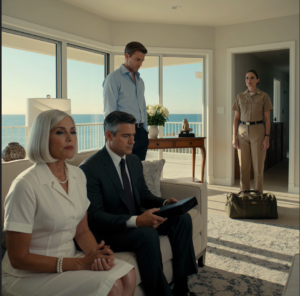
My mother-in-law gave me 30 minutes to pack my life into cardboard boxes. She said it the way you’d tell a stranger the pharmacy closes at nine: polite, flat, final. Her lawyer sat beside her with a leather folder on his knee. My husband stood behind the sofa, studying the baseboards as if they’d suddenly become fascinating.
And I stood in the doorway of the Malibu house, still in my uniform, still smelling of jet fuel and three weeks of desert dust. And I thought, “They have no idea. Not one of them.”
They had just thrown out the only person in that room who knew exactly whose name was on the deed.
Let me back up to the moment I walked in.
Phân cảnh 2: Confrontation and clarity
It was a Thursday in late October, a little after four, and the Pacific light was turning the living room the color of warm honey. I’d been traveling 19 hours. The cab from LAX had smelled of pine air freshener and old coffee, and I’d spent the ride rehearsing something light to say when Ryan opened the door, something that sounded like a wife who had missed her husband.
My duffel dug a groove into my shoulder. All I wanted was a shower and my own bed. I hadn’t told Ryan which day I’d land. I’d wanted to surprise him. Funny how that turned out.
The first thing I noticed was the cardboard. Six moving boxes, already assembled, lined up along the hallway wall. Somebody had taped them properly, and Ryan has never taped anything properly in his life.
The second thing I noticed was Margaret in the good armchair by the window, silver bob immaculate, pearls exactly where pearls belong. Beside her sat a man in a charcoal suit with a leather folder on his knee. On the coffee table, squared to the edge, lay a thick stack of papers. And Ryan stood behind the sofa with his hands in his pockets, refusing to meet my eyes.
Fourteen years in uniform teaches you what guilt looks like when it’s trying to stand still.
“Good. You’re early,” Margaret said. “That saves time. You have 30 minutes to pack your things.”
Nobody offered me a seat, so I stayed where I was and set my duffel down slowly, the way you do when you’re deciding what to do with your hands. A younger version of me would have shouted. Instead, that old quiet came over me, the one that arrives when a briefing goes sideways and everything inside slows and sharpens. The person who stays calm in a room usually ends up knowing the most.
“Whose house,” I asked, “are you asking me to leave?”
Margaret smiled, small and practiced, the smile she saved for charity luncheons.
“Ryan’s, dear.”
The lawyer slid the papers across the table. A petition for dissolution of marriage. Beneath it, a document about exclusive occupancy of the marital residence. My name typed in capitals, little yellow flags marking where I was supposed to sign.
I finally looked at my husband.
“It’s not personal, Stell,” he said, rubbing the back of his neck. “We’ve been drifting for a long time. It’s just better this way.”
Eight years, and what I got was a sentence he couldn’t even finish.
Phân cảnh 3: Marriage of secrets
I met Ryan Coleman at a fundraiser in Santa Monica when I was a brand-new first lieutenant wearing a borrowed dress. He was charming the way men in real estate are charming: firm handshake, easy laugh, a hand at the small of my back when he introduced me around. I mistook it for pride.
When I told him I was in the Army, he grinned and said, “So, you’re married to your paycheck.”
I laughed. I thought it was sweet in a clumsy way. He assumed I lived on a lieutenant’s salary, and I let him. That was deliberate. I wanted to be loved by someone who believed I had nothing to offer but myself.
After the wedding, he loved saying, “We’re building this life from scratch,” at barbecues, in front of co-workers, to anyone within earshot. I never corrected him. I kept my own account, paid my own bills, and steered conversations away from family and money. Silence became a habit, and then it became a wall.
The night that stays with me happened last spring at Margaret’s table in Brentwood. Twelve people, candles, roast lamb from a place that doesn’t list its prices. Margaret lifted her wine glass in my direction.
“You should be grateful, Stella. Ryan married someone willing to live within his means.”
A few polite chuckles. Then Ryan leaned back in his chair and said, “She thinks wearing a uniform makes her independent.”
The table laughed properly, Daniel slapping the tablecloth. I looked at my water glass and watched the candle flame bend inside it. Three ice cubes. I remember counting.
Across the table, Ryan was too busy enjoying his audience to look at me. And I realized he had never once, in all those years, defended me. What I felt wasn’t anger. It was colder, more patient.
Because while 12 people laughed at a woman they believed was broke, I was the only one who knew exactly what this house was worth, who held title to it, and what quietly paid for the roof, the pool, and the property taxes none of them had ever wondered about.
Now, in that honeyed light, the same stillness returned. The lawyer folded his hands.
“Mrs. Coleman, this can be simple. Take your clothing, your personal belongings, anything you brought into the marriage. We only ask that you vacate tonight and sign the acknowledgement so we can avoid unpleasantness.”
Unpleasantness. In my own living room.
I looked past him at the wall of windows, the gray-blue ocean, the terrace Ryan liked to call our little slice of heaven. I looked at Margaret’s pearls, at my husband’s shoes. Then I asked, as gently as I’ve ever asked anything, “Are you absolutely certain you know who owns this property?”
I didn’t say anything more that afternoon. Ryan let out a short, nervous laugh, and Margaret waved a hand as if I’d asked whether the ocean was wet. But the question was out, and I let it sit in the room while my mind went back to the man who taught me that silence can be a kind of armor.
Phân cảnh 4: A father’s legacy
My father, Thomas Whitaker, made his money the old-fashioned way. He bought tired lots along the California coast in the seventies, when nobody wanted them, and held on long after everyone told him to sell. He wore the same scuffed leather watch for 30 years and drove a truck with a cracked dashboard.
When I was 12, I asked why we didn’t have a nicer car, and he said, “The car doesn’t know the difference, Stella. Neither should you.”
He had watched money rot people. His own brother burned through an inheritance in four years and spent the next 20 blaming everyone but himself. So, before I was old enough to understand what he was doing, my father sat down with a lawyer and built a wall around what he’d earned.
The Malibu house went into a family trust years before I ever met Ryan. It could not be sold on anyone’s whim or divided by anyone’s divorce, and it would always be a place where I had a roof. A trustee managed it. I was the beneficiary. Nobody else was, and nobody else would ever be.
He died four years ago in March. Pancreatic cancer, fast and unkind. I flew home on emergency leave and held his hand, which had gone thin as paper, and he said, “Don’t let anybody love the house instead of you.”
I laughed because I thought he was being dramatic. I think about that sentence almost every day now.
Phân cảnh 5: The slow erosion of trust
So why did I marry Ryan without telling him? Because in the beginning, he was kind. I want to be fair about that, because the easy version of this story makes him a monster from the first page, and he wasn’t.
He brought me soup when I had the flu in a rented apartment near Fort Liberty. He drove four hours for 40-minute visits. When I told him I planned to stay in the Army, he said he admired it.
I believed that man loved me, and I wanted to keep believing it without a single dollar muddying the water. If love only survives when it’s well-funded, it isn’t worth much. So I made a quiet decision, the kind you can’t take back once it’s made. I would let him love the woman he thought I was.
The house came later. After the wedding, I told him it was family property and left it there. He assumed some sentimental arrangement with relatives. Nobody asks hard questions about a gift.
The change was slow, which is how it always works. First came the jokes.
“You work all day and still make less than the guy who restocks our break room,” he told a friend at our own table, with me passing the potatoes.
Then came the nickname: “My little soldier.”
At first, it sounded affectionate. By year six, it sounded like a pat on a dog’s head. He stopped asking about my deployments and started asking when I’d be done with all that.
And then there was Margaret, who had decided before the wedding cake was cut that her son had settled. She never insulted me outright. Her talent was subtler. A small sigh when I walked in with yesterday’s hair. A question lightly asked: “Does the Army cover a decent dress, or is that out of pocket?”
She reminded Ryan, within my hearing, that he carried the family’s reputation, that a man needs a wife who’s actually home. Every remark came wrapped in concern, so I could never object without looking ungracious.
Here is what none of them knew. For years, I had been covering the house’s upkeep through the distributions the trust allowed: the roof after the winter storms, the pool equipment, the property tax installments, the insurance premiums that climbed every spring.
I’d move the money quietly and tell Ryan the family arrangement handled it. He never asked how. He enjoyed the terrace, the view, and the story about building from scratch, and I paid for the scratch.
Phân cảnh 6: Signs of betrayal
Then Ryan’s business began to wobble. He had sunk money into a development deal in Nevada with a partner I never met and a spreadsheet I never saw. When it collapsed, he started sleeping badly and snapping at the dishwasher. He borrowed against things. He took calls out on the terrace and lowered his voice when I stepped outside.
I noticed all of it the way you notice weather before a storm. And I said nothing because I still hoped he would turn to me and say the words: “I’m in trouble. Help me.”
I would have helped him. That’s the part that still stings.
Instead, one evening in August, I came home early from the base and let the front door close softly behind me. He was in the kitchen with his phone on speaker, a glass of bourbon sweating on the counter.
“If she had any real money,” Ryan said, “she’d have told me by now.”
“She doesn’t,” Margaret answered. “She’s hiding her paycheck, that’s all.”
I stood in the hallway with my keys cold in my fist. I could have walked in. I could have ended it with five words, but I had waited so long to learn the truth about my marriage that I wanted to hear the rest.
“Then we use the house,” Ryan said. “It’s the marital residence. Eight years I’ve lived there. I’ve fixed things there. A judge would see it my way.”
“Then we’d better find out exactly how the title reads,” Margaret said, “before she does.”
I backed out of the hallway without a sound, got into my car, and sat in the driveway until the sprinklers came on. My hands were steady. I checked. Fourteen years of training, and all it taught me that night was how to breathe through it.
Somewhere in those minutes, something shifted. For a long time, I had told myself that Ryan’s contempt was a flaw, an ugly habit I could outwait. But a man who mocks you is one thing. A man and his mother planning how to take your home before you know it’s being taken is something else entirely.
They weren’t just disrespecting me anymore. They were measuring the house for a different owner.
After that night in the driveway, I did what soldiers do with information they can’t use yet. I filed it away and kept moving.
September came in hot and dry. Ryan turned polite in a way that frightened me more than his jokes ever had. He started offering me coffee. He kissed my forehead on his way out the door. He was a man rehearsing tenderness, and I was the audience.
Some nights, he didn’t come home until after midnight, smelling of valet-parked leather and expensive bourbon. And when I asked, he said, “Meetings,” without looking up from his phone.
Phân cảnh 7: The breaking point
The email found me on a Tuesday. His laptop sat open on the kitchen island, the shower running upstairs, and a notification slid across the corner of the screen. I didn’t touch the keyboard. I didn’t have to.
The preview was one line from a woman named Dana Puit at a brokerage on Pacific Coast Highway. Subject line: “Malibu. Next steps.”
“Once the divorce is filed, we can discuss the property.”
I read it twice, standing there in my socks with a mug going cold in my hand. I took one photograph of the screen, the way I document anything I might need later. And then I rinsed my mug and put it in the rack.
When Ryan came down, hair damp, humming, I asked if he wanted eggs. He said yes. I made them, and I watched him eat them. And neither of us said a word about the future.
Margaret made her move eight days later. She invited me to lunch at her club in the Palisades, the kind of place with linen napkins folded into little tents and a waiter who never asks what you want. She ordered a salad she didn’t eat. She waited until the plates were cleared, then folded her hands the way she does when she’s about to be generous.
“Stella, I’ll be direct because I respect you. This marriage has run its course. You should make this easy for everyone.”
“Easy how?”
“You leave the house quietly. You don’t contest anything. In return, Ryan sees that you keep a portion of your savings, and the family holds on to what belongs to the family.”
I turned my water glass a quarter turn on the tablecloth.
“What family?”
She looked at me as if I’d asked what color the sky was.
“The Coleman family.”
I almost laughed. For eight years, I had carried that name on my ID, my mail, my medical forms. And she was telling me, with a straight face and a diamond on every knuckle, that I was a guest in a family I’d legally belonged to longer than some of her country club friends.
But I didn’t laugh. I thanked her for lunch and told her I’d… Relief was so visible, it was almost tender. She thought she’d won.
That afternoon, I drove to Santa Monica.
Phân cảnh 8: Seeking legal counsel
Evelyn Hart’s office occupies the third floor of an unremarkable building with a view of a parking structure, which tells you most of what you need to know about her. She was 59, silver hair cut blunt at the jaw, reading glasses on a chain, and she had been my father’s attorney for 26 years.
At his funeral, she had stood at the back in a gray suit and hadn’t cried, and I’d loved her for it. She didn’t hug me now. She just pulled out my chair and said, “Tell me everything. Start with the part you think doesn’t matter.”
So I did. The email, the overheard phone call, Margaret’s lunch. She listened with her pen capped, which I’d learned meant she was memorizing, not skimming.
When I finished, she opened a file as thick as a dictionary and spread documents across the desk like a hand of cards.
“Here is where we are,” she said. “The trust was executed years before your marriage. The Malibu property has been titled in the trust ever since. You are the beneficiary. Ryan is not, and he never has been. He cannot sell it, mortgage it, or transfer it. Your father built this thing to survive exactly this kind of weather.”
I let out a breath I’d been holding for six weeks.
“But,” Evelyn said, and I felt the floor tilt a little, “the house may be protected, and we still don’t assume your marriage has no financial claims against it. California is a community property state. If marital funds went into improvements or into paying down anything connected to the property, Ryan’s side will argue for reimbursement. We find that out before they do, and we don’t guess.”
“The distributions I took from the trust, the repairs—those matter, too?”
“Every dollar. Every receipt.”
Over the next two weeks, her paralegal and a forensic accountant pulled the record apart. Evelyn called me in on a Friday and slid three pages toward me without comment.
The first was a loan application for a bridge loan in Nevada, filed in Ryan’s name five months earlier. Under assets, he had listed the Malibu residence: “Jointly held. Estimated value,” and a number that made my stomach turn.
The second was a letter to the trustee’s office requesting a copy of the governing documents, signed by Ryan as a “co-owner of record.”
The third was a note from a realtor’s file, which Evelyn wouldn’t tell me how she’d obtained, recording Ryan’s words: “My wife won’t fight me over it.”
“None of this makes him a criminal,” Evelyn said carefully. “It makes him a man who told several people something that wasn’t true and signed his name beneath it.”
I looked at that signature for a long time. It was the same loose slant that used to appear on notes left on the fridge. “Back by six. Love you.”
“I don’t want to destroy him,” I said, and heard how tired it sounded.
Evelyn removed her glasses. “Then what do you want, Stella?”
I thought about my father’s thin hand. I thought about three ice cubes and a table full of laughter.
“I want the truth,” I said, “to become impossible for them to ignore.”
She nodded once, slowly, the way a person seals an envelope.
“Then you don’t sign anything. You don’t confront anyone. You go on exactly as you were.”
Phân cảnh 9: A test of character
Three days later, my orders came through. Three weeks overseas. I kissed my husband goodbye at the front door, and he held me a beat too long, the way you hold something you’ve already sold.
“Our home,” Ryan said again, as if repetition could pour concrete.
We were back in that honeyed living room, the 30 minutes ticking down on the mantel clock, the six taped boxes lined up like witnesses. I hadn’t moved from the doorway. My duffel still sat where I’d set it, and the strap had left a red line across my palm.
“You already brought your mother and a lawyer into our house,” I said. “That doesn’t sound like a man who thinks this is simple.”
He pushed a hand through his hair. “Stella, this doesn’t have to get ugly.”
Ugly is a strange word for a Thursday afternoon with six boxes.
The lawyer cleared his throat. His name was Gregory Pel, and I’d noticed he hadn’t once looked directly at the walls, the art, the view. He was looking at his folder. Men like Pel know the difference between a client’s confidence and a client’s version of events, and I could see him beginning to wonder which one he’d been sold.
Margaret had no such doubts. She shifted in the good armchair and lifted her chin.
“You’re a soldier, Stella. You carry a rifle and follow orders. You don’t understand real estate law, and frankly, there’s no shame in that.”
I almost smiled. Fourteen years of reading terrain, and she believed my expertise ended at the firing line.
“Maybe I don’t,” I said. “I’m sure Mr. Pel does, though.” I turned to him. “Your client has told you who signed the deed, I assume?”
Something crossed his face, small and fast, like a card dealer noticing a marked deck.
“Mrs. Coleman, the question of title will be addressed through the proper channels.”
“That’s not an answer.”
“It’s the answer I can give you today.”
Margaret made a sharp sound in her throat. “She’s bluffing. Look at her. She’s trying to frighten us because she has nothing else.”
Ryan took a step around the sofa. His voice softened into the tone he used with clients who were about to be disappointed.
“Stell, come on. Let’s not do this. Sign the acknowledgement, take what’s yours, and we’ll sort out the rest like adults. I’ll even help you carry the boxes.”
The offer was so generous, so perfectly gentle, that it took me a moment to realize he meant it. He honestly believed he was being kind. That was the part that landed hardest—not the cruelty, the decency he’d convinced himself he still had.
“I won’t be signing anything tonight,” I said.
“Then pack your bags,” Margaret snapped. “You have 20 minutes.”
“No.”
The word came out so quietly that, for a second, nobody reacted. I’d said yes to a great many things in that house. Yes to hosting Thanksgiving. Yes to smiling through the lamb. “Yes, Ryan. I’m sure it’s fine.”
Phân cảnh 10: Calling their bluff
It was the first time in eight years that I’d said no in that room, and I felt it travel through my body like a cold drink on a hot day.
Ryan’s face darkened. “You don’t get to stay here after filing for divorce. That’s not how it works.”
“I didn’t file anything.”
I watched that sentence arrive. His mouth stayed open a half second too long, and I saw him reach for the next line and find the shelf empty. He glanced at his mother, then at Pel. And Pel, to his credit, turned a page in his folder and said nothing at all.
Because the petition on the coffee table had been drafted by Ryan’s side, and Ryan’s side had told me a story that I was already the one leaving. They’d skipped a step somewhere between their plan and my front door. They had confused the paperwork with the permission.
“Whose petition is this, then?” I asked, nodding at the table.
“It’s—we were going to file after you signed,” Ryan said.
“So there’s no case number?”
“Stella.”
“No hearing, no order, no court telling me to leave a home I’ve paid to keep standing.” I held his eyes. “Just your mother’s watch and your lawyer’s folder.”
The room changed temperature. Margaret’s smile had gone brittle at the edges, like an old photograph left in the sun. She smoothed her skirt, a small automatic gesture, and I noticed that her ring hand was trembling.
I took out my phone. Nobody stopped me, which told me they were still too certain to be careful. I pressed Evelyn’s number and put it on speaker. She answered on the second ring, as she always did.
“They’re here,” I said.
A brief pause on the line, the sound of a pen being uncapped.
“Who is ‘they,’ and what are they asking you to do?”
“Ryan, his mother, and an attorney named Gregory Pel. They want me to surrender possession of the house tonight and sign an acknowledgement.”
“Has anyone served you with anything filed by a court?”
“No, just drafts.”
“Then don’t sign a thing,” Evelyn said, crisp as a snapped ruler. “Don’t argue, don’t explain, and don’t let them rush you. Mr. Pel, I assume you can hear me. My name is Evelyn Hart. I represent the trust. I’ll be at that property at nine tomorrow morning with the governing documents. I suggest you bring your complete file.”
Pel closed his folder very slowly. He had gone the color of tea left too long in the cup. Ryan looked from the phone to me.
“The trust? What trust?”
I ended the call. [Snorts.]
“Stella,” he said, and for the first time his voice cracked. “What trust?”
Margaret recovered first, because she always did. She rose from the armchair, straightened her pearls, and let out a laugh that sounded rehearsed.
“Oh, for heaven’s sake. A soldier calls some lawyer in a panic, and suddenly we’re meant to tremble. You think a stranger on a phone is going to save you?”
I looked at her for a long moment, past the silver bob and the careful pearls, past eight years of sighs and small corrections. I thought of the funeral, of my father’s last advice, of a woman at a lunch table calling my marriage a family matter.
“No,” I said. “I don’t think a lawyer will save me.”
I picked my duffel up off the floor and settled the strap on my shoulder.
“I think the documents will.”
Phân cảnh 11: Revealing the trust
At nine the next morning, the doorbell rang exactly once. I’d been awake since five, sitting on the edge of the guest bed in my own house, listening to the surf and watching the light turn from slate to pearl.
Nobody had pushed me out the night before. Pel had quietly advised his client to wait for counsel. Margaret had swept out in a cloud of lavender and indignation, and Ryan had slept on the sofa like a man guarding a door that no longer needed guarding.
Evelyn arrived in a navy suit and flat shoes, carrying one rolling case, with a slim man named Martin Cho behind her, a trust administrator from the corporate trustee. No sports cars, no entourage, nothing a person could point to and call a performance. Just two people and a great deal of paper.
They took over the dining table, the one Margaret had chosen the tablecloth for. Evelyn laid out each document with the unhurried precision of a surgeon arranging instruments: the trust instrument, the recorded deed, the chain of title going back to my father’s first purchase, the trustee certification, a ledger of distributions, and a folder of receipts I had never imagined anyone would read.
Margaret came in at 9:20 with Pel and an air of wounded dignity. Ryan trailed them, unshaven, in yesterday’s shirt. Nobody sat until Evelyn gestured at the chairs.
“Let’s begin with the simplest question,” she said. “Who holds title to this property?”
She turned the deed so it faced them.
“The trustee, on behalf of the trust. It has held title since long before Mr. and Mrs. Coleman were married. Mr. Cho can confirm.”
Martin Cho nodded. “Recorded and unchanged. Mrs. Coleman is the beneficiary. Mr. Coleman is not a beneficiary and has no authority over the property.”
Ryan didn’t look at the page. He looked at me, and I saw him trying to fit this against eight years of memory, the way you try a key you already know is wrong.
“Then why,” he said slowly, “did she act like she was renting the place?”
“Because she was under no obligation to explain the trust to you,” Evelyn said.
Margaret found her voice. “How much is this house worth?”
“That isn’t relevant to whether your son owns it,” Evelyn said without a trace of heat.
Pel touched his tie. “My clients were operating under the understanding that this was marital property.”
“I’m sure they were.”
Evelyn slid a single sheet across the table.
“Which brings us to this letter sent to Mr. Cho’s office five weeks ago, signed by Mr. Coleman as ‘co-owner of record.’”
Phân cảnh 12: The weight of the truth
Nobody spoke. Outside, a gull cried, thin and ridiculous. Ryan turned toward me then, and the look on his face wasn’t quite anger. It was closer to vertigo.
“You lied to me.”
I had imagined this moment for months, and in every version, I’d felt triumphant. In none of them had my hands been shaking.
“No,” I said. “I didn’t tell you everything.”
“That’s the same thing.”
“It isn’t.” I kept my voice level. “A lie is telling you something false. I never told you the house was ours. You decided that. I just never corrected you.”
“Because you were testing me.” He barked out a short, ugly laugh. “Eight years, Stella.”
“Yes.”
“That’s sick.”
“Maybe,” I said. “I’d call it learning something I needed to know.”
Evelyn lifted a hand gently, a referee ending a round.
“This is where I need everyone to listen carefully, including my client.”
She looked at me over the chain of her glasses.
“Nothing here means every financial question disappears. The house is protected. The marriage is still a marriage in the eyes of California. If community funds paid for improvements, repairs, or anything tied to the property, that has to be accounted for, and Mr. Coleman may have a legitimate reimbursement claim. We’ll do that. Honestly.”
I saw Pel’s shoulders ease half an inch. For the first time that morning, he looked like a lawyer with something to work with. It was the right move on Evelyn’s part, and I understood it. She wasn’t there to humiliate anyone. She was there to be accurate.
“Honest is fine,” Ryan muttered. “Honest is all I want.”
“Then you’ll appreciate this,” Evelyn said, and opened the last folder.
It held printouts from Dana Puit’s brokerage file, obtained through a formal request after Ryan’s letter set the process in motion. The emails were short. “Once the divorce is filed, we can discuss the property.” A listing consultation penciled in for the week after my return. And a note in Puit’s own handwriting summarizing a phone call: “Client says wife won’t fight him over it. Wants quick close.”
Quick close on a house he’d never owned.
“Who wrote that?” Margaret demanded, though she knew.
“Your son said it,” Evelyn replied. “Ms. Puit wrote it down.”
Ryan sank into a dining chair. He didn’t collapse. It was subtler, a slow lowering, as if gravity had doubled for him alone.
I looked at the man I’d married, at the stubble and the wrinkled collar, and I tried to find the one who’d brought me soup in a rented apartment. He was in there somewhere. But he was sitting very still, hearing his own voice read back to him and learning what I had learned in a hallway in August.
Margaret placed both palms flat on the tablecloth.
“This is a misunderstanding.”
“Mrs. Coleman,” Evelyn said, almost kindly, “a misunderstanding is when two people believe different things by accident.”
The room went quiet in a way I can still hear. Pel closed his folder. Cho’s pen stopped. And Ryan, without lifting his eyes, said the thing I hadn’t expected, in a voice so small it barely carried.
“You were going to let me find out like this?”
“No,” I said. “You were going to let me find out like that.”
I gestured at the boxes in the hallway, still taped, still waiting. He had no answer. And for the first time in eight years, neither of us was pretending to need one.
Phân cảnh 13: Financial arithmetic
Evelyn’s accounting arrived 11 days later, bound in a plain gray folder, and she asked me to read it in her office rather than at home.
“Numbers are easier to hear when nobody’s watching your face,” she said.
Ryan came with Pel, who had grown noticeably more careful since the dining room. Margaret, to my surprise, had stayed away. Daniel had never come at all. Funny how families thin out when the paperwork thickens.
The forensic accountant, a quiet woman named Priya Natarajan, walked us through it line by line: Ryan’s contributions in one column, mine in another, trust distributions in a third. She had color-coded everything, and the colors told a story I had half known and never wanted to see written down.
For eight years, Ryan had paid the cable bill, his own car, and roughly a third of our groceries. I had paid the rest, along with the roof, the pool equipment, the insurance, and the property taxes, drawn from the distributions the trust allowed.
Where marital funds had touched the house, there were a few modest items: a kitchen faucet, a patio heater, a landscaping invoice. Real, documentable, and small. Evelyn had been right. Honesty cut both ways, and I found that I didn’t mind.
Then Priya turned to the last page.
“There’s one more matter,” she said, and glanced at Ryan with something close to apology. “Fourteen months ago, a payment of $180,000 left the joint checking account. It went to an LLC registered in Nevada.”
I looked at my husband.
“That’s the development deal.”
He said nothing.
“That money came from the joint account,” I said. “The one my savings went into every month. The one you told me we couldn’t touch because the mortgage was due.”
“There is no mortgage, Stella,” Ryan said quietly, and then seemed to hear himself.
“No,” I said, “there isn’t. You told me there was for a year and a half, and I believed you. I kept moving money into that account to cover it.”
Pel shifted in his chair. Priya turned the page to show the transfers, dates and amounts in neat black type. Ryan had spent a large share of our joint money on a deal he never mentioned, then blamed me at his mother’s table for not contributing enough.
In the final tally, I had carried far more than he had ever guessed. That figure wasn’t a weapon. It was just arithmetic. But arithmetic can be devastating when it’s finally allowed to speak.
Margaret appeared in the doorway then, uninvited, in a camel coat and the pearls. She must have heard the elevator behind her own pulse.
“This is just paperwork,” she announced to no one in particular.
Evelyn didn’t raise her voice.
“Paperwork is how ownership and obligation get established, Mrs. Coleman. It’s the only way they ever are.”
No theatrics followed, no shouting, no slammed doors. Margaret lowered herself onto the edge of a chair and held her purse in her lap with both hands, and I watched a woman who had spent her life being certain discover what the inside of doubt felt like.
Ryan asked if we could speak alone. Evelyn looked at me. I nodded.
We stood in the hallway beside a water cooler that gurgled every few seconds. Up close, he looked older. There was gray at his temples I hadn’t noticed and a nick on his jaw where he’d shaved in a hurry.
“Stella, we can fix this privately,” he said. “Us, without all of this.”
“When?”
He blinked.
“When was the private moment, Ryan? Before you brought your mother and a lawyer into the house? Before the realtor? Before you wrote ‘co-owner’ on a letter to people who’ve never heard your name?”
He opened his mouth and closed it. A nerve jumped in his cheek.
“I was scared,” he said finally. “The deal collapsed. I didn’t know how to tell you.”
“You could have said exactly that.”
My voice wavered, and I let it.
“I would have helped you. Do you understand that? If you’d come to me in August, in the kitchen, with that bourbon in your hand, and said, ‘I’m in trouble,’ I would have sat down with you, and we’d have figured it out.”
His eyes were wet. I believed the tears and still didn’t move toward him. Both things can be true at once. It took me 34 years to learn that.
Phân cảnh 14: Setting the terms
Back inside, I told Evelyn what I wanted, and she wrote it down. It wasn’t dramatic. It wasn’t meant to be.
A complete, transparent accounting of all marital finances. Independent counsel for Ryan so that nobody could later claim he’d been pressured. No sale, transfer, listing, or encumbrance of the Malibu property by anyone, ever. A divorce that followed the law from first page to last. And Ryan answering in the proper forum for what he had signed.
I did not ask him to kneel. I did not ask for a public apology or a spot in his mother’s Christmas card. Margaret stared at the list as though she’d expected a ransom note and found a grocery receipt.
“That’s all?” she said.
“That’s all.”
“But the house?”
She stopped. For once, she seemed to be searching for a threat that wouldn’t come.
I stood and buttoned my jacket. Ryan was watching me from across the room, and I knew I owed him the one honest sentence I’d been carrying since the funeral.
“I never needed you to know how much my family had,” I said. “I needed to know whether you’d love me when you believed I had none.”
He nodded slowly, the way a man nods when the verdict is read and the evidence leaves him nothing to dispute. In that nod, I saw him understand it. He had been given a test he didn’t know he was taking, and he had failed it long before the first box was taped.
Nobody spoke. Down the hall, the water cooler gurgled once more, and the afternoon went on.
Phân cảnh 15: Final resolution
The divorce took seven months. Nobody wrote a movie about it, which was exactly the point. It moved through lawyers’ offices and a mediation room with beige carpet and a bowl of mints no one touched.
Priya’s accounting held up under every question Pel could think of. The small marital contributions to the house were acknowledged and reimbursed, a few thousand and a handshake that felt like a funeral.
The Nevada money was a different matter. Ryan answered for it in the proper forum, and for the loan application, and for the letter to the trustee, with a settlement that cost him dearly and a lesson that cost more.
The Malibu house stayed where my father had always meant it to stay: inside the trust, beyond the reach of anyone’s mood or mortgage or bad idea. No judge handed me a mansion. There was no mansion to hand over. There was only a deed that had said the same thing for 30 years.
I’d braced for a feeling of victory. It never came. What arrived instead was quieter, like the first morning after a fever breaks, when you notice the room is just a room again.
I saw Ryan once more in the courthouse parking lot after the final signature. He was standing beside his car with his tie loosened and his hands hanging at his sides, looking like a man who’d lost something he couldn’t name.
I think he had expected to lose the house. He hadn’t expected to lose the version of himself who got to be the provider, the one with the wife who needed him. All those years, he’d treated my modesty as a weakness he could lean on. It took a stack of paper to show him the weakness had been his.
“I really did love you, you know,” he said.
“I know,” I said. “I loved who you were in that rented apartment. I just couldn’t find him anywhere after the wedding.”
He nodded and looked at the asphalt. Then he got in his car, and I didn’t watch him go.
Phân cảnh 16: Reflection and peace
Margaret came to the house in early spring, alone, without Pel or pearls. She stood on the walkway in a plain wool coat, smaller somehow, her hand resting on the gate as though it might not hold her up. The wind off the water tugged at her hair, which was no longer perfect.
“You could have told us,” she said.
I stood on the porch step with a mug of coffee warming my palms.
“I could have.”
“Why didn’t you?”
I thought about it honestly, because she deserved an honest answer, even if she hadn’t earned a gentle one.
“I wanted to know who you were when you thought I had nothing.”
She absorbed that. The gulls wheeled, the surf hissed, a neighbor’s sprinkler ticked somewhere down the lane. Margaret opened her mouth, closed it, and finally nodded, the first time in nine years she’d conceded anything to me without a smile attached.
She turned and walked to her car, and I noticed she’d stopped straightening her back before she took each step. I’d like to say I felt nothing. I felt a small, unglamorous sadness for her. Pride can look so much like love from the inside that people spend decades mistaking one for the other.
Colonel Reed called a week later. He had been my commanding officer for three years and the only person in the Army who knew about the trust, because the security clearance paperwork required it. He’d never once mentioned it.
“Heard you’ve had a rough season, Coleman,” he said in that gravel voice I could have picked out of a thousand.
“I’m all right, sir.”
“I know you are. Your unit’s been asking when you’re back.”
I looked out at the water, silver under a thin spring sun.
“Two weeks, sir.”
“Good. They need you.” A pause. “And Stella, for what it’s worth, nobody in this outfit ever cared about your family’s money. We cared about the way you carried the rest of us when it got hard.”
I didn’t trust my voice, so I thanked him and hung up.
The night before I shipped out, a fellow captain named Dolores Reyes stopped by to borrow a field manual and stayed for a glass of wine on the terrace. She’d never seen the house, and she took in the glass, the deck, the long gold sweep of the coastline, and let out a low whistle.
“So, what are you going to do with it?”
I swirled my wine and looked at the horizon.
“Live in it when I’m home.”
“And when you’re deployed?”
I smiled. “It can wait.”
It can. That’s the thing nobody tells you about a place that’s truly yours. It doesn’t demand to be proven, defended, or displayed. It sits and waits, patient as a tide, until you come back.
I spent a long time believing I had to prove I didn’t need money, that my worth lived somewhere outside the deed and the trust and the Malibu sunsets. Standing on that terrace, I finally understood I had never needed to prove it at all.
My worth wasn’t in the rank on my collar or the balance in an account or even in the divorce I’d come through standing. It was in knowing exactly who I was and refusing ever again to shrink it for someone else’s comfort.
After Dolores left, I stayed outside as the sun sank into the Pacific, the whole sky going copper and rose. My phone buzzed against the railing. A text from Ryan, one line: “I wish I’d known.”
I looked at it for a long while. Then I turned the phone face down, let the screen go dark, and watched the last sliver of sun slip under the water.
He thought I was a broke soldier living paycheck to paycheck. What he never understood was that I had never needed his money. I only needed to know whether he would love me without it. And now I knew.
If this story stayed with you, I’d love to hear from you. Have you ever kept something quiet just to see who a person really was? Leave a comment below and tell me where you’re watching from and what time it is where you are. If you’ve ever been underestimated by the people who should have known you best, share this with someone who needs to hear it.
We have more stories like this waiting for you every single day. So, please subscribe and turn on the notifications so you never miss one. Thank you for spending this time with me. Take care of yourselves and each other. Until next time.