“YOU HAVE THE ARMY!” My Father-in-Law Demanded My House—Then the Bank Called…
Three days after my father-in-law told me I didn’t deserve my own house, a bank called me in Okinawa and asked why I’d taken out a $320,000 loan I never signed. I hadn’t been in the country. I hadn’t touched a pen. And somehow, my signature was already on the paper.
That phone call didn’t just shatter my afternoon. It cracked open a secret my husband’s family had been building behind my back for months. What I found next would end with someone in that family losing everything they thought they’d already won.
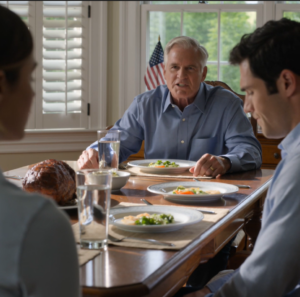
I remember exactly how the light fell across that dinner table the night my father-in-law decided my life belonged to him. An amber glow came through the kitchen window behind Karen’s shoulder, catching the steam off the pot roast like something out of a Norman Rockwell painting. Everything about that house was supposed to feel safe, comfortable, familiar.
I’d sat at that table for twelve years, since before Daniel and I were married, since before I ever put on a uniform that meant something to me. I knew where the silverware was kept without asking. I knew which floorboard creaked outside the bathroom. I thought I knew these people.
Richard set his glass down harder than he needed to. That was his tell: the small violence in ordinary gestures, the way he made a water glass sound like a gavel. He looked at me—not at Daniel, not at his own wife, but straight at me—and said it plainly, like he was reading off a grocery list.
“You have the Army, Lillian. My daughter needs that house more than you do.”
I actually laughed at first, a short, disbelieving sound, because I thought I’d misheard him or that this was some strange joke that hadn’t landed. But nobody else at the table laughed. Karen stared down at her plate like the pot roast had suddenly become the most interesting thing in the state of Ohio. Daniel’s jaw tightened. Emily just watched me, quiet, waiting.
“Are you asking me to give Emily my house?” I said.
“I’m telling you what’s fair,” Richard answered.
And there it was, that word, fair, dressed up like it meant something other than what it actually meant: his decision dressed as justice. He laid it out like he’d rehearsed it. I had the Army. I had a steady paycheck, housing, stipends, benefits, a pension waiting for me at the end of twenty years. I had, in his words, a whole system behind me.
Emily had nothing. Emily had a divorce, two kids, and a man named Mark Carter who’d left her with debt instead of a future. In Richard’s math, my strength was supposed to be Emily’s rescue. My discipline, my sacrifice, was supposed to become her inheritance.
What he never said, because he didn’t need to, because it was written all over his face, was that the house he was talking about wasn’t his. It was mine. Mine and Daniel’s, but mostly mine. The down payment had come almost entirely out of savings I’d built over three deployments, money I hadn’t spent on myself in years so we could have four walls that were actually ours.
Richard didn’t see it that way. To him, Daniel was his son, and a son’s house was still somehow a father’s business. I didn’t raise my voice. I’ve learned over the years that raising your voice in a room like that just gives the other person a story to tell later: She got emotional. She overreacted.
So I kept mine level, even as my pulse climbed.
“Serving my country doesn’t mean surrendering my rights,” I said.
Richard’s mouth twitched like he was deciding whether to escalate or retreat. He chose a third option: attack from the side. I was selfish, he said. I put my career above my family. Emily was the one who actually needed help—real help, not medals and travel orders.
A person who served her country, he said, should understand sacrifice better than anyone at that table. I sat with that for a moment, feeling the old, familiar heat rise in my chest, the one I’d trained myself for years to control. I thought about every field hospital, every long night on a base thousands of miles from anyone who loved me.
Every time I’d told myself the distance was worth it because I was building something for Daniel and me to come home to. And now the man who raised my husband was telling me that building it made me selfish.
Daniel finally moved. He put his hand on my arm and steered me toward the back porch, away from his father’s voice, away from Emily’s careful silence. Out there in the cold, he admitted his father had been pushing him for weeks. He said it quietly, like a confession, like he thought quiet would make it smaller.
“Maybe we could let Emily stay there temporarily,” he said.
That single sentence told me everything I needed to know about where this was actually headed. This was never about a kind gesture, a spare room, a temporary favor between family. This was about control, about who got to decide what belonged to whom.
And I understood, standing on that porch with my breath fogging in front of me, that the conversation inside wasn’t really about a house anymore. It was about whether I had any right to keep what was mine. I told Daniel firmly, finally. Then I flew back to my post in Okinawa three days later, half a world away, certain the matter was closed.
I was wrong.
Three days after that dinner, my phone rang while I was standing in my quarters, still in uniform, still tired from a twelve-hour shift. A voice I didn’t recognize introduced herself as a loan officer.
“Ma’am, we’re calling regarding your $320,000 loan.”
I remember the exact silence that followed inside my own head, because I had never signed anything. I had never even applied. For a moment, I actually thought I’d misheard her. I asked her to repeat herself, and she did, patient in that practiced customer-service way, reading off numbers that didn’t belong to any life I recognized.
Three hundred and twenty thousand dollars. My name. My Social Security number. A mortgage application that had, according to her records, been fully processed and was now sitting one signature away from disbursement.
I was standing in my quarters on Okinawa, eight thousand miles from Ohio, and somewhere back home, a piece of paper existed with my name on it that I had never touched. I made myself slow down. Panic wasn’t going to get me anywhere, and twenty years of training had taught me that the fastest way through a crisis is to ask the right questions in the right order.
So I asked them one at a time, my voice steadier than I felt.
“When was the loan signed?”
She gave me a date. I didn’t even have to check my deployment calendar. I knew exactly where I’d been that day because it was burned into memory the way certain days are. I had been on base in Okinawa, running a training exercise that started before sunrise.
There was no version of that day where I was standing in a loan office in Ohio.
“Where was it signed?”
A title company office two towns over from Richard’s house.
“Who notarized it?”
A name I didn’t recognize.
“Who submitted the application?”
She hesitated slightly before answering that one, which told me something before she even said the words. The application had been submitted through a mortgage broker, but the paperwork listed a family member as the point of contact for verification purposes.
And the money—where had it gone? Not into any account with my name on it. It had been transferred toward a property acquisition and renovation fund tied to an address that wasn’t mine.
I asked her to repeat that address twice, just to be sure I’d heard it right. She did. It wasn’t my house. It wasn’t Daniel’s house. It was a property I didn’t recognize by street number, though something about the neighborhood name tugged at the back of my mind.
I thanked her, told her I needed to make some calls, and hung up. Then I sat on the edge of my bed for a long moment, staring at the wall, feeling something cold settle into my stomach that had nothing to do with panic and everything to do with certainty. Something was very wrong, and it had my name stitched into the middle of it.
I called Daniel. It was the middle of the night back home, but I didn’t care. He picked up on the third ring, groggy, confused by the timestamp on my call.
“Lil, what’s wrong?”
I told him. I watched—or rather, listened—as the sleep drained out of his voice and something closer to fear took its place. He swore up and down he knew nothing about any loan. No paperwork, no signatures, nothing.
I believed him, mostly because Daniel has never been a good liar. His voice does this thing where it climbs half an octave when he’s hiding something, and it wasn’t climbing. It was just scared.
But then I asked him the question that mattered.
“Did your father know about our mortgage, about our finances, our accounts, anything like that?”
The silence on the other end of that line lasted maybe four seconds. It felt like forty. And in those four seconds, I understood that whatever this was, it hadn’t happened in a vacuum. Somebody in that family had information they shouldn’t have had, and Daniel’s silence told me he already suspected who.
I didn’t push him further that night. I needed documents, not guesses. I called the bank back the next morning and requested copies of everything: the application, the identity-verification forms, the notarized signature page, the contact information on file.
It took two days to arrive in my inbox. Two days when I went through my duties on autopilot, present in body, absent in mind, running scenarios that all led back to the same unbearable conclusion. When the documents finally came through, I opened them alone in the dark of my quarters, well past midnight local time.
My signature was there, slanted in a way that looked almost right. Close enough to fool someone glancing quickly, wrong enough that I felt a chill looking at it, because I knew my own hand. And this wasn’t quite it.
My identification information was there, accurate down to details that shouldn’t have been easy to get. The notarization was there, stamped and sealed like it meant something. And then I found it: the detail that made my hands go cold around my phone.
The contact email listed on the application, the one used to verify my identity remotely, wasn’t mine. It was close. Close enough that anyone skimming wouldn’t notice. But I had never owned that address in my life.
I called the bank a third time. The representative on the line asked gently whether I wanted to formally report this as identity theft, as a fraudulent loan application requiring investigation. I didn’t hesitate.
“Yes,” I said. “And I want every document preserved. Every email, every timestamp, every signature. All of it.”
Something shifted in me as I said those words. This wasn’t a family disagreement anymore. It wasn’t a difficult conversation about boundaries and expectations. This was fraud dressed up in familiar handwriting, hiding inside people I’d shared a dinner table with for over a decade.
I called Daniel one more time before I tried to sleep. My voice was quieter now, but harder.
“Where is your father right now?”
He answered without thinking.
“At Emily’s house.”
I sat with that for a second, then opened the bank documents again and scrolled down to the disbursement address, the property where $320,000 of debt tied to my name had actually gone. It matched.
I didn’t sleep that night. Not really. I lay in my quarters with the ceiling fan ticking overhead and my phone glowing on the nightstand, and I made a decision that would define everything that came after. I wasn’t going to react. I was going to build a case.
Being stationed on the other side of the world from your own family crisis does something strange to you. It strips away the option of storming into a room and demanding answers face-to-face. There’s no slamming a door on Okinawa and driving to Ohio to confront anyone.
All I had was distance, time zones, and paperwork. And it turned out those were exactly the tools I needed. I didn’t call Richard. I didn’t call Emily. I didn’t even tell Daniel everything I knew.
Instead, I went back to the bank, calm and methodical, and asked them to formally freeze the loan, flag it as disputed, halt any further disbursement, and preserve every scrap of documentation and communication tied to the account. I requested timestamps on every login, every phone call, every email exchange associated with the application. I wanted a paper trail nobody could argue with later.
While I was building my case quietly from eight thousand miles away, Daniel was doing something braver back home. He drove to his parents’ house the next evening and asked his father directly why my name was attached to a $320,000 loan. He told me about it afterward, his voice tight with something between anger and disbelief.
Richard had waved him off at first, calling it a misunderstanding, the kind of vague non-answer designed to end a conversation rather than resolve it. Daniel didn’t let it go. He pushed, and that’s when Emily walked into the room, eyes already rimmed red, and said the words that told Daniel this was no misunderstanding at all.
“Dad was only trying to help me.”
“Help you with what?” Daniel asked.
She didn’t answer. She just cried, the kind of crying that isn’t really about guilt so much as being caught. Piece by piece over the following days, the shape of it became clear.
Emily needed a new home. Something bigger, something stable for her and her kids, something that would let her start over after her divorce from Mark had left her buried in debt. But no bank was going to hand Emily Carter a loan on her own credit. Not with her financial history.
Richard, in his mind, had a solution sitting right in front of him: a daughter-in-law with steady income, strong credit, government employment, and, most conveniently of all, an ocean between her and the paperwork.
I keep coming back to one sentence Daniel repeated to me from that conversation, because it explained more about Richard than anything else he’d ever said in twelve years of Sunday dinners.
“Lillian doesn’t need to worry about money. She’s got the military.”
He’d said it like it settled something, like my service was a blank check he was entitled to cash on his daughter’s behalf. Daniel told me his father’s words landed differently once he heard them repeated back in that context. Not as a compliment about my career, but as a justification for using me.
I sat with that realization for a long time after Daniel relayed it. It reframed the entire dinner-table conversation from weeks earlier. When Richard said I had the Army and Emily needed the house more, he wasn’t expressing an opinion. He was laying the groundwork.
He’d already decided, probably before that dinner ever happened, that my name was going on paperwork whether I agreed to it or not. A few days later, another document arrived from the bank: a higher-resolution scan of the notarized signature page. I zoomed in on my own name, studied the slant of the letters, the pressure of the pen strokes.
Then I pulled up an old benefits form I’d signed years earlier and held the two side by side on my screen. They weren’t the same hand. Close, deliberately close, but not the same.
I checked the notarization date again, cross-referencing it against my deployment log. There it was in black and white: the day the loan was supposedly signed in an office in Ohio, I had been standing in a briefing room on Okinawa at that exact hour, surrounded by a dozen other officers who could vouch for my location without hesitation.
I called the notary listed on the document. She confirmed, politely but firmly, that she had verified my signature in person. I asked her to describe me. She couldn’t, because she had never met me in her life.
Then I noticed something else buried in the loan file, something I’d skimmed past twice without registering it: a referral field listing who had connected the applicant to the broker in the first place. A name that made my stomach drop even further than it already had.
Daniel West.
I stared at that name for a long time. My husband’s name, sitting inside a fraud file next to my forged signature. And I didn’t know yet whether it meant he was part of this or just one more person who’d been used without fully understanding what he was handing over.
I called Daniel the next morning before my shift, my voice flatter than I meant it to be. There was no easy way to ask the question sitting in my chest, so I just asked it.
“Did you submit my information for that loan?”
He didn’t get defensive. That was the first thing I noticed, and it mattered. A guilty man protects himself first. Daniel just went quiet, and then, in a voice stripped of any pretense, he swore he hadn’t known the loan existed.
Not the amount, not the paperwork, none of it. I believed that part completely. But then he told me something that made my chest tighten all over again.
A few weeks before that dinner, Richard had come to him with a handful of questions: my Social Security number, details about our property, bank account information, even my deployment schedule. When I’d be gone, for how long, when I’d be reachable, and when I wouldn’t.
Daniel said his father framed it as concern, as due diligence, something about seeing if Lillian could help Emily get approved for something. Daniel, trusting his father the way sons are raised to, had handed over pieces of that information without asking a single hard question.
I sat with the phone pressed to my ear, staring at the wall of my quarters, feeling something shift inside me that wasn’t quite anger and wasn’t quite grief. It was closer to disorientation, the sensation of realizing the ground you’ve been standing on for twelve years was never as solid as you believed.
“Did you ever think to ask me?” I said, quiet, not accusing, just asking.
He didn’t answer. There wasn’t an answer that would have made it better, and I think he knew that.
I want to be honest about something here, because this is the part of the story people don’t expect. I didn’t hang up and start planning an exit from my marriage. I’ve seen what happens to people who make permanent decisions in the middle of a crisis, and I’ve made a career out of not doing that.
What I felt toward Daniel in that moment wasn’t hatred. It was disappointment, deep and specific, the kind that comes from loving someone and realizing they let a door swing open that they should have guarded.
“You didn’t steal my identity,” I told him. “But you handed the door key to someone who did.”
He didn’t argue. I think, for the first time since this whole thing started, Daniel actually understood the weight of what his trust in his father had caused. Meanwhile, the bank kept sending documentation, and each new piece sharpened the picture.
One file in particular stopped me cold: a verification record showing that whoever submitted the loan application had specific knowledge of my travel schedule, cross-referenced against the exact window when I’d be unreachable and unable to dispute anything in person. That detail alone told me this wasn’t opportunism. It was planning. Someone had watched my calendar and built a scheme around my absence.
I brought all of it—the loan file, the signature comparison, the notary statement, the referral record with Daniel’s name—to a lawyer. Not a family friend, not someone connected to the Wests in any way, but a civil attorney who specialized in identity theft and financial fraud, recommended by someone in my unit’s legal office.
I laid everything out for her over a video call, my voice steady even as my hands weren’t. She listened without interrupting, and when I finished, she gave me the first piece of advice that would shape everything that followed.
“Do not confront them yet.”
I understood why immediately. Confrontation without documentation is just noise. It gives guilty people the chance to coordinate their stories, to destroy evidence, to close ranks before you have anything solid enough to hold them to.
So I did the hardest thing a person can do when they’ve just discovered their own family used their name like a blank check. I stayed quiet. I didn’t post anything online. I didn’t call Richard and scream at him, though God knows some nights I wanted to.
I didn’t threaten anyone. I just kept building the file one document at a time, patient in a way that felt almost unnatural given how much it hurt. Near the end of that call, my attorney asked me a question that would end up cracking the whole case open further than I expected.
“Do you still have the original documents from your home? Old paperwork with your actual signature—mortgage forms, benefits applications? Anything from before this loan?”
“Many,” I told her. “Yes.”
I’d kept everything, the way you do when you’ve moved as many times as military life requires: every important document scanned, backed up, organized by year out of pure habit.
“Then we may have a problem for them,” she said.
Because the signature on the fraudulent loan, when compared properly against years of my genuine handwriting, wasn’t just slightly off. It was inconsistent in ways a forensic document examiner would have no trouble flagging. Someone had tried to imitate my signature without ever having watched me actually write it enough times to get it right.
For the first time since that bank had called me, I felt something other than dread settle into my chest. It was the quiet, cold clarity of knowing I finally had something real to stand on.
The next break in the case didn’t come from a bank or a lawyer. It came from the last person I expected: Karen, my mother-in-law, a woman who had spent twelve years at that dinner table saying almost nothing while Richard ran the room like it was his personal courtroom.
Daniel called me late one evening, his voice carrying a strange mixture of relief and disbelief. His mother had shown up at our house that afternoon, unannounced, and asked him to sit down because she had something she needed to say before it ate her alive.
Karen told him Richard had been planning this for months. Not weeks—months. Emily’s debt situation had gotten worse than the family led on, worse than the version everyone quietly agreed to believe.
Richard had convinced himself that the family’s stability, meaning Emily’s stability, mattered more than any boundary I might have around my own name, my own credit, my own house. Karen said she’d tried to talk him out of it more than once, and each time he’d waved her off the same way he waved off everyone who questioned him.
Then she told Daniel something that turned my stomach when he repeated it to me. Richard had said, at some point during the planning, “Once the loan closes, Lillian will never know where the money went.”
I sat with that sentence for a long moment after Daniel read it to me over the phone. It wasn’t carelessness. It wasn’t a father trying to help his daughter and stumbling into a legal gray area. It was a man who understood exactly what he was doing and built a plan around making sure I’d never find out until it was too late to stop it.
Karen didn’t stop there. She had an old email, one Richard had sent to a mortgage broker months earlier, before any of this reached me. In it, he’d written a line that Daniel forwarded to me word for word because he knew I needed to see it myself.
“My son’s wife is overseas most of the time.”
Not a throwaway comment. A calculated detail offered up to someone helping him build a scheme, framing my deployment as convenience rather than sacrifice. Karen packaged up everything she had—the email, notes she’d kept, dates she remembered from overheard conversations—and sent it all to me directly.
I read through it alone in my quarters late at night, the way I’d read through every other piece of this case. I didn’t cry. I’m not sure I had it in me anymore by that point. I’d moved past the raw hurt into something quieter and more resolved.
“Now I know,” I said out loud to an empty room.
And something about saying it aloud made it feel final. Two days later, Richard called me himself. I almost didn’t answer.
Part of me wanted to let it go to voicemail and let my lawyer handle every future interaction, but another part of me needed to hear what he’d say when he thought he still had the upper hand. He opened with the tone I knew so well: calm, faintly condescending, a man used to being the final word in every room he entered.
“You are making a family matter into something ugly,” he said.
“You made it financial when you used my identity,” I answered.
Silence on his end, brief. Then I kept going, because I’d waited a long time to say this out loud.
“And you made it criminal when you forged my signature.”
That’s when his composure cracked. His voice rose, sharp and defensive, the mask slipping just enough to show what was underneath.
“You think that uniform makes you untouchable?”
“No,” I said. “The law does.”
He didn’t have an answer for that. What he did instead, minutes after we hung up, was send a text message, one I read three times before I fully absorbed what he’d written.
“If you want your marriage to survive, drop this.”
I stared at those words for a long time. Not because they scared me, but because they confirmed everything I already suspected about the kind of man Richard West really was underneath the family-patriarch routine. A man who used threats against my marriage as leverage, the same way he’d used my absence as opportunity.
I forwarded the message to my attorney without a single word of commentary attached. She responded within the hour, brief and precise.
“That’s going in the file.”
I sat back and let out a breath I felt like I’d been holding for weeks. Richard had spent his whole life believing that confidence and control were the same thing, that if he simply spoke with enough certainty, people would fall in line the way Daniel always had, the way Karen always had, the way he assumed I would, too.
What he never understood was that every phone call, every text message, every careless sentence he threw around like it cost him nothing was becoming another page in a file that would eventually be laid out in front of him. Undeniable, unforgiving, and entirely his own doing.
My deployment ended in early spring, and when I finally walked off that transport and back onto American soil, I wasn’t the same woman who’d left. I want to be careful how I say that, because it wasn’t about anger hardening into something bitter. It was about clarity. I knew exactly what I needed to do, exactly what I was walking into, and exactly who I was walking in as.
I didn’t call ahead. My attorney and I had agreed on a plan: a single meeting at the West family house, where everything would be laid out at once. No room left for anyone to reshape the story after the fact.
Daniel picked me up from the airport, and I watched him during that drive, searching his face for the man who’d handed his father my information without asking a single question. He looked tired in a way I hadn’t seen before, the kind of tired that comes from finally understanding your own part in someone else’s harm.
“I’m with you,” he said somewhere on the highway, not as an apology, because apologies felt too small for what had happened, but as a decision. “Whatever happens in there, I’m standing next to you.”
I believed him. Not blindly—trust doesn’t just snap back into place because someone says the right sentence at the right time—but enough to let him walk through that door beside me.
Karen was already at the house when we arrived, sitting stiffly at the same table where this had all started months earlier. Emily was there, too, eyes swollen, twisting a paper napkin in her hands like it might absorb some of what was coming. When she saw me, she started crying almost immediately, before I’d even set my folder down.
“I didn’t know,” she said. “I didn’t know Dad put the loan in your name. I swear, Lily, I didn’t know.”
I looked at her for a long moment. I want to be honest about what I felt, because this story only means something if I tell it straight. I didn’t hate Emily.
She’d been drowning in debt after her divorce, desperate in a way I understood, even if I didn’t excuse what came from it. And I don’t believe she orchestrated the fraud herself. But understanding isn’t the same as absolution.
“Emily, I don’t hate you,” I told her. “But I won’t pay for choices I didn’t make.”
She nodded, crying harder, and admitted she’d known her father was trying to find some way to get her into a house. She’d known he was talking to brokers, making calls, moving pieces around. What she said she hadn’t known—and I chose that day to believe her—was that the loan he’d found a way to get approved was sitting on my name, my credit, my signature forged onto documents I’d never seen.
Richard sat at the head of the table, the same seat he’d occupied the night he told me I had the Army and Emily needed the house more than I did. He still tried denial first, the same tone he’d used with Daniel weeks earlier, calling it a misunderstanding, insisting things had gotten twisted out of proportion.
My attorney didn’t say much. She simply began setting documents on the table, one after another, methodical, unhurried. The bank records. The email Karen had saved, the one about me being overseas most of the time. My deployment schedule, proving exactly where I’d been on the day of the supposed signing.
My genuine signature side by side with the forged one. The wire-transfer records showing where the $320,000 had actually gone. And finally, screenshotted and printed, Richard’s own text message: “If you want your marriage to survive, drop this.”
I watched the color drain slowly out of his face as each page landed in front of him. This was a man who had spent his whole life controlling every room he entered through sheer force of certainty. And for the first time, I watched certainty fail him completely.
“You could have handled this like family,” he said finally, his voice smaller than I’d ever heard it.
I didn’t raise my voice. I didn’t need to anymore.
“Family doesn’t sign your name while you’re six thousand miles away.”
Nobody spoke after that. The silence in that dining room was different from every other silence I’d sat through at that table over the years. Not tense with things unsaid, but heavy with things finally, undeniably confirmed.
The dispute moved forward through proper channels after that. The bank opened a formal fraud investigation. Everyone connected to the application was required to give statements.
I didn’t personally try to punish anyone in that room. I’d promised myself early on that I wouldn’t let this turn me into someone who needed revenge to feel whole. I let the evidence speak, let the process move the way it was designed to move.
It was my attorney, a week later, who found the detail that made even her pause. The $320,000 wasn’t the entire picture. Buried in a secondary transfer routed through an account connected to Emily was another sum Richard had apparently believed no one would trace: $47,500.
He’d thought it was small enough to disappear quietly into the noise of a larger transaction. He was wrong. The bank’s investigators found it within days.
The investigation took a few more weeks to fully close, and when it did, the findings were exactly what the evidence had always pointed toward. The $320,000 loan was formally classified as the product of identity theft and fraudulent application, my forged signature confirmed against a decade of genuine documents. I was released from any obligation tied to that debt.
My credit, which had briefly shown the strain of a loan I’d never taken, was corrected and restored through the bank’s fraud-resolution process. It took time, more paperwork than I care to remember, but eventually my financial record looked like mine again, clean of anything Richard had tried to attach to it.
Richard faced consequences that reached further than he’d ever imagined sitting at that dinner table months earlier, confident that his plan was airtight simply because he’d never been challenged before. Legal and financial repercussions followed him in ways that stripped away the authority he’d assumed was permanent.
Emily lost the house that had never really been within her reach to begin with. Not honestly, not through any door that didn’t require someone else’s stolen name to open.
People sometimes ask me, when I tell this story, what the revenge actually looked like. I understand why they ask. There’s a version of this story where I show up at that house and burn it all down out of spite, where I make sure Emily loses everything down to the last dollar, where Richard is publicly humiliated in front of everyone who ever respected him.
That’s not what happened. And honestly, that was never the ending I wanted. What I actually did was quieter and, I think, in the long run, far more permanent.
I cut Richard’s access to my family’s financial life completely. Not through some dramatic gesture, but through clear, unambiguous boundaries that Daniel and I built together, deliberately, in the weeks that followed.
No one outside the two of us would ever again have access to our financial information. No one would make decisions about our property, our accounts, our future without both of us explicitly agreeing to it. No exceptions for family. No exceptions for fathers who believed love gave them the right to control.
The last time I saw Richard, it was brief. He asked me a question that I think had been sitting in him since the day the bank called me in Okinawa.
“After everything I’ve done, you still think you’re better than us?”
I looked at him for a long moment before I answered, and I meant every word of what I said next.
“No. I just finally understand the difference between helping family and allowing family to use you.”
He didn’t have anything to say to that. For a man who had always had an answer ready, always had the last word, that silence told me more than any apology could have.
I flew back