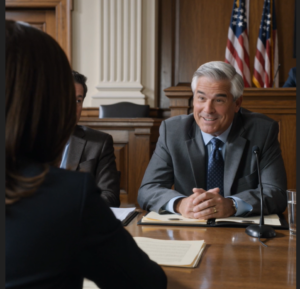
“She Has Nothing!” My Ex Tried to Take My Kids & Pension—Then the JAG Commander Saluted Me
Phân cảnh 1: The divorce filing
The lawyer across from me smiled, and then he said the sentence that changed everything.
“She’s just an unstable veteran with nothing.”
Twenty years of my life folded into a single insult and set down in front of the judge like a parking ticket. My children were sitting twenty feet away. My husband of seventeen years wouldn’t look at me. And I remember thinking, with a calm that surprised even me, that these men had made one very expensive mistake. They had studied my file. They had never once studied me.
The Fairfax County Courthouse smells like floor wax and old paper, and I have never walked into it without straightening my spine. Twenty years in the Army will do that, and eight months of watching my marriage get dismantled inside this building hadn’t undone it.
I wore the navy suit I’d bought for my retirement ceremony, the one Daniel once said made me look like I could run the world. This morning, he didn’t glance at it. He sat at the opposing table in a charcoal jacket I didn’t recognize, hands folded the way a man folds them when someone has coached him to look sincere.
Behind him, in the first row of the gallery, sat Emily and Lucas. Emily, thirteen, had her arms crossed over a sweater too warm for September and stared at the carpet. Lucas, nine, kept turning around to find me, and every time our eyes met, he gave a small wave down by his knee, the kind he thought nobody could see. I waved back the same way. It was the only thing holding me up.
My name is Sienna Harper. I’m forty-two, a retired Army officer who now consults for a hospital system in Arlington, making sure supplies reach the places that need them. It’s the same work I did overseas, only now the worst thing that happens is a delayed shipment of surgical gloves.
I coach Lucas’s soccer team badly. I know every one of Emily’s teachers by first name. I thought that was a life—a good, ordinary, hard-earned one.
Daniel had filed in January with no warning, no counseling, no long talks at the kitchen table. I came home on a Tuesday and found a process server’s envelope under the flowerpot on our porch and my husband upstairs packing a bag with the efficiency of a man who had rehearsed.
“I think it’s best if we don’t make this ugly, Sienna,” he said gently, and walked past me out the front door.
The papers took longer to sink in than the divorce did. Daniel wasn’t asking for his freedom. He was asking for everything: primary physical custody of both children, child support paid by me, the house I’d put my deployment savings into, and a substantial share of my military retirement—the check I’d earned across two decades of long nights, short leaves, and a year I still don’t describe at dinner parties.
I had braced for a fight about money. I hadn’t braced for how they planned to win it.
Phân cảnh 2: Courtroom accusations
“Your Honor,” Richard Cole said, rising with the unhurried ease of a man who bills $900 an hour and wants the room to know it.
He was sixty, silver-haired, with a voice like warm bourbon and a reputation across Northern Virginia for turning custody cases into demolitions.
“My client is a devoted father who has watched with growing alarm as the mother of his children has become increasingly volatile.”
Volatile. A word you could stamp on anyone. He walked the room, laying out my life like a crime scene.
“Short-tempered since I came home,” he said. “Sleepless. Distant. A well-documented pattern consistent with combat-related stress.”
He said PTSD twice, carefully, never quite as a diagnosis, because there wasn’t one. I had passed every post-service evaluation the Army gave me, and Richard knew it. He also knew a judge doesn’t need a diagnosis to be afraid of a word.
“And while Ms. Harper pursues her career,” he went on, “who is at the school pickups? Who is making dinner? Daniel Harper. And he is exhausted.”
Heat crawled up my neck. I kept my hands flat on the table. Daniel had cooked dinner perhaps a dozen times since Emily was born.
What struck me most wasn’t the accusation, though. It was how he used my service.
“A decorated officer,” he kept saying, as though the decorations were the symptom.
Every medal became exposure, every deployment a reason. Twenty years of being the steady one while other people came apart were being rewritten as an injury I was too proud to admit. Daniel hadn’t come here hoping to win an argument. He had come with a strategy.
Across the aisle, he finally lifted his eyes to mine. And for one second, I saw the man who used to hold my hand on the flight line and promised to keep the porch light on. Then he looked away, and what remained was someone I’d have passed in a grocery store without knowing.
Richard picked up a thick folder and let it drop onto the clerk’s table with a flat, heavy sound.
“Your Honor, my client is asking for primary custody and an equitable share of her military retirement.”
Then he turned, found me, and smiled the small, tender smile you give a dog before the vet.
“She’s just an unstable veteran with nothing.”
The room went still. Somewhere behind me, a pen clicked and stopped. Lucas whispered something to his sister, and Emily said, “Shh,” without looking up.
I didn’t raise my voice or stand. I turned and looked at my children and held on to that look like a railing in the dark.
Phân cảnh 3: Internal resolve
Nothing, he’d said. As though the nights I spent on a cot writing Emily about her first lost tooth were nothing. As though the voicemail of Lucas singing happy birthday through static, which I’d played until the file corrupted, were nothing.
An old sergeant major taught me something when I was a young lieutenant, itching to answer every provocation. The loudest person in a hostile room is rarely holding the strongest position. The strongest position belongs to whoever is still listening.
So I listened. Richard saved his last line for the judge and delivered it kindly, which was the worst part.
“By the end of this hearing, Your Honor, Ms. Harper may lose her children, her home, and the retirement she spent twenty years earning.”
Daniel’s shoulders loosened, the way a man relaxes when the hard part is behind him. I saw then, with a clarity I can only call cold, that he had never really asked himself who I was. He had counted my paycheck and cataloged my bad nights. He had never wondered what a person learns from twenty years of being underestimated in rooms full of people who outranked her, or what she does with it.
They both glanced my way, waiting for the crack, the tremor, the tear. I gave them none of it. I folded my hands, sat very straight, and let them look. He thought my silence meant I was afraid. It meant I was counting.
Phân cảnh 4: Reflecting on the marriage
I met Daniel on a July afternoon in a parking lot outside Fort Jackson when I was a twenty-two-year-old second lieutenant with a dead car battery and a worse attitude. He was twenty-five and wearing a paint-spattered T-shirt, and he walked over with jumper cables already in his hand, as if he’d spent the whole day waiting for someone to need him.
He didn’t ask what I did for a living. He asked if I’d eaten. Two hours later, we were splitting a plate of fried catfish, and he was making me laugh so hard I forgot to be guarded, which back then was a full-time job.
That was the thing about him. I was all edges, built from drill sergeants and early mornings, and Daniel was the soft place I landed. He remembered the names of my soldiers’ wives. He cried at our wedding before I did.
When I deployed the first time, Emily was two years old, and he mailed me a shoebox every week with drawings, crackers she’d licked for luck, and a note in his looping handwriting: “Proud of you. Porch light’s on.”
I read those notes until the creases went soft. I believed in that man the way you believe in gravity. I also paid for the belief, though I never kept a ledger.
I turned down a battalion-level assignment at Fort Bragg because Daniel’s insurance job was here and the kids needed one home. I took staff positions that kept me close to Northern Virginia when the harder, shinier jobs went to men who didn’t have to ask permission from a marriage.
When Daniel’s landscaping business collapsed, leaving $41,000 in debt, I paid it off from my deployment savings and never mentioned it. The down payment on our house came from the same account. So did Emily’s tuition at the school she loved. I told myself that’s what a partnership is: one person carrying the weight while the other finds their footing.
Daniel did find it for a while. He was good with the kids in ways I wasn’t, patient at homework, endlessly willing to be the pirate or the dragon. I won’t tell you he was a villain from the start. I’ve turned that over for months, and the truth is stranger and sadder.
Phân cảnh 5: Signs of betrayal
Somewhere along the way, a man who loved being needed started to resent being the one who stayed.
It began after I retired. Not overnight, but like water finding a crack. The ceremony was small: a folded flag, a handshake from a general who’d once been my captain. Afterward, Daniel hugged me in the parking lot and said all the right things. But in the weeks that followed, something in him curdled.
I’d mention a former colleague calling, and he’d go quiet. Once, when I started telling a story at a neighborhood barbecue, he cut in, smiling, and finished it wrong.
“You’re not a soldier anymore, Sienna,” he told me one night, stacking dishes with his back to me. “Nobody cares about that.”
I stood in the kitchen with a dish towel in my hands and felt it land somewhere beneath my ribs. I told myself he was tired. His career had stalled. He’d been passed over for a promotion that spring, and I knew what that did to him. I wanted so badly to believe the cruelty was grief wearing a mask.
Maybe part of it was. That’s what makes it hard to forgive. It wasn’t all fake.
Then he got curious about money, and I mistook it for closeness. How much would the pension pay monthly? Who was the named beneficiary? Was the survivor benefit elected? And which accounts were in my name only?
He asked casually, over coffee, over the news.
“Just good planning, babe.”
I printed every statement and slid the folder across the table myself. Looking back, I handed him the map.
The other signs came sideways, and each one I explained away. I’d find his phone propped against the fruit bowl, screen down when an argument started. He’d begin with something small and cheerful, a comment about my sleeping or my tone, and keep poking until I snapped.
“Stop,” I’d say, sharp.
And he’d answer mildly, “Say that again, a little louder.”
Later, I realized the recordings never began at the beginning.
Then Emily’s school counselor, Mrs. Alvarez, stopped me at pickup one afternoon, uneasy. Daniel had emailed her, she said, out of concern, to let the school know I’d been emotionally unstable lately and that Emily might need extra support. She’d wanted me to hear it from her.
I thanked her. I drove home gripping the wheel so hard my fingers ached. That night, Emily said, without looking up from her cereal, “You’re not like you used to be, Mom.”
Not angry. Just reciting.
It took me a full minute to understand she was repeating something someone had said to her so many times it had started to sound like her own idea.
Phân cảnh 6: Discovering the plot
I found the last piece in August by accident, while reconciling the household accounts the way I always had. A retainer of $15,000 had left our joint savings the previous April, nine months before Daniel filed, made out to Cole and Whitfield LLP.
I stared at the line item for a long time. In April, he’d taken me to dinner for our anniversary. He had held my hand across the table and thanked me for everything.
The family iPad was still logged into his email. I told myself I’d look at one message. I read forty.
The thread with Richard Cole began in April and ran for months, brisk and businesslike, full of schedules and strategy and the phrase “the veteran angle.” In the middle of it, dated the week of our anniversary, Daniel had written a single line I read until the words stopped looking like words.
“Once we establish instability, custody becomes much easier.”
I set the iPad down on the kitchen counter and straightened the dish towel beside it. Upstairs, Lucas was laughing at something on his tablet, bright and unguarded. Then I picked up my phone and began to take pictures of every page.
Phân cảnh 7: Facing the evidence
The first witness Richard called was a neighbor, a pleasant woman named Karen Puit, who had once borrowed my leaf blower and returned it with a plate of lemon bars. She sat in the witness box with her purse on her lap and said that on a night in June she had heard raised voices from our house.
Richard asked whose. She said, reluctantly, mine.
She did not say that Daniel’s phone had been lit on the counter that night, or that he’d spent twenty minutes asking me in that mild voice whether I’d always been this way. She hadn’t heard that part. Nobody had, because it wasn’t on the recording.
The recording came next. Richard played ninety seconds of me saying, “Stop. Just stop,” through the courtroom speakers, my voice cracking like a dropped plate. I had never heard myself sound like that.
He let the silence stretch afterward, then clicked to a photograph on the monitor: me at our kitchen table at six in the morning, hair flattened on one side, eyes hollow, gripping a coffee mug in both hands. It had been taken the day I flew back from a hospital supply audit in Germany after nineteen hours of travel.
Daniel had snapped it from the doorway and said, “Rough night.”
I remembered the flash of his phone. I thought he was being sweet.
“Exhaustion, Your Honor,” Richard said. “That is not, with respect, typical of a stable parent.”
There was more. A text I’d sent Daniel after he’d skipped Lucas’s dentist appointment for the third time: “I cannot believe you did this again.” Richard read it in a trembling falsetto as though I’d been screaming.
A night in April when I couldn’t sleep and went downstairs to reread old deployment letters, which Daniel had logged in a note on his phone as “Found Sienna awake at 3:00 a.m., distressed, staring at papers.” The note had a timestamp, which told me he’d written it while standing there watching me.
“A decorated officer,” Richard said, pacing slowly in front of the bench, “who became emotionally unstable after leaving the military. Your Honor, we are not here to punish Ms. Harper’s service. We are here to ask whether it has left her fit to raise two children alone.”
He said it so gently that I understood why he won. He never accused. He merely wondered aloud, over and over, until the wondering sounded like fact.
Then came the money. Daniel’s side asked the court to treat my retirement as marital property, and I want to be honest here, because honesty is the only thing I had left that they couldn’t spin. I never disputed that part of my pension could fall within what a court divides. I’d served most of those years inside this marriage. I’d sat with my lawyer and accepted that.
What Daniel wanted was not a fair share. It was the lion’s portion, justified by an argument I could now read like a map. If I was unstable, I was a danger to the children. If I was a danger, he was the custodial parent, and the custodial parent, in his version of the math, deserved far more of the check I’d bled for.
The part I couldn’t have prepared for came on the third afternoon. The judge, a tired, careful woman named Judge Whitaker, announced she would speak privately with the children in chambers.
I sat in the hallway on a bench so hard it felt designed to punish waiting. When Emily came out, her eyes were dry and her jaw was set in an expression I recognized from my own mirror. Lucas came out holding the judge’s clerk’s hand and asked if he could have a juice box.
That evening, my attorney at the time received the sealed summary and read me the relevant line over the phone because she thought I’d rather hear it than find it. Asked about her parents, Emily had said, “Mom gets quiet when she’s hurt. Dad says that means she’s unstable.”
I stood at the kitchen sink with the water running over a plate I’d already washed. I wasn’t angry yet. What I felt was a quiet, enormous grief, the kind that makes the room go slightly out of focus.
My daughter had been handed a sentence, taught to translate my pain into a defect, and she’d carried it into a judge’s office as if it were her own homework. Daniel hadn’t just built a case against me. He’d built it inside a thirteen-year-old.
I turned off the faucet and told myself I was allowed to feel it for exactly ten minutes. I set a timer on the microwave. When it chimed, I wiped my face, folded the dish towel, and called someone new.
Phân cảnh 8: Building a defense
Naomi Brandt had been recommended by a former colleague’s wife, and her office was above a dry cleaner in Alexandria. She was fifty-five, wore reading glasses on a beaded chain, and had a habit of listening without writing anything down until I finished.
I had fired my first lawyer that morning. She’d suggested settling quietly to avoid “a public record of your mental state.”
Naomi laid my photographs of Daniel’s emails across her desk and read in silence for twenty minutes.
“Sienna,” she said finally, “I could stand up in that courtroom and tell a better story than theirs. They’d tell it louder, and the judge would shrug.”
She took off her glasses.
“We don’t fight his story with another story. We build a record.”
So we built one. School attendance logs. Pediatrician records showing who had brought Lucas to eleven of his last fourteen appointments. Emails from teachers, bank statements, receipts, the retainer to Cole and Whitfield nine months before the filing, every text Daniel had ever sent that contradicted his own story.
Naomi called it boring on purpose, and I came to love the word. Nothing is harder to argue with than boring facts arranged in order.
On the fourth Friday, she was reading through Daniel’s filings at her desk, a coffee gone cold at her elbow, when she stopped. She turned a page toward the lamp. Then she slid it across to me.
It was a sworn declaration supposedly signed by me, admitting to “episodes of emotional dysregulation requiring intervention.” It had been filed in March.
“Sienna,” she said quietly, “did you ever sign this?”
I looked at the signature at the bottom. It was a good forgery. The S looped the way I loop it. The H slanted the way I slant mine. Except for one small detail: I have crossed my t’s the same way since West Point, in a hard, flat line. This one curved.
Naomi did not raise her voice. She picked up the phone, called a forensic document examiner she’d used twice before, and booked him for Monday. Then she hung up and looked at me over her glasses.
“Whatever else happens, that signature just became the most expensive piece of paper in Daniel’s case.”
Phân cảnh 9: Investigating the source
The examiner was a quiet man named Dr. Phelps, who smelled faintly of peppermint and handled my real signatures—a dozen of them from old leases and school forms—like they were pressed flowers.
He needed four days. On the fifth, he sat in Naomi’s office and told us in a flat, apologetic voice that the declaration had been traced, not written. A hesitation in the stroke, a pen lift in the wrong place. Someone had slid my real signature under a sheet of paper and followed it with a pen.
I thought about who had access to my signature. Then I thought about who had access to my desk.
Naomi’s next request was more tedious and more important. She subpoenaed the source of every exhibit in Daniel’s binder. The photographs and texts were easy enough, but in the back, behind a tab labeled “Background,” sat eleven pages I had not seen since I retired: pieces of my old evaluation reports, a counseling statement from a deployment year, a medical screening form, all cropped and stapled to make a story.
A line about fatigue and irritability following extended operations had been lifted from a report that went on two sentences later to recommend me for early promotion. Daniel’s copy ended at the comma.
“Where did he get these?” Naomi asked.
I knew the answer, and it made my stomach turn. Years ago, when I’d moved into the house, I’d kept a gray filing box in the closet of our home office. Old paperwork I hadn’t had the heart to shred. It wasn’t locked. I had never imagined it needed to be.
Daniel had been the one to hand me the box when we unpacked, saying, “Don’t lose this, babe. This is you.”
I went home that night and opened it. Half the folders were missing.
“Don’t touch anything else,” Naomi said when I called her from the closet floor, my back against the wall. “And, Sienna, listen to me carefully. If any of it has markings, any at all, you do not copy it. You do not photograph it, and you do not hand it to me.”
“I know,” I said. “I’m not going to.”
I had held a clearance for nineteen of my twenty years. Some habits aren’t habits. They’re the shape of your spine.
Two of the pages Daniel had filed carried a small header I recognized immediately, the kind that marks a document as controlled, not for release outside official channels. They weren’t classified, but they weren’t meant to be sitting in a county courthouse binder either.
Nobody who wasn’t me could have carried them out of that box. Nobody who wasn’t me should have been allowed to. And Daniel, sitting at the defense table in his new jacket, had put them in front of a civilian judge as though they were birthday cards.
I did it the right way, the slow way. I didn’t call anyone I knew and ask a favor. I contacted the Army’s legal assistance office for retirees and filed a written inquiry, copy to Naomi, describing exactly what I’d found and what I had not done. I asked who should be notified when controlled records appear in someone else’s hands.
Then I waited, which, for the record, is the hardest assignment the Army ever gave me.
The answer came back faster than I expected, from a woman named Major Teresa Ooa, who had worked records and benefits cases in the JAG Corps and whose email, polite and bureaucratic, read to me like a flare going up. She asked three precise questions and one that wasn’t a question at all.
“Has anyone attempted to access your benefits accounts without your authorization?”
I stared at that line for a long time. Then I logged into my retirement portal, something I hadn’t done in months because Daniel had always said he’d handle the paperwork.
The access history loaded slowly. There were fourteen logins I did not make. Five were from the same address: ours. Two had tried the survivor benefit election page. One had tried to change the direct deposit routing number to an account that, when Naomi traced it, belonged to an LLC Daniel had registered in February under his sister’s maiden name.
I put my forehead against the cool desk for the length of three breaths. Then I forwarded the screenshots to Major Ooa and to Naomi and sat in the dark listening to the dishwasher run.
Phân cảnh 10: Federal intervention
The next hearing was on a Thursday. Naomi laid it all out in measured sentences: a forged declaration, controlled documents of uncertain provenance, unauthorized access to federal benefit accounts, and a motion to examine all of it.
Richard Cole stood, buttoned his jacket, and let a small, weary laugh escape him.
“Your Honor, I have represented a great many people in this courtroom. I have rarely heard a more elaborate theory.”
He swept a hand toward me.
“This is exactly what I mean. She sees conspiracies everywhere. First it’s her husband, now the paperwork. Tomorrow it’ll be the weather. A mother who believes the whole world is conspiring against her isn’t the steady presence these children need.”
Heat rose in my face, then drained away. I’d learned long ago that the hottest moments are the ones where you do nothing. I didn’t answer. I turned and looked at Naomi, and she looked back at me with the same patient, level calm and gave me the smallest nod I have ever seen.
Judge Whitaker took the motion under advisement and called a recess. I walked out into the hallway with my pulse thudding in my ears, found the water fountain, and drank until my hands steadied.
My phone buzzed against my hip. An unfamiliar number, area code 703. I almost let it go.
“Mrs. Harper?”
The voice was young, crisp, and careful.
“Please hold for one moment. Colonel Reed would like to meet with you.”
I stood very still. In my head, I could hear the old sergeant major’s voice: Don’t answer the first question. Learn the second.
“Why?” I said.
A pause. Then the voice again, softer, almost sympathetic.
“Because, ma’am, your military record has just become part of a civilian court case.”
I didn’t meet Colonel Reed in the hallway. The young voice on the phone told me the colonel would see me in the courtroom, that his office had filed a notice of appearance twenty minutes earlier, and that I should “proceed as planned, ma’am.”
I stood at the water fountain with the phone against my ear long after the line went quiet. Then I went to find Naomi, who was already hurrying toward me with her own phone held out like a lantern.
“Someone just filed with the clerk,” she said, keeping her voice low. “Department of Defense counsel. Limited appearance, federal issues only.”
She studied my face.
“Sienna, do you know a Marcus Reed?”
“I knew a Captain Reed,” I said. “A long time ago.”
It was all I could manage, because the rest of it arrived at once.
Phân cảnh 11: Colonel Reed’s arrival
Twelve years earlier, at a forward base I still can’t name at dinner parties, a twenty-nine-year-old JA captain with a nervous stammer had walked into my office holding a report about missing fuel contracts. A full colonel wanted it buried, and Reed was too frightened to sleep and too stubborn to stop.
I read all ninety pages that night. In the morning, I signed my name beneath his and carried it up the chain myself. It cost me a promotion. I never regretted it, and I never expected to hear his name again.
Court resumed at two. I took my seat beside Naomi and laid my hands flat on the table. And across the aisle, Richard Cole leaned toward his junior associate, not quite whispering.
“She’s grasping. Forged signatures, federal benefits. She’s got nothing left to throw.”
He said it with the affection of a man admiring his own handiwork. Daniel gave a short laugh and adjusted his cuff. He looked like someone who had already booked the celebratory dinner.
The doors at the back of the room opened. I knew it was him before I turned, because the room changed the way a room does when someone enters who doesn’t need to be announced. Boots on the courthouse tile, even and unhurried.
When I looked, I saw a tall man in Army green, silver at the temples now, ribbons stacked neatly over his heart, and behind him, two attorneys in civilian suits with matching leather cases. The stammer was gone from his stride. The gravity was new.
He came down the center aisle without glancing at the bench or at the defense table. He stopped three feet from my chair, drew himself up to a stillness I felt in my own shoulders, and raised his right hand in a salute so crisp it seemed to cut the air.
He held it. A retired officer is owed no salute. Nobody required it of him, and that was exactly why it undid me.
I rose without deciding to. My hand came up the way it had ten thousand times, emotion lodged so deep in the body that no divorce, no recorder, no cropped page could pull it out. I returned it.
For three seconds, nobody in that courtroom breathed.
“Ma’am,” Colonel Reed said.
“Colonel,” I answered, and my voice held, which surprised me more than anything else that day.
He lowered his hand. I lowered mine. Behind me, someone’s chair creaked. I didn’t turn around to see Daniel’s face. I could feel it anyway, the way you feel weather.
Phân cảnh 12: Presenting the truth
Richard Cole recovered first, the way men like him always do, with a smile built for cameras.
“Forgive me,” he said, half rising. “I don’t believe we’ve been introduced. And you are?”
Reed turned to him slowly, with the patience of a man who had been interrupted by far more dangerous people.
“Colonel Marcus Reed, Mr. Cole. Judge Advocate General’s Corps.”
He faced the bench and inclined his head.
“Your Honor, with the court’s permission, I’m appearing on a limited basis on behalf of the Department of Defense.”
Judge Whitaker took off her glasses.
“Colonel, I was not told the department would be joining this proceeding.”
“No, Your Honor, and that’s by design, with apologies.”
He held up one finger in a small, courteous gesture.
“The department isn’t here to take any part in the question of custody. Custody belongs to this court, and nothing I say today alters that.”
A pause, measured to the half second.
“We’re here because a counterclaim filed by Ms. Harper raised issues that aren’t state matters. Controlled records appearing in a civilian filing. Unauthorized attempts to access federal benefit accounts. A sworn declaration whose signature a qualified examiner has found to be traced. Those fall under federal authority, and the department has taken them up.”
Then he looked at me, only for a moment, and spoke in a quieter register, formal and unmistakably personal at once.
“Ma’am, the Department of Defense has authorized counsel to address the federal issues raised by your counterclaim.”
I heard someone cough on Daniel’s side. I heard Naomi’s pen stop. And I heard, quite distinctly, the sound of Richard Cole’s smile leaving his face.
It didn’t fall. It simply drained away like water down a slow pipe, until what remained was a man who had walked into a room he’d already lost and was only now reading the sign on the door.
“Your Honor,” Richard began, “I object to the timing of this.”
“Mr. Cole.” Reed didn’t raise his voice. “Custody remains with this court, but the federal matters surrounding Ms. Harper’s military records and benefits are no longer something you can simply dismiss.”
He let that settle.
“I’d advise your client to listen carefully.”
Richard turned to look at Daniel. I turned too, for the first time. My husband sat motionless, one hand still raised halfway to his tie, mouth slightly open, color gone from his face in uneven patches.
For eight months, he had never lacked a word. Now he looked at Richard the way a child looks at a parent in a dark parking lot, waiting to be told what comes next. Richard had no answer for him, and for the first time in all those months, neither did Daniel.
Naomi stood to present the counterclaim, and I noticed that her hands were perfectly steady. She’d spent four months teaching me that evidence is a kind of patience. Now she laid it out in order, one exhibit at a time, like a woman setting a table for people who hadn’t expected to be fed.
She began with the children. School attendance logs showed my name beside nearly every conference, every early pickup, every sick-day call. Mrs. Alvarez, the counselor who had once stopped me at pickup, took the stand and said that Daniel’s email about my instability was the only one of its kind she had received in six years, and that she had never observed anything in me but a mother who showed up.
Lucas’s pediatrician, Dr. Nasser, testified that I had brought him to eleven of his last fourteen appointments and that Daniel had rescheduled the other three twice without telling me. The teacher who coached Emily’s debate team said I had driven the van to a Saturday tournament in a thunderstorm and stayed to the last round.
Then Naomi turned on the monitor and put up a text thread. Daniel to his old college roommate, dated February: “If I get custody, the retirement issue gets way easier.”
The roommate’s reply sat just below it: “Dude, that’s cold.”
Daniel had answered with a laughing emoji.
I watched Judge Whitaker read it. I have seen a lot of faces in a lot of hard rooms, and I know what it looks like when a person quietly rearranges their opinion. Her mouth didn’t move. Her pen did.
Dr. Phelps came next, peppermint and all, and walked the court through the traced signature in the same flat, apologetic voice he’d used with me. He put my real t-crossing beside the forged one on the screen and let the judge see the curve.
Richard objected twice. Both objections were overruled, and the second time, Richard’s voice came out a half step higher than the first.
After him, Colonel Reed’s co-counsel, a precise woman named Ms. Delequa, called a retirement services specialist from the Defense Finance and Accounting Service. He explained, with the dull, wonderful clarity of a man who does this for a living, what the law actually permits a court to divide and what it doesn’t.
A portion of my retired pay was eligible as marital property. That was never in dispute. But the share Daniel had demanded exceeded anything the framework allowed, and several of the benefits he’d listed weren’t divisible at all.
His own filing contradicted the rules he claimed to rely on. He hadn’t understood them. He’d only understood that they were mine.
The access logs went up on the screen next. Fourteen logins, five from our home address, two aimed at the survivor benefit page, and one attempt to reroute my deposit to an LLC registered under his sister’s maiden name.
Nobody in the courtroom said anything, which was how I knew it was landing.
Phân cảnh 13: Daniel takes the stand
Richard stood. I’ll give him credit for one thing: he didn’t fold quietly. He walked to the center of the room, straightened his tie, and went for the only target he still had.
“Ms. Harper,” he said almost kindly, “you expect this court to believe that after twenty years of service, with all your training and discipline, you’ve suddenly become the victim?”
It was a good question, built to make me defend my strength by proving my weakness, or the reverse. Eight months earlier, it might have worked. I looked at him for a moment and then at the bench.
“No, Mr. Cole,” I said. “I expect the court to read the evidence.”
Nobody laughed. Nobody needed to. Richard stood there with his mouth slightly open, then turned and sat, and his associate slid a folder toward him that he did not open.
Judge Whitaker leaned back and folded her hands.
“Mr. Harper,” she said, “please take the stand.”
Daniel walked to the witness box like a man crossing ice. He put his hand on the Bible, and I saw it tremble. And for a strange moment, I felt something I hadn’t expected, which was grief. Not forgiveness, just the plain, ugly sadness of watching someone you once loved be exactly as small as he’s chosen to be.
The judge questioned him herself in a level voice that never rose and never needed to.
“Mr. Harper, did you record your wife during arguments?”
“Yes, Your Honor. For my own protection.”
“Did you record the entirety of those arguments?”
A long pause.
“No.”
“Did you begin recording before or after the disagreement started?”
His eyes found Richard’s, then dropped.
“After.”
“Did you consult Mr. Cole before filing for divorce?”
“Yes.”
“How long before?”
“A few months.”
“Your wife testified, and the retainer records show, that it was nine.”
She let that hang.
“Did you tell your daughter her mother was unstable?”
His mouth opened. Closed. In the gallery, I heard Emily draw in a small, sharp breath.
“I may have said something like that,” Daniel whispered. “I was worried.”
“Mr. Harper.”
The judge removed her glasses and set them gently on the bench.
“I have presided over family court for nineteen years. I know what a worried father sounds like. He doesn’t ask his counsel what the retirement is worth before he asks what the children need.”
She picked up the text thread and held it as if it weighed more than paper.
“I am increasingly concerned that custody has been used as leverage in a financial dispute.”
Daniel looked at me then, across the whole length of the room, and there was no anger left in his face. There was only the dawning, belated look of a man seeing for the first time the person he’d spent a year trying not to know.
I didn’t smile. I didn’t look away either. He had spent months building a story about who I was. In the end, he’d done something far more useful. He had written down, in his own hand, every word needed to take it apart.
Phân cảnh 14: The final ruling
Judge Whitaker took eleven days to rule. I spent them the way I’d spent every long wait in uniform: by staying busy. I made Lucas’s lunches. I sat through Emily’s debate practice with a book I never opened. I drove to the grocery store twice for the same milk.
On the twelfth morning, Naomi called and said four words I’d stopped letting myself hope for.
“She’s ready. Come in.”
The courtroom was nearly empty, which felt right. Daniel sat at his table without Richard beside him, because Richard had asked the court’s permission to withdraw the Friday before. His associate sat in his place, young and pale, scribbling nothing.
Colonel Reed stood quietly near the back wall with Ms. Delequa, there for the federal matters and nothing else, exactly as he’d promised. The judge read her findings in a level voice, one paragraph at a time, as if she were laying bricks.
She did not grant Daniel primary physical custody. She found no credible evidence that I was unfit, and she noted with one dry sentence that the only documented instability in the record had been manufactured.
She ordered a parenting plan built around the children’s schedules and needs, with Daniel keeping substantial regular time, because she was not in the business of punishing a father for being a fool. She said the children deserved both of us.
I felt that line in my chest because she was right, and because I wanted it to be true for Emily and Lucas even more than I wanted it for me.
The house stayed with me, along with the deployment savings I had put into it. My retired pay was divided only where the law allowed, a fair and modest share calculated by the book. And Daniel’s inflated demand was dismissed with a single sentence.
He would not take what he’d planned to take. He would take what the rules said, which was all I had ever offered.
Then she turned to the rest. The forged declaration, the controlled documents, and the unauthorized attempts on my federal accounts were referred to the proper authorities, state and federal, to be handled in their own channels. She wanted no part of acting as a prosecutor, she said, and she was clear that a referral was not a verdict.
Beyond that, she directed the clerk to forward the record to the state bar for review of the conduct of counsel. She never said Richard Cole’s name. She didn’t need to.
I heard later from Naomi that Richard’s firm had quietly parted ways with him by Christmas and that a bar inquiry was moving at its own slow pace. I felt no joy about it. I’d grown up believing that the satisfying thing about justice would be watching someone fall. It turns out the satisfying thing is the silence after the noise stops.
Phân cảnh 15: Restoring a life
Daniel found me in the hallway afterward. He stood a few feet away with his hands hanging at his sides, in the charcoal jacket that no longer looked like armor. He looked ten years older than he had in January.
“Sienna,” he said, “I never meant for it to go this far.”
I considered that.
“I think you meant for it to go exactly this far,” I said. “You just didn’t mean for it to fail.”
I kept my voice quiet.
“But the kids are going to need you, Daniel. So you’re going to need to be someone worth needing. Start there.”
He nodded once. His eyes were wet. I didn’t wait for more, and I didn’t offer it. He had wanted to control the story of who I was. What he’d lost was the only thing he’d really been after, which was power over me. And it had never been mine to give him.
Emily and Lucas were waiting at the end of the corridor with Naomi’s assistant, who had been told to keep them away from the shouting. There hadn’t been any.
Lucas ran the last ten feet and hit me at the waist hard enough to knock the air out of me, and I picked him up, even though he’s nine and too big for it. Emily came more slowly, arms crossed, chin lifted. When she reached me, she stopped.
“Mom,” she said.
Her voice cracked in the middle of the word.
“Are we okay?”
I set Lucas down and took her face in both of my hands, the way I used to when she was small and the world was too loud.
“I’m not going to tell you it’s all fixed,” I said. “I’m going to tell you the truth, because you’re old enough for it. It’s going to be hard in places, but yes, we’re going to be okay.”
She leaned into me then, all at once, thirteen and fierce and crying into my navy jacket.
“I’m sorry I said that about you,” she whispered. “About being quiet.”
“You were repeating what you were told,” I said into her hair. “You never owed me an apology. You just needed someone to tell you the truth. Quiet isn’t broken, baby. Sometimes it’s just someone thinking.”
Lucas tugged my sleeve.
“Mom.”
He squinted up at me, eyes huge.
“Are you still a soldier?”
I laughed, which surprised all three of us. I crouched until we were eye to eye.
“Not every battle needs a uniform, buddy,” I said.
He considered this very seriously and nodded as if filing it away for later.
That evening, I stood on our front porch while the sky turned the color of peaches, the porch light still off because it wasn’t dark yet. Inside, the kids were arguing happily about pizza toppings.
My laptop buzzed on the railing with an email from Major Ooa confirming that the matters I’d reported were now in the hands of the people whose job it was to carry them. I read it once. I didn’t celebrate. I closed the laptop, set my palm on top of it, and breathed.
For months, my husband tried to convince everyone, including me, that my service had broken me. He was wrong. My service didn’t make me unstable. It taught me how to stand still when the whole world wanted me to fall.
And when the truth finally walked into that courtroom, I didn’t need revenge. I only needed it to have a place to stand.
He wanted my retirement. He wanted my children. He wanted me to disappear. Instead, he gave me something I hadn’t had in years, and that was my life back. Then I reached over and switched on the porch light.
If this story stayed with you, I’d love to hear where you’re watching from and what you would have done in Sienna’s place. Leave a comment below, because I read every single one. If you’ve ever been underestimated by someone who should have known better, share this with the person who needs to hear that quiet is not weakness.
And if you want more stories like this, true to life and told with heart, subscribe and turn on the notifications so you never miss one. We have so many more to share with you, and I’d be honored to have you with me for every one. Thank you for staying until the end.