Family Revenge Stories| My Mother-In-Law Served Everyone Prime Steak — I Only Got a Salad. Then ..
Phân cảnh 1: The outsider’s struggle
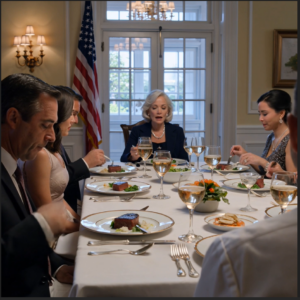
At my mother-in-law’s table, 32 guests cut into ribeye flown in from Japan. My plate: a plain garden salad. That was the night I learned I was never meant to be family.
Even now, when I close my eyes, I can still hear the scrape of knives against porcelain, the hum of polite conversation, and the clink of wine glasses raised in perfect rhythm. Every sound reminded me of what I didn’t have: a steak, a dessert, a place card, even the smallest gesture that said, “You belong here.”
Instead, I sat there exposed, as though the empty plate in front of me was a spotlight announcing to everyone that I was an outsider.
My name is Rachel Carter. I am 34 years old, and I never imagined that a single dinner would split my life into two chapters: before that night and after.
By profession, I am a speech therapist. I help children find their voices, guiding them through the stumbles and silences until words finally break free. My work has always been about lifting others, about teaching them they are not invisible.
But in that dining room, with candles glowing and waiters circling like dancers, I felt as voiceless as any child who had ever sat in my office, desperate to be heard.
I grew up in Boston in a modest brick duplex sandwiched between a corner store and an auto shop. My father drove a delivery truck for 30 years. My mother worked as a secretary at an elementary school.
We didn’t take vacations to Europe or attend charity gallas. We clipped coupons, stretched paychecks, and celebrated birthdays with homemade cakes. But there was love in every corner of that small house, and the belief that if I worked hard enough, I could carve out a better future.
I carried that belief through long nights in college libraries, through part-time jobs waiting tables, through loans I am still paying off. Eventually, I earned my master’s degree and built a practice of my own.
My life was simple but honest: an apartment filled with thrift store furniture, a reliable used car, and a handful of close friends I trusted like family. I thought I knew who I was.
Then came Daniel Harrington.
Phân cảnh 2: Meeting the Harringtons
We met at a wedding: him in a tailored navy suit as best man, me in a borrowed dress as a friend of the bride. Our eyes locked across the dance floor in the kind of cliche you don’t believe happens until it does.
He had an easy laugh, a grounded charm that cut through the formality of the evening. We danced until the staff stacked chairs and dimmed the lights, reluctant to part.
Daniel was handsome, intelligent, and from a world I had only glimpsed in magazines. His family lived in a sprawling colonial estate in Connecticut. His father, William, ran a prestigious investment firm.
His mother, Evelyn, descended from old money and carried herself like every room was a stage. Their dinner parties were featured in local society pages. Their vacations involved yachts and vineyard tours.
When Daniel asked me to marry him after 6 months, I said yes without hesitation. I believed love could bridge any divide: class, money, tradition. I believed, perhaps naively, that hard work and sincerity were enough to earn anyone’s respect.
That was before Evelyn’s smile stopped just short of her eyes. Before the subtle exclusions accumulated into something undeniable. Before the night my plate stayed empty while everyone else feasted.
Looking back, I realize the steak wasn’t just steak, and the salad wasn’t just salad. They were symbols of a truth I had refused to see. In Evelyn’s world, I would never be enough.
And in Daniel’s silence, I heard the echo of something even more painful. Maybe he believed it too.
That night didn’t just change dinner; it changed everything.
If you are watching this, drop a comment telling me where you are from. Hit subscribe and stay tuned to hear how I finally stood up for myself after years of being the forgotten daughter-in-law.
To understand that infamous dinner, you need to know how it all began. Love stories don’t usually come with warning labels, and mine was no different.
When I met Daniel, it felt like a fairy tale written just for me. I had spent my life grinding for every inch of progress. And suddenly, here was this man from a world of abundance who looked at me like I was enough, just as I was.
Daniel was warm, attentive, and charming. He never flaunted his wealth, though it was obvious in every detail: the cut of his suits, the car he drove, the vacations he could take without checking a balance.
I didn’t care about any of that. What I cared about was how he made me laugh, how he listened, how he held my hand like he never wanted to let go.
6 months later, when he knelt down on the beach at Cape Cod and asked me to marry him, I didn’t think twice. I thought love would be enough. I thought effort would earn me a seat at the Harrington table.
I thought wrong.
Phân cảnh 3: A pattern of exclusion
The first crack showed at our engagement dinner. William, his father, was polite in a stiff, almost distracted way, more interested in discussing market trends with Daniel than in asking me a single personal question.
Evelyn, though, was another story. She arrived in a silk dress that looked effortless but probably cost more than my car. Her hair was perfect, her lipstick immaculate, her smile razor thin when turned in my direction.
Throughout the evening, she peppered me with questions that felt more like cross-examination. Where exactly did I grow up? What did my parents do for a living? What schools had I attended?
Each answer seemed to confirm her suspicions that I was beneath their name. And then came the comparisons.
She mentioned Clare, Daniel’s ex, half a dozen times, each one sharper than the last.
“Clare’s family summers in Martha’s vineyard,” she said casually, sipping her wine. “Clare’s father is a hospital director, such a pillar in the community. Clare and Daniel looked so perfect together at the Prescott Gala.”
Daniel, bless him, either didn’t notice or pretended not to. When I squeezed his hand under the table, he smiled at me like I was imagining it.
“She’s just being protective,” he said later. “Give her time.”
I wanted to believe him. I wanted to believe anyone could come around if I tried hard enough.
And I did try. I showed up with thoughtful gifts. I volunteered to help at charity events. I read about the topic she loved so I could start conversations, but every effort landed with a dull thud, forgotten or dismissed before the moment even ended.
The crystal vase I gave her for her birthday never left its box. My offer to help with her auction was brushed aside because “the committee is already set.”
For two years, I convinced myself it was cultural, generational, anything but personal. Until one night in the Harrington living room, I saw something I couldn’t explain away.
Evelyn had stepped out to take a call, leaving her iPad open on the couch. A notification flashed across the screen. I didn’t mean to snoop. It was impossible not to see.
The text preview read, “Don’t worry, Clare. These things never last.”
My stomach dropped. The message haunted me.
“Don’t worry, Claire. These things never last.”
It replayed in my head like a cruel echo, a reminder that I was living on borrowed time in Evelyn’s world. I told myself I was overreacting. Maybe it was about something else. Maybe I’d misread it.
But deep down, I knew my marriage wasn’t just between me and Daniel. It was a constant audition for his mother’s approval. And no matter what I did, I always failed the audition.
It started small. Family photographs where I was asked to step aside for “just one shot.” At first, I smiled and complied, thinking they wanted a siblings-only picture or maybe grandparents with grandchildren.
But the longer it went on, the clearer it became. Those familyonly shots never included me. Even after Daniel and I were married, even after I took his last name, my place in the frame was always negotiable.
Conversations followed the same pattern. Evelyn would ask about my work, and the moment I started to answer, she would cut in with a new story about Elaine’s promotion or Michael’s latest investment.
My words died in my throat, drowned out by her carefully orchestrated spotlight on everyone else. The message was subtle but unmistakable: what I did, who I was, didn’t matter.
The worst was Christmas.
Phân cảnh 4: Proof of the exclusion
The Harringtons had a tradition: a lavish gift exchange, where every stocking hanging from the mantle was filled to bursting. I remember the twinkle of lights on the tree, the sound of paper tearing, the polite laughter as each family member opened an expensive sweater or a gleaming watch.
And then it was my turn. Except there was nothing. My stocking was empty, like it had never been meant for me at all.
“Oh,” Evelyn said lightly when silence fell. “We must have overlooked her name on the list.”
She laughed as if it were nothing, as if an oversight could erase the sting of humiliation in front of 20 relatives.
Daniel looked uncomfortable but said nothing. I forced a smile so wide my cheeks achd. I wanted to cry, but I told myself it was an accident. It had to be.
Weeks later, the truth slipped out in a way that chilled me. I was helping Daniel with some bills when I saw an open email chain on the family’s shared account.
It was a spreadsheet, neatly organized with names and gift assignments: William, Evelyn, Elaine, Michael, even distant cousins. But one name was missing: mine.
And at the bottom, Evelyn’s note: “Keep this among immediate family.”
The words burned into me. It wasn’t an accident. It was deliberate.
I closed the laptop quietly, my hands shaking. I could have confronted Daniel right then. I could have thrown the laptop at him, demanded an explanation.
But I didn’t. I sat there in silence, swallowing the proof like a bitter pill. And that choice, that silence, still divides people who hear my story.
Some say I should have fought back immediately. Others say they understand why I stayed quiet, why I hoped it would change. I wanted to believe Daniel would notice on his own, that he would finally stand up for me, but he never did.
Instead, the sllights piled higher like snow drifts threatening to bury me, each one cutting deeper than the last. And as much as I tried to pretend otherwise, I knew Evelyn was building a case.
A case that I didn’t belong. I just didn’t know how far she was willing to go.
Phân cảnh 5: The retirement dinner
William Harrington’s retirement dinner was supposed to be a celebration. 35 guests, blacktai attire, a renowned chef, and Evelyn orchestrating every detail as though it were the social event of the season.
For Daniel, it was a milestone in his father’s career. For me, it felt like an exam I could never study enough for.
I spent weeks preparing. I scrimped and saved for a dress from a boutique, one that was elegant but understated. I booked an appointment at a salon, something I rarely allowed myself, and practiced my makeup until I could recreate the look without trembling hands.
If Evelyn saw me as unpolished, I wanted to prove her wrong. If she saw me as unworthy, I wanted to leave her no room to dismiss me.
The night arrived on a crisp October evening. Daniel drove us up the long driveway to the Harrington estate, headlights sweeping over manicured gardens and stone fountains. The house glowed with warm light, chandeliers visible through tall windows.
A valet opened my door, and I stepped out, clutching my wrap around me like armor. Evelyn greeted us at the entrance.
“Daniel,” she exclaimed, kissing him on both cheeks and admiring his tuxedo.
Then her eyes landed on me. A smile, practiced and cool.
“Rachel, you made it.”
Just two words delivered like my presence was uncertain, like I was a lastm minute guest who had slipped in without an invitation.
Inside, the house was alive with conversation, laughter, and the clink of crystal glasses. A string quartet played softly from the corner, and servers in black and white uniforms carried trays of champagne.
Everywhere I turned, I saw evidence of the Harrington’s world: polished, effortless, untouchable.
Then I noticed the slideshow. In the grand foyer, a projector cast images onto a screen: Williams career highlights, family vacations, charity gallas, holidays through the years.
Guests stopped to watch, smiling at familiar faces, reminiscing. I moved closer, searching for something, anything that tied me into this family. But there was nothing.
No photo of our wedding, no picture of me and Daniel, not even a candid shot from holidays I had attended. Instead, there was Clare smiling beside Daniel at a gala, her arm linked through his like they were still together.
Guests whispered fondly, Evelyn beaming as though reliving a better time. I felt the air tighten in my chest. It wasn’t just absence. It was eraser.
I forced my lips into what I hoped passed for a smile, though my stomach churned. Daniel, distracted by greetings from colleagues, didn’t notice. He never seemed to notice.
As the cocktail hour flowed on, I wandered to the dining room. A long mahogany table stretched the length of the room, set with gleaming china, polished silverware, and crystal stemware arranged with mathematical precision.
Each seat bore a name card in elegant script. I scan the row: William, Evelyn, Elaine, Michael, Stephanie, even out-of-town cousins, but not me.
I walked the length of the table twice, my pulse quickening with each step. My name wasn’t there. Nowhere.
I glanced at Daniel, laughing with his father across the room. Should I interrupt him? Should I say something? My throat felt dry, my palms damp.
Imagine watching your life erased in front of strangers. Would you speak up or swallow it just to keep smiling?
I swallowed.
And then I saw Evelyn standing at the head of the table, her eyes on me. She knew exactly what I had discovered, and she smiled.
Phân cảnh 6: The breaking point
The call to dinner came with the soft ring of a silver bell. Guests flowed toward the long mahogany table like an elegant tide, their conversations buoyant with champagne and anticipation.
I lingered a moment, scanning the seating cards one last time. My name was nowhere. Not on the table, not on the extra list by the door. Nowhere.
Daniel noticed my hesitation.
“What’s wrong?” he asked, his hand brushing my arm.
“My name isn’t on the chart,” I whispered.
He glanced at the table, then shrugged with a casualness that sliced deeper than any blade.
“Probably an oversight. You can sit beside me.”
He pulled a spare chair from the wall and slid it next to his. It squealled against the polished floor, disrupting the symmetry Evelyn had designed so carefully.
No charger plate, no silverware set, no gleaming goblet, just a bare patch of mahogany, as if even the table itself hadn’t made room for me.
I lowered myself onto the chair, every eye prickling my skin. Evelyn noticed immediately. Her smile didn’t falter, but the corners of her mouth curved tighter, like she was savoring my discomfort.
The first course arrived. Servers moved in choreographed unison, placing steaming bowls of lobster bisque before each guest. The truffle oil’s aroma filled the air.
Guests murmured appreciation, lifting spoons, breaking the surface of rich, golden broth. The server passed me by without pause, arms already laden with empty trays.
Daniel slid his bowl halfway across the table.
“We can share,” he whispered, his voice low, almost apologetic.
Then, just as quickly, he turned back to Michael to discuss quarterly projections, leaving me to sip two careful spoonfuls before pushing the bowl back.
The second course followed: scallops and burr blanc glistening under candle light. Plates were set before each guest in a flawless rhythm, except me. My space remained bare.
I pretended to sip water, though even my glass hadn’t been refilled. Daniel forked a scallop from his plate and placed it on a napkin for me, his eyes never leaving the conversation about European business schools.
By the third course, a sorbet served in delicate glass cups, I stopped waiting. My spot remained stubbornly empty.
Around the table, I noticed a few sympathetic glances, quickly averted. William looked confused, his brow furrowing, but as always, he deferred to Evelyn’s control.
Then the main course arrived. Servers carried silver domes, the smell of prime ribeye flooding the room, juices sizzling against porcelain. Guests gasped in delight as plates were uncovered: perfectly seared steaks, roasted vegetables, truffle mashed potatoes.
And then came my turn.
The server, avoiding my eyes, set down a small plate with nothing but a plain garden salad. No dressing, no garnish, just limp lettuce leaves and two slices of tomato.
The sound of forks and knives clinking against porcelain faltered. Conversations stumbled. Margot’s fork clattered against her plate, sharp as a gunshot.
“Excuse me,” she said, her voice slicing through the silence. “Why does Rachel have a salad when everyone else has steak?”
Every head turned. The room froze. All eyes landed on me, my salad glowing under the chandelier like a cruel joke.
Evelyn’s smile remained fixed, but her eyes hardened into shards of ice.
“I only ordered for family,” she said sweetly, her tone honeyed but poisonous. “The stakes were quite expensive, flown in just this morning. I thought Rachel might appreciate something lighter.”
The humiliation was complete. My throat burned, but no words came. Two years of swallowing slights, convincing myself they were accidents, crashed down in a single moment.
I turned to Daniel, my voice barely above a whisper.
“Am I family or not?”
He kept chewing, eyes fixed on his plate. Silent.
And in that silence, the truth roared louder than anything Evelyn could have said.
I don’t remember standing up.
Phân cảnh 7: The public confrontation
One moment I was staring at that pathetic salad. The next I was on my feet, my palms pressed against the bare wood of the table.
Conversations died mid-sentence, forks froze halfway to mouths, and 30-plus pairs of eyes locked on me.
“For 2 years,” I began, my voice trembling but steady enough to carry, “I’ve tried to be part of this family. I’ve overlooked the accidents, the forgotten invitations, the empty stockings. I’ve told myself it was just miscommunication, but tonight has made something painfully clear.”
Evelyn leaned back in her chair, swirling her wine glass, her smile painted on like armor.
“Rachel, this is hardly the time for dramatics. You’re imagining slights where none exist.”
“Imagining,” I repeated. “Let me be specific.”
Then I turned slowly, meeting the eyes of each relative around the table.
“No place card with my name, no first course, no second course, no sorbet. And now, when everyone here is eating imported steak, I’ve been given lettuce. Lettuce.”
My voice cracked on the word, but I didn’t back down.
“If this is your idea of family, I want the record to show: I am not blind to it anymore.”
A ripple of discomfort moved around the table. Elaine shifted in her seat, eyes dropping. Michael stared at his plate. William’s brow furrowed in confusion, but he said nothing.
Evelyn set her glass down with a delicate clink.
“Rachel, dear, you’re embarrassing yourself. We’ve welcomed you into our home, into our traditions, and now you choose to repay us with a public tantrum.”
I reached for my purse on the floor and pulled out my phone, my hands trembling as I unlocked the screen.
“A tantrum would be shouting. This is evidence.”
I scrolled to the screenshot I’d saved weeks earlier: the text exchange between Evelyn and Daniel, left open on his nightstand one careless evening. I held the phone high enough for those closest to see.
“Your mother wrote, ‘Nadia looked completely out of place at the fundraiser. Julia always understood these events.’ And Daniel replied, ‘I know, Mom. Sometimes I wonder if she’ll ever fit in.’”
Gasps broke out along the table. Elaine covered her mouth. Stephanie glanced at Michael, whose jaw tightened. Daniel’s face drained of color.
“Rachel—”
“Don’t,” I said sharply.
My voice cracked, but I pressed on.
“Not once in 2 years have you defended me. Not once have you told her enough. Do you know what that feels like, to sit in silence, shrinking smaller and smaller, waiting for your husband to see you? Tonight I’m done waiting.”
Evelyn’s mask slipped. Her voice sharpened.
“How dare you? Daniel has given you a life you never could have dreamed of. A nobody from nothing. And this is your gratitude.”
“Mom,” Elaine whispered, horrified.
William finally spoke, his voice low but firm.
“Vivien, that’s enough.”
But Evelyn’s eyes blazed. She turned to her son, her voice rising.
“Choose, Daniel, right now: your family or her.”
The air in the room thickened. The clink of silverware had stopped. The music from the quartet in the next room faded beneath the weight of silence.
I turned to Daniel, my chest tight, my voice raw.
“Well, am I your family?”
He looked at me, then at his mother, then down at his plate. His stake knife trembled slightly in his hand, and then he said nothing.
The silence was louder than any words could have been.
I don’t remember leaving the table.
Phân cảnh 8: Walking away
My legs carried me through the glowing foyer, past the string quartet that played on as if nothing had happened, past the startled valet holding out his hand for my ticket.
My chest was tight, my throat raw, but my head was clear for the first time in months. I was done.
“Rachel,” someone called after me.
For a split second, my heart leapt, thinking it might be Daniel. But when I turned, it was Margo, her heels clicking against the marble as she hurried toward me.
“I’m proud of you,” she whispered, pulling me into her arms. “That took more courage than anyone in that room has shown in years.”
I wanted to cry, but I didn’t. Not on Evelyn’s driveway, not in front of her house. Dignity was all I had left.
I slid into my car, my hands trembling as I gripped the wheel. Margot insisted on following me home to make sure I was safe. In my rear view mirror, her headlights were a steady reminder that at least one person had my back.
But Daniel never came out. Not then. Not when I pulled into our apartment garage. Not when I dragged myself upstairs and collapsed onto the couch.
The silence in our home pressed in on me, thicker than the silence at that table. It was close to midnight when I finally heard his key in the lock. He walked in, his tie loosened, his expression tight with anger.
“What the hell was that?” he demanded, tossing his jacket over the chair.
I sat up slowly, my eyes swollen but dry.
“That was me refusing to be humiliated one more time.”
“You embarrassed my family on my father’s retirement night.”
I stared at him, stunned by the choice of words. My family, not our family.
“You let your mother humiliate me in front of 30 people, Daniel. And you said nothing.”
He paced the room, running a hand through his hair.
“I told you she’s particular about these events. You could have spoken to me privately afterward, not turned it into a circus.”
My chest burned.
“Afterward? How many afterwards have there been? After the empty stocking at Christmas? After the slideshow with Clare and not a single picture of me? After she compared me to her at every chance? When has staying quiet ever changed anything?”
He flinched but pressed on.
“You didn’t have to drag me into it with those texts.”
“You left your phone open,” I said coldly. “And for the record, I wasn’t looking for proof. Proof landed in my lap.”
His jaw clenched.
“You had no right.”
“I had every right. You’ve never defended me. Not once. At that table tonight, you could have said one word, just one. And instead, you said nothing.”
Daniel’s shoulders slumped, but his eyes hardened.
“So what now? You want to pack up and leave over this?”
I stood, my hands shaking, as I reached for the suitcase I had halfpacked weeks earlier, back when Evelyn’s cruelty had left me gasping in the bathroom with wine stains on my dress.
“Yes. I won’t stay where I’m not respected.”
He moved quickly, blocking the doorway, his voice low and dangerous.
“If you walk out now, Rachel, don’t bother coming back.”
My breath caught. His words hung between us, heavier than anything his mother had ever said. And yet my hand tightened around the suitcase handle.
I didn’t answer Daniel that night. I brushed past him, dragging the suitcase down the hall, my chest tight with fury and grief. He didn’t follow.
The sound of the front door shutting behind me was the only answer I needed.
I spent the night at Marggo’s apartment, lying awake on her couch as the city hummed beyond the windows. At dawn, she placed a steaming mug of coffee in my hands and asked the question I had been dreading.
“What happens now?”
I didn’t know. Part of me wanted to fight for my marriage. Another part wondered if there was anything left worth saving.
For the first time in years, I had stood up for myself, and I wasn’t sure I could go back to silence.
Phân cảnh 9: Path to healing
The days that followed blurred together. Daniel called, texted, left voicemails that swung wildly between anger and apology, but he never once admitted the truth: that his silence at the table had spoken volumes.
Then, slowly, something shifted. First, Michael called, something he had never done privately before. His voice was awkward, almost guilty.
“Rachel, I just wanted to say what happened at dinner was wrong. Mom has always been difficult, but this—this was too far. Stephanie and I support you.”
Later that day, Stephanie texted me.
“When I married Michael, she treated me the same. Not as extreme, but I know what you’re feeling. You’re not crazy. You’re not alone.”
Even Elaine came by unannounced. Her eyes were red, her voice low.
“I should have said something that night. I was afraid of being her next target. I’m sorry, Rachel.”
The biggest surprise came when William called directly. His voice was formal, but softer than I’d ever heard.
“I want to apologize. I should have been more involved, more observant. I let her dominate for too long.”
For the first time, I heard regret in his voice. Not just for me, but for decades of silence.
But Evelyn was not done. A week later, a lawyer’s letter arrived at Margot’s door, accusing me of borrowing jewelry from her and failing to return it. It was baseless, meant to intimidate.
Margot urged me to see a family law attorney, and I did. I began documenting everything: texts, emails, rumors Evelyn spread at her charity lunchons. If she wanted a war, I would not walk in unarmed.
Then, two weeks after the dinner, Daniel asked to meet at a coffee shop. He looked older, worn, dark circles shadowing his eyes.
“I’ve been doing a lot of thinking,” he said, voice subdued.
For the first time, he admitted the truth. He had always enabled his mother. He had been raised to smooth things over, to keep her happy at all costs.
He said he wanted to change. He asked for counseling. I was cautious, but I agreed. One session at first, then more.
Dr. Ria helped us unravel years of dysfunction. Daniel admitted his failures openly, sometimes with tears in his eyes. I admitted my exhaustion, my fear that nothing could really change.
For the first time, we spoke honestly.
And then came William’s idea: family counseling, all of us. At first, I thought it was a trap, another stage for Evelyn to perform on. But slowly, painfully, she cracked.
She spoke of her own childhood, of a mother whose love was conditional, of a life spent trying to maintain perfection. It didn’t excuse what she’d done to me, but it explained the hunger that drove her cruelty.
Months passed. Progress was uneven but visible. Boundaries were set. Daniel enforced them.
And then, one evening at William’s birthday dinner, I walked into the Harrington home to find something I never thought I’d see: our wedding photo, framed and hanging on the wall among the others.
Evelyn greeted me stiffly but offered a seat already set with my name printed in elegant script. It wasn’t forgiveness. It wasn’t full acceptance, but it was a start.
The biggest change came quietly in our own home: two pink lines on a pregnancy test. When we shared the news, Evelyn’s face flickered between genuine joy and calculation.
But Daniel placed his arm around me, his voice steady.
“Mom, we’ll raise our child on our terms. Respect is non-negotiable.”
For the first time, I believed him.
6 months later, as spring bloomed, I reflected on that night with the empty plate. It had nearly broken me. But it also gave me something priceless: a voice I would never silence again.
Because families are not just about blood or money or names engraved on invitations. Families are built on respect, on boundaries, on love that protects instead of humiliates. And sometimes the only way to change a family is to risk losing it.
So I ask you: would you have stayed and fought for this marriage or walked away the moment your plate came empty?
Sometimes silence breaks you. Sometimes it saves you. What would you choose?
I learned that dignity is worth more than approval. That love without respect is just another cage. And that even in the ruins of broken traditions, you can build something new.
Built on kindness, on forgiveness, on letting go of hate to live a fuller life ahead.