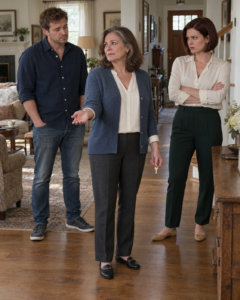
I Gave My Daughter-in-law A Housewarming Gift – After She Tried To Claim My Life Savings
Phân cảnh 1: The breaking point
I looked my daughter-in-law straight in the eye and set my coffee cup down with a click that sounded louder than I meant it to.
“If you ask me one more time when I’m going to sign the house over,” I said, “you are going to find out exactly how much of a mistake that question was.”
Rachel’s mouth opened, then closed. Behind her, my son Mark stared down at his plate like it held the answers to a test he hadn’t studied for. Neither of them said a word.
I picked my purse up off the back of the chair and walked myself to the door. And I didn’t look back to see their faces, because I already knew what they’d look like.
Caught.
It hadn’t started that way. Nothing like this ever does.
Phân cảnh 2: A history of shared joy
6 weeks earlier, my son and his wife had closed on a house in Maple Hollow, a pretty little cul-de-sac neighborhood 20 minutes from me, the kind of place with new sidewalks and skinny trees still staked to the ground with wire.
It was their first home, and I was thrilled for them in the plain, uncomplicated way a mother is thrilled when her child finally gets something they worked for. Mark had wanted this for years.
He and Rachel had been married for six of them, renting the same cramped two-bedroom apartment the whole time, saving whatever they could, which admittedly wasn’t much. So, when they told me the offer had been accepted, I cried a little right there on the phone. And I meant every tear.
I’m Diane. I’m 61 years old, and I have lived alone in the house my late husband Walter and I bought 34 years ago, back when the street was still half-built and you could hear crickets louder than cars.
Walter passed four years ago this spring—quick and sudden, a heart that gave out on an ordinary Tuesday while he was fixing the gutter. He left me the house free and clear, a modest life insurance payout, and a retirement account he had fed faithfully for 30 years, dollar by dollar, the way some men build birdhouses or restore old cars.
Money was never Walter’s hobby. Steadiness was.
He used to say the whole point of saving was so that neither of us would ever have to depend on anybody else’s mood to feel safe. I didn’t fully understand what he meant by that until recently. Now I understand it completely.
Phân cảnh 3: The discovery of a motive
For the housewarming, I didn’t want to just show up with a bottle of wine and a nice card. I wanted to give them something that mattered, something that would actually help two young people starting out.
So, I wrote a check for $8,000, tucked it into a card with a photograph of the house Walter and I bought when we were their age, and drove it over myself on a Saturday morning with a tray of banana bread still warm from the oven.
They didn’t have furniture yet. We sat on the floor of their empty living room, the three of us eating slices of bread off paper towels. And for about 20 minutes, it was one of the nicest afternoons I’d had since Walter died.
Mark kept getting up to show me things—the water heater, the crawl space, a crack in the driveway he was already worried about—like a little boy proud of a fort he’d built. Rachel sat across from me, cross-legged, scrolling through paint samples on her phone, asking my opinion on colors.
I remember thinking, “This is going to be good. This is going to be a good chapter.”
Then I reached into my purse for a tissue, and out came Walter’s old leather wallet, the one I still carried out of habit, even though I’d long since moved my cards to a newer one.
It fell open on the hardwood floor, face up, and tucked in the billfold, where I’d stuffed it months ago and forgotten, was a folded print-out from my financial adviser.
Total portfolio value.
The number was right there in bold at the top, the way those summaries always printed, big and unmissable. Rachel picked it up before I could.
She wasn’t trying to pry, or at least that’s what I told myself in the moment. She was just doing what anyone does when a piece of paper falls near them. She picked it up to hand it back.
But her eyes caught the number before she could stop them, the way eyes do—involuntary, quick, unable to look away from a car accident. I watched it happen in real time, watched her face rearrange itself for exactly one second before she smoothed it back into a smile.
“Whoops,” she said, holding it out to me. “Don’t want to lose that.”
“Thank you,” I said, and folded it back into the wallet and told myself it meant nothing.
It meant everything.
I want to be fair here, because fairness matters to me even now. I don’t think Rachel walked into that house a schemer.
I think something shifted in her that afternoon, something small and human and ugly that I understand better than I’d like to. She saw a number, and the number was bigger than she expected. And somewhere in the back of her mind, a door opened that she hadn’t known was there.
I’ve read enough about human nature in 61 years to know that opportunity doesn’t corrupt people so much as it reveals what they were already capable of imagining.
Rachel had been imagining things for a while, I’d learn later. She just hadn’t had a reason to say them out loud yet. The reason arrived about 10 days after that.
Phân cảnh 4: Subtle manipulation
She called me on a Tuesday evening, and the call itself was strange because Rachel and I had never really been phone call people. We were pleasant. We were cordial.
We sent each other birthday texts and liked each other’s photos, and that was about the depth of it. So when my phone lit up with her name at 7:00 on a Tuesday, I felt a small flicker of surprise before I even answered.
“Diane, hi. I hope this isn’t a bad time.”
It wasn’t, and I said so. And then she talked for 11 minutes about the house.
The gutters needed replacing. The fence in the back was leaning. Did I know a good contractor? Because they’d gotten a quote for a new deck, and it had come in higher than they expected.
I listened, made sympathetic noises, offered the name of a fence company Walter had used years back. It felt at first like an ordinary conversation between family.
Then she said, almost as an afterthought, the way people slip in the real reason for a call at the very end of it:
“You know, Mark mentioned you might be thinking about downsizing eventually. That house of yours is awfully big for just you.”
I sat with that for a second.
“I hadn’t mentioned anything like that,” I said, “to Mark or anyone.”
“Oh.” A small laugh, brushing it off. “I just assumed, with it being so much space. Anyway, we should have you over again soon.”
I hung up feeling like I’d walked through a spiderweb without seeing it. That sensation of something sticky brushing your face that you can’t quite locate or wipe away.
I told myself I was being oversensitive. Grief does that, I found. It makes you suspicious of things that used to feel harmless because you’ve already been blindsided once by life, and some part of you stays braced for it to happen again.
I should have trusted that instinct. I’ve learned in the time since to trust it completely.
The calls kept coming, always with that same structure: 15 minutes of pleasant catching up, and then, tucked into the last 30 seconds like a period at the end of a sentence, some small comment about my house, my space, my finances, delivered so casually you’d almost miss that it was the entire point of the call.
Had I thought about what would happen to the house someday? Wasn’t it a lot of upkeep for one person? Didn’t I think family should look out for each other, help each other get ahead, rather than everyone struggling alone?
I answered every version of it the same way—politely, vaguely—and I started, without really deciding to, keeping a small mental list of every conversation, filing each one away like Walter used to file his tax receipts in case I ever needed to lay them all out at once and see the whole shape of something I could only feel in pieces.
Phân cảnh 5: The ultimatum
Three weeks after the housewarming, Mark called and asked if I’d come to dinner on Sunday.
“Just the three of us,” he said. “Rachel’s making that chicken thing you like.”
I should have known the moment he said, “We want to talk to you about something,” exactly what kind of evening I was walking into. But I went anyway because he’s my son, and because some stubborn, hopeful part of me kept believing that whatever was building underneath all those phone calls, it couldn’t possibly be what I was starting to suspect.
Mothers do that. We give our children the benefit of every doubt we have left, sometimes long after the doubt has earned its keep.
Dinner was fine—strained, but fine. Rachel had made the chicken, and it was good, and she complimented my earrings twice in a way that felt rehearsed.
Mark barely touched his plate. He kept refilling water glasses that weren’t empty, the nervous busy work of a man who wanted his hands doing something other than sitting still.
When the dishes were cleared, Rachel didn’t offer coffee. She stood up, walked to the counter, and came back with a manila folder and an iPad, and set them both on the table with a kind of ceremony that made my stomach drop before she’d said a single word.
“So,” she said, opening the folder like a real estate agent about to close a deal, “Mark and I have been doing a lot of thinking, and we wanted to run something by you, something that we really think could work out for everyone.”
I folded my hands in my lap and waited, the way you wait for a doctor to finish a sentence you already know isn’t going to end well. She tapped the iPad awake, and there on the screen was a spreadsheet—columns and numbers, a little pie chart in the corner, the whole production.
“Your house is worth probably 420, 450 in this market,” she said. “That’s a lot of equity just sitting there, and it’s four bedrooms for one person, Diane. That’s so much house to maintain. So much money going into taxes and insurance and repairs for space you’re not even using.”
“I use every room,” I said. “I have grandchildren who stay over.”
She waved that off the exact way you’d wave off a nat.
“Hear me out. What if you sold? You take the equity, you help us pay down our mortgage, which, by the way, would basically eliminate it. And then we finish the basement for you.
“Full suite, bedroom, bathroom, little kitchenet if you want it. You’d have your own space, totally private, but you’d never be alone. We’d be right upstairs. The kids would be right upstairs.
“You’d save a fortune. We’d save a fortune. And everybody wins.”
I looked at the spreadsheet. Every dollar of my imagined home sale had already been assigned a destination: mortgage payoff, basement renovation, a new car for Rachel, listed cheerfully under “quality of life improvements,” a family vacation fund.
Nowhere on that screen, not in a single cell, was there a line for my retirement. Not one column acknowledged that the money in my name was mine to decide about, mine to protect, mine to spend or not spend as I alone saw fit.
“What happens,” I said slowly, “if I need more care someday? Assisted living, memory care, something like that?”
Rachel didn’t even pause.
“We’ll figure it out when we get there. That’s forever from now.”
“And if I simply prefer to live in my own house?”
She smiled at me then, patient, a little pitying, the way you’d smile at a child who’d said something sweetly naive.
“Why would you want that? You’d be with your grandkids every single day. You wouldn’t have to worry about a thing. Doesn’t that sound better than rattling around alone in a big empty house?”
And there it was. Not a plan to include me. A plan to use me—my equity, my savings, my presence as free live-in child care—packaged up and presented to me as generosity, as family, as togetherness.
I sat there and felt something in my chest go very still and very clear, the way water gets right before it freezes.
“I’m not selling my house,” I said.
Rachel blinked like I’d spoken in a foreign language.
“I’m not paying off your mortgage, and I will not be living in anyone’s basement.”
The color came up fast in her cheeks.
“Wow. Okay.” She sat back, arms crossing. “I didn’t realize you’d rather sit on all that money by yourself than help your own family get ahead.”
“My son chose his mortgage,” I said, keeping my voice level the way I’d learned to keep it level in 30 years of PTA meetings and later hospital waiting rooms. “I didn’t cosign it, and I’m not going to liquidate my life to cover it.”
Mark still hadn’t said a word. Not one.
He sat there studying the tablecloth like it might rescue him, and something in me, some old reflex, some last hope, turned to him and waited, gave him one more chance to be the kind of man his father raised him to be.
“Mark,” I said quietly. “Do you have anything to say?”
He looked up finally, and his eyes were miserable, but his mouth stayed shut for three long seconds before he managed:
“Mom, we just—we thought it could be good for everyone.”
“That’s not an answer,” I said. “That’s a hope. I asked if you have anything to say.”
And to his credit—and I do want to give him this credit because it mattered later more than he probably knew in the moment—he turned to Rachel and said:
“Ra, I told you I didn’t think she’d want to sell.”
It wasn’t much. It wasn’t standing up and ending the conversation right then, but it was the first crack of daylight I’d seen from him all evening, the first sign that somewhere underneath the conflict avoidance, my son still existed.
Rachel shot him a look sharp enough to cut glass, and he shrank back into his chair, and the crack closed up again just as fast as it opened. But I’d seen it. I filed it away, too.
I stood up, thanked them for dinner, and drove home in the rain that had started sometime during dessert. Wipers going, radio off, my mind turning the whole thing over and over like a stone I couldn’t put down.
Walter used to say that money doesn’t change people so much as it removes the need for them to keep hiding who they already were. I’d nodded along to that for years without really feeling it. That night, driving home in the rain, I felt it land in my chest with the full weight of understanding.
Phân cảnh 6: Financial betrayal
When I got home, I didn’t go to bed. I made tea, sat at Walter’s old desk in the study, and turned on the computer. If Rachel had already built an entire spreadsheet around spending money that wasn’t hers, I needed to know with total certainty exactly what she could and could not touch.
My checking account was untouched. My savings, the same. My retirement account, exactly where it should be.
I let out a breath I hadn’t realized I was holding. And for a moment, I thought maybe I was overreacting. Maybe this was just an ugly conversation and nothing more.
Then I remembered the old card.
Years ago, when Mark was in college and driving a car held together mostly by hope, I’d added him as an authorized user on one of my credit cards—an emergency card, strictly for breakdowns and unexpected bills, the kind of thing any mother does for a kid two states away with no safety net of his own.
After he graduated and got on his feet, he’d stopped using it, and I’d genuinely forgotten he was still on the account. It had been years. It hadn’t crossed my mind once.
I logged in anyway, mostly to be thorough, mostly to close a loop I assumed was already closed.
There was a pending charge: $4,215.60, dated 4 days earlier, from a company called Hollow Creek Outdoor Living.
My hands went cold on the keyboard. I sat and stared at the number for a long moment, doing the math I didn’t want to do. And then it clicked into place with an almost audible sound.
The deck quote Rachel had mentioned on the phone, the one that had come in higher than expected. She hadn’t been asking me for advice on a fence company out of politeness.
She’d been laying groundwork, and somewhere in the space between that phone call and tonight’s dinner, someone had decided not to wait for my answer at all.
I didn’t sleep much that night. In the morning, I was standing outside the bank branch five minutes before it opened, waiting in my car with my hands wrapped around a coffee I wasn’t drinking.
A young man named David helped me. I laid the card on his desk and told him I needed to report it as compromised.
“Was it lost or stolen?” he asked, already typing.
“Neither,” I said. “Someone used it without my knowledge or permission.”
He pulled up the pending charge, confirmed the amount, and asked if I wanted it disputed before it posted. I told him yes, and within a few clicks, it was done. The charge frozen, reversed before it could ever settle.
Then I asked him to remove the authorized user from the account entirely. And he did that, too. A few keystrokes undoing a favor I’d extended 15 years earlier to a boy who no longer existed in the man sitting across from me at dinner the night before.
I wasn’t finished. That morning, I opened a new checking account under my name alone, moved every dollar out of the old one, and closed it completely.
I changed every password on every financial account I had, each one long and different and written down nowhere but in my own head and a locked drawer. I set up alerts on every account so that any transaction, no matter how small, would ping my phone the instant it happened.
By the time I left the bank, it was almost noon, and I felt something I hadn’t felt in 3 weeks. Steady. In control of my own life again.
That afternoon, I drove to the safe deposit box I’d been meaning to open since Walter died, and finally did it. The deed to the house, his life insurance documents, my will—everything that mattered, sealed away where no accidentally dropped wallet could ever put it in front of the wrong eyes again.
Phân cảnh 7: Severing the ties
I didn’t have to wait long for the phone call. Three days, to be exact. I was in the backyard deadheading the roses when my phone buzzed against the patio table, Mark’s name lighting up the screen.
“Mom.”
His voice had that particular strain to it, the sound of a man standing in a room he didn’t want to be standing in.
“Can you call the credit card company, like, right now?”
“Why would I do that?”
A pause.
“Rachel’s at the outdoor furniture place. They’re finalizing the deck materials, and the card got declined. She’s kind of freaking out.”
“I know,” I said.
Silence on the line, thick enough to touch.
“Wait, you knew?”
“Yes.”
“You knew the card was declined?”
“I canceled it, Mark. 3 days ago. I also removed you as an authorized user.”
His breathing changed, went ragged.
“Why would you do that?”
“Because someone spent over $4,000 of my money on patio furniture without asking me. That’s not an emergency. That’s theft dressed up in nicer language.”
“We were going to pay you back,” he said.
And I could hear how much he wanted that sentence to fix something.
“You never asked to borrow it in the first place,” I said. “A gift is something I choose to give. It is not a account you get to help yourself to whenever you decide you need something.”
He didn’t have an answer for that. I told him, gently as I could manage, that if Rachel wanted a deck, she was welcome to build one with money that belonged to her. And then I said goodbye and ended the call before he could find the next excuse waiting in his throat.
40 minutes later, an SUV came tearing into my driveway hard enough that I heard the tires from the kitchen. Rachel was out of the car before it had fully stopped rolling.
She didn’t knock. She pushed through my front door like she still had a claim to it, Mark trailing a few steps behind, pale, saying nothing.
“How could you do that to me?” she demanded, standing in my living room like she’d been personally wronged.
I stayed in my chair, tea in hand, and looked up at her.
“Do what exactly?”
“Humiliate me. In front of the sales manager. They looked at me like I was some kind of criminal.”
“You were using a card that didn’t belong to you,” I said, “to buy something I never agreed to pay for. I’d call that an accurate read of the situation, not a humiliation.”
Her face went a deep, furious red.
“It’s family money. You have more than you could ever spend in one lifetime, and you’re going to just sit on it while we struggle.”
“That is not your concern,” I said. “And I already helped. $8,000 for a housewarming gift you both seemed thrilled about at the time. You decided on your own that it was only a down payment on something much bigger.”
“Families are supposed to share,” she snapped.
“Families are supposed to respect each other,” I answered. “Those aren’t the same thing. And I think somewhere along the way you convinced yourself they were.”
That was when Mark finally stepped forward, and for the first time all evening, he looked at me instead of the floor.
“Mom.” His voice came out smaller than I’d heard it since he was a boy. “We messed up. I should have said something at dinner. I should have said something a long time before that.”
“Yes,” I said. “You should have.”
“I’m sorry.”
I believed him. I want to be honest about that. I did believe he meant it.
But an apology, however sincere, doesn’t undo three weeks of silence while his wife drew up a plan to spend my life savings without asking me a single question. Sincerity and trust are not the same currency, and you cannot pay off one debt with the other.
I stood, walked to the little table by the front hallway, and picked up the spare key I kept there for exactly this kind of moment. The one Mark had, the one I’d given him years ago for emergencies.
“I’d like the key back,” I said. “The one to my house.”
Rachel’s arms crossed instantly.
“Why? What are you even implying?”
“I’m not implying anything. I’m asking for my own house key back.”
“We’re not giving it back,” she said. “What if something happens to you and we need to get in?”
“Then you’ll call me first,” I said. “And if I don’t answer, you’ll call for help the way anyone else’s family would. You do not get unrestricted access to my home simply because you’re related to me.”
“We’re keeping it,” Rachel said, flat, final, like the discussion belonged to her to close.
I looked at her for a long moment, and then I smiled, and I think that smile unsettled her more than anything I’d said all night.
“That’s fine,” I said. “Then I’ll take care of it myself.”
I walked to the front door and opened it.
“I think it’s time for you both to go.”
Rachel muttered something under her breath as she pushed past me, and Mark lingered a second on the porch, rain starting to fall around him.
“I’m sorry, Mom,” he said again. “I hope you’ll understand why we thought this could work.”
I did understand, actually. I understood perfectly. I just didn’t agree.
And those are two very different things.
Phân cảnh 8: Setting boundaries
The moment their car pulled out of the driveway, I called a locksmith. Within 2 hours, every exterior lock on my house had been replaced with new deadbolts, and the key Rachel had refused to hand over became, quite simply, a piece of metal that opened nothing at all.
The next morning, I turned my attention to the garage. Over the past year, in dribbs and drabs, Mark and Rachel had used one whole corner of it as free storage for things they hadn’t found room for in the apartment, and later hadn’t bothered to move into the new household—textbooks, a broken treadmill they kept meaning to fix, boxes of kitchen gadgets, a set of golf clubs Mark hadn’t touched in 3 years.
It had never bothered me before. That morning, it bothered me a great deal.
I spent two hours loading every last box into my car. And by early afternoon, I was pulling into their driveway in Maple Hollow, stacking everything neatly by their front door.
On top of the pile, I set one small gift box. Inside it were the cut-up remains of the canceled credit card, a printed list of the three nearest self-s storage facilities, and a handwritten note that said simply:
“Respect costs nothing. I hope one day the difference between that and money becomes clear to you.”
I rang the doorbell and walked back to my car without waiting. As I pulled away, I watched in the rearview mirror as Mark opened the front door and stood there absolutely still, staring at the pile on his porch.
Then, for the first time in weeks, I heard raised voices coming from inside that house. Not mine, not aimed at me, but at each other.
Whatever picture Rachel had been so carefully constructing was finally starting to come apart at the seams. And I felt no satisfaction in that, exactly. Just a quiet, tired relief, the kind you feel when you finally set down something heavy you’d been carrying without realizing how much it weighed.
The weeks after that were quiet in a way that took some getting used to. My phone rarely rang, and when it did, it was never Rachel.
I heard secondhand and much later that she told anyone who’d listen how I had embarrassed her, humiliated her, torn the family apart over what she called a misunderstanding. I stopped feeling the need to correct that version of events.
People who believe they’re entitled to someone else’s money rarely recognize themselves as the ones who overstepped. When that access disappears, they tend to experience the boundary itself as the cruelty rather than whatever led to it.
Phân cảnh 9: Finding peace in clarity
Mark surprised me, though. About a month in, he called and asked if he could come by just for coffee, just him.
He showed up alone on a Sunday afternoon. No folder, no spreadsheet, no case to make. We sat at my kitchen table, the same table he’d eaten breakfast at every morning of his childhood.
And for a while, we talked about nothing important. His job, the weather, whether the maple outback needed trimming before winter. It felt almost normal, almost like before.
Eventually, he set his mug down and said, “I’m sorry, Mom. I should have shut that down the second Rachel brought up selling the house. I told myself it wasn’t a big deal because we were going to pay you back eventually. I let myself believe that made it okay.”
“Family doesn’t take without asking first,” I said. “That’s the whole rule. It’s not complicated.”
“I know that now,” he said.
And for once, I believed he meant it all the way down. There wasn’t much more to say after that. An apology can’t rewrite what already happened, but it can be the first honest brick in something new.
And that’s what I chose to let it be.
From then on, Mark came by about once a month, always alone. And we settled into an unspoken agreement that certain subjects—my house, my accounts, my future—were simply closed, permanently. Not out of anger, out of clarity.
As for me, I decided to spend some money on something that was entirely, unapologetically mine. I hired a small local company to redo my backyard: new flower beds along the fence line, a stone path curving out to a bench under the old maple where Walter used to sit with his coffee every morning before work.
Some evenings now, I bring a book and a glass of iced tea out there and just sit, listening to birds argue in the hedges, and I think about how close I came to signing away 34 years of my own life for the sake of being agreeable.
I don’t think giving Mark and Rachel that $8,000 was a mistake. For a long time, I did. I thought I’d handed a stranger the keys to my own vulnerability.
But I’ve come around to seeing it differently now. That gift didn’t create the problem. It simply revealed, faster than anything else could have, exactly who Rachel was underneath the thank you cards and the paint sample text.
If she’d been content with generosity freely given, none of the rest would have happened. Instead, one glimpse of a number on a piece of paper was enough to set a whole plan in motion. A plan that assumed my money existed to solve everyone’s problems but my own.
I don’t feel angry about it anymore. And honestly, I don’t feel much satisfaction either, though I understand why some people might expect me to.
Mostly, what I feel is grateful. Grateful I found out who I was dealing with before I’d signed anything. Grateful I locked down what was mine before anyone else could get their hands on it.
Grateful that Mark eventually found his way back to the son I raised.
People sometimes talk about boundaries like they’re the same as walls, like setting one automatically means shutting someone out for good. I don’t see it that way anymore. Not since all this happened.
A boundary doesn’t push anyone away who genuinely wants to be there. It just stops pretending for the benefit of people who were only ever interested in what they could get.
My house is still mine. My savings are still mine, untouched, exactly where Walter and I built them—dollar by careful dollar, over 30 years of choosing steadiness over comfort.
And my relationship with my son is smaller now, quieter, but it’s honest in a way it never quite was before. And I’ll take honest over comfortable every single time.
Some nights, I sit under that maple tree and I think about the word no. How small it is. How long it took me to say it without flinching.
And how it turned out to be the strongest thing I owned.
Stronger, in the end, than any number that ever showed up on a piece of…