“Leave My House Right Now,” My Daughter-in-Law Said—So I Cancelled Every Payment and Moved to Por…
Phân cảnh 1: The conflict
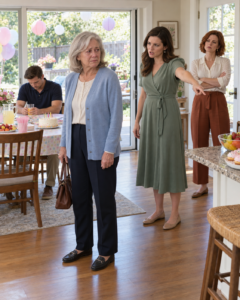
“Say it again,” my daughter-in-law said, “and you can leave my house.”
She wasn’t shouting. That was the part that stayed with me long after I drove home. She said it the same way someone might tell a child to stop fidgeting at the table. Flat, final, certain of her own authority.
My son, Caleb, was sitting 4t away. He had a glass of orange juice in his hand, and he was staring at the little plastic forks arranged next to the birthday cake, and he didn’t say a word.
That was the moment something inside me went very still. My name is Virginia Hart.
Phân cảnh 2: Tension and departure
I’m 64 years old. For nearly 7 years, I had confused being useful with being valued.
On that Saturday afternoon, standing in the kitchen of a house I helped make possible, I finally understood the difference, and the choice I made in the weeks that followed surprised everyone, including me.
The birthday party had started beautifully. My granddaughter Abby had just turned 8, and the backyard was strung with paper lanterns that caught the light in a way that made everything look like a magazine photograph.
I had arrived early to help arrange the fruit trays, and Abby had run to me at the gate with that particular speed children have before the world teaches them to slow down.
My daughter-in-law, Brooke, moved through the gathering with the efficiency of someone who had planned this event down to the minute. She was gracious to her own family, warm with the neighbors, and perfectly correct with me, which was how things had been between us for the past 3 years.
Correct, not warm, not hostile on the surface. Just a careful distance she maintained the way some people maintain their posture: deliberately, always.
Her sister, Dana, had arrived with two kids of her own, and at some point in the afternoon, the two of them had drifted toward the kitchen while I was refilling the lemonade pitcher. I heard them talking about the school district, about Aby’s upcoming year, about whether private school was worth continuing.
And then Dana said, “Do you just let your mother-in-law weigh in on everything?”
I didn’t think I’d said anything unusual. I had mentioned gently that Abby had seemed a little tired lately, and that I wondered if the schedule was getting to her. That was it. That was all.
Brooke turned from the counter.
“Virginia, I’ve asked you before not to make those kinds of comments in front of her.”
I sat down the picture.
“I didn’t say it in front of her.”
“You said it at the table.”
“Abby was inside.”
“It doesn’t matter.” Her voice was clipped. “Every time we have a family event, you find something.”
“I wasn’t finding anything, Brooke. I was expressing concern for my granddaughter.”
Dana crossed her arms.
“Some grandparents don’t know how to respect boundaries.”
I looked at her. I had met this woman four times in my life.
“I’m sorry,” I said carefully. “I don’t think I was speaking to you.”
The kitchen became quiet in a way that felt rehearsed. Then Brooke said it:
“Say it again and you can leave my house.”
I waited. I looked at Caleb.
He was still at the table on the other side of the window, visible through the glass, and for a fraction of a second, I thought he was about to stand up. But he just turned his glass slowly in both hands and looked at the tablecloth.
“All right,” I said.
I picked up my purse from the counter. I kissed Abby on the top of her head on my way through the living room. She didn’t understand why I was leaving early.
I told her I had to take care of something at home and that I’d call her later. And she believed me because 8-year-olds still believe the things adults say.
Phân cảnh 3: Deciding to leave
I drove home on autopilot. I made a cup of tea I didn’t drink. I sat at the kitchen table while the afternoon turned into evening, and I thought about my son’s face through that window.
Not Brook’s face. His.
Caleb had known what was happening. He could hear the conversation. He had chosen to look at the tablecloth. That was the thing I couldn’t set down.
An hour after I got home, my phone showed one text. Not from Caleb. From Brooke.
It read, “I hope you understand why I had to say something. This has been a long time coming.”
I read it twice. Then I put the phone face down on the table.
The next morning, nothing from Caleb. Not a call, not a message asking if I’d gotten home safely. Nothing.
By noon, I had stopped waiting. Instead, I did something I’d been avoiding for years. I sat down with a legal pad and a calculator, and I wrote down every dollar I had quietly contributed to my son’s life since he and Brooke had married.
38,000 toward the down payment on their house. A house with four bedrooms and a finished basement and a backyard now strung with paper lanterns that I had helped purchase with a cashier’s check 7 years ago.
$1,200 a month toward Aby’s private school, which came to just over $100,000 over the years she had attended.
The roof, $16,000 two summers ago, when Caleb had called me in a panic because they didn’t have the savings to cover it.
4 months of mortgage payments when Caleb’s company had downsized and he’d spent the better part of a year searching for the right next position. Not just any position, he told me. The right one.
A car repair, medical bills from the year Brook’s appendix had ruptured and their deductible had nearly wiped out their checking account, a family vacation to Disney when they’d said they couldn’t afford it, but Abby had been asking about it for 2 years.
I circled the total at the bottom of the page and stared at it. Then I thought about Dana, who had met me four times, telling me that some grandparents don’t know how to respect boundaries.
I thought about Brook’s voice, flat and certain. And I thought about an email I had received eight months earlier from my friend Patricia. Wait, that name’s taken. My friend Ellen. Ellen Marsh.
We had room together at Ohio State in the early 1980s, and she had retired 2 years ago and moved to the Algarve Coast in Portugal. She had sent me a photo of her terrace overlooking the ocean and one line beneath it:
“The cottage next door just came available. You keep saying you’ll visit. Come for longer.”
At the time, I had filed it away without responding. I had told myself I needed to stay close, that Abby needed me nearby, that Caleb depended on me.
Sitting at my kitchen table the morning after my granddaughter’s birthday party, I read that email again. And for the first time, the invitation didn’t sound like a casual suggestion. It sounded like the answer to a question I hadn’t let myself ask.
I called Ellen. She answered on the second ring.
“I’ve been waiting to hear from you,” she said, which was such an Ellen thing to say that I laughed in spite of everything.
“Is the cottage still available?”
A pause, then:
“Give me 2 hours.”
Phân cảnh 4: The final severance
I went to my bank that Monday. I had been a customer at that branch for 26 years. My account manager was a woman named Pam, who recognized me immediately and offered me coffee, which I declined.
I told her I needed to make several changes. She pulled up my account. I watched her eyes move across the screen as she took in the landscape of automatic payments I had set up over the years.
She asked me twice if I was sure. The first time I said yes. The second time I said, “Pam, I’ve been sure for longer than I realized.”
My hand shook slightly when I signed the paperwork. Not from doubt. From the specific feeling of doing something you should have done years ago and recognizing, as you do it, exactly how much time you spent not doing it.
I walked out of the bank into the October sunshine, and my phone buzzed immediately. Caleb.
His message said, “Mom, Brooke is still upset about Saturday. She says she thinks you need to take some time to reflect. Maybe it would help if you reached out to her this week.”
I read that message standing on the sidewalk outside the bank. There was no, “Are you okay?” No acknowledgement of what had happened.
Just a request dressed as a suggestion for me to go fix the problem he had watched happen and done nothing to stop.
I put the phone in my purse and walked to my car. Over the next 10 days, I dismantled the life I had arranged so carefully around other people’s needs.
Phân cảnh 5: Dismantling the past
I told my downstairs neighbor, a retired teacher named Frank, who had been looking for a quieter place than his current apartment, that my condo was available to rent, furnished, starting in 6 weeks. He said yes before I’d finished the sentence.
I sorted through 30 years of accumulated living. I donated the things I had kept out of habit. I packed the things that actually meant something.
My late husband Gerald’s field notebooks from his years as a surveyor, three photograph albums, a quilt my mother had made the winter before she died, and a cast iron skillet that had belonged to my grandmother, and that I had lent to Brooke 2 years ago when she was going through a cooking phase.
She had mentioned returning it once and then hadn’t. I drove to Caleb’s house when I knew they were both at work, let myself in with the spare key, and found the skillet in the back of a lower cabinet.
I also left the spare key on the kitchen counter with a note. The note said four things:
“Here is your key. The automatic payments are cancelled. I love you and Abby. Take care of yourselves.”
I almost wrote more. I stood in that kitchen for probably 2 minutes, debating whether to explain myself in greater detail. Then I thought about how many times I had explained myself in greater detail, and it had changed nothing.
And I folded the note, set the key on top of it, and walked out.
Caleb called that evening. I didn’t answer. I was finishing packing.
Ellen met me at Farro airport wearing a wide-brimmed hat and looking exactly like someone who had made a good decision and had two years of evidence to prove it.
Phân cảnh 6: A new beginning
She hugged me for a long time without saying anything useful, which was exactly right.
The cottage was small: white walls, terracotta floors, a kitchen barely large enough for two people to stand in comfortably, and a narrow terrace that looked out over a hillside of cork trees toward the blue gray water beyond.
I carried in my two suitcases, set my grandmother’s skillet on the stove top, and arranged Gerald’s notebooks on the shelf beside the window. Then I sat on the terrace with a glass of wine and did absolutely nothing for 45 minutes.
It was the longest I had sat without doing anything in years, maybe longer.
Ellen came by that evening with bread and olive oil and a bottle of local wine, and we sat outside until the stars were fully visible.
She said, “You look like you put something down.”
I said, “I did.”
She didn’t ask what. She already knew.
Phân cảnh 7: The fallout
3 days later, everything back home began to move. The school’s billing office called Caleb. The car payment declined.
The cleaning service that came every 2 weeks sent a notification that their scheduled payment hadn’t processed. And then the mortgage autodraft, which I had been covering as a standing transfer for 2 years since Caleb had quietly told me that things were still tight, also failed to go through.
By that evening, Caleb had called 11 times. Brooke had called four. There were text messages I read in sequence, like chapters in a book I already knew the ending of.
The first: “Mom, where are you? Something’s wrong with the account.”
The second: “The school called. There’s a problem with Aby’s tuition.”
The third: “Why would you do this without warning us?”
The fourth: “Please just call me. I don’t understand what’s happening.”
The fifth, from Brooke: “This is incredibly cruel. You’re hurting Abby.”
I sat on my terrace with a bowl of soup and read every message. I felt no triumph. What I felt was clearer than that.
I felt the specific sadness of watching someone discover that the floor they’d been standing on had always required someone else to hold it up.
I called Caleb the following afternoon. He answered before the first ring had finished.
“Mom, where are you?”
“Portugal.”
Silence.
“I’m sorry?”
“I’m in Portugal, Caleb. I’m living here for now.”
“You—what do you mean, living there?”
“I mean, I rented a cottage. I’m staying.”
His breathing changed.
“Mom, the school called. The car payment bounced. We need—”
“Caleb.”
I waited.
“Those were never your bills to have. They were gifts I chose to give, and I’ve chosen to stop.”
“You can’t just—”
“I already did.”
He was quiet for a long time. When he spoke again, his voice had the particular flatness of someone working to control something.
“What are we supposed to do?”
“The same thing most people do,” I said. “Figure it out.”
“That’s not fair.”
I looked out at the water. A fishing boat was moving slowly along the horizon.
“Caleb,” I said, “neither was watching your wife tell me to get out of your house while you stared at the tablecloth.”
He didn’t answer that.
“I love you,” I said. “That hasn’t changed. But I’m not coming home to apologize for something I didn’t do, and I’m not going to keep paying for the privilege of being treated the way I was treated on Saturday.”
The call ended without resolution. That was okay. I had stopped needing everything to resolve immediately.
Phân cảnh 8: Adapting to distance
The months that followed were the strangest I had known in a long time. Strange in the way that good things sometimes are when you’ve been so accustomed to difficulty that peace feels unfamiliar.
Ellen introduced me to her neighbors, a retired Portuguese couple and two expat women from Canada who had formed the loose social fabric of that little community. I joined a Tuesday morning watercolor group that met at a cafe with bad coffee and very good light.
I walked along the coastal paths in the early mornings, which I had time for because I was no longer spending those hours managing someone else’s crisis. I read books. I cooked actual meals and ate them slowly.
Back home, I heard things through my cousin Diane, who kept me updated with the particular dedication of someone who believed I had every right to know.
That Aby’s school enrollment had transferred to the public school two towns over. That Brooke had gone back to working full-time at the insurance company where she’d been before Abby was born.
That the lease on Caleb’s truck had ended and he’d bought a used Honda with his own savings. That the cleaning service was gone. That the arguments had been significant before they had become manageable.
Caleb called once a month, brief and careful. I answered every time. We talked about small things: how he was adjusting, how Abby was doing in her new school, what the weather was doing.
We did not talk about money. We did not talk about that Saturday. Not yet.
2 months after I’d left, he called and said, “I want you to know we’re doing okay. Better than I expected, honestly.”
A pause.
“That doesn’t mean I’m not angry.”
“I know.”
“What you did felt like a punishment.”
“It wasn’t meant as one.”
“It felt like one.”
“I understand.”
I waited.
“But Caleb, what I was doing before wasn’t healthy. Not for you, not for me, and definitely not for what was growing between all of us.”
He didn’t respond to that. We said goodbye and hung up.
He called again 6 weeks later. And this time, before he said anything else, I could tell from the first syllable that something had shifted.
“Mom.”
“Hi, honey.”
Phân cảnh 9: A son’s apology
“I owe you an apology.”
I didn’t say anything. I sat very still.
“A real one,” he said. “Not an explanation where I also tell you what you did wrong. Just, I’m sorry.”
I waited.
“I sat there,” he said. “I knew what was happening, and I just sat there.”
His voice cracked on the last word.
“I kept telling myself that if I got involved, it would make things worse between you and Brooke, but what I was actually doing was making sure you were the one who absorbed everything.”
“Yes,” I said. “That’s what was happening.”
“I’m sorry, Mom.” He exhaled. “I’m sorry I let her talk to you that way. I’m sorry I kept asking you to smooth things over. I’m sorry I didn’t understand how much of our life was built on you quietly holding things together. Than that…”
He stopped, started again.
“I never said thank you, not once.”
I had promised myself I would not cry on this call. I did not keep that promise.
“Thank you,” I said when I could speak again. “That matters more than you know.”
He asked if the grandchildren could visit me in Portugal. My heart answered before my brain could examine the question.
“I would love that.”
He hesitated, then asked, “And Brooke?”
I thought about this carefully.
“Not this time,” I said. “Maybe later, but not this trip.”
He accepted that without argument. That acceptance meant more than he probably understood.
Phân cảnh 10: A meaningful reunion
They came in early June: Caleb, Abby, and my grandson Sam, who was four and very serious, is about birds. I had been living in the cottage for 8 months by then, and it had become genuinely mine in a way that the condo back home never quite had.
I arrived at the arrival hall 20 minutes early. When Abby spotted me through the crowd, she made a sound that was somewhere between a word and a cry and crossed the distance between us at full speed.
Sam followed at a slightly more dignified pace and then buried his face in my shoulder. Caleb hugged me. He held on longer than he ever had as an adult, and I let him.
“I missed you,” he said quietly.
“I missed you, too,” I said. “All of you.”
We spent 5 days together. I had found them a little guest house nearby, bright and clean and close enough that I could walk over each morning. They came to my cottage for meals.
We drove out to the beaches where the water was cold and wild and absolutely worth it. Abby painted a wobbly watercol of the terrace with the cork trees in the background, and I put it on my refrigerator while she was still watching.
Sam identified six different bird species in the cork forest with almost no help and was very pleased about this.
One evening, Caleb and I sat on the terrace after the children had gone to sleep. The night was warm, and the lights from the fishing village below made soft trails on the water.
“I was furious when you left,” he said.
“I know.”
“I told myself you were being dramatic, that you’d be back in a week.”
I smiled.
“And then the school called,” he said, “and I thought, ‘Okay, 2 weeks.’ And then the mortgage didn’t clear, and I realized you were actually gone.”
He looked out at the water.
“That’s when I understood we’d been living in a way that only worked because of you, and you’d been letting us, and none of us had ever asked if that was okay.”
“I let you,” I said. “That’s on me, too.”
“Still.” He shook his head. “We treated you like a resource, Mom, not like a person.”
Those words were hard to hear, even though I had known them for months.
“You’re learning something different now,” I said.
“We are.”
He smiled, a little tired.
“Brooke is working. We have a budget. We fight about the budget, but we have one.”
He paused.
“It’s actually better. The fighting about the budget is better than pretending we didn’t need one.”
I laughed.
“I’m proud of you,” I said.
“I don’t know if I deserve that yet.”
“You’re here,” I said. “You apologized. You came.”
I looked at my son.
“That’s not nothing, Caleb.”
He reached across and squeezed my hand.
When the week was over and I stood outside the guest house, watching their taxi pull away, Abby waved from the back window until the car turned a corner. Sam, I noticed, was pointing at something in the trees beside the road.
I stood there until I couldn’t see them anymore, then walked back to my cottage.
Phân cảnh 11: Finding herself
That evening, my phone showed a message from Brooke. It was the first direct message she had sent me since the birthday party almost 10 months ago.
It said, “Thank you for taking care of them this week.”
Six words, no apology, no explanation. I sat with it for a while, then I typed back, “It was wonderful to have them.”
I didn’t push further. I didn’t close the door either. There would be time for the harder conversations, or there wouldn’t be. And that was a truth Brooke and I would both have to sit with.
I thought for a long time that night about that Saturday afternoon, about Dana’s folded arms, about Brook’s voice, flat and certain, about Caleb’s hands turning the glass.
I used to replay it looking for the thing I could have done differently, the word I could have said that would have deescalated it, smoothed it over, kept everybody comfortable.
That’s the particular talent you develop over decades of keeping the peace in other people’s homes. You become very good at finding your own exit from a situation before anyone has to ask you to use it.
But lately, I’ve stopped replaying it that way. Because here is what I know now that I didn’t know then.
There was no version of that afternoon where I said the right thing and Brooke saw me differently. There was no apology that would have made her respect me, because my willingness to apologize was part of what she had learned to count on.
Every time I had smoothed it over and shown up the following Sunday, I had been teaching everyone in that family what I was willing to accept.
I don’t say this to condemn Brooke. People treat others the way they’ve been shown they can. I showed her she could.
I don’t say it to condemn Caleb either. He made the mistake of believing that his silence was neutral. He learned it wasn’t.
I say it because I spent 61 years being very good at being needed and only recently learned how to be simply myself.
There’s a woman in my watercolor group, Margaret, who came to Portugal from Germany after her husband died and her children tried to move her into a smaller apartment closer to one of them so she’d be, as she put it, easier to manage.
She looked at me across a cafe table last spring and said, “The moment I stopped making myself convenient, they started treating me like someone worth knowing.”
I’ve thought about that a lot.
My terrace is quiet this evening. The boats are coming in from the day’s work, and the light is the particular shade of gold that doesn’t have a name in English, but probably should.
Gerald would have loved this place. I think about him often, which is different from being sad. It’s more like he’s part of the light.
Abby has already asked whether she can come back next summer. Sam wants to see the flamingos at the lagoon an hour’s drive east. Caleb said a little shyly that he’d like to come for two weeks instead of one.
I said yes to all of it. I love my son. I love my grandchildren. Those things are not in question.
What I learned at 64 is that you can love someone completely and still refuse to lose yourself in the arrangement. That love doesn’t require you to disappear. That being a mother doesn’t mean being a safety net stretched so thin it stops being a net at all.
On that Saturday afternoon, Brooke pointed toward her door and told me to get out. I got out.
Not because I had given up, not because I was done loving the people in that house, but because the woman who had been absorbing everything, apologizing for things she hadn’t done, paying for a life she wasn’t being allowed to fully participate in—she deserved to walk out that door.
She deserved the terrace and the light and the cork trees and the wine and the Tuesday watercolor class and the flamingos and the long mornings with nowhere to be.
She deserved to take her grandmother’s skillet home. She deserved to hear her own thoughts again.
And she does, every single morning, with the ocean right there, steady and unchanged, reminding her that some things hold their shape without anyone having to hold them.