‘Let Your Brother Tell It, You Weren’t There,’ Dad Said—Then His Admiral Guest Stopped the Story
Phân cảnh 1: Bourbon, Butter and Salt Air
“Kandahar. Three trucks. I pulled them out myself.”
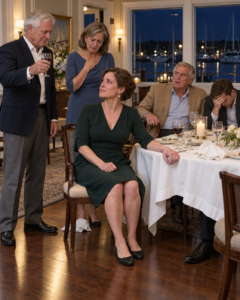
My brother said it standing up with a glass of bourbon in his right hand, and 22 guests turned toward him like sunflowers. It was 8:40 on a Saturday night in April. The private dining room of the Sevenpoint Yacht Club smelled like butter and salt air.
The windows looked out over black water and a row of white masts. There were candles in hurricane glasses. There was a cake on a side table with a flag made of strawberries and blueberries: “Welcome home, Brody.”
My father sat at the head of the table. He was beaming—not at my brother, at the man on his right. Retired Rear Admiral Harold Ashby, the commodore of the club. The man my father had spent two years trying to impress.
“Tell it right, son,” my father said. “Tell Howal the part about the fire.”
I kept my left hand under the table. I had kept it there all night. I had eaten a whole plate of crab cakes with one hand. I had passed the bread with one hand. I had held my water glass with one hand.
When Brody said “three trucks,” I reached for my napkin without thinking. Too slow.
The admiral’s eyes went down the table. They stopped on the back of my left hand, on the smooth, shiny skin that runs from my knuckles to my wrist. The skin that never tans. The skin that has never looked like the rest of me since July of 2011.
He stopped chewing. He did not swallow. He did not look away. He just stopped with his fork halfway down to his plate.
My father laughed. He had a big, easy laugh. The laugh of a man who sells boats.
“Something wrong, Hal?”
The admiral set his fork down very carefully. The way you set something down when you do not trust your hands. Then he turned in his chair—not toward my father, toward my brother.
“Son,” he said, “show me your hands.”
Nobody moved. The waiter by the door stopped with a coffee pot in the air. My brother’s wife, Jenna, gave a little laugh that died halfway out of her mouth.
Brody looked at his hands, then at our father, then at me. I will never forget his face in that second. He looked 23 years old again. He looked like a boy in a truck seat.
The question the admiral asked next had waited 14 years for somebody brave enough to ask it. But let me back up a little.
In the mathing PCA mathing has a great 219’s place.
2 days before that dinner, I was at my desk in Virginia Beach. It was a Thursday. It was 4:15 in the afternoon.
I was the operations officer for a Navy explosive ordinance disposal group. My whiteboard had 11 training events on it, three dive windows, and a note that said, “Call the range about the demo permit.” My coffee had gone cold at noon.
My husband Sam was somewhere in the Mediterranean on a destroyer flying helicopters, and he had sent me one photo that morning—a sunrise—and the words, “6 more weeks.”
My phone lit up: “Dad.”
My father does not call on Thursdays. My father calls on birthdays and when a pipe bursts at the house.
“Joe”—he never says hello—“Brody’s home.”
“I know, Dad. He texted me Tuesday. I’m so glad.”
“9 months in Kosovo.”
He said it like he had done the 9 months himself.
Phân cảnh 2: A Phone Call at Four Fifteen
“We’re doing a dinner Saturday. The club. 7:00.”
“I’ll be there.”
“Good. Listen to me.”
I heard his office chair creek. I could picture him leaning back under the wall of framed photographs.
“Hal Ashb is coming.”
“The Commodore.”
“The admiral,” my father corrected me. “A real admiral. He’s going to decide the haul out contract for the whole club in May. 41 boats, Joe. 41 boats hauled, bottom painted, and stored at Mercer Marine. Do you understand what that is?”
“That’s a lot of boats.”
“That’s the next 5 years.”
He paused.
“So, here are the rules.”
I picked up a pen. I do not know why. Old habit. When someone gives you rules, you write them down.
“No uniform,” he said.
“I wasn’t going to wear a uniform to a dinner, Dad.”
“You wore it to grandma’s funeral.”
“It was a military funeral. Grandpa was a Marine.”
“No uniform,” he said again. “And no stories.”
I put the pen down.
“What stories?”
“Your Navy stories, your bomb stories, your whatever. This is Brody’s night. Brody’s the one who’s been gone. Brody’s the soldier in this family, Joe. You know that. Let him have it.”
The soldier in this family. I had heard that sentence so many times that it did not even sting anymore. It was like a scar. It just sat there.
“I’m happy for him to have it,” I said.
And I meant it.
“Good. And Joe…” His voice dropped. “When he tells the convoy story, you let him tell it. Don’t do the thing.”
“What thing?”
“The thing where you sit there with that face like you know better. Hal’s going to ask about Afghanistan. Brody’s going to tell it. You smile and you eat your dinner.”
I looked at my left hand on the desk. The shiny skin caught the fluorescent light.
“Okay, Dad.”
“7:00,” he said. “Wear something nice.”
He hung up. I sat there for a long time. The clock on my wall said 4:22.
7 minutes. It had taken my father 7 minutes to tell me one more time who I was allowed to be.
I want to explain something before I go on. My family is not a cruel family. Not in the way people imagine cruel families. Nobody hit anybody. Nobody starved.
My father built a boatyard on the South River with his own hands. He started with one travel lift and a gravel lot. And by the time I was 10, he had 40 slips, six employees, and a sign with our name on it painted in navy blue and gold.
My father loves the water. He loves boats. He loves men in uniform. He just never saw one standing in his kitchen when it was me.
I went to the Naval Academy. It was 12 miles from our house. My father drove me to induction day in 2003 and said in the parking lot, “Well, it’s a good place to meet a husband.”
He was right about that, in a way. I met Sam there. But I also met a version of myself that I liked. A woman who could run a problem to the ground. A woman who was calm when other people were loud.
I was commissioned in May of 2007. I was 22. I spent two years on a ship. Then I did something that surprised everyone, including me.
I put in for explosive ordinance disposal. EOD, the bomb squad, divers, parachutists, and people who walk toward the thing everyone else is running from.
The training was long. Dive school first, then the ordinance school, then more. I failed nothing.
I came home for Christmas that year with a new badge on my chest, and my father asked if the Navy let women actually touch the bombs or just the robots.
“Both, Dad,” I said.
“Huh?” he said, and then he asked Brody about his truck.
Brody is 3 years younger than me. He enlisted in the army in 2010 as a motor transport operator. He drove trucks, big ones. He was good at it.
He was 22, loud, funny, and so proud of himself in that uniform that he wore it to the grocery store. My father framed his basic training photo the week it arrived.
In the spring of 2011, Brody deployed to Kandahar Airfield in Afghanistan with a transportation company. In May of 2011, so did I.
Different services, different missions, same patch of desert. That is the part of the story that my family has never once said out loud.
That Thursday night, I went home to my apartment near the beach. I made a grilled cheese.
Phân cảnh 3: A Clipping With a Straight Edge
I did not eat it. I opened my laptop and I went to an email folder I had made 14 years before. It had one message in it.
The folder was named B. I did not open the message. I just looked at the subject line. It said, “Please.”
It was sent on July 14th, 2011, at 11:52 at night, Kandahar time. I had kept a promise for 14 years. I did not know it was also a lie I was helping him tell.
I closed the laptop. I went to bed. I did not sleep much.
When I did, I dreamed about heat—not the heat of the desert, the heat of metal, the kind of heat that comes through a glove.
On Friday, I left work at 2 and drove north. Three and a half hours up the Bay Bridge tunnel and across the eastern shore and back over the big bridge into Annapapolis.
I stayed at my parents’ house in my old room, which had become my mother’s sewing room around the time I left for the academy. My mother, Carol, hugged me at the door. She smelled like lemon soap. She held on one second longer than usual.
“He’s so thin,” she whispered. “Brody. Kosovo made him so thin.”
“He’ll eat,” I said.
“Your father’s been at the yard all day. He wants you to come see the new lift.”
So I drove down to Mercer Marine. The yard looked the same as it always did. Hulls on stands, a forklift with one headlight. The smell of bottom paint and diesel and river mud.
My father was in the office, a low building with a porch and a window unit that rattled. He showed me the new travel lift—70 tons, blue paint. He patted it the way some men pat a horse.
Then we went into his office and I saw the wall.
I have seen that wall my whole life. My father’s wall. It is covered in frames. Boats he built. Boats he saved. A photo of him with a governor. A photo of him with a man who once played baseball for Baltimore.
In the center, in the biggest frame, is Brody. Brody in his Army uniform, grinning. And beside it, a newspaper clipping from the Annapapolis paper from August of 2011.
The headline says, “Local soldier’s convoy survives ambush in Afghanistan.”
There is a photo with it. A burned truck on a road, a column of smoke. The clipping is narrow, narrower than it should be.
The right side of it is cut in a clean, straight line, as if someone laid it on a table and used a ruler and a razor. I had noticed that cut when I was 26. I had noticed it every year since. I had never asked.
“Nice, right?” my father said.
He was looking at the wall, not at me.
“I had them rematted—gold trim—for the dinner. I’m bringing Hal down here Monday to see the yard. I want him to see this.”
“It’s nice, Dad.”
“That’s my boy,” he said.
He tapped the glass over Brody’s face.
“Three trucks. Pulled them out himself.”
I looked at the clean edge of the clipping. I said nothing.
Summer versus a batter stis.
Saturday came in gray and cold, with wind off the sea that made the flags on the club dock snap like sheets on a line. I wore a dark green dress and flat shoes. I put my hair up.
I looked at myself in my mother’s sewing room mirror and practiced a face. The face my father wanted. Pleasant, quiet, nothing behind the eyes.
My mother knocked and came in holding a pair of earrings.
“Wear these,” she said. “They were grandma’s.”
“Thank you, Mom.”
She clipped them on for me the way she did when I was little. Her fingers brushed my left hand as she stepped back. She looked down at the scar. She always looked at it. She never asked about it.
“Your father’s nervous,” she said. “About the admiral.”
“I know.”
“Just let tonight be easy, honey.”
“For Brody, I will.”
She hesitated at the door. For a second, I thought she was going to say something else. Then she smoothed her skirt and went downstairs.
The Sevenpoint Yacht Club sits on a low bluff over the river. It is white clapboard with dark shutters, and there is a brass bell by the front door that the members ring when someone wins a race.
There were 22 place cards on the long table in the private room. My father had written them himself.
I found my card at the far end of the table between a boat broker named Trip and the empty chair where the dessert cart would sit. Brody’s card was at the head, on my father’s left. The admiral’s was on my father’s right.
My brother arrived at 7:10 with Jenna on his arm. He was in a pressed blazer and his Army National Guard lapel pin. He was thin, like my mother said. His cheekbones stood out.
His eyes looked tired in the way eyes look when they have been somewhere for 9 months that was not home. He saw me across the room and his face opened up.
“Jojo.”
Nobody else calls me that. He hugged me hard and lifted me off my feet the way he used to when we were teenagers and he had just grown taller than me.
“Welcome home,” I said into his shoulder. “I missed you.”
“Missed you too.”
He sat me down. He looked at me for a second too long.
“You good?”
“I’m good.”
Jenna kissed the air next to my cheek.
“Joanna, you look nice. Civilian.”
Phân cảnh 4: Twenty-Two Place Cards
“Thank you, Jenna.”
“Lyall said you might wear your little navy outfit.”
“Not tonight.”
“Good call,” she said, and turned away to find the bar.
The admiral came in at 7:20. He was not what I expected. I had pictured a big man with a big voice.
Harold Ashb was medium height and trim, with white hair cut short and a face lined like a chart. He wore a navy blazer with the club crest on the pocket. He walked the way senior officers walk even in retirement. Unhurried, like the room would wait.
My father met him at the door with both hands.
“Hal, how? Welcome, everyone. This is Commodore Ashb. Rear Admiral Ashb. A real admiral, folks. 34 years in the Navy.”
“33,” the admiral said, smiling. “Lyall rounds up.”
People laughed. My father laughed loudest.
Then my father brought him down the length of the room, introducing him to everyone. The broker, the marina manager, two couples from the racing committee, Brody’s old friends from high school, Jenna’s parents.
When he got to me, my father’s hand came to rest on my shoulder lightly. The way you steady a boat against a dock.
“And this is my daughter, Joanna. She’s down in Virginia Beach. Works for the Navy.”
“Is that right?”
The admiral looked at me with polite interest.
“Which command?”
My father’s hand pressed down. Just a little.
“She’s in an office,” my father said. “Paperwork, planning, you know.”
“Mostly planning,” I said.
“Well,” the admiral said, “somebody has to.”
He shook my right hand. His grip was dry and firm. He moved on.
I sat down at the end of the table and put my left hand in my lap. The dinner was very good. Crab soup, crab cakes, rockfish with lemon butter.
My father ordered four bottles of wine and a bottle of bourbon that cost more than my first car payment. He kept Hal’s glass full. He kept the conversation on boats and weather and the contract until Hal politely steered it somewhere else.
“So, Brody,” the admiral said as the plates were cleared. “Kosovo. What was the mission like?”
Brody sat up straighter. He told them about it. Patrols, checkpoints, the cold. A family that brought his squad bread every Sunday.
He was a good storyteller. He always was. He had a way of leaning in, of lowering his voice at the right moment, of looking you right in the eye.
It was a good story. It was true. I was proud of him.
Then Jenna put her hand on his arm.
“Tell them about Kandahar, babe.”
Brody’s smile flickered. Just once. I saw it because I was looking for it.
“Nah, that’s old news.”
“Come on,” my father said.
He clapped the table.
“Hal’s never heard it. Tell it, son. Tell it right.”
The admiral turned his chair a little toward Brody politely. The way men of his generation do when a younger veteran speaks.
“I’d like to hear it,” he said. “I spent some time in Kandahar myself.”
That was the moment. I could have stood up. I could have said I had a headache. I could have gone out to the parking lot and sat in my car and let it happen without me in the room.
I did not. I do not know why. Maybe some part of me wanted to hear it one more time with that man sitting there.
Brody picked up his bourbon. He stood.
“August of 2011,” he said. “Highway 1, west of Kandahar City. We’re running a combat logistics patrol. 11 vehicles, fuel, water, ammo, parts for a forward operating base out in…”
My voice changed when he told it. It always did. It got slower, deeper. A voice for campfires.
“0600. We roll out. Sun’s barely up. It’s already 90°. You can smell the road. Like hot tar and dust and something burning. Always something burning out there.”
I closed my eyes for a second. I could smell it, too.
I had been in the fourth vehicle. An armored truck with a robot bolted to the back and two of my sailors in the seats behind me. I opened my eyes.
“Couple hours in,” Brody was saying, “we hit it.”
He was wrong about that. It was 40 minutes in. The strike came at 6:40 in the morning. I know because I called it in. I have heard my own voice on the recording reading the time.
“Big pressure plate bomb under the lead truck,” Brody said. “Then the rockets from the treeine. Truck one goes up. Truck two slams into it. Truck three gets hit in the side. Three trucks on fire. Just like that.”
The table was silent. 22 people holding their forks. Brody set down his glass so he could use both hands.
“And everybody’s frozen,” he said. “Everybody. You can’t imagine it. The noise, the heat, guys screaming on the radio.”
That part was true.
“So I get out of my seat,” Brody said.
Something in my chest pulled tight like a line coming taut.
“I run up that road,” he said. “I don’t even think. I get to truck one. Driver’s door is jammed. I get it open. I drag him out. Then truck two, then truck three.”
He paused. He always paused there.
“Truck three was the worst,” he said quietly. “Fire all over the back. The rear hatch is stuck. There’s a guy inside yelling. And I’m pulling on that handle and it’s so hot.”
I heard myself speak.
“It was July, Brody.”
I said it softly. I do not even know why I said it. Maybe because he had just said it was August. Maybe because the date is the one thing I have never been able to hear wrong.
“It was the 14th of July,” I said. “Not August.”
The whole table turned and looked at me.
My father’s face did something I had seen only a few times in my life. It went very still. Then it went red from the collar up.
“Joanna.”
“I’m sorry. I just meant—”
“Let your brother tell it.”
Phân cảnh 5: A Boy on a Bicycle
My father’s voice was not loud. It did not need to be. It carried down that table like a cold draft under a door.
“You weren’t there.”
Nobody said anything. The broker next to me looked at his plate. One of the racing committee wives covered her mouth with her napkin.
Jenna smiled a small, satisfied smile and leaned into Brody’s arm.
“Some of us,” she said to no one in particular, “don’t need to correct the hero.”
I looked at my father. He looked back at me the way he has looked at me my whole life. As if I were a boat that had drifted into the wrong slip.
You weren’t there.
I thought about saying it. I thought about the six words it would take. I was there. I was right there.
Then I thought about an email sent at 11:52 at night, 14 years earlier, with one word in the subject line. Please.
I picked up my water glass with my right hand. I took a sip. I put it down.
“You’re right, Dad,” I said. “Go ahead, Brody.”
My brother looked at me. He did not look relieved. He looked like a man standing on something that had just shifted under him.
“Anyway,” he said.
His voice was thinner now.
“Truck three.”
My father smiled again and turned to his guest.
“This is the best part, Hal.”
“Kandahar,” Brody said. “Three trucks. I pulled them out myself.”
And that was when I reached for my napkin. That was when the admiral’s eyes came down the table and found my hand. That was when he stopped chewing.
And in that one second, while 22 people waited for him to swallow, I was not in the yacht club anymore.
I was on Highway 1. It was 6:40 in the morning on the 14th of July, 2011. I was 26 years old.
I was a lieutenant in the United States Navy, and I was the officer in charge of a threeperson explosive ordinance disposal team attached to an Army counterbomb task force in Kandahar Province.
Our job that morning was simple on paper. Ride with the convoy. If the route clearance team up front found something, we would stop, send the robot, and take it apart. If something found us first, we would do what we could.
11 vehicles, big armored trucks spaced 50 m apart. We were in the fourth.
My technician, Petty Officer First Class Luis Carrasco, sat behind me with the robot controller on his knees. My second tech, a quiet kid from Oregon, had the radio.
I knew which company we were escorting before I got in the truck. I had asked for this convoy. I had traded a mission with another team to get it because my little brother was driving truck 7.
I had seen him once at the airfield two weeks before. We had eaten bad pizza together at a picnic table under a camouflage net. He had called me Jojo in front of three of his friends and I had let him.
He told me he was scared of the roads. I told him that was the correct thing to be.
“Nobody at home knows we’re both here,” he said. “Don’t tell mom. She’ll lose her mind.”
“I won’t.”
“You think dad knows the Navy even sends people here?”
“I think dad thinks I’m on a boat,” I said.
He laughed so hard that he choked on his pizza.
So, on the morning of the 14th of July, I sat in truck four, and three trucks behind me, my brother sat in truck 7. And I thought, if anything happens today, I am close.
The road was flat. The fields on both sides were green in strips where the canals ran and brown everywhere else.
There was a line of trees on our right, maybe 200 m out, a mud wall, a boy on a bicycle who stopped and watched us go by and then turned around and rode away very fast.
“Boy on the bike just bugged out,” Carrasco said.
“I saw,” I said.
I keyed the radio to tell the convoy commander. I got as far as the first word.
The lead truck went up.
I have tried for 14 years to describe that sound and I cannot. It is not a bang. It is a weight. It lands on your chest and your ears at the same time.
The windshield of our truck went white with dust. Our driver stood on the brakes.
When the dust thinned, I saw truck one tipped on its side with its front end torn open. Truck two had run straight into its back. Truck three had swerved left, and as it did, something came out of the treeine with a streak of gray smoke and hit it in the side.
Then there was fire. Rifle fire from the trees, our gunners answering it. Somebody on the radio yelling a call sign over and over. Black smoke coming off three trucks at once and rolling across the road toward us.
“Contact right,” our driver was saying. “Contact right. Contact right.”
I called it in. I heard my own voice. Very flat, very slow.
“0640. Three vehicles hit. Fire in all three. Request medevac.”
Then I looked back through the rear window. Truck 7 sat in the road 150 m behind us. The driver’s door was closed.
Through the windshield, I could see a shape in the driver’s seat. Both hands on the wheel. Not moving. Brody.
I turned around. I looked at the burning trucks ahead of us. There were men inside them.
The convoy would not move forward. It could not. The road was blocked. The trucks behind us would hold. The gunners would hold the tree line.
The medics were in truck 9 and truck 10, and they were already calling for cover to move up. But the fire would not wait for cover.
Phân cảnh 6: Mother May I in White Paint
“Luis,” I said, “you’re on the robot. Sweep the shoulder in front of truck one. If there is a second device, I want to know before I step on it.”
“Ma’am, you can’t—”
“Sweep it.”
“Ma’am—”
“That’s an order, Luis. Sweep it now.”
He swept it. The robot rolled out of our back hatch and bumped down onto the road. I watched the little screen over his shoulder for 40 seconds.
40 seconds is a very long time with men on fire in front of you.
“Shoulder’s clear to the first truck,” he said. “Left side only. Stay on the left side.”
I got out. I do not remember deciding to run.
I remember the heat coming off the asphalt through my boots. I remember the sound of rounds going over, a snapping sound, like someone cracking a whip just above your head. I remember counting my steps because counting is what they teach you to do when your mind wants to do something else.
Truck one was on its side. The driver was hanging in his harness, awake, bleeding from his face, shouting that his leg was stuck.
I cut the harness. I got his leg free from under the pedal. I dragged him out through the windshield opening and around the front of the truck into the ditch where the steel would be between him and the trees.
His name tape said, “Oduya.”
He kept saying, “Thank you. Thank you. Thank you.” Like it was the only word he knew.
“Stay down,” I told him. “Stay right here. Medics are coming.”
Truck two. The cab was crushed against the back of truck one and smoke was pouring out of the engine. Two men inside. The passenger door would not open.
I climbed up on the running board and got the driver’s door. I pulled the driver. Then I went across the seat for the passenger, who was unconscious and very heavy.
And I got my hands under his arms and I backed out of that truck one step at a time. I put them both in the ditch with Oduya.
Then truck three.
Truck three was the worst. My brother was right about that much. It had been hit in the side. The rocket had come through behind the cab.
The back compartment was burning. I could see flames through the gunport. The crew in front had gotten out on their own and were down in the ditch, dazed, but somebody was still in the back.
I could hear him. He was banging on the inside of the rear hatch with his fist. Slow, heavy, like he was running out of strength.
The rear hatch on that kind of truck is a big steel door with a handle that you pull down and out. I grabbed it with my right hand. It did not move. It was jammed from the blast.
I put my left hand on it, too. The handle was so hot that it did not feel hot. It felt cold, and then it felt like nothing at all.
I pulled. I pulled with my whole body. I put my boot against the bumper and pulled until I heard something in the frame give.
The hatch opened six inches. Then a foot, then enough.
There was a man inside in body armor on his knees in the smoke. Older, gray hair, no helmet. His face was black with soot.
He was not in the army uniform. He was in navy camouflage, and I did not know him, and I did not have time to wonder who he was.
He looked up at me. I reached in with both hands and got him by the shoulder straps of his armor, and I said something to him.
I have never told anyone what I said. Not my husband, not my mother, not the investigator who took my statement that night at the airfield.
It was not brave. It was not anything. It was just the words that came out.
Then I pulled him out and we both fell down on the road, and the back of that truck went up in a sheet of orange behind us.
The medevac helicopter landed at 6:58. They took Oduya and the two men from truck 2 and the older officer from truck 3.
The older officer held on to my left hand the whole way to the helicopter. He would not let go. A medic had to open his fingers one at a time.
That was when I looked down and saw my glove. It had melted into the back of my hand.
I did not feel anything until the next afternoon. And then I felt it for about 3 months.
I looked back once before they put me in the second helicopter. I looked back down the road. Truck 7 was still sitting there. The driver’s door was still closed.
It is the matter any day.
Phân cảnh 7: A Kneeboard in Grease Pencil
“Son,” the admiral said again. “Your hands, please.”
Brody laughed. It came out wrong, high and short.
“Sir?”
“Humor and old man.”
My brother looked at our father. My father spread his own hands and chuckled like this was a party game.
“Go on, Brody. Show him. Hal wants to see the hands of a hero.”
Brody set his glass down. Slowly, he held out both hands, palms up over the white tablecloth.
They were good hands, big, square, a few calluses from the guard and from summers at the yard. A white line on one thumb from a boat cleat when he was 12. Nothing else.
The admiral looked at them for a long moment. Then he nodded as if he had confirmed a measurement.
“Thank you,” he said. “You can put them down.”
Brody put them down. He did not sit.
“Truck three,” the admiral said. “The rear hatch, you said it was stuck.”
“Yes, sir.”
“Which way does it open?”
Brody blinked.
“Sir?”
“The rear hatch on that truck. Does it swing out to the left or out to the right? Does the handle pull up or down?”
“It…”
Brody looked at the ceiling.
“It swings out to the side.”
“Which side?”
“The right, I think. It was a long time ago, sir.”
“It was,” the admiral agreed.
He picked up his napkin and folded it once, very neatly, and set it beside his plate.
“Something was painted on the back of that hatch. Big white letters. The crew painted it themselves. What did it say?”
The room had gone completely silent. Out on the water, a howiard was slapping against a mast. Clink, clink, clink.
My father leaned forward. His smile was still there, but it had gone stiff at the edges.
“Hal, come on. The boy’s been home a week. Give him a break.”
“I will, Lyall. In a moment.”
The admiral did not look away from Brody.
“What did it say, son?”
Brody opened his mouth. Nothing came out.
I knew what it said. I had been looking at it when I pulled. It said “mother may I” in white spray paint with a little crooked smiley face after it.
I did not say anything. I kept my eyes on my plate.
“I don’t remember, sir,” Brody said.
“No,” the admiral said gently. “I don’t think you would.”
“Hal.”
My father’s voice had changed. It was the voice he used on customers who questioned an invoice.
“I don’t understand what we’re doing here.”
The admiral turned then. Not to my father, not to Brody—to me.
He looked down the whole length of that table, past the candles and the wine glasses and the strawberries on the cake, and he found my eyes and he held them.
“Joanna,” he said. “May I see your left hand?”
I did not move.
“Oh, for heaven’s sake,” Jenna said with a little laugh. “It’s a burn. She burned it on a stove or something. She’s had it forever.”
The admiral did not look at Jenna.
“Please,” he said to me.
I brought my left hand up from my lap. I laid it on the tablecloth, palm down. The candle light moved across the shiny skin.
The admiral looked at it the way you look at the face of someone you thought had died. Then he spoke, and he spoke to the whole room.
“On the 14th of July, 2011,” he said, “I was a captain in the United States Navy. I was the deputy commander of a counterexlosives task force headquartered at Bram.
“I rode along on a combat logistics patrol west of Kandahar City to see how our route clearance teams were doing their jobs. I sat in the back of the third truck.”
My father’s mouth opened. It stayed open.
“We hit a buried device at 6:40 that morning,” the admiral said. “Then rockets. The third truck caught fire with me inside it. The rear hatch jammed. I could not open it from the inside. I banged on that door until I could not lift my arm.”
He paused. His voice was steady, but his hand on the table was not.
“Someone opened it from the outside. It took a long time. It took a long time because the handle was glowing. The person who opened it put both hands on that handle anyway.
“She pulled me out and fell in the road with me. And I held on to her left hand all the way to the helicopter. It was burned to the wrist. I remember the glove. It had melted into her skin.”
Nobody breathed.
“I did not know her name that morning,” he said. “I learned it that night. I wrote it down and I have carried it for 14 years. Lieutenant Joanna Hadley, United States Navy, Explosive Ordinance Disposal.”
Phân cảnh 8: Rain on a Tin Roof
He looked at me.
“Hadley is your married name, isn’t it?”
“Yes, sir,” I said.
My voice was very quiet.
“It is.”
The admiral nodded slowly. Then he asked me the question. The one I had never answered for anyone.
“Commander, what did you say to me when that hatch opened?”
Commander. He had worked it out. My years, my rank. He had done the math at the table the way I would have.
My father turned and stared at me as if he had never seen me before.
I could have said I did not remember. It would have been easy. It would have been kind to everyone at that table except me.
I looked at my brother. He was still standing. His face had gone gray. He gave me the smallest nod I have ever seen. Almost nothing, just a dip of the chin.
“Go ahead,” it said.
So I told the truth.
I said, “Sir, you are heavier than you look. Stay with me.”
The admiral closed his eyes.
“Yes,” he said. “That is exactly what you said.”
He pushed back his chair and stood up. He was 64 years old and he stood up very straight.
He picked up his wine glass and raised it. Not high, just to the level of his heart, and he looked at me.
The racing committee members stood. Trip, the broker, stood. Brody’s old friends from high school stood. One of the waiters by the door put down his coffee pot and stood at attention like somebody had called the room to order.
My mother stood last. Her napkin fell off her lap onto the floor, and she did not pick it up.
My father did not stand.
“Hal,” he said.
His face had gone from red to white.
“Hal, she doesn’t even know what truck you mean. She was never out there. She was on a ship. She—”
“Ly.”
The admiral’s voice was very calm and very tired.
“Your daughter was the only person on that road who got out of her seat.”
He did not say anything else. He did not have to.
Brody sat down all at once like his legs had quit. He put his face in his hands. Those clean, unmarked hands.
The admiral lowered his glass without drinking.
“Commander,” he said to me, “would you walk me to my car?”
I stood up. I did not look at my father. I walked the length of that room, past the candles and the cake with the strawberry flag, and every person in it watched me go.
In the hallway, under a painting of a clipper ship, the admiral stopped and turned to me.
“I tried to find you,” he said. “After I put you in for the Silver Star, I wrote a statement and I signed it. I called your command twice. They told me you’d rotated home. I thought about you every 14th of July.”
Phân cảnh 9: One Chair on the Pier
“I got the paperwork,” I said. “I didn’t know who the statement was from. It just said the senior officer in truck 3.”
“It was me,” he said. “It was always me.”
He put out his hand, his right hand. Then he looked down and he switched and he held out his left hand instead.
I put my scarred hand in his. He held on to it. He held on the same way he had on the road, like he would not let go until someone opened his fingers.
“Thank you,” he said. “I never got to say it. Thank you.”
“You’re welcome, sir.”
He let go. He looked back toward the private room. We could hear voices now. Low and fast. My father’s voice over the top of them.
“I’m sorry,” he said, “about how that happened. Your father’s a friend. I didn’t mean for it to happen in front of everyone.”
“You didn’t make it happen, sir.”
“No,” he said. “I suppose I didn’t.”
He put on his coat at the door. He stopped.
“I’m going to call you this week,” he said. “I kept a copy of something. You should have seen it 13 years ago.”
Then he went out into the wind.
Everything of that bloopers and description.
I did not go back in the room. I stood in the hallway for maybe a minute. Guests started coming out. The racing committee couple. Trip.
They did not know where to look. One of the wives touched my arm on her way past and said, “Thank you for your service,” very quickly, the way people say it at airports.
And then, before she let go, she said it again, slower.
“No, really. Thank you.”
Then my father came out of the private room. He shut the door behind him. He walked up to me close. So close I could smell the bourbon.
“You planned this.”
“Dad—”
“You planned this. You knew who Hal was. You sat there all night and you let it happen. You set this up to humiliate your brother.”
“I didn’t know who he was until he said it. Neither did you.”
“You could have stopped it.”
“How, Dad?”
I heard my voice rise for the first time that night. I brought it back down.
“You told me I wasn’t there. I said you were right. I let Brody tell it. I did everything you asked me to do.”
“You put your hand on the table.”
“He asked me to.”
My father stared at me. His jaw was working. For a second, a small, stupid part of me thought he was going to say it.
I’m sorry. I didn’t know. Why didn’t you tell me?
“41 boats,” he said instead. “Do you understand what you just did to me? In front of Hal.”
I looked at him for a long moment.
“Yes,” I said. “I think I finally do.”
I walked past him and out the side door and down the wooden steps to the dock. It was 10:05 at night. The wind had dropped.
The water was black and flat, and the masts made a forest of white sticks against the sky. I walked out to the end of the dock and stood there with my arms crossed and my left hand tucked under my right elbow the way I had stood a thousand times.
I heard footsteps on the boards behind me. I knew the walk. I had known it since he was four and followed me down this same dock to look for crabs.
Brody stopped a few feet away. He did not come closer.
“Jojo.”
I did not turn around.
“I’m sorry,” he said.
His voice broke on the second word.
“I’m so sorry.”
“Why, Brody?” I asked the water. “14 years. Why?”
He was quiet for a long time.
“Because when I came home, dad met me at the airport with a sign,” he said. “It said, ‘My son, the hero.’ He’d seen the newspaper. He’d heard there was an ambush on my convoy. He asked me what happened. And I couldn’t tell him that I sat there.”
I turned around then. He was crying. Not loudly. The way men cry who were taught not to.
“You went past my window,” he said. “I watched you go past my window. You ran right past me and I couldn’t make my hands let go of the wheel. I couldn’t get out of the seat, Joe. I tried. I told my hands to move and they wouldn’t.”
“I know,” I said.
“And then Dad was standing there with that sign. And I said, ‘Three trucks.’ And he said, ‘You pulled them out?’ And I didn’t say no. [snorts] I just didn’t say no.”
He wiped his face with the back of his hand.
“And then I said it at the yard, and then I said it at Christmas, and every time I said it, it got easier and I got sicker.”
“You asked me not to tell him.”
“I know.”
“That night you emailed me.”
“I know what I wrote.”
He looked at the dock under his feet.
“Do you still have it?”
I took my phone out of my purse. I opened the folder named B. For the first time in 14 years, I opened the email.
We have not allowed for it. Winding to word.
The subject line said, “Please.” The body was four lines long.
“Joe, I couldn’t get out of the seat. I watched you go past my window and I couldn’t move. I’m so ashamed. I can’t breathe. Please don’t ever tell Dad. Please. B.”
11:52 at night. 14th of July, 2011. I read it out loud to him on the dock. My voice did not shake until the last word.
Brody sat down on a dock box and cried into his hands. I sat down beside him. I did not put my arm around him. I did not move away either.
“I kept it,” I said. “Every time I changed phones, every time I changed computers, I kept it because it was the only place in the world where the truth was written down.”
“You could have shown him anytime.”
“I promised.”
“I know.”
He laughed. A wet, broken sound.
“You always keep your promises. It’s the most annoying thing about you.”
We sat there until the club manager came out and told us very politely that they were closing the dock.
On Sunday morning, I drove back to Virginia Beach. My father did not come out of his bedroom to say goodbye. My mother stood on the porch in her robe with her arms around herself and watched me load the car.
“I didn’t know,” she said.
That was all.
“Joe, I didn’t know.”
“I know, Mom.”
She did not ask me anything else. I did not offer. I was too tired and I did not trust myself to do it kindly.
That night, my phone buzzed with a text from a number I had not seen in 2 years. Chief Petty Officer Luis Carrasco, my technician from Truck 4. He was a chief now at a unit in San Diego.
“Ma’am, got a call from a retired admiral this afternoon asking if I remembered the morning of the 14th of July, 2011. Told him I remember it every day. Is everything okay?”
I stared at it for a long time. Then I typed back.
“Everything is finally okay, Luis. I think.”
Three dots appeared and disappeared four times. Then:
“For the record, ma’am, since he asked, strike at 0640. You sent me to sweep the shoulder at 0641. You were out the door at 0642. First driver in the ditch at 0643.
“Truck 2 crew by 0648. Truck 3 hatch open at 0651. Bird on deck at 0658. I wrote it on my kneeboard in grease pencil. I still have the kneeboard.”
And then:
“You told me to stay on the robot. I have never been that scared of an order in my life. You were right, though. There was a second device 40 m past truck one, right side. If you had gone right, we would not be texting.”
I set the phone face down on my kitchen table. I put my forehead down next to it.
I had never known about the second device. Nobody had told me. They had pulled me out of that road and put me on a helicopter and started peeling a glove off my hand, and the world had kept going without me.
In this time, on Monday morning, the admiral called my office.
“Commander Hadley, it’s Hal Ashb.”
“Good morning, sir.”
“I’m going to be in Norfolk on Wednesday for a board meeting. May I come by? I’d like to bring you something.”
“Of course, sir.”
“And commander…”
He paused.
“I called your father yesterday to tell him I’d be taking the club’s hall out contract to a public bid. I want you to know that’s not about you. It’s about me.
“I can’t give a contract to a man who looked me in the eye and told me my rescuer was never out there. I’d have to think about that every time I walked through his yard.”
I did not know what to say to that. So I said, “Yes, sir.”
“Wednesday,” he said. “10.”
He came at 10:00 exactly, in a gray suit, carrying a thin brown folder under his arm.
My office is small. One desk, two chairs, a window that looks out on a parking lot, and a line of pine trees.
He sat in the chair across from me and set the folder on the desk between us. He kept one hand flat on top of it.
“In September of 2011,” he said, “I wrote this. It’s a statement of eyewitness to go with your commander’s recommendation. I recommended you for the Silver Star.”
He slid the folder across. The paper inside was 13 years old and soft at the edges. Two pages, typed, signed at the bottom in blue ink. HR Ashby, Captain, United States Navy.
I read it. I will not tell you everything it said. Some of it is not mine to share, but one line of it I have read so many times since that day that I could say it with my eyes closed.
“She moved toward the fire when every trained instinct in the human body says to move away from it, and she did it three times.”
“Somebody up the line changed it,” the admiral said. “A bronze star with a combat V. Still a valor award, still an honor, but not what I wrote.”
He tapped the edge of the folder.
“I wrote the words. Somebody above me changed the medal. Nobody could change what you did.”
“They pinned it on me in March of 2012,” I said. “In a hanger in Virginia Beach.”
“Was your family there?”
I opened my desk drawer. I took out a photograph. I had not looked at it in years.
It showed me in dress blues, standing at attention with an old commander pinning a metal on my chest. Behind us were folding chairs, 12 of them.
Two had little reserved cards taped to the seats. Mr. and Mrs. Mercer. Both chairs were empty.
“Boat show weekend,” I said. “Anapapolis in the spring. Dad had four boats in the water.”
The admiral looked at that photo for a long time. Then he took off his reading glasses and rubbed his eyes.
“Well,” he said, “He<ilct none of them ours.”
On Saturday, my mother called. She never calls. My mother texts, short texts with too many exclamation points and photos of her tomatoes.
“Joe.”
She was whispering.
“I’m in your father’s office at the yard. He’s at the hardware store. I need to send you something.”
“Mom, what’s wrong?”
“Nothing’s wrong. Everything’s wrong. Hold on.”
My phone buzzed. A photo.
It was the top drawer of my father’s desk. The one he kept locked when we were kids. Inside, on top of a pile of old invoices, was a yellowed rectangle of newspaper.
It was the right side of the clipping, the part that had been cut off. It was a second photograph, smaller.
A young woman in desert camouflage with a white bandage wrapped around her left hand, sitting on the backst step of an ambulance at Kandahar Airfield. She was looking at the camera like she did not know it was there.
And under it, the caption: “Navy Lieutenant Joanna Hadley of Annapapolis is treated for burns after pulling crew members from three burning vehicles during the ambush. Military officials credited her actions with saving four lives.”
My mother’s voice came back on the line.
“Your name was on it, Joe,” she said. “Your picture. It was right there. He cut it off himself. He kept it in the drawer.”
She was crying now.
“14 years. He kept the piece he cut off. Why would he keep it?”
I looked at that young woman in the photo. 26, hand wrapped, eyes far away.
“I don’t know, Mom,” I said. “Maybe he couldn’t throw it away. Maybe he just couldn’t hang it up.”
“I’m going to take it,” my mother said. “I’m taking it out of here.”
“Mom, no.”
“I’m taking it.”
There was a pause. I heard a drawer slide shut.
“Brody wants to talk to your father tomorrow,” she said. “Here at the yard. He asked if you would come.”
I looked at the photo on my screen for a long time.
“I’ll come,” I said.
He has no whly.
On Sunday, April 13th, I drove north again. 3 and 1/2 hours. I did not play the radio.
The yard was closed. It was raining lightly. The hulls on their stands were dark and dripping. My father’s truck was parked by the office. Brody’s was next to it.
Inside, my father sat behind his desk under the wall. Brody stood by the window with his arms folded. My mother sat in the old vinyl chair by the door where customers wait.
Nobody said hello.
“Well,” my father said, “here she is.”
Brody took a folded piece of paper out of his jacket pocket. His hands were shaking.
He had printed the email. He had printed it on a Saturday night, at home on his own printer, and folded it in quarters.
“Dad,” he said, “I need to read you something. I need you to let me get all the way through it.”
My father looked at him. He looked at me. He leaned back in his chair and crossed his arms.
“Go on, then.”
Brody read it.
“Joe, I couldn’t get out of the seat. I watched you go past my window and I couldn’t move. I’m so ashamed I can’t breathe. Please don’t ever tell Dad. Please. Be.”
He folded it back up. He put it on the desk in front of our father.
“I wrote that the night of the ambush,” he said. “I was in truck 7, Dad. I sat there. I never got out of the seat. She pulled out every single one of those men.
“I stole her story because I was ashamed. And you wanted it so bad. I just let you have it. And she let me keep it for 14 years because she promised.”
My father did not pick up the paper. He looked at it. He looked at Brody.
Then he turned his head and looked at the wall, at the big frame with the gold trim, at his son in uniform and the narrow, cut down clipping beside it.
“It doesn’t matter,” he said.
Brody stared at him.
“What?”
“It doesn’t matter who did what.”
My father’s voice was calm, almost reasonable.
“It was 14 years ago. It was a war. People remember things different. You were there. You served. You came home.”
He pointed at the frame.
“You’re the soldier in this family, Brody. That’s not going to change because Hal Ashby had too much wine.”
The room was very quiet. The rain ticked on the tin roof. My mother made a small sound in her chair.
I stood up. I reached into my coat pocket and took out the piece of newspaper my mother had pressed into my hand in the parking lot in a plastic sleeve. I laid it on the desk next to the email.
The young woman with the bandaged hand looked up at the ceiling.
“You knew,” I said.
My father did not look at it.
“You read it in August of 2011,” I said. “You saw my name. You saw my picture and you took a razor and you cut me off the page and you put the piece in your drawer and you hung up the rest.”
“Joe—”
“I’m not asking you why, Dad. I stopped needing to know that about 10 minutes ago.”
I kept my voice level. It is a trick they teach you for rooms with bad things in them. Slow your breathing. Say less.
“I just need you to know that I know.”
“You always had to be the one,” he said.
His voice had gone low and bitter.
“The academy, the bombs, the medals. You never needed anything from me. Brody needed me. Brody needed something to be proud of.”
“He had something,” I said. “He had a sister who went back for him.”
My father’s jaw tightened. He looked away.
“It never mattered to you,” I said. “It mattered to me. That’s the difference, Dad.”
He said nothing.
“This was never about the story,” I said. “It was about who you would let me be.”
I left the clipping on his desk beside the email under the wall of frames. I did not wait to see if he would pick them up.
I walked out of the office and down the steps and into the rain, and I stood in the middle of the gravel yard between the dark, wet hulls, and for the first time in 14 years, I did not feel like I was carrying anything at all.
And in the most fidual 17 day.
Brody came to see me in Virginia Beach in July. He drove down alone on a Sunday. He sat on my porch steps in the heat with a glass of iced tea and he did not touch it.
“I told the guard,” he said. “My first sergeant, my company commander. I told them what I’ve been saying for 14 years, and I told them it wasn’t true.
“I never put in for anything. I never wore anything I didn’t earn. But I told the story. I told it to soldiers who looked up to me.”
“What did they say?”
“My first sergeant said the bravest thing I ever did was sit on his couch and tell him.”
He turned the glass in his hands.
“I don’t know if that’s true.”
“It’s true,” I said. “It’s the second bravest. The first was the email.”
He looked at me.
“I’m not going to tell you it’s fine,” I said. “It isn’t. But I love you and you’re my brother and I went back for you once. I’m not going to stop now.”
“What do I do?”
“You tell it right,” I said. “Or you don’t tell it at all.”
He nodded. He finally drank his tea.
My mother came in August, alone. She had driven herself, which she never does on the interstate. She brought me a flat package wrapped in brown paper.
It was a frame. Inside was a new copy of the whole newspaper page from August of 2011. She had gone to the county library and asked for it on microfilm and paid a man to print it.
Both photographs, both columns, my name in the caption.
“I should have asked you,” she said, “about your hand. Every year I looked at it and I should have asked you.”
“You’re asking now, Mom.”
She cried. Then she made me take her to the beach, and she stood in the edge of the water with her shoes in her hand and she asked me about all of it. Every minute. I told her.
My father never called. Not in July, not on my birthday. Not at Christmas.
The club put the hall out contract to a public bid in May, and a yard across the river won it. I heard that from my mother.
I heard that he took Brody’s photo down from the center of the wall and put it back up two days later. I heard that the email and the clipping were not on his desk anymore and nobody knew where they had gone.
I used to think the ending of this story would be an apology. It turns out the ending was me putting down something I had carried for 14 years and realizing I did not have to pick it back up.
He may never say it. That is his to live with. My life does not wait on it anymore.
The new frame hangs in my front hallway. I walk past it every morning.
Camera gadget slong with maybe a.
In June of 2026, I took command of a Navy explosive ordinance disposal mobile unit in Virginia Beach. The ceremony was on a pier under a white tent with the wind coming off the water.
My husband Sam was home and he fixed my collar twice before I went up. My mother sat in the front row in a blue dress with a program she kept folding and unfolding.
Brody sat beside her in his army uniform. His real one, with the ribbons he earned and nothing he didn’t. Luis Carrasco flew in from San Diego with his kneeboard in a plastic bag.
And in the third row sat a tall army sergeant first class named Terrence Oduya, the driver of truck 1, who had found me through the admiral and asked if he could come.
When I passed him on the way to the podium, he said very quietly, “Thank you. Thank you. Thank you.”
And I laughed so I would not cry.
Rear Admiral Harold Ashb, retired, sat in the front row on the aisle. There was one empty chair beside my mother. I had saved it. The card on it said Mr. Mercer.
It stayed empty. I let it stay empty.
After the colors, after the orders were read, after I said, “I relieve you, sir,” and the outgoing commander said, “I stand relieved,” the admiral came up to me at the edge of the pier.
He shook my left hand. He did not let go right away.
“Commander,” he said, “you are heavier than you look.”
“So I’ve been told, sir.”
If my story has taught you anything, let it be this. The truth does not need you to shout it. It needs you to stay standing long enough for it to find its way into the room. And the people who love you best will be the ones who ask about your scars.
If this story moved you, please share it with someone who has ever had their courage told as someone else’s story. Tell me in the comments: Has someone in your family ever refused to see who you really are?
I read everyone. And if you want more stories about courage, justice, and hope, subscribe so you never miss the next one.
Thank you for staying with me until the very end. The end.