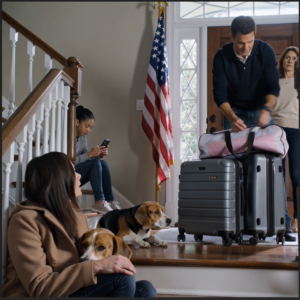
My Dad Said, “Your Ticket Isn’t Worth It,” And Flew Everyone To My Sister’s Wedding Without Me
“Your ticket isn’t worth it, MNA.”
Dad zipped my sister’s garment bag shut under the framed photo of my grandmother and her beagles.
“You’re sick anyway. I’m doing you a favor. Watch the dogs.”
I was on the bottom stair with my coat still on and a fever of 101.
My parents were flying seven people to Maui for my sister Lacy’s wedding. They had paid for every seat: Mom, Lacy, my cousin. Even my cousin’s girlfriend of four months, whose last name nobody in that house could spell.
Lacy didn’t look up from her phone.
“Honestly, it’s better. You’d cough through my vows, and somebody has to do the dog thing. It’s literally what you’re good at.”
I looked at Mom. Mom looked down at the luggage tag in her hand and kept writing.
I said yes.
I said yes because Biscuit, the older of my grandmother’s two beagles, is 13 and blind in one eye. And the last thing my grandmother, MNA, whose name I got, asked of me before she died was that her dogs would never be left in a kennel.
Then I asked my father to put it in a text. He did without looking up.
“Watch the dogs. No ticket.”
I saved it.
So on Tuesday afternoon, I drove across Billings with a kidney infection and a paper bag of antibiotics, let myself into my parents’ house, where the dogs could never be left alone overnight, and Biscuit needed drops in his eye every 4 hours, even at 3:00 in the morning, and found every bathroom door locked.
The master, laces, the hall bath.
The powder room under the stairs had a broken latch, so it had been stripped instead. No soap, no towel.
Taped to the master bedroom door, in my father’s square capital letters:
“Bathrooms closed. Use the dog wash. Don’t touch Lacy’s things. Dad.”
The dog wash is a steel tub in the laundry room with a sprayer hose. On its edge sat one bottle: oatmeal dog shampoo.
By 9ine that night, I was shaking. I stood in that tub under the sprayer and washed my hair with it.
Then I sat on top of the dryer, wrapped in a towel I’d brought from my own apartment, and cried for an hour while Biscuit pressed his gray face against my shin.
Sunday night, the night after the wedding, two messages came 4 minutes apart.
The first was a text just to me:
“Dogs again at Christmas. Family only.”
The second landed in the family group chat. 41 people: aunts, cousins, my sister’s brand new in-laws.
Under a photo of everyone in lays, my father had written:
“Whole crew made it. Mina’s holding down the fort. Don’t feel sorry for her. She gets paid better than any of us.”
11 laughing faces underneath.
I didn’t answer him. I walked back into the laundry room, turned on the light, and took one photo.
The steel tub, the sprayer hose, the bottle of oatmeal dog shampoo, half empty, and beside it, the note I’d peeled off the master bedroom door.
No caption. Not one word.
I sent it to the family chat at 9:52 and laid my phone face down on the dryer.
At 11:58, when it wasn’t even 8:00 yet in Maui, Lacy texted me:
“Dad has 31 missed calls from Aunt Gail. 31. He won’t pick up. What did you do?”
Aunt Gail. My father’s older sister. The only person in our family he has never once hung up on.
I read it twice. Biscuit sighed against my foot. The house was so quiet I could hear the furnace click on.
At 12:41, my phone lit up with my aunt’s name. She was in the Seattle airport between flights home from the wedding.
She didn’t say hello. She asked me whether my father had ever given me the envelope she mailed him in July.
I said, “What envelope?”
On the other end of the line, I heard a boarding announcement.
Then my aunt said very quietly, “Don’t tell your father I called. I’m driving down Wednesday. I’m bringing your grandmother’s papers.”
When she finally hung up, I opened the notes app on my phone and typed a single date: December 19th, the day they would leave for Christmas.
Before I tell you what was in that envelope, if you’ve ever been the one left behind to hold down the fort while everyone else got the photo, stay with me through this one.
My name is Ma Westfall. I’m 30. I drive a library bookmo out of Billings, Montana.
And if you’d like to hear how a single photo of a dog tub turned into a stack of paper on a lawyer’s desk, subscribe and tell me in the comments where you’re listening from tonight.
Here is what my aunt told me before she hung up at 12:45 in the morning.
“July 14th,” she said. “Check number 2207, $1,180. Memo line: MNA’s ticket. Your father cashed it on the 16th.”
I was still sitting on the dryer. I remember looking at my own bare feet.
“I didn’t know about a ticket,” I said.
“He told me you didn’t want it.”
I heard her tapping at her phone.
“He said you’d rather stay home and take the sitting money. $70 a night, he said, out of Mom’s dog money. He said you’d make more in a week with the beagles than you’d spend in Maui.”
The furnace clicked off. In the quiet, Biscuit’s tags tapped once against the tile.
“Aunt Gail,” I said. “What dog money?”
She didn’t answer right away. When she did, her voice had changed.
It was the voice she used at Nana’s funeral, when the pastor got my grandmother’s middle name wrong and she stood up in the second pew to correct him.
“Honey, I’ll explain Wednesday. I need to read something first. Don’t say anything to your father. Not yet.”
“I haven’t said anything to him in almost a week.”
“Good,” she said. “Keep it that way.”
Then she was gone, and I was sitting on a dryer at 1:00 in the morning with a dog asleep on my foot, holding a phone full of numbers I had never seen.
To understand why I typed that date, you need to know about the bottle on the edge of that tub and the grandmother whose name I carry.
My grandmother, Nana to all of us, MNA Westfall I, raised beagles for 40 years on a scrap of land outside Laurel.
Westfall Beagles. A handpainted sign at the end of a gravel road. Kennel runs out back. Puppies in a welping box in the kitchen every spring.
I was named after her, and I think that’s why she claimed me.
Every summer from the time I was six, I spent two weeks at her place, and every evening she would fill a steel tub with warm water, pour in a capful of oatmeal shampoo, and hand me a dog.
“You always start with their name,” she told me, “before you get them wet. You say their name so they know who’s holding them.”
I was nine. I thought it was the most important rule in the world. I still do.
By the time she got sick, the kennel was long gone. Sold to pay for the hip she broke in 2009 and the 12 years after it.
What she kept were the last two: Biscuit, who was eight then, and Tater, who was six.
When she moved into my parents’ house for her final winter, the dogs came with her, and so did a small brass tag she’d had engraved for Biscuit’s collar. I helped her clip it on.
It said, “If found, call MNA.”
Under that, my cell number. Not hers. Mine.
I asked her why.
“Because you’ll still be here,” she said.
She died in May of 2022 in the downstairs bedroom with Biscuit lying across her feet.
The night before, she held my wrist with a grip I didn’t know she still had and made me promise two things: that I’d never let her dogs be left in a kennel and that I would always say their names first.
My father stood in the doorway for that. He didn’t come in.
I remember the way he held the doorframe with one hand, the knuckles thick and scarred in a way I’d never really looked at before. The hands of a man who had scrubbed a lot of kennel runs a long time ago.
When he finally washed Biscuit after the funeral, he did it in about four minutes flat. One hand on the scruff, the sprayer in the other, never once saying the dog’s name.
He was faster at it than Nana ever was. I didn’t ask him where he’d learned.
In our house, you didn’t ask my father where he’d learned anything.
I was 26 that spring, living in my old bedroom to save for a place of my own, working the bookmobile route 5 days a week.
Every weekday, I drove a 31 ft library on wheels out to towns like Molt and Shepard and Broadview, parked it in a church lot or beside a grain elevator, and checked out westerns to ranchers and picture books to kids who’d never been inside a real library.
It paid $19 an hour. I kept a log of everything: miles, stops, late returns, who’d asked for which book.
It was the job. And then it was just who I was.
So when my parents started traveling after Nana died and my father said, “You’re here anyway. You watch the dogs,” I did what I always did.
I kept a log.
I bought a blue spiral notebook at the Walgreens on Grand Avenue. On the first page, I wrote, “Biscuit and Tater, July 2022.”
Every trip after that, I wrote down the dates, the feedings, the eye drops, the walks, the night Tater ate a sock, the vet visits. Every night I stayed.
Once, in the spring of 2023, after my parents came back from Scottsdale, I asked my father if he could at least cover my gas since I was driving back and forth to the house on my lunch breaks to let the dogs out.
He texted me back, and I still have it:
“Nobody gets paid for family, MNA. Your grandmother would be ashamed you asked.”
I didn’t ask again. Not once in all the years after.
I moved out on June 1st of this year into a studio on the south side with a landlord who allowed pets and a bathtub I could actually fit in.
2 weeks before the wedding, I came down with a kidney infection that put me on the floor of that bathroom with a fever of 103.
And 10 days after that, I stood in a dog tub in my father’s laundry room because he had locked every door in his house that had a shower behind it.
That night on the dryer, after Aunt Gail hung up, I counted what I knew.
One check my aunt sent for me that I never saw. One promise my father made her that I never agreed to. $70 a night that had never once touched my hands.
I didn’t cry again. I got down off the dryer, found the blue notebook in my bag, and started counting nights.
By the time the sun came up over the rims on Monday, my father had deleted his post.
The photo of everyone in Lays was gone from the family chat. So was the line about me being paid better than any of them, and so were the 11 laughing faces.
My photo was still there, right where I’d put it. The steel tub, the hose, the bottle.
Underneath it, nobody had typed anything at all. 41 people, and not one of them had found a word.
At 7:15, my phone buzzed. It was a text from my father, just to me.
“Take it down. You’ve embarrassed your sister on her wedding weekend. I won’t ask twice.”
I read it standing at my parents’ kitchen counter, measuring kibble into two steel bowls.
Biscuit got a cup and a half with a spoon of pumpkin because his stomach was sensitive. Tater got two cups and nothing else because Tater would eat the bowl if you let him.
I wrote both amounts in the notebook the way I had for 4 years. Then I set the phone face down next to the bowls and left the photo exactly where it was.
At 7:40, Lacy sent a voice memo. I didn’t play it. At 8:02, she sent another.
At 8:30, she texted, “Pre’s mom saw it. Do you understand that? His mom.”
I took the dogs out into the backyard. Tater went straight for the fence line.
Biscuit stood on the patio with his good eye turned toward the sun and waited for me to say his name before he stepped down onto the grass.
I said it. He stepped down.
The last message came at 4:41 in the morning, Maui time, which meant my mother had been lying awake in a hotel room in Wa with my father asleep next to her.
“I didn’t know about the doors. I swear to you, I didn’t know.”
I looked at that one for a long time. Then I wrote back the only true thing I had.
“You knew about the ticket.”
She didn’t answer. Somewhere in the house, the ice maker dropped a tray of cubes, loud as a slammed door.
They came home Tuesday afternoon, all of them but Lacy, sunburned and quiet.
I’d stripped the guest bed, run the dishwasher, and washed both dog bowls. My bag was already by the front door.
I’d decided on the drive over that I wasn’t going to say a single word about the photo unless someone else said it first.
My father said it first.
He walked in, dropped his keys on the hall table, and looked at me like I was a stain he’d have to explain to company.
Then he picked the keys back up, separated one small brass key from the ring, and unlocked the master bedroom door. I watched him do it.
The key to every bathroom in that house had been on his truck keys the entire time, in his pocket on a beach in Maui.
“What was that stunt?” he said.
“It was a photo of your laundry room.”
“You know exactly what it was. Name.”
He picked his note up off the dryer where I’d left it, folded it once, and put it in his back pocket as if it had never been there at all.
“Your aunt has been calling me like a crazy woman for two days. Lacy cried at her own brunch over a dog tub.”
“I showered in that dog tub, Dad. I was burning up.”
He laughed.
It wasn’t a mean laugh. That was the worst part. It was the laugh of a man who genuinely thought I was being soft.
“I wash dogs in a tub like that from the time I was 9 years old,” he said. “Every morning before school, 5:00 in January. You do it for one week and you whine to the whole family.”
There it was. I didn’t know yet what it meant.
I only knew that something had come out of my father’s mouth that he hadn’t planned to say because his jaw shut on the end of it like a trap.
Behind him, my mother set her carryon down without a sound and looked past both of us down the hall toward the laundry room door.
“December 19th,” my father said. “We fly out that morning, same as before. Don’t make me ask twice.”
I picked up my bag. My hands were steady. My pulse was going so hard I could feel it in my teeth.
“I heard you,” I said.
Aunt Gail drove 3 hours from Great Falls the next day, exactly like she’d said.
At 6:00 in the morning, she texted, “Leaving now. Make coffee.”
And at 11:20 on Wednesday morning, she was standing outside my studio on the south side in a quilted vest and reading glasses, holding a manila folder against her chest like it might blow away.
My aunt is 64, 5t tall, and the only person in the Westfall family who has ever told my father no to his face.
She taught high school chemistry in Great Falls for 31 years. She was my godmother, though in our family that mostly meant a card with a 20 in it every birthday and every few years a ran 2 hours.
She sat at my little table, took one sip of coffee, and opened the folder.
“Your grandmother set up a trust for the dogs,” she said. “Before she died. A pet trust. They’re perfectly legal. People do it all the time. She put $160,000 in it from what was left of the kenneland, and she hired Helen Sunquist downtown to run it.”
I had heard the name Helen Sunquist exactly once, at the funeral, from a gay-haired woman in a navy coat who shook my hand and said, “You must be the other mmyra,” and then didn’t say anything else.
“The trust pays the dog’s caretaker $500 a month,” Aunt Gail said. “On top of that, it pays every vet bill, every bag of food, and when the caretaker travels, it pays for a sitter up to $70 a night.”
She turned the folder around and slid it toward me.
On top was a printed email, soft at the corners, dated June 2022, from my father to my aunt.
“Gail, don’t worry about the dogs. I’ve got it handled. I’m the caretaker for now since M is still living at home. She sits for them when we travel, and I pay her out of the sitter allowance. Everybody wins. Mom would be happy.”
I read it twice, then a third time.
“I kept it,” my aunt said quietly, “because it was the last nice email your father ever sent me.”
I put the email down on the table between us. My coffee had gone cold without my touching it.
“500 a month,” I said, “since June of 2022.”
“That’s what the trust allows. I don’t know what he’s actually taken. I never asked to see anything. He’s my little brother.”
She took off her reading glasses and pressed two fingers against the bridge of her nose.
“When I sent the money for your ticket, I thought I was doing a nice thing for you. He called me that same week and said you’d turned it down. Said you’d rather have the sitting money than a week with your sister.
“And I believed him, MNA. I was angry at you. I was angry at you in Maui. I sat at that reception and looked at your empty chair and thought, she chose $70 a night over this.”
“There wasn’t an empty chair,” I said. “Lacy didn’t give me one.”
My aunt looked at me for a long moment. Then she looked down at her own hands.
“I called him 31 times,” she said. “I’d have called him a 100.”
“Don’t call him again.”
She looked up.
“Not yet,” I said. “Please don’t call him. Don’t text him. Don’t post anything. Whatever you know, keep it in that folder.”
“Why?”
I didn’t have the whole answer yet. What I had was a feeling, cold and very clear.
The same feeling I get on the bookmobile when somebody hands back a book with pages cut out and smiles at me like I won’t check.
You don’t argue with that person at the counter. You open the book.
“Because right now he thinks the worst thing that happened this week was a photo,” I said.
My aunt studied me over the top of her glasses. Then, slowly, she closed the folder and pushed it across the table to me.
“Your grandmother said you were the quiet one who counted,” she said. “She meant it as a compliment.”
After she left, I took Tater’s old leash off the hook by my door, the one I’d brought from my parents’ house by mistake months ago, and sat down on the floor with three blue notebooks and my laptop.
I counted.
July 2022, five nights. 4th of July in Kurden.
November 2022, four nights. Thanksgiving in Denver.
December 2022, six nights. Christmas in Scottsdale.
On and on through the spring trips and the summer trips and the Christmases. Every one of them in my handwriting.
The dates. What Biscuit ate. When I put the drops in his eye. The night in 2024 when he came home from surgery with one eye sewn shut and I slept on the laundry room floor next to his crate so he’d hear me breathing.
16 trips. 99 nights.
I did the arithmetic twice on paper, the way I do mileage logs at the end of every month. 99 nights at $70 a night was $6,930.
Then I opened my bank app and downloaded every statement back to January 2022.
4 years and 9 months. Every paycheck from the library, every grocery run, every student loan payment.
I searched them for my father’s name, for my mother’s name, for any deposit that wasn’t the city of Billings.
Nothing. Not $1, not one Venmo, not one check.
Then I scrolled back through my texts with him and took screenshots.
Every request:
“You’re here anyway. You watch the dogs.”
“We leave Thursday. Feeding chart’s on the fridge.”
And the one from the spring of 2023. The one I’d never deleted because some small, stubborn part of me had wanted to keep proof that I’d once asked.
“Nobody gets paid for family, MNA. Your grandmother would be ashamed you asked.”
I saved all of it into a folder on my laptop. Then I copied the folder onto a thumb drive, and the thumb drive went into the zippered pocket of the bag I take on the bookmo everyday.
It was almost midnight when my phone started buzzing against the floor. It was Lacy. Video call.
I almost didn’t answer. Then I did, and there was my sister on a lai in Kawaii in a white robe with her hair wrapped in a towel and her face scrubbed and furious.
“Do you have any idea,” she said, “what you did?”
“I took a picture of a laundry room.”
“You took a picture of a laundry room in front of Preston’s entire family. His mother asked me at brunch whether my father makes my sister shower in a dog bath. At brunch, Mna. With mimosas.”
Her voice cracked on the last word, and for one second she looked about 14.
“Do you know how hard I worked to make them think we were normal? And you hate crowds anyway. I was protecting you from a week of people asking about your kidneys. I was doing you a favor.”
I did know. I’d been there for most of it.
The pageant years when Dad drove her to Bosezeman and Great Falls in Missoula every other weekend, and the dress for the state finals cost more than our car payment.
The night she came in second and he didn’t speak the whole 4 hours home, and she cried in the backseat until she threw up, and he never once looked in the mirror.
She’d learned exactly what she was worth in that truck. She’d learned it was whatever the judges said.
“I’m not taking it down,” I said.
“Then you’re unbelievable. Dad paid for this whole trip himself. He paid for our honeymoon himself. He gave us $3,500 just so we could do the snorkel tour in the helicopter. And you’re out there making him look cheap.”
I wrote that number down on the inside cover of the notebook while she was still talking.
“Congratulations, Lacy,” I said. “You looked beautiful in the pictures.”
She hung up on me.
I sat there with the pen in my hand and the number on the cardboard, and I thought about where a man who’d been laid off from the refinery 18 months ago had found $3500 for a helicopter.
Aunt Gail called me the following Monday. She’d spent the weekend reading about pet trusts on her porch with a legal pad, the way she used to grade lab reports.
“I’m what they call a remainder beneficiary,” she said. “When the last dog passes, whatever’s left in the trust gets split between me and the animal shelter out on Monad Road. Your father doesn’t get any of the remainder. Mom made sure of that.”
“Why?”
“I don’t know, but it means I’m allowed to ask Helen for a copy of the whole trust and for an accounting of what’s been paid out. In writing. She has to answer me.”
“Then ask,” I said. “But let me write it.”
So on Wednesday night, after a 10-hour route, I sat at my table with a bowl of cereal and wrote my aunt a letter to sign. I kept it short and dry.
A request as remainder beneficiary of the Westfall Pet Trust for a complete copy of the trust instrument and any amendments, and for an itemized accounting of all distributions from June 2022 to the present, including caretaker fees, veterinary payments, and travel care reimbursements.
Please send copies to the address below. Thank you for your time.
I didn’t put my name anywhere on it. I didn’t need to yet.
Aunt Gail signed it Thursday morning, October 1st, and drove it to the post office in Great Falls herself. Certified, return receipt.
“Helen will have it on her desk tomorrow,” she texted me.
That same Thursday, my route took me to Molt, 40 minutes northwest of Billings, where I park the bookmobile in the gravel lot behind the community hall every other week.
Mr. Ingabretzen was waiting for me like always. 83 years old in a canvas coat with his healer Duke sitting at his boot.
Duke was 15 and mostly deaf. Mr. Ingabretzen returned to Louisa Moore and asked for two more.
And then, while I was stamping the due dates, he said, “Vet says Duke’s got about a season left.”
“I’m sorry,” I said.
“Don’t be. He’s had a good one.”
He reached down and scratched the old dog’s ears.
“My kids keep telling me to put him in a kennel when I go to my brother’s for Christmas. I told them I’ll take him in the truck or I won’t go. A dog that old, you don’t leave him with strangers. He thinks you died.”
I handed him his books. My hands were steady.
I made it all the way to Broadview before I had to pull over.
My father texted me three times that week, and none of them were about the photo.
On Friday, he posted in the family chat a picture of Biscuit asleep on the living room rug, gray muzzle on his paws.
“My mother’s dogs, my responsibility. Love these two old boys.”
23 hearts. One of them was from Preston’s mother.
On Saturday, he texted me directly.
“Thanksgiving is at our house this year. The Havfords are flying in from Scottsdale. I need you to come over next weekend and scrub out the dog wash and the laundry room. Preston’s mom has allergies, and I don’t want that room looking like a barn.”
The dog wash.
He wanted me to come clean the tub he’d made me shower in so that the woman who’d asked about it at brunch would never have to see it.
I wrote back, “I’ll see.”
He sent a thumbs up. To my father, “I’ll see” from me had always meant yes.
On Sunday afternoon, my mother came to my apartment. She didn’t tell my father.
I knew that before she said a word because she’d parked her Subaru around the corner instead of out front, and because she kept looking at the window.
She was carrying a Target bag. Inside were two bars of Dove soap, a bottle of the shampoo I’d used in high school, and a set of thick gray towels with the tags still on.
“I should have brought these a month ago,” she said.
“You should have brought them to your house,” I said. “In September.”
She sat down on the edge of my couch with her purse on her knees like a woman in a doctor’s waiting room.
“I didn’t know about the doors, MNA. I swear to God, I didn’t know until I saw your picture.”
“But you knew about the ticket.”
She looked at the towels.
My mother grew up in Casper, the oldest of four, with a father who drank and a mother who taught them all to read his footsteps on the porch.
She told me once, when I was little and had asked why she never yelled, that in her house, the loudest person got hit first.
She married a man who didn’t drink at all. I think for a long time she believed that meant she was safe.
“Your father’s under a lot of pressure,” she said, “with the layoff and the wedding and the Havfords. If I’d argued with him about the ticket, it would have been worse for you. It’s always worse when he’s angry. You know that.”
“Mom,” I said, “did Dad ever pay me for watching the dogs?”
She frowned, genuinely confused.
“Pay you? Honey, no. He always said you’d never take money from family. He said it would insult you.”
I watched her face. There was nothing behind it. She didn’t know.
In 30 years of marriage, my mother had learned how to not know things, and she had gotten very, very good at it.
“Thank you for the soap,” I said.
At the door, she stopped with her hand on the knob.
“He’s not a bad man,” she said. “He just never got anything for free.”
Then she went down the stairs to her car parked around the corner, and I stood at the window and watched her look up and down the street before she got in.
Helen Sunquist answered in 5 days.
On Tuesday, October 6th, Aunt Gail called me from her kitchen in Great Falls. All she said was, “It came. It’s thick.”
I swapped my Wednesday route with a coworker, put Tater’s leash back on its hook, and drove three hours north in the dark the next morning with a thermos of coffee and the three blue notebooks on the passenger seat.
My aunt had the packet spread out on her kitchen table in neat stacks, the way she must have laid out lab stations for 31 years.
A cover letter on paper, a copy of the trust, 41 pages, and an accounting, 12 pages of columns, every dollar that had left the Westfall Pet Trust since June of 2022.
“Start with this one,” she said, and slid the accounting toward me.
Most of it was what you’d expect. Caretaker fee. Curtis Westfall, $500 every month. 53 months in a row.
Feny Animal Hospital. Chewy. Rimrock Pet Pharmacy.
Then, scattered down the pages like stones in a field, a different line.
“Travel Care Reimbursement. Sitter: M. Westfall. Paid in cash by caretaker. $70 per night.”
July 2022, five nights, $350.
I open the first Blue Notebook to its first page.
Biscuit and Tater. July 2022. Five nights.
My own handwriting, a little rounder than it is now.
November 2022. Four nights, $280.
I turn the page. Four nights. Thanksgiving, Denver.
December 2022. Six nights.
My aunt didn’t say anything. She just sat across from me while I went line by line, my finger moving down her accounting and my other hand turning the pages of my notebooks.
16 lines. 16 trips. Every date matched. Every number of nights matched.
On the back of each reimbursement request, there was a copy of a short form my father had filled out and signed at the bottom under a printed sentence that said, “The caretaker certified the information above was true and correct.”
Sitter name: M. Westfall. Amount paid, [clears throat] in his handwriting.
The last line was from 3 weeks ago. Wia Maui, September 15th through the 22nd. Seven nights, $490, paid in cash to M. Westfall.
The week I stood in a dog tub with a fever. He’d gotten $490 for it in my name.
$6,930.
It was the exact number I’d worked out on my apartment floor.
I closed the notebook. I set my pen down parallel to it, very carefully, the way I line up returns on the cart at the end of a route.
Outside, a neighbor’s sprinkler kicked on and ticked across the driveway.
“Mna,” my aunt said.
“I’m fine,” I said. “Give me a minute.”
I went out and sat in my car in her driveway with the engine off. I didn’t cry.
I sat there with my hands on the steering wheel and looked at my name in my head: M. Westfall, printed in my father’s handwriting on 16 forms I’d never seen.
Somebody had been paying me for 4 years. I just wasn’t the one who got the money.
When I came back inside, my aunt had made fresh coffee and was standing at the window with her arms crossed.
“There’s something you should know about your father,” she said. “Nobody ever told you, because nobody in this family tells anybody anything.”
She told me about the kennel, Westfall Beagles, outside Laurel.
My grandfather, Walt, started it in 1966 with two dogs and a borrowed truck. And by the time my father was nine, there were 40 dogs in the runs.
My grandfather didn’t believe in hired help. He believed in sons.
So every morning at 5:00 before the school bus, my father hosed the runs, filled the water pans, and bathed whatever dogs were going to a buyer that week. In January, in the dark, in a steel tub in the barn with a sprayer hose.
“Dad used to introduce us at church,” Aunt Gail said. “‘This is Gail. She’s going to college. And this is Curtis. He’s the help.’”
I didn’t move.
“Every Sunday, MNA, for years. He thought it was funny. And Mom never said a word. Not one time.”
My aunt’s mouth tightened.
“I went to Missoula. Curtis stayed and cleaned those runs until he was 24. And he never got paid a dime because Dad said nobody gets paid for family.”
Nobody gets paid for family.
I had it saved on a thumb drive in my bag.
“I’m not telling you this so you’ll forgive him,” my aunt said. “I’m telling you because I think he’s been doing to you exactly what was done to him, and I don’t think he can even see it.”
I nodded. Then I picked up the copy of the trust, all 41 pages, and started at page one.
Most of it was language I had to read twice. Definitions, powers of the trustee, a list of approved veterinarians, a paragraph, very firm, saying the animals must never be boarded in a commercial kennel under any circumstances and that the trustee should treat any such boarding as a serious breach by the caretaker.
Then I reached page 9, section 4.2, Two, designation of caretaker.
“My granddaughter, MNA Westfall, shall serve as caretaker of my animals at such time as she maintains a residence of her own in which the animals are permitted. Until that time, my son, Curtis Westfall, shall serve as interim caretaker.
“The interim caretaker shall notify the trustee in writing within 30 days of my granddaughter establishing such a residence.”
I read it four times. My aunt read it over my shoulder, and I heard her breath stop.
“She picked you,” Aunt Gail said. “Oh, honey, Mom picked you.”
Behind section 4.2 was a single page clipped to the trust, the most recent document in the whole packet.
It was an annual caretaker certification, the one the trust required every summer. It asked a few simple questions about the dog’s health, their food, their home.
At the bottom, a box:
“Has the designated caretaker established a separate residence?”
An X in the box marked no.
And on the line underneath, in my father’s square capital letters:
“MNA continues to reside with us.”
Signed, Curtis Westfall. Dated June 28th, 2026.
I had signed the lease on my studio on June 1st. My father had helped me carry the mattress up the stairs.
The next morning, on my drive back south, my father texted me a photo of Biscuit’s face. His good eye was red and weeping, crusted at the corner.
Under it, my father had written:
“Yes infected again. I’m not paying another vet bill for a dog that’s half dead. Either you take him to Fenies this week or I’m booking the boarding place in Laurel for Christmas and you can stay home. Your choice.”
I pulled into a gas station in Roundup and read it three times.
Another vet bill. He hadn’t paid a single vet bill in 4 years.
And the boarding place in Laurel was a commercial kennel 2 miles from the land where Westfall Beagles used to be. The one place on earth my grandmother had made me promise her dogs would never go.
I called Fenies from the gas station and got the last appointment of the day.
Biscuit knew my car. When I pulled into my parents’ driveway at 4:00, he was already at the front window, his gray face pressed to the glass, his tail going.
Nobody else was home. I said his name before I touched him. He leaned his whole weight into my legs.
At the clinic, Doctor Finey cleaned the eye and wrote a prescription for drops and said it was treatable. Caught early. Nothing to panic about.
At the front desk, I reached for my wallet out of habit.
“Oh, you’re all set,” the receptionist said, already typing. “This bill straight to the trust, like always.”
She turned her monitor a few degrees so I could see where to sign for the medication.
At the top of Biscuit’s file, it said, “Responsible party: Westfall Pet Trust.”
And under that, caretaker: Curtis Westfall.
Biscuit sat on the scale by the counter, shaking a little the way he always does at the vet. The brass tag on his collar caught the light.
“If found, call MNA.”
I signed for the drops. My hand didn’t shake.
I carried him to the car because his back legs don’t trust the step down anymore. And I sat with him in the back seat for a while with the heater running, and I didn’t cry and I didn’t call anyone.
I took him home to my parents’ house, put the first drop in his eye, wrote it in the notebook, and drove back to my studio.
Then I sat down at my table and made three lists.
The first list was everything I had: the notebooks, the texts, four years of bank statements, my lease, my aunt’s packet.
The second list was everything my father didn’t know I had.
The third list was short. It was a list of things he hadn’t done yet.
The Christmas trip was 72 days away. I needed fewer than 50.
I called my aunt before I went to bed.
“Don’t call him,” I said. “Don’t email Helen anything else. Not yet.”
“MNA. He’s stealing from your grandmother.”
“I know,” I said. “Let him keep talking.”
On Friday, October 9th, I apologized to my father in front of 41 people.
I typed it on my lunch break in the bookmo, parked behind the grain elevator in Shepherd with a stack of returned picture books on the seat beside me.
“I want to say sorry for the photo I posted last month. I was sick and running a fever, and I was being dramatic. Dad, I’m sorry I embarrassed you. Lacy, congratulations again. You are a beautiful bride.”
I read it once, checked the spelling, and hit send.
Then I opened a text to my father, just to him, and wrote, “I’ll do Christmas.”
He answered in under a minute.
“Good girl. Knew you’d come around.”
10 minutes later, he answered in the family chat, too.
“Apology accepted, our resident dog whisperer. Everybody, Christmas is covered, folks.”
14 hearts. Lacy sent a single pink one. Preston’s mother sent nothing at all.
My coworker, Dana, who rides along with me on Fridays and had been eating her sandwich across from me, watched my face while I scrolled.
“You okay?” she said.
“I’m good,” I said.
And I was, in a way I couldn’t have explained to her. I wasn’t apologizing. I was holding a door open and waiting to see if he’d walk through it.
He walked through it in 5 days.
On Wednesday, October 14th, a letter from Helen Sunquist arrived at my parents’ house. I didn’t see it. I didn’t have to.
My mother called me that night from the car in the Albertson’s parking lot, the only place she could talk.
“Your father got something from your grandmother’s lawyer,” she whispered. “Something about Gail. He’s been on the phone with her for an hour. He’s screaming, MNA. I’ve never heard him scream at his sister.”
What Helen’s letter said, I learned later, was simple. The remainder beneficiary had requested an accounting.
As part of that process, the trustee was asking the caretaker to provide supporting documentation for all travel care reimbursement since 2022. Receipts, payment records, or assigned acknowledgement from the sitter within 30 days.
What my father screamed at his sister, she told me the next morning:
“What did you do? What are you trying to do to me?”
And what she said back, very calmly, exactly the way we’d agreed:
“I asked for what Mom left, Curtis. I’m allowed.”
She hung up on him. For the first time in her life.
That should have been enough to make a careful man stop. A careful man would have called Helen, apologized for a bookkeeping mess, and quietly paid something back.
My father did something else.
On Friday, October 16th, two days after that letter, he filed a new request with the trust, an advance for Christmas travel care.
December 19th through the 27th. Eight nights. Sitter: M. Westfall. $560.
Helen sent a copy to my aunt because my aunt was now entitled to see everything. My aunt forwarded it to me with no message at all, just the attachment.
I opened it on my phone in the library staff room, standing next to the microwave, and read my own name one more time in my father’s handwriting.
He’d had my apology for a week. He’d had Helen’s letter for 2 days, and with both of them in his hand, he went back to the trust and asked for more money in my name.
I saved the file. I printed two copies.
One went into the blue notebook. One went into the zippered pocket of my bag next to the thumb drive.
On Thursday, October 22nd, he came to see me at work.
My Thursday route ends in Laurel. I park the bookmobile in the lot behind the old IGA, a mile and a half from where Westfall Beagles used to be.
I’ve parked there for 4 years. I’d never once seen my father on that side of town.
At 3:40 that afternoon, his blue Silverado pulled in beside the bookmobile, and he climbed the steps like he’d been doing it his whole life.
He looked around at the shelves, the westerns, the picture books, the plastic tub of returns. He picked up a board book about a farm and set it down again.
“So this is it,” he said.
“This is it.”
He smiled at me, an easy, generous smile. The one he uses on waitresses and the men at church.
“Listen, your grandmother’s lawyer is being fussy about some paperwork. Your aunt stirred something up. It’s nothing. But I’m going to need you to sign something for me. Just a formality. Family stuff.”
Behind the checkout counter, my left hand closed around the edge of the date stamp so hard the corner bit into my palm.
“Sure, Dad,” I said. “Bring it by.”
He brought it by on Sunday.
He came alone at 5 in the afternoon, carrying a quart of chicken noodle soup from the diner on Grand that I used to love when I was a kid and had the flu.
He set it on my counter and looked around my studio like he’d never been inside, though he’d carried my mattress up those stairs almost 5 months before.
“You’re feeling better?” he said.
It wasn’t a question.
“Mostly.”
“Good. Good.”
He pulled a folded sheet of yellow legal paper out of his jacket and smoothed it flat on my table with the side of his hand.
“This is all it is. Your grandmother’s lawyer wants proof you got paid for the dog sitting. So, I wrote it up. You just sign at the bottom.”
I looked down at it. It was written in his square capital letters in blue ink with a ruler line drawn under each sentence.
“I, MNA Westfall, acknowledge that I received $6,930 in cash from Curtis Westfall for petsitting between July 2022 and September 2026.
“I also acknowledge receipt of $560 in advance for Christmas 2026.”
Under that, a line for my signature and a line for the date.
“Dad,” I said, “you never paid me.”
“I gave you a roof.”
He said it gently, like he was explaining something to a child.
“Four years of free rent, food, utilities. Do you know what a room costs in this town? You were paid, MNA, just not in an envelope.”
“That’s not what this says.”
“It’s what it means.”
He sat down across from me without being asked. For a second, he looked very tired.
“Look, your grandmother owed me. You don’t know what that place was like. 15 years I cleaned up after those dogs, and I never saw a nickel. And when she died, she left them to a lawyer and a bank account and a 26-year-old.
“I’m not stealing anything. I’m collecting. You’re young. You’re strong. You can take it. Dog work never killed anybody. It didn’t kill me.”
He meant it.
That was the thing I couldn’t stop seeing. Every word of it he meant.
He stood up to leave and stopped at my refrigerator. There’s a photo there, held up by a magnet from the bookmo, of Biscuit as a puppy in my grandmother’s lap. Both of them squinting into the sun on the kennel porch.
My father looked at it for a long time. His hand came up like he was going to touch the picture, and then it went back down to his side.
When he turned around, his face was closed again.
“Sign it by Friday,” he said. “Or Biscuit goes to the kennel in Laurel at Christmas, and you can explain to your grandmother’s lawyer why her precious dog’s in a cage.”
I folded the yellow paper in half along his crease.
“Let me read it over,” I said.
He nodded, satisfied, and let himself out. I listened to his boots go down all 14 stairs.
Then I took a photo of both sides of that sheet of legal paper, front and back, slid it into a clear plastic sleeve, and put it in the blue notebook, unsigned.
The soup went in the refrigerator. I couldn’t throw it out, and I couldn’t eat it.
On Monday morning, October 26th, I took a personal day and climbed the narrow stairs to the second floor of the old first interstate building downtown, where a brass plate on a frosted glass door said, “Sunded Quist Law.”
Helen Sunquist was in her late 60s, small and silver-haired in a navy cardigan.
She shook my hand across the desk and held it a beat longer than she needed to.
“The other mna,” she said. “I wondered when you’d come.”
I put everything on her desk in the order I’d practiced it in the car.
A one-page letter signed by me stating that I had maintained my own residence since June 1st, 2026, in which animals were permitted and that I accepted the role of caretaker under section 4.2 of my grandmother’s trust.
A copy of my lease with the pet clause highlighted. The three blue notebooks. Printed screenshots of my father’s texts with the dates. Four years and 9 months of bank statements with not one deposit from my father.
And last, the clear plastic sleeve with the yellow legal paper inside.
Helen read for 40 minutes without saying a word. She turned the pages of my notebook slowly, one at a time.
When she got to the legal paper, she took off her glasses.
“He brought this to you yesterday?”
“Yes.”
“And you didn’t sign it?”
“No.”
She wrote something on a pad. Then she looked up at me.
“Your grandmother sat in that chair in March of 2022 and told me you’d be the one who kept records,” she said. “I’ll be honest. I thought she was being sentimental.”
She stacked my papers carefully and squared the edges.
“There is one more item in your grandmother’s file,” she said. “I’m not permitted to discuss it with you. Her instructions were that it goes to one person, either when he comes in to ask for it or when the caretaker changes. In 4 years, he has never come in.”
“Who?”
Helen looked at me over the top of her glasses and didn’t answer.
She didn’t have to.
I drove home and didn’t hear anything for a week. And in that week, my father planned Thanksgiving.
He did it out loud in the family chat, the way he does everything he’s proud of.
The Havfords were flying in from Scottsdale on the Wednesday before. Preston’s parents, Preston’s grandmother, Preston’s younger brother.
Dinner at our house, 2:00. A 22lb bird from the Hutterite colony.
He posted a picture of the dining room with the leaf in the table and the good china stacked on the sideboard.
Then, on the Friday after I’d sat in Helen’s office, he tagged me.
“MNA, you’re on dogs that day. Bring their good leashes and keep them in the laundry room with you during dinner. Preston’s mom has allergies, and we don’t need a repeat of last time.”
Lacy replied 20 seconds later.
“LOL dog girl.”
41 people saw it. My cousin’s girlfriend reacted with a laughing face.
Someone’s uncle in Spokane wrote, “Haha, poor MNA.”
I sat in my car in the library staff lot and read it twice.
The laundry room at Thanksgiving with the dog tub he’d made me shower in, which he’d also asked me to scrub so his daughter’s mother-in-law would never know about it.
I typed, “Okay.”
He hearted it.
He didn’t know that the trust’s travel care advance, the $560 for Christmas, was sitting in a file on Helen Sunquist’s desk next to a sheet of yellow legal paper in his handwriting.
He didn’t know that every word he typed in that chat was going into a folder on my laptop with the date on it.
He thought he’d won. He thought the girl in the laundry room had said, “Okay.”
On Monday, November 2nd, the $500 didn’t come.
It was the first of the month, and for 53 months in a row, a caretaker fee had landed in my father’s checking account on or before the second.
On the third, my mother called me from the Albertson’s parking lot again.
“Something’s wrong with the bank,” she said. “Your father’s been on the phone all morning. He says the lawyer froze something.”
What Helen had done was exactly what the trust allowed her to do.
She’d sent my father a letter by certified mail. All distributions to the interim caretaker were suspended, effective immediately, pending review of the travel care reimbursements and the 2026 annual certification.
[snorts] She requested that every adult living in the household sit for a recorded interview under oath in her office within 10 days.
Mr. Westfall, Mrs. Westfall, and the sitter, M. Westfall.
My phone rang at 6:14 that evening. My father.
I let it ring four times before I picked up.
“Did you talk to that lawyer?”
His voice was very quiet. I’d never heard it that quiet.
“I gave her my notebook,” I said.
The line went silent. Not hung up. Silent.
I could hear the television on in the background. A football game. A crowd cheering for something.
“What notebook?” my father said.
“The one I’ve kept every night I watched your dogs, Dad. Since July of 2022.”
He didn’t say anything else. After a while, the call ended.
I set the phone down on my table and looked at my hands. They were steady.
Under the table, my right knee was bouncing so hard the floor shook.
My mother sat for her interview on Wednesday, November 4th. She told me about it that night.
She’d driven over without telling my father, which meant she’d parked around the corner again, and she sat on my couch with her coat still on and a cup of tea she didn’t drink.
“She asked me if Curtis had ever paid you for watching the dogs,” my mother said. “With a little recorder going on the table, and I had to put my hand up first, MNA. Like court.”
“What did you say?”
My mother looked at the steam coming off the tea.
“I said no.”
Her voice was barely there.
“I said he never paid you a dollar. I said he told me you’d be insulted if he tried.”
She sat very still. For a second, I thought she might cry.
She didn’t. My mother doesn’t cry where people can see.
“He hasn’t spoken to me since this morning,” she said. “He sleeps in Lacy’s old room now with the door locked.”
The next envelope from Helen Sunquist didn’t go to my father. It went to my sister.
When a trust’s money is paid out where it shouldn’t be, the trustee is allowed to follow it.
Helen had followed the travel care reimbursements into my father’s checking account and out of my father’s checking account on September 10th into a joint account at a bank in Scottsdale.
$3500. Memo: honeymoon, love, Dad.
The letter was addressed to Mr. and Mrs. Preston Havverford.
It explained politely and in plain language that a portion of those funds appeared to be traceable to improper reimbursements from the Westfall Pet Trust and requested that they contact the trustee within 21 days to arrange their return.
Preston opened it. Not Lacy. Preston.
My sister called me at 2:07 in the morning on Friday, November 6th. I knew before I answered.
Nobody calls at 2007 with good news.
“Preston’s mom asked me what I’m worth,” she said.
Her voice was so broken, I almost didn’t recognize it.
In the background, I could hear a dishwasher running, which meant she was standing in a kitchen in Scottsdale in the middle of the night so her husband wouldn’t hear her.
“She said, ‘Lacy, honey, I’m only asking because we’re family now. What exactly is your family worth if your father had to steal from his own mother’s dogs to pay for your helicopter ride?’ At dinner. In front of Preston’s grandmother.”
I closed my eyes. I thought about the backseat of a truck on a highway out of Great Falls and a 14-year-old girl in a sequined dress who’d come in second.
“I’m sorry, Lacy,” I said, and I meant it.
“Then fix it.”
Her voice hardened all at once, like ice skinning over a puddle.
“Call that lawyer and tell her you made a mistake. Tell her Dad paid you in cash and you forgot. You can do that. You’re the only one who can do that.”
“I can’t withdraw a notebook, Lacy.”
“You’re doing this to me on purpose.”
“No,” I said. “Dad did it to you. He just used my name.”
She hung up. I lay in the dark for a long time, listening to my own heart.
My father drove to Great Falls that Saturday. He didn’t call ahead.
He just showed up on my aunt’s porch at 10:00 in the morning with his hat in his hands, my aunt told me later, looking older than she’d ever seen him.
He told her it was a misunderstanding. He told her MNA was confused, that the girl had been sick, that she’d always been oversensitive.
He told her he’d pay back whatever Helen wanted if Gail would just call off the accounting because a man’s name had to mean something in this family.
My aunt let him finish. Then she went inside and came back out with page seven of Helen’s accounting.
“August 2024,” she said. “Fine Animal Hospital. $2,400 paid directly by the trust for Biscuit’s eye.”
My father didn’t say anything.
“You called me that same week, Curtis. You said Biscuit needed surgery and you couldn’t afford it on your own. You asked me for half, and I sent you $1,200 the next morning because he was Mom’s dog.”
My aunt’s voice didn’t rise. She told me it was the hardest thing she’d ever done, keeping it level.
“You took my $1,200 for an eye Mom had already paid for.”
She said my father stood on her porch for almost a full minute. Then he put his hat back on and walked to his truck without a word.
“That was the moment,” my aunt told me on the phone that night. “That’s when I knew he wasn’t confused. Not about any of it.”
On Tuesday, November 10th, Helen Sunquist formally designated me as caretaker of Biscuit and Tater under section 4.2 of my grandmother’s trust, effective immediately.
She sent a letter to my father asking him to deliver both dogs, their medical records, their food, and their medications to my residence within 7 days.
My father refused in writing. One sentence on his own letter head from the refinery he no longer worked at.
“These are my mother’s dogs, and they will stay in my mother’s son’s house.”
[snorts] Then he went into the family chat.
“Some of you have heard rumors. I want you to hear it from me. MNA has hired a lawyer to take my mother’s dogs away from me so she can collect the money from Mom’s trust. After everything we’ve done for her, I’m heartbroken.”
[snorts] 34 people read it. Some of them sent hearts.
My cousin’s girlfriend wrote, “OMG, that’s so messed up.”
I didn’t answer. I took a screenshot and saved it with the date.
Helen didn’t answer him in the chat either. She answered him in Yellowstone County District Court.
On Thursday, she filed a petition asking the court to instruct the interim caretaker to deliver the trust’s animals to the designated caretaker.
The court set a hearing for Tuesday, November 24th, 2 days before Thanksgiving.
On the morning of November 12th, my mother texted me a single photo.
It was the empty dog bed in the corner of the living room, and under it, three words:
“He took Biscuit.”
Not both dogs. Just Biscuit. Tater was still home, pacing the front window.
My father had driven Biscuit out to the boarding kennel in Laurel at 7 in the morning alone and checked him in for 2 weeks.
“Until this mess is sorted out,” he told my mother. “I’m not having that lawyer show up here with a sheriff and take him in front of the neighbors.”
The one thing. The only thing my grandmother had asked.
I drove out to Laurel at lunch.
The kennel is a long tan building with chainlink runs out the back, a mile and a half from where my grandfather’s sign used to stand.
I couldn’t take Biscuit. He wasn’t legally mine to take yet. Not until the court said so, and I wasn’t going to give my father the gift of a scene.
So, I asked the girl at the desk if I could at least see him. She walked me around back.
Biscuit was in the third run, curled on a raised cot, his blind side toward the gate.
He didn’t know I was there until I said his name. Then his head came up and his tail went, and he walked straight into the chain link and pressed his gray face against it, the way he’d pressed it against my shin that night on the dryer.
I put my fingers through the wire. He licked them.
I stayed until the girl said they were closing the runs for feeding.
In the car, I called Helen.
“He is in a commercial kennel,” I said. “Section 6. My grandmother specifically—”
“I know,” Helen said.
Her voice was gentle and very firm.
“I’m adding it to my filing this afternoon. Let him, Mna. Every day that dog is in that kennel goes in front of the judge.”
I sat in the parking lot with my hands in my lap.
It was the hardest thing anybody had asked me to do yet. To wait. To let it hurt and wait.
On Sunday, November 15th, the Havfords canled Thanksgiving.
Lacy didn’t tell me. My mother did. From the Albertson’s parking lot.
Preston’s mother had called my father directly. The family wouldn’t be flying to Billings after all. Under the circumstances, she said it didn’t feel appropriate.
And Christmas in Scottsdale, the one my father had been talking about since August, the one I’d been ordered to stay home from with the dogs, would be just their family this year.
Preston and Lacy would be there. Of course, they were family.
My father had told me in September that Christmas was family only. Now, he wasn’t family either.
My mother told me he stood in the dining room for an hour after that call, looking at the good china stacked on the sideboard.
Then he took the leaf out of the table by himself and carried it down to the basement.
The week before the hearing, my father came to my apartment with money.
It was a Wednesday night, late, almost 10:00. He didn’t knock. He called from the curb.
And when I came down, he was standing beside his truck under the street light, holding a bank envelope.
“$2,000,” he said. “Cash. I went to the bank today.”
He held it out.
“Take it. Then you can tell that lawyer I paid you. It won’t even be a lie anymore.”
I looked at the envelope. It was the first money my father had ever tried to hand me for those dogs. It had taken a court date to make him do it.
“You want me to sign it now?” I said. “With real money.”
His arm stayed out between us. Then it came down slowly.
“I’m trying to make this right.”
“No, Dad. You’re trying to make it go away.”
I went back upstairs.
When I looked out the window 10 minutes later, his truck was still at the curb, engine off, and he was sitting behind the wheel in the dark.
The call from the county attorney’s office came the next morning, Thursday, November 19th.
An investigator from the county attorney’s office, a woman named Ortega, very polite.
Helen had sent over a referral: the 16 reimbursement forms, the false annual certification, the Christmas advance filed 2 days after the trustee asked for documentation, and the yellow legal paper.
The investigator wanted to know if I’d be willing to come in and give a statement.
“About what specifically?” I asked, though I knew.
“About whether you were ever paid, Ms. Westfall, and about the document your father asked you to sign.”
I went in that afternoon.
I told her the truth the same way I log returns: dates, nights, amounts, what he said, what I said. I didn’t add anything, and I didn’t leave anything out.
When I walked out of that building into the cold, I stood on the steps for a long time and watched my breath go up.
I had not wanted this part. I want that on the record.
I wanted my grandmother’s dogs, and I wanted my name back. But I had stopped being the person who decided what happened to a man who writes his daughter into a ledger. That belonged to someone else now.
My mother moved to Casper on Saturday.
Not forever, she said. To her sister’s. For a while, until she could think.
She stopped at my apartment on her way out of town, the Subaru packed to the windows, and this time she parked right out front.
She asked me if she could see the dogs after it was over, whatever happened at the hearing.
I’d thought about this. I’d thought about it more than anything else, more than my father, more than Lacy.
My mother had stood at the foot of those stairs and written on a luggage tag while my father told me I wasn’t worth a plane ticket. She had known about the ticket and said nothing.
She had also, earlier this month, put her hand up in a lawyer’s office and told the truth when it cost her a marriage.
“The first Sunday of every month,” I said. “2:00 at the dog park on Rimrock Road. 1 hour. You can bring treats. Not rawhide. Biscuit can’t chew it anymore.”
She nodded. Her mouth worked.
“I’m also going to tell Helen that you never knew about the forms,” I said. “Because it’s true.”
“MNA—”
“That’s not forgiveness, Mom. It’s just the truth. You can have one hour once a month with Nana’s dogs. That’s what I have to give you right now.”
She didn’t try to hug me. I think she knew better.
She just touched the sleeve of my coat once, the way you’d touch a door to see if there’s fire behind it. And then she got in her car and drove south.
On Monday, Lacy found me at work. She’d flown in alone.
I found out later she’d paid back the $3,500 to the trust on Friday from her own savings before Preston could do it for her.
She was waiting at my Monday stop in Shepherd when I pulled in, standing beside a rental car in a camel coat that probably cost more than my bookmobile’s tires, and she climbed the steps without being invited.
She looked thin. Her eyes were swollen.
“Was it worth it?” she said.
I stamped the due date on a stack of picture books for the elementary school before I answered.
“Ask Dad what my ticket was worth,” I said.
She flinched.
Then she took her phone out of her coat pocket, opened the family chat, and scrolled back, all the way back to September 20th. To my photo.
I watched her look at it. I don’t think she’d ever actually looked at it before.
The steel tub, the hose, the bottle of oatmeal dog shampoo, half empty.
“Nana used that,” she said quietly. “On the puppies at the kennel.”
“I know.”
“You washed your hair with it.”
“I had a fever of 101, Lacy. And every other door in that house was locked.”
My sister stood in the aisle of the bookmobile with the phone in her hand. For a moment, I thought she was going to say something else.
Then a little boy in a car heart jacket came up the steps behind her with his mother, asking for the dinosaur books, and Lacy stepped aside to let him through.
And when I looked up again, she was gone.
On Monday night, the night before the hearing, my mother drove 4 hours back from Casper and walked into Helen Sunquist’s office with a key.
It was the small brass key from my father’s truck keys, the one he’d used to open the master bathroom door.
She’d slipped it off his ring on Saturday morning before she left, while he was in the shower, she told Helen, because she’d remembered something.
In the master bathroom, there’s a linen closet, and on its top shelf behind the spare towels, my father kept a gray plastic file box. Taxes, insurance, Nana’s paperwork.
It was the reason my mother finally understood that he’d locked that particular door. Not the towels, not Lacy’s skinare. The box.
It was my mother’s house, too. She had every right to that closet.
So, she’d opened it, put the box in the trunk of her Subaru, and carried it around Wyoming for 2 days, deciding.
On Monday, [clears throat] she decided.
Helen called me at 8:30 that night.
“Your mother brought me something,” she said. “Among other things, there’s an envelope from my office in this box. I mailed it to your father in June of 2022. Certified.”
“What’s in it?”
“A notice,” Helen said, “telling him that I was holding a sealed letter for him from his mother and telling him what else she’d left him.”
She paused.
“MNA, the envelope has never been opened. It’s still sealed. The green card he signed for it has been in my file since June of 2022.”
I sat down on the floor of my apartment next to the door.
“Does he know?”
“He will tomorrow,” Helen said.
We never went into the courtroom.
At 8:15 on Tuesday morning, my father’s lawyer, a young man named Renfr from a strip mall firm on King Avenue, called Helen and asked to meet before the hearing.
By 9, all of us were sitting around the long table in her conference room on the second floor, with the radiator knocking and the window looking out over the bank’s parking lot.
My father and his lawyer on one side, Helen at the head, my aunt beside me, my mother at the far end, near the door, her coat still on.
Lacy had come too, and sat alone against the wall in a folding chair, as far from everyone as the room allowed.
Through the window, I could see my father’s Silverado in the lot, and through its back window, the shape of a dog crate.
He’d picked Biscuit up from the kennel at 7 that morning. Tater was in there, too. I could see his ears.
Renfr opened. He was polite and nervous and had clearly been handed the case on Friday.
“My client’s position,” he said, “is that his daughter was in fact compensated for her petsitting services in cash over a period of years. Mr. Westfall simply didn’t keep receipts, which is common in family arrangements.
“Ms. Westfall’s recollection may be affected by the illness she was suffering in September, and by a family disagreement surrounding her sister’s wedding.”
My father sat with his arms folded and looked at the table.
I didn’t say anything. I reached into my bag and took out three blue spiral notebooks, and I set them in the middle of the table, one on top of the other, squared at the corners.
On top of them, I laid the clear plastic sleeve with the yellow legal paper inside.
“These are the knights,” I said. “All 99. And that’s the receipt my father wrote out for me to sign four weeks ago. I didn’t sign it.”
Renfra looked at the yellow paper. Then he looked at my father, and something in his face changed.
Helen didn’t raise her voice. She just read 16 reimbursement forms by date, each one matched to a page in my notebooks.
The certification of June 28th, “Myerna continues to reside with us,” set beside my lease, signed June 1st.
The Christmas advance, filed 2 days after her own request for documentation.
The August 2024 payment to Feny Animal Hospital, set beside a copy of my aunt’s canceled check for $1,200, memo: for Biscuit’s Eye.
And the text my father sent me in the spring of 2023:
“Nobody gets paid for family, Ma. Your grandmother would be ashamed you asked.”
When she finished, the room was quiet except for the radiator.
My father unfolded his arms.
“She agreed to sign it,” he said.
His voice came out horsearo.
“She told me she’d sign it. She said, ‘Let me read it over.’”
“No, Curtis.”
It was my mother. From the end of the table. Not loud.
“She didn’t. And you never paid her a dollar. I already told Helen that under oath.”
My father turned and looked at my mother like he’d never seen her before.
Then something went out of him. I watched it happen.
His shoulders came down an inch. His hand, the thick knuckled hand, lay flat on the table and didn’t move.
“I cleaned those runs for 15 years,” he said to no one. “Every morning. And she never once said my name out there. Not once. Dad called me the help in front of the whole church, and she just stood there.”
He swallowed.
“And then she gave the dogs to my kid.”
Nobody answered him. There wasn’t anything to answer.
Helen let a few seconds pass. Then she laid out what would happen in the same even voice she’d used to read the forms.
As of that morning, my father was removed as interim caretaker. He would deliver both dogs, their records, and their medications to me before he left the building.
He would repay the trust $9,430, the sitter reimbursements plus every caretaker fee paid since I moved out in June, less the $3,500 Lacy had already sent back.
He would repay my aunt 2,380, her ticket money and her 1,200 for the I.
If he signed the agreement today, the trust would withdraw its petition, and nobody would need to go before a judge at 10:00.
The county attorney’s matter was separate. That wasn’t hers to decide.
Then she looked at me.
“MNA, you said you had something.”
I took one sheet of paper out of my bag and laid it on top of the notebooks.
I’d written it the night before on my kitchen table and rewritten it four times until there were only three lines left.
One, Biscuit and Tater live with me starting today.
Two, my mother may visit them the first Sunday of every month.
Three, I will not accept $1 from the trust for any night I have ever spent with those dogs. Any backpay owed to me goes to the shelter on Monad Road.
My father read it. He read it twice. His jaw worked.
“You don’t even want the money,” he said.
He sounded almost bewildered.
“I never did, Dad,” I said. “I wanted the ticket.”
My father signed the agreement at 9:40. His hand was steady, which surprised me. He signed it the way he signed everything, in block capitals.
Then Helen opened a drawer and took out two envelopes.
The first was the one my mother had brought from the linen closet. Helen’s office address in the corner. Certified stamped in red across the front. The certified mail sticker still on it.
It was still sealed. A coffee ring had dried on one corner. Years old.
The second envelope was smaller, cream colored, sealed with a strip of old tape that had yellowed at the edges.
On the front, in my grandmother’s slanted handwriting, it said, “For Curtis, my boy.”
“Your mother gave me this in March of 2022,” Helen said, and set it on the table in front of my father. “Her instructions were that it be delivered to you when you came in to ask for it, or when the caretaker changed. The notice in that other envelope told you it was here. In 4 years, you never came.”
My father looked at the cream envelope. He didn’t touch it.
“I didn’t open the lawyer’s mail,” he said. “I knew what it was. I knew she’d left everything to MNA. I didn’t need to read it.”
“You didn’t know what it was,” Helen said. “That’s the point.”
He picked up the envelope. His fingers wouldn’t work the tape.
He tried twice, and then he just held it out across the table. Not to me, not to my mother, but to his sister.
“Gail,” he said. “I can’t.”
My aunt took it.
She opened it with her thumbnail, slowly, unfolded two pages of my grandmother’s blue stationery, and put on her reading glasses.
Then she read it out loud because he’d asked her to.
“Curtis, if you are reading this, then MNA has the dogs and you are angry with me. You have a right to be. I am writing this because I was never brave enough to say it to your face.
“From the time you were 9 years old, your father made you the help. I heard him say it in church, and I let him. I watched you in that barn in the dark in January, and I let him. I told myself it was making you strong. It wasn’t.
“It was making you into him, and I knew it, and I did nothing because I was afraid of him too. I am sorry, my boy. I am more sorry for that than anything I have ever done.”
My aunt stopped, took a breath, kept going.
“I have asked Helen to keep an account for you at Valley Credit Union. $20,000. It is your wages, Curtis. 15 years of them, late.
“It is not from the dog trust. It is from me, and it is yours with no conditions. All you have to do is go in and sign for it.”
Nobody in that room moved.
$20,000 sitting in a credit union 2 miles away since the spring of 2022, in his name, waiting for him to open one envelope.
And he’d spent four years taking $70 a night out of his mother’s dogs in his daughter’s name because he was sure she’d left him nothing.
Across from me, my father’s face had gone a color I’d never seen on a living person.
“There’s one more part,” my aunt said very quietly. “It’s about MNA.”
She read it.
“You will think I gave the dogs to your daughter because I loved her more than I loved you. I didn’t. I gave them to her so that you would never be tempted to do to her what we did to you.
“She is the only one who ever asked me their names. Please, Curtis, don’t make her the help. Let it stop with you.”
My aunt lowered the pages.
My father put his hand over his eyes. He didn’t make a sound. His shoulders just started to shake the way Biscuit shakes at the vet, a long, silent tremor that went on and on.
Against the wall, Lacy had both hands pressed over her mouth. My mother was looking at the floor. I sat very still.
I had imagined this morning a hundred times since September. In none of those versions had I ever wanted to reach across the table and put my hand on my father’s arm.
I didn’t. I kept my hands flat on the blue notebooks, but I wanted to.
Helen let the room be quiet for a long time. Then she said, as gently as I’ve ever heard anyone say anything:
“Curtis, under the repayment agreement, the accountant valley will be applied first to the trust and to your sister.”
He nodded behind his hand. He knew.
His mother had left him his wages, and he would never spend a dollar of them. They’d go to pay back what he took in my name from her dogs.
Out in the parking lot at 10:15, my father opened the back of his truck. He lifted the crate down himself and set it on the asphalt between us.
He opened the door. Tater came out first, all ears and nose, and went straight to me, the way he goes straight to anybody with pockets.
Biscuit came out slowly. He stood on the asphalt with his blind side toward the building, lifting his gray nose into the cold, sorting the air.
“Biscuit,” my father said.
His voice cracked on it.
“Here, boy.”
The old dog turned toward the sound. He walked to my father very slowly and leaned his head against the toe of my father’s boot.
Just for a moment. One breath.
My father bent down, and his big scarred hand rested on top of that gray head.
Then Biscuit lifted his nose again and found me. He walked across the asphalt, past the empty crate, and pressed his face against my shin.
I said his name and lifted him into my car. He didn’t look back.
My father stood in the parking lot beside the open, empty crate, and he didn’t call him again.
Helen came down the stairs while I was buckling Tater’s harness. She had a third envelope in her hand, a small one, and she held it out to me across the open car door.
“This one’s yours,” she said. “It was clipped inside section 4.2 for whoever became the caretaker.”
On the front, in that same slanted hand, it said, “For the one who asked their names.”
I didn’t open it there. I opened it that night on the floor of my studio with Biscuit asleep across my feet the way he used to sleep across hers.
It was only four lines.
“MNA. Say their names first.
Don’t let anyone tell you that caring for something makes you the help. It makes you the family.
I knew you’d still be here.
Love, Nana.”
My aunt had followed me out to the car, too. She stood in the bank’s parking lot in her quilted vest, and she waited until Helen had gone back upstairs.
Then she said, “Christmas is at my house this year. Great Falls, the 19th through whenever you want.”
“I have the dogs,” I said.
“I know you have the dogs.”
She reached in and scratched Tater behind the ears.
“Bring them. It’s family only.”
She looked at me over her glasses.
“That means you, Mna.”
That first night, I put the drops in Biscuit’s eye at 9:00 and again at 1:00 and again at 5. And I wrote each one in a new blue notebook I’d bought at the Walgreens on Grand.
On the first page, I wrote, “Biscuit and Tater, November 24th, 2026. Home.”
Under that, I wrote one more line, and then I closed the notebook.
“Night one. Paid nothing. Owed nothing.”
We drove to Great Falls on December 19th, the same morning my parents had once planned to fly to Scottsdale.
It snowed the whole way up, big soft flakes on the windshield, and Biscuit slept in the back seat with his head on Tater’s flank.
My aunt’s house smelled like cinnamon and wet dog by the first evening. We [snorts] ate ham at her kitchen table, the same table where I’d read section 4.2, and the dogs lay under it with their chins on our feet.
On Christmas Eve, I took my phone out and scrolled back to September, to a text I hadn’t deleted.
[snorts] “Dogs again at Christmas. Family only.”
He’d been right. That’s exactly what it was.
Here is where everyone is now, in March.
In January, my father accepted a deferred prosecution agreement with the county attorney on a charge of theft.
The $20,000 from my grandmother paid the trust and my aunt back in full, and what was left went to his lawyer.
If he completes 2 years without another offense, the charge will be dismissed. Part of the agreement was 120 hours of community service, and the county placed him at the animal shelter on Monad Road.
My aunt drove past one Saturday in February and saw him through the window of the grooming room in a rubber apron, washing a shelter dog in a steel tub.
She said he was saying its name.
He hasn’t called me. I haven’t called him. That’s where it is.
My mother is still in Casper. She comes up once a month on a Sunday at 2:00 to the dog park on Rimrock Road with a bag of soft treats. She stays exactly 1 hour.
Last month, for the first time, she asked me how my route was going. I told her. That’s where that is, too.
Lacy and Preston are in counseling. The $3500 came out of her savings, not his.
She spent Christmas in Scottsdale with the Hfords without our parents. And she sent me one text on Christmas morning: a photo of a Christmas tree, no caption.
I sent back a photo of Biscuit in a Santa hat. No caption.
It’s a start or it’s nothing. I don’t know yet.
My aunt is teaching me to make her cinnamon rolls.
Helen Sunquist sends me a short, dry email every quarter with the trust’s balance, and every quarter, at the bottom, a single line:
“Give Biscuit my regards.”
And me? I have a new route.
In January, I asked the library if I could start a reading program on the bookmobile for the elementary school stops, where kids who are nervous about reading out loud can read to a calm old dog instead.
They said yes. Tater is too excitable. Biscuit is perfect.
He lies on a blanket in the back of the bookmo with his blind side to the wall. And a second grader in Shepherd reads him a book about a farm, and he thumps his tail at every name.
On the first warm Sunday of March, I filled my own bathtub with warm water. I poured in a capful of oatmeal shampoo from the bottle I’d carried out of my father’s laundry room in September, the one in the photo.
Then I knelt on the bath mat. And before I got him wet, I said his name.
“Biscuit.”
He knew who was holding him.
I don’t know your family. I don’t know who in it gets the plane ticket and who gets left behind to hold down the fort, but I know there’s someone listening right now who has been the one who stays, the one who feeds the dogs and waters the plants and drives the sick aunt to her appointments while everybody else gets the photo.
And somebody told you it was what you’re good at, that nobody gets paid for family.
Caring for something doesn’t make you the help. It makes you the family.
So, I want to ask you something.
Have you ever been the one who stayed behind? And did anyone ever notice?
Tell me in the comments. I read everyone, usually in the back of the bookmo with an old beagle asleep on my feet.
If this story stayed with you, subscribe and share it with the one in your family who always holds down the fort.
Thank you for listening. I’ll see you in the next.