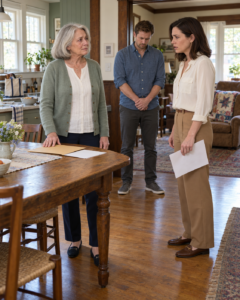
My Daughter-in-Law Said, “Pack Your Things and Leave My House”—So I Put the Deed on the Table
Phân cảnh 1: The confrontation
My daughter-in-law looked me dead in the eye and said, “This isn’t your family anymore. Pack your things and leave.”
She said, “It’s standing in my living room, in my house.” The house my late husband Ray and I had bought together 31 years ago, when we were young and broke and stubborn enough to believe we could make something beautiful out of a neglected craftsman bungalow on Sycamore Ridge Road.
My son Kevin was sitting on the couch, not 10 ft away. He heard every word. He looked at her. Then he looked at me, and he said nothing.
I want you to hold on to that moment, because that silence is what changed everything. Not her words. His silence.
But here is what neither of them knew. Tucked inside the canvas tote bag sitting on the kitchen counter was a Manila envelope. Inside that envelope were two documents: the property deed to this house and a formal notice I had signed 3 days earlier with the help of my attorney.
I hadn’t planned to bring them out that morning. I thought I still had time to avoid this, but sometimes people make the decision for you.
And when my daughter-in-law Renee told me to pack my things in the home I had owned outright since 2009, I reached into the tote bag, set both documents on the coffee table, and I said, “You’re right. Someone is leaving tonight. But it won’t be me.”
But I’m getting ahead of myself, because what happened that Saturday morning didn’t start with Renee pointing toward my front door. It started with Ry.
Phân cảnh 2: Building a life with Ray
Everything in my life starts with Ry. My name is Joanne Whitfield. I’m 63 years old. I taught third grade for 27 years at Maplewood Elementary.
And for most of my adult life, I was the kind of woman who kept the peace. Kept it the way some people keep a tidy house: constantly, quietly, at a cost I didn’t always understand until it was too late.
Rey was the opposite. He was loud in the best way. Laughed too easily, disagreed without apology, fixed things whether you asked him to or not.
He was a Finnish carpenter by trade, and he treated our house the same way he treated his work: with patience, with care, and with a stubborn belief that anything worth having was worth doing right.
We bought the house on Sycamore Ridge Road in the spring of 1993. It needed everything. The porch boards were rotting. The bathroom tile was cracked.
The kitchen was so small that two people could barely stand in it without bumping elbows. Ray walked through every room twice, nodding to himself the way he always did when he was already building something in his head that didn’t exist yet.
He said, “Joe, this is the one.”
I said, “Ray, the ceiling is sagging.”
He grinned. “That means we can make it exactly what we want.”
So, we did. Over the years, Ray replaced the porch, rebuilt the kitchen, retiled the bathroom, refinished the floors, and added a sun room off the back that became my favorite place in the world.
I graded papers in that sunroom for two decades. I read every book I loved in that sun room.
On Sunday mornings, Ry would bring me coffee and sit across from me without saying much. And that quiet felt like the most complete thing I’d ever known.
We raised Kevin in that house. He learned to ride his bike on the driveway. He had his first serious girlfriend over for dinner at the table Ray built by hand.
He went off to college, came back for holidays, grew into a man I was genuinely proud of. Not perfect, but good. I believed that right up until I watched him sit on that couch and say nothing while his wife told me to get out.
Ray died four years ago. A stroke—sudden, the kind that doesn’t give anyone time to prepare. One morning, he was in the garage sharpening a chisel. By afternoon, he was gone.
It lived in my chest like something dense and immovable. And for a long time, I didn’t know how to carry it.
But I stayed in the house. People told me not to. My sister said it would be too hard, too empty, too much upkeep for one person.
My neighbor asked if I’d thought about one of those 55 and over communities down near Asheford. I smiled and said I’d think about it. I never thought about it.
This house was where Ray still existed. In the notch he’d carved into the kitchen door frame marking Kevin’s height every birthday, in the sunroom addition he’d built with his own hands, in the slight unevenness of the back porch step that he kept meaning to fix and never did.
I wasn’t going to leave. Kevin came around more often after Ray died. I appreciated that.
Phân cảnh 3: A son’s request
He had a good job in IT project management, a nice apartment across town, a fiance named Renee I had met twice at family dinners. She was polished, organized, the kind of person who color-coded her planner.
We were cordial, warm enough. I thought we understood each other.
Then Kevin called me on a Tuesday evening. His voice had that careful, cautious tone I recognized from when he was a teenager about to tell me something he already knew I wouldn’t like.
“Mom, things have gotten a little complicated.”
He and Renee had been planning a wedding. The venue deposit alone had been more than either of them expected.
Then Kevin’s company announced layoffs, and while he kept his position, he took a significant salary cut. Their lease was up in 3 months. They were trying to figure out what to do.
I listened to all of it. Then he said, “I was wondering if maybe, just for a little while, we could stay with you. Just until we get back on solid ground.”
I looked around the sun room. The evening light was coming through the windows at that particular angle Rey always liked. I thought about Kevin as a little boy running down the hallway in his socks. I thought about what Rey would have done.
“Of course,” I said. “Come home.”
Kevin thanked me so many times I had to tell him to stop.
The first few weeks were fine. Better than fine, actually. Kevin helped me with the yard. He fixed the bathroom faucet that had been dripping since February.
We ate dinner together most nights. Renee was quieter, more reserved, but she helped clean up after meals and said, “Please,” and, “Thank you.”
And I thought, “Okay, we can do this. This is what family looks like sometimes.”
The first sign that something was shifting came about a month in. I came downstairs on a Saturday morning and found Renee in the kitchen rearranging the cabinets.
Phân cảnh 4: Slow erosion of boundaries
She had taken down every item from the upper shelves and reorganized them according to some system that made sense to her and made no sense to the space I had lived in for 30 years.
“I hope you don’t mind,” she said, not looking up. “The flow was really inefficient.”
I stood there for a mugs. She pointed to a different cabinet.
“Over here. It makes more sense with the coffee maker.”
I moved them back the next day. She moved them again the day after that.
I told myself it was small, a minor difference in preference. I told myself it wasn’t worth the tension. So, I let it go.
And that was my first mistake, because every time I let something go, Renee moved to the next thing.
She started leaving decorating magazines on the kitchen table with pages folded down. She made comments about the sunroom furniture being outdated. She mentioned off-handedly that the guest bathroom could really use a refresh.
One evening, she walked through the living room, looked at Ray’s old recliner in the corner, and said, “That chair is really taking up a lot of space.”
I looked at the chair. Rey had sat in that chair every evening for 15 years. He read in it. He watched baseball in it.
The armrest on the left side had a small permanent dent from where he rested his elbow.
“It stays where it is,” I said.
It was the first time I had said no that directly, and I watched Rene’s expression shift in a way I filed away for later.
Kevin smooth things over at dinner. He was good at that. Smoothing things over, making both sides feel acknowledged without actually addressing what was happening.
I recognized it as a skill, but I was beginning to understand that it was also an avoidance.
The next shift happened in October. I have a small room off the hallway that I use as a sewing and craft room. After Ray died, I started quilting.
My doctor had suggested finding something to do with my hands, something that required concentration, and quilting turned out to be exactly right.
I made baby quilts for my former students when they had children. I made a quilt for Kevin when he graduated college. It was a room full of fabric and thread and an old Singer machine and bins of half-finish projects, and it was mine completely.
One afternoon, Renee stood in the doorway.
“I’ve been thinking,” she said. “Kevin really needs a proper home office. He’s been working from the bedroom, and it’s hard for both of us.”
I waited.
“This room would actually be perfect.”
I put down my scissors.
“This is my sewing room, Renee.”
“I know, but you have so much space in the sun room. You could move some of this stuff out there.”
I looked at her.
“I don’t want to move it out there.”
She smiled the smile she used when she was about to reframe something.
“I just think it would be better for Kevin’s work if he had a dedicated space.”
“There are two other rooms upstairs,” I said. “His home office is his responsibility to figure out within the space available to him.”
She left without answering.
That night, Kevin came to me. He sat at the kitchen table, the same spot where he used to do his homework, and he said, “Mom, could you maybe consider it? Just consider it.”
“No,” I said.
He blinked.
“Okay.”
That was the whole conversation. But something had changed between us, and I could feel it.
It changed further the following month when I came home from my book club on a Wednesday evening and found that the lock on the back door had been replaced.
I tried my key. It didn’t turn. I stood on the back step in the cold, grocery bag in one hand, keys in the other, feeling something I had never felt in 31 years of living in that house.
I felt like I didn’t belong there.
Kevin opened the door from inside. He saw my face.
“Oh, the lock. Yeah, Renee said the old one was sticking.”
“When did she have it changed?”
He hesitated.
“Yesterday.”
“Did she give me a key?”
Another hesitation.
“Not yet.”
I walked inside and put the groceries on the counter and didn’t say another word about it. But I lay awake that night thinking about a word.
Not angry. Not even hurt, exactly. I was afraid of where this was going.
Then I found the folder.
Phân cảnh 5: The discovery of a plan
It was on a Wednesday, about 6 weeks after the lock incident. I was looking for a rubber band in the kitchen drawer, and instead I found a Manila folder that didn’t belong to me.
I opened it. Inside were printed emails between Renee and a real estate agent named Gretchen Pollson with Harbor Point Realy.
The most recent email was dated 11 days earlier. In it, Gretchen was outlining a preliminary assessment of the property at our address on Sycamore Ridge Road. She mentioned the square footage, the lot size, the comparable sales in the neighborhood.
She wrote, “Based on current market conditions, the property could list between 485,000 and $510,000, pending interior updates. Happy to discuss a timeline once the ownership situation is clarified.”
Ownership situation.
I read that phrase three times. Then I set the fat and raise recliner and stared at the wall for a very long time.
Kevin came home at 6:00. I was still sitting there. I held up the folder.
He saw it. His jaw tightened slightly.
“Mom—”
“Sit down, Kevin.”
He sat on the couch across from me.
“What is this?”
“It’s not what it looks like.”
“Tell me what it is, then.”
He rubbed his face with both hands.
“Renee has been researching options. Just researching.”
“A very organized plan.”
He was quiet.
“Kevin, does she think she has a claim to this house?”
“No, of course not.”
“Does she know my name is on the deed, just my name?”
He met my eyes.
“Yes.”
“Then why is a real estate agent discussing the ownership situation?”
He didn’t have an answer.
Renee came home 40 minutes later. She walked into the living room, saw the folder on the coffee table, and looked at Kevin, then at me.
“I was exploring options,” she said.
“Without telling me.”
“It wasn’t the right time.”
“For what, exactly? For telling me that someone was researching how to sell my house?”
She sat down. She used a measured voice.
“Joanne, this house is very large for one person. Eventually, you are going to have to think about what makes sense longterm. Kevin and I were just trying to get ahead of it.”
I looked at her for a long moment.
“Did it occur to you that I might prefer to think about my own future?”
“We were trying to help.”
“You changed my lock without giving me a key. You tried to take my sewing room. You contacted a real estate agent about a property you have no legal connection to. That is not helping. That is something else.”
The room was very quiet. Kevin was looking at the floor. I stood up.
“I’m going to bed. We’ll talk more tomorrow.”
But I didn’t go to bed. I went to my desk, and I found the business card I had kept in the top drawer since Ray’s estate was settled.
Arthur Vines, Family and Property Law.
I sent him an email that night. He called me the next morning. I explained everything.
He asked me two questions. First, was my name the sole name on the deed?
“Yes.”
Second, had I signed anything, agreed to anything in writing, made any financial arrangement with Kev or Renee?
“No.”
“Then your position is very clear,” he said. “Would you like to formalize it?”
I thought about that for a moment. About Kevin’s face, about the little boy in the socks, about Rey saying, “Come home.”
Then I said, “Yes.”
Arthur prepared the documents. The formal notice gave 60 days. He recommended 60 over 30 because it showed good faith and would hold up better if anything became complicated.
I signed everything on a Thursday afternoon and drove home and put the envelope in my canvas tote bag and went about my week without saying a word. I had dinner with Kevin on Friday.
Phân cảnh 6: The ultimatum
I asked him how work was going. He said it was going well, that his manager had mentioned a possible title change. I smiled and said that was wonderful.
I was waiting. Renee pushed the timeline forward herself.
On Saturday morning, she came into the kitchen while I was making oatmeal. She poured a glass of water and stood by the sink and said, “Kevin and I need to talk to you about something.”
Kevin appeared in the doorway right on Q. He looked uncomfortable.
“Okay,” I said. “Go ahead.”
Renee crossed her arms. She wasn’t unkind, exactly, but she had the energy of someone who had rehearsed this.
“We’ve been doing a lot of thinking about the future, about everyone’s future.”
“Mhm.”
“This arrangement has given us time to stabilize, and we’re grateful for that. But Kevin and I need a real home, our own space, and honestly, Joanne, so do you. A place that’s more manageable for one person.”
I stirred my oatmeal.
“What are you suggesting?”
She glanced at Kevin.
“We think it makes sense for you to start looking at other options. A condo, maybe something smaller, easier to maintain. We’d handle all the upkeep and expenses going forward.”
I put my spoon down.
“You’d take over the house, essentially.”
“Yes.”
“My house.”
“It’s a lot for one person.”
“I’ve been managing it just fine for 31 years.”
Kevin spoke up.
“Mom, we’re not trying to upset you. We just thought—”
“This isn’t your family anymore,” Renee said. “Pack your things and leave.”
She said it in a flat, certain voice, as though she had been rehearsing that line the longest.
I looked at her. Then I looked at Kevin. He was looking at the floor again.
That silence. That terrible practice silence.
I wiped my hands on the dish towel. I walked to the kitchen counter. I picked up my canvas tote bag. I reached inside and took out the Manila envelope.
I walked back to the kitchen table and set both documents down. Then the notice.
Renee looked at the papers.
“What is this?”
“The deed,” I said.
I tapped my name.
“My name. Sole owner. No leans. Paid off in full in 2009.”
She picked up the second document. I watched her read the first paragraph, then the second. Her face changed.
“You had a lawyer draw this up.”
“Yes.”
“When?”
“Last week.”
“60 days.”
I confirmed.
She looked at Kevin.
“Kevin.”
He was still looking at the floor.
“Kevin, say something.”
He raised his eyes to mine. I saw something in them I hadn’t expected. It wasn’t anger. It was shame.
He said, “Mom, I didn’t know she was going to say that to you.”
“But you knew about the real estate emails.”
He swallowed.
“Yes.”
“And the lock.”
“Yes.”
“And the plan for my sewing room.”
A long pause.
“Yes.”
“Then you knew enough,” I said.
“You can’t just throw us out. We gave up our apartment. We’ve been here for 8 months. You invited us. You said it was what family does.”
“I did say that,” I told her. “And family doesn’t plan to sell each other’s homes behind their backs.”
She had no answer to that. For the first time since I had known her, Renee had nothing to say.
I picked up my oatmeal, carried it to the sunroom, and sat down in the morning light.
Phân cảnh 7: Resolving the tension
Those 60 days were not easy. I won’t pretend they were. There were evenings when the house felt so tense that I ate dinner early just to avoid the kitchen.
There were nights when I second-guessed myself, when I wondered if I was being rigid, too unforgiving, too quick to end something that might still have been salvaged.
Then I would remember that folder in the drawer, the lock I couldn’t open, the real estate agent’s email about the ownership situation, and I would remember that I had been patient for 8 months.
I had absorbed small erosions one at a time, each one minor enough to dismiss. All of them together amounting to something that felt like being slowly erased from my own life.
Kevin and I had our hardest conversation about 3 weeks before they left. He came into the sun room late on a Sunday. He sat in the chair across from mine.
Neither of us said anything for a while. Then he said, “I should have said something when she moved your mugs.”
I looked at him.
“That was the first thing. I saw her do it, and I thought, ‘I’ll talk to her later.’ And I never did. And then it kept going, and I kept telling myself I’d handle it later, and later never came.”
I waited. He looked at his hands.
“I was trying to keep everybody happy.”
“I know.”
“That doesn’t work, does it?”
“No,” I said. “It doesn’t. Keeping everybody happy usually means keeping nobody safe.”
He was quiet.
“I’m sorry, Mom.”
I believed him. I want to be clear about that. I believed he was sorry.
But sorry doesn’t undo 8 months. Sorry doesn’t give back the morning I stood on my own backstep unable to get into my own house. Sorry is the beginning of something, not the end.
I said, “I know you are, and we’ll find our way through this. But you need to understand something for the rest of your life. The people who love you deserve your voice. Not your silence.”
He nodded. He didn’t try to hug me. He seemed to understand that I wasn’t ready for that yet.
He just sat with me for a while in the sun room, and eventually we watched the sun go down through the windows Ry had installed, and that was enough for that night.
Renee surprised me. About a week before they moved out, she knocked on the door to my sewing room. I told her to come in.
She stood near the threshold, the same way she had stood there months earlier when she wanted to take it from me.
She said, “I owe you an apology.”
I kept my hands on the fabric I was working with.
“Okay.”
“I came here thinking I was being practical. I told myself I was planning ahead for everyone.”
She paused.
“But what I was actually doing was treating your home like a problem to be managed. Like an asset, not like somewhere you live.”
I looked up at her.
“That’s an honest thing to say.”
She looked around the room at the quilts folded on the shelf, at the little ceramic dish Ray had made in a pottery class 20 years ago. The one I used to hold my pins.
“Ry made that room addition, didn’t he?”
“He did.”
She was quiet for a moment.
“I think I was intimidated by how much of him is still in this house. I don’t know why that made me want to change things.”
I thought about that. It was more insight than I had expected from her.
“It made you feel like an outsider,” I said.
“Yes.”
“You could have just said that.”
She nodded slowly.
“I know.”
I accepted her apology, not because everything was resolved, not because I trusted her completely, but because she had offered me something real, and I’ve lived long enough to know that real apologies deserve real acknowledgement.
Moving day was a cold Saturday in November. I stayed in the sun room most of the morning, listening to the sounds of boxes and footsteps, the elevator clunk of the dolly on the hardwood, the low voices.
Phân cảnh 8: Claiming her place
Around noon, Kevin came in carrying two cups of coffee. He sat one beside me without saying anything. Then he sat down.
We drank coffee together in Ray’s sun room for maybe 20 minutes. Neither of us said much.
When he stood to go, he picked up his cup and held it for a moment.
“I used to sit in here and do my homework when I was little,” he said.
“I know.”
“I’d forgotten that.”
He looked at the windows.
“Dad built this room.”
“He did.”
“He built it for you.”
“He built it for us,” I said. “This whole house.”
Kevin nodded. He walked to the door and then stopped.
“I’ll call you this week.”
“Yes,” I said. “Please do.”
He left.
A little while later, I heard the front door close as I heard a car start. I heard it back out of the driveway and moved down Sycamore Ridge Road until the sound faded, and then the house was quiet.
Not the hollow, aching quiet of when Ray died. A different quiet. Settled. Mine.
I sat in the sun room until the afternoon light shifted and turned gold. The way it does in November, the way Ry always said was his favorite light.
I looked at the small ceramic pin dish on my sewing table. I looked at the notch in the kitchen door frame I could see through the open door. I looked at the slightly uneven back porch stepped through the window.
I thought about what I had been afraid of these past months. Not losing the house. I could have fought for the house legally without much difficulty. Arthur had told me that from the beginning.
What I had been afraid of was qualing myself inside it. Becoming so focused on keeping peace, on not disrupting, on making room for everyone else that I would disappear from my own home the way I had slowly disappeared from my own mornings in my own kitchen and my own sewing room.
That was the real danger. Not Renee, not even Kevin’s silence. Me. My habit of shrinking.
I thought about Rey. He never shrank, not once. He disagreed. He fixed things. He laughed too loud.
He took up space without apology. And he never asked me to make myself smaller to make him feel bigger.
I had spent 31 years with a man like that. I had learned his lessons imperfectly, it turned out. But I was learning.
Kevin calls every week now. We talk about ordinary things: his work, my quilting group, the garden I’ve started planning for spring.
He and Renee found a rental across town. I think they are genuinely trying to build something honest together, which is all any of us can do.
Renee sends me a text every now and then, nothing heavy. Sometimes it’s a photo of something she cooked. Once it was a picture of a quilt she saw in a shop window.
She wrote, “Thought of you.”
I wrote back, “It’s beautiful.”
That’s enough for now.
I still live on Sycamore Ridge Road. I still drink my coffee in the sun room on Sunday mornings.
I still quilt, still garden, still vote in every election, still stop by the hardware store when I need nothing in particular, which is, I have decided, one of the quietly dignified privileges of being 63 and knowing exactly what you own.
Last week, I found one of Ray’s old chisels at the back of the garage shelf. It was clean, oiled, the way he always kept his tools.
I held it for a long time. Then, I put it back exactly where it was.
Some things you don’t move. Some things you protect, not because they’re valuable to anyone else, but because they are the evidence of a life you built carefully and deliberately, and with love.
My daughter-in-law told me this wasn’t my family anymore, and to pack my things and leave. She said it standing in my house, in the hallway Ray had finished by hand, under the ceiling he had repaired four different times over 30 years.
I put the deed on the table. I said, “Someone is leaving tonight, but it won’t be me.”
And I meant it. Not as a threat. As a fact. As the simplest and most honest thing I had said in 8 months.
I belong here. Not because my name is on a document, though it is. Not because I can prove it in a court of law, though I could.
I belong here because I lived here. Because I loved here. Because I am still here, in the sun room, in the morning light, in the quiet that finally feels like mine again.
And that is not something anyone can take from you.