My Daughter-In-Law Threw A Plate At Me And Called Me Selfish On Thanksgiving Day… True Story
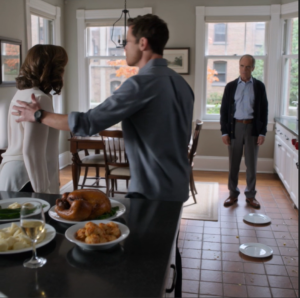
My daughter-in-law threw a plate at me on Thanksgiving. “You selfish old man!” she screamed, her face twisted with rage because I refused to let her parents move into my house. My own son, Matthew, just watched.
“You’re not my father anymore!” he shouted, siding with her.
I just smiled, made one single phone call, and by the time they got back to their luxury apartment, the locks had already been changed. They didn’t know who owned the building, and they didn’t know who I really was.
Before I continue this story, I’m glad you’re here. Please like this video and subscribe to the channel if you believe that respect is something to be earned, not demanded. And let me know in the comments where you are watching this from.
The air in my kitchen was thick, heavier than the rich scent of roasting turkey and sage. Today was Thanksgiving, a day meant for gratitude, but the only thing I felt was the familiar cold tension seeping in from the living room. I’m Gregory, sixty-nine years old, and this four-story Brooklyn brownstone has been my home for four decades. Through the doorway, I could hear them whispering—my son, Matthew, and his wife, Brenda. Her voice was a low hiss, sharp enough to cut through the festive music.
“It’s ridiculous, Matt. Four whole floors, and he’s just one man. My parents deserve that garden apartment.”
I paused, the basting spoon hovering over the turkey. Four floors. This house. My home. My late wife, Clara, and I bought this place forty years ago with every penny we had, back when this neighborhood was just a place where working families lived, long before the artisanal bakeries and million-dollar condos. We poured our youth into these walls, sanded these floors by hand, painted these rooms ourselves. Now Brenda just saw square footage. She saw an asset. And Matthew—Matthew just saw what she told him to see.
They both see Gregory, the sixty-nine-year-old retired history teacher, living a quiet life on a meager pension. That’s the man I’ve allowed them to see. It was safer that way. Clara, bless her soul, always said it: “Be careful, Greg. Money makes people strange, especially family.”
She was right.
The whispers stopped. A moment later, footsteps. Brenda appeared in the kitchen doorway. She wasn’t dressed for a family dinner. She was dressed for a corporate takeover: a sharp, expensive-looking dress that I knew for a fact my son could not afford on his salary.
“Gregory,” she said. She never called me Dad. “I’m glad you’re not busy.”
I turned slowly from the oven. “I’m basting a turkey, Brenda. It’s Thanksgiving. I am, by definition, busy.”
She waved a perfectly manicured hand, a gesture of pure dismissal. “Fine, I’ll be quick. I’ve made a decision. My parents will be moving into the garden apartment at the end of the month. They need a place to stay.”
It wasn’t a request. It was an announcement. The sheer audacity of it hung in the air, thicker than the aroma of the roasting bird. I calmly placed the baster down on the spoon rest. I wiped my hands on my old, faded apron.
“No, Brenda.”
She blinked, just once—a flicker of surprise. “What did you say?”
“I said no. That won’t be happening.” I kept my voice low. “That apartment—that was Clara’s art studio. It’s my office now. It is not available.”
Her carefully composed face began to crack. “Why not? Because of her? She’s gone, Gregory. It’s been ten years. You are one man rattling around in a four-story house while my parents are about to be homeless. How selfish can you possibly be?”
Matthew skittered into the room right on cue, wringing his hands. The classic mediator, always trying to smooth the edges she created.
“Dad, come on. Please, just for a little while. They—they have nowhere else to go. We can’t afford the deposit on a new place for them right now.”
I looked at my son, my only child, thirty-eight years old and still letting this woman lead him around by the nose.
“Matthew,” I said, my voice still quiet, “I helped you with the deposit on your current apartment and the apartment before that. And I co-signed the loan for that car you’re driving, the one you defaulted on twice. The answer is no.”
This was the moment Brenda realized her usual manipulation had failed. She saw the finality in my eyes. Her control didn’t just slip; it shattered. Her face flushed a dark, ugly red.
“Selfish,” she whispered, her voice trembling with a rage that was anything but whispered. “You are the most selfish man I have ever met.”
Before I could say another word, she grabbed a plate from the counter. It wasn’t one of Clara’s good china plates, thank God. It was one of the cheap, everyday stoneware plates I had intentionally set out for them. She didn’t hesitate. She hurled it.
Crash.
The plate shattered on the kitchen tile, a spray of white fragments skittering under the cabinets.
“You selfish old man!” she screamed, her voice cracking.
I stood perfectly still. I looked at the broken plate. I looked at her heaving, her chest rising and falling under the expensive fabric. And then I looked at Matthew. This was it, the moment of truth. My son. My blood. This was the moment for him to stand up, to defend his father, to draw a line in the sand.
He looked at me. His face was pale, but not with fear for me. It was with annoyance. I had become a problem. I was ruining his Thanksgiving.
“See what you did?” he said, his voice cold. “You upset her. You’ve ruined everything.”
He stepped forward, not toward me, but toward Brenda. He put his arm around her, comforting her.
“Dad, if you can’t be a part of this family”—he gestured between himself and his raging wife—“if you can’t support us, then don’t call me your son anymore.”
The words hung in the silence, the final betrayal. And in that moment, I felt nothing. No pain. No shock. Just clarity. The fog I had been living in for the past ten years, the fog of misplaced hope and one-sided sacrifice, finally lifted. I didn’t tremble. I didn’t raise my voice. I smiled—a small, tired, and utterly final smile.
“If that’s what you want, Matthew.”
I untied the old apron, the one with the burn mark from a Thanksgiving ten years ago when Clara was still alive. I folded it carefully and placed it on the counter. I pulled my old, scuffed smartphone from my pocket. Their angry faces morphed into confusion. They had expected tears, begging, or surrender. They were not prepared for calm.
“What are you doing?” Brenda snarled, her voice still shaky. “Calling the police? Go ahead. We’ll tell them you’re senile and violent.”
I ignored her. I pressed a single number on my favorites list. I put the phone to my ear, my eyes locked on theirs.
“Victor,” I said, my voice perfectly level. “It’s Greg. Happy Thanksgiving, brother.”
I paused, listening to the tiny voice on the other end. Matthew and Brenda were frozen, watching me.
“Yes,” I continued. “Everything is just as you said it would be. Exactly to the letter.”
I saw Matthew’s brow furrow. Brenda’s eyes narrowed.
“Activate the plan,” I said. “Activate everything.”
Brenda’s face, which had been red with rage, went pale with confusion. “Plan? What plan? Who is Victor? What are you talking about?”
I didn’t answer her. I walked past them, picked up the broken pieces of the cheap plate, and dropped them into the trash can. Then I turned and pointed to the front door.
“The Thanksgiving dinner is over. Please leave my house.”
Matthew looked at me, utterly baffled. “Dad, what are you doing? You can’t just kick us out. It’s Thanksgiving.”
“You kicked yourself out, Matthew,” I said, my voice as cold and hard as the November pavement outside. “You made your choice. You told me not to call you son. So, as a stranger, I am asking you to leave my property.”
“You old—” Brenda started, but Matthew grabbed her arm.
“Fine,” he spat, his voice cracking with a mixture of anger and bewilderment. “Fine, we’ll go. But don’t come crying to us when you’re all alone and need someone to change your diapers.”
They stormed out, slamming the heavy oak door so hard the frame rattled. I heard them shouting all the way down the front steps, their voices echoing in the quiet Brooklyn street. I heard Brenda scream something about me being ungrateful and senile.
I just stood there in the silence of my kitchen, the smell of the forgotten turkey starting to fill the house. I turned off the oven. I wasn’t hungry. I walked into the living room, sat in Clara’s old armchair, and waited. The house was finally quiet. It had been years since it had felt this peaceful.
Fifteen minutes passed. Right on schedule, my phone, resting on the side table, began to vibrate. I looked at the screen. Matthew. I let it ring once, twice. The sound was jarring in the silence. It rang a third time, a fourth. On the fifth ring, just before it went to voicemail, I picked it up.
“Hello?”
“Dad!”
It wasn’t a word. It was a raw scream of panic.
“Dad, what did you do?”
I feigned confusion. “Matthew, what are you talking about? I thought I wasn’t your father anymore.”
“Stop it. Just stop it!” he yelled.
I could hear Brenda sobbing hysterically in the background.
“I just got an email, an official email. We’re being evicted. It says our lease is terminated, effective immediately. They’re giving us twenty-four hours to get out. Dad, what did you do?”
“Evicted?” I said, injecting just the right amount of elderly confusion into my voice. “I don’t understand. How can I do that? I don’t even know who your landlord is.”
“It’s—it’s some corporation, VC Properties. You must have called them. You told them some lie about us.”
I paused for a beat. “VC Properties,” I repeated slowly, as if tasting the name. “No, son. I’ve never heard of them. I’m sorry to hear about your troubles.”
“Sorry? You—”
He was sputtering, choking on his own rage and panic.
“This can’t be a coincidence. It happened fifteen minutes after we left your house. You did this. You have to fix it. Call them. Tell them you were joking. Tell them—”
“Matthew,” I interrupted, my voice no longer confused but firm. “I can’t fix this. I didn’t do it. You and your wife are adults. You’ll have to figure out your own housing. Now, if you’ll excuse me, I have a dinner to clean up.”
“Dad, wait—”
I hung up the phone. I leaned my head back against the worn velvet of the armchair. Phase one was complete. I closed my eyes, and for the first time since Clara died, I felt a genuine, cold smile spread across my face.
“Dad!”
It wasn’t a word. It was a raw scream torn from his throat, vibrating with pure, unadulterated panic.
“Dad, what did you do?”
I held the phone slightly away from my ear, savoring the sound. I let the silence stretch, listening to the sharp, hysterical sobs of Brenda in the background. She sounded like she was hyperventilating.
“Matthew,” I finally said, injecting the perfect amount of elderly confusion into my voice, “what on earth are you shouting about? And why are you calling me Dad? I thought, by your own request, that I wasn’t your father anymore.”
“Stop it! Just stop it!” he shrieked. “This isn’t a joke. This isn’t funny. You’ve ruined us. You’ve actually ruined us.”
“I’m afraid I don’t follow, Matthew. Ruined is a very strong word.”
“The email, Dad. The email!”
I could hear him pacing, his footsteps frantic on what I knew was the expensive hardwood floor of his luxury apartment—the apartment I had guaranteed the lease for.
“I just got an email, an official legal email. We’re being evicted.”
Brenda’s sobs turned into a high-pitched wail. “He did it, Matt. That old bastard actually did it.”
“Matthew,” I said, my voice dripping with feigned concern, “evicted? That’s terrible. But what does that have to do with me?”
“Don’t lie!” he roared. “It happened fifteen minutes after we left your house. Fifteen. It says—it says—”
I heard him fumbling, his breath catching.
“It says our lease is terminated, effective immediately. We have to vacate the premises within twenty-four hours. Twenty-four hours, Dad. Where are we supposed to go? It’s Thanksgiving.”
“My goodness,” I said, looking at my clean, quiet kitchen. “That does sound like a predicament.”
“It’s from some corporation,” he shouted, his voice cracking. “A management company, VC Properties. You must have called them. You must have told them some horrible lie about us, that we don’t pay rent or—or—”
I let him trail off. I let the silence fill with his panic. Then I spoke, letting the name roll off my tongue as if I were tasting something foreign.
“VC Properties.” I paused. “No, son. I’m afraid I’ve never heard of them. It sounds like you have a problem with your landlord. I’m very sorry to hear about your troubles.”
“Sorry? Sorry?” he sputtered. “You—you’re enjoying this, aren’t you? This is your sick revenge just because we asked for that stupid apartment.”
“I am simply cleaning up the remains of a Thanksgiving dinner that was so rudely interrupted,” I said calmly. “What you and your wife are experiencing sounds like a legal matter between a tenant and a landlord. I don’t see how I fit into it.”
“Fix it!” he suddenly screamed.
It wasn’t a plea. It was a command—the command of a spoiled child who has just had his favorite toy taken away.
“I don’t know how you did it, but you did it. You have to call them back. Tell them—tell them you were joking. Tell them it was all a—a sick Thanksgiving prank. Tell them anything. Just fix it.”
I heard a muffled sound, like Brenda had snatched the phone from him.
“Gregory.”
Her voice was completely different. It was no longer the arrogant shriek from my kitchen. It was a syrupy, desperate, and utterly fake whisper.
“Gregory, please. I—I’m sorry. I was upset. I didn’t mean what I said. You know I—I love you like a father. Please, you can’t let this happen to us. My parents, we were going to—we can talk about the garden apartment. Maybe we were too hasty. Maybe we can find another solution. Just please make the call.”
Ah, there it was. The negotiation. The moment she realized her power was gone and tried to bargain with the very thing she had used as a weapon.
“So,” I said, “the garden apartment is back on the table, is it? You’ll let me keep my own home in exchange for you keeping yours.”
“Yes, yes, anything!” she cried. “Just stop this. We have nowhere to go.”
“Matthew,” I said, knowing he was listening. “Put your son back on the phone.”
There was a fumbling sound, and Matthew’s voice returned, now smaller, broken.
“Dad?”
“Matthew,” I said, and my voice changed.
The fog of the confused old man evaporated. The warmth was gone. All that was left was cold, hard steel.
“I cannot fix this. As I told you, I have never heard of VC Properties. You and your wife are adults. You are on your own. You will have to figure out your own housing.”
“But—but we have no money. We have—”
“Now, if you’ll excuse me,” I interrupted, “my dinner is getting cold. I suggest you start packing. Twenty-four hours isn’t a lot of time.”
“Dad, wait! The credit cards. The credit cards aren’t working either. I tried to book a hotel room, and it was declined. All of them. What did you do?”
I smiled. Phase two.
“I have no idea what you’re talking about, Matthew.”
I hung up the phone. I stood in the quiet of my house and took a deep, clean breath.
“Happy Thanksgiving, Gregory,” I whispered to myself. “Happy Thanksgiving indeed.”
I disconnected the call, cutting off Matthew’s frantic, sputtering protests. The silence that filled my living room was immediate and deeply satisfying. I picked up my coffee cup, took a slow sip, and dialed a different number, a number my son didn’t even know existed. It rang once.
“Well?” His voice was crisp, amused.
“The VC Properties name was a nice touch, Victor,” I said, letting a small smile play on my lips. “Victor and Clara. She would have appreciated the poetry of it.”
My brother chuckled on the other end of the line. “I’m glad you liked it, Greg. I thought it was appropriate. So, I take it phase one is complete?”
“They’re packing as we speak,” I said. “He was surprised. He genuinely believed his landlord was a stranger.”
“Of course he did,” Victor said, his tone shifting from amusement to the sharp, precise voice of the man who managed our shared empire. “That apartment building is one of the best assets we bought ten years ago. We just terminated the family subsidy you’ve been secretly paying for him. He thought he was paying two thousand a month for a penthouse in DUMBO. The market rate is seven thousand.”
I sighed, looking at a photo of Clara on the mantel. “He called me selfish, Victor.”
“He doesn’t know the meaning of the word,” Victor replied, his voice hard. “He’s been living on your charity, financed by your silence, for his entire adult life. He just doesn’t know it yet.”
“Welcome to the real world, Matthew.”
The banging started just after midnight. It wasn’t a polite knock. It was the frantic, desperate pounding of fists against solid oak. Bang, bang, bang. It echoed up the four flights of my brownstone. I wasn’t surprised. I had been waiting for it. I walked calmly from the kitchen, tea in hand, and pressed the button for the intercom, turning on the small black-and-white video feed.
There they were, illuminated in the harsh glare of the streetlamp. Matthew was vibrating with panic, his hair a mess. Brenda looked like a cornered animal, her expensive coat pulled tight around her, her face a mask of disbelief and pure fury.
“Who is it?” I asked, my voice calm through the speaker. “It’s the middle of the night.”
“Dad, open the door, please. Dad, open the door.” Matthew’s voice was high, cracking.
“Matthew, what’s wrong now? You’ll wake the entire neighborhood.”
Brenda shoved him aside, her face coming right up to the camera. “He’s done it again, Matt. He’s playing dumb. Open this door right now, Gregory. The credit cards—they’re all blocked.”
Ah, phase two. The credit cards. I leaned back, taking a sip of my chamomile tea. I knew all about those credit cards. I knew about the Platinum Amex that Brenda used for her weekend spa trips. I knew about the Visa Infinite that Matthew used for—well, for whatever Brenda told him to buy. I knew about the Neiman Marcus charge card that had an obscene balance.
Brenda, with her flawless confidence and her MBA from a second-rate university, truly believed she had earned those high-limit cards. She bragged to her friends about her perfect credit score. She thought that hundred-thousand-dollar limit was a reflection of her own financial savvy. She had no idea that limit was a reflection of my assets.
Years ago, when Matthew was just starting out, he wanted to build his credit. I co-signed for his first card, a simple fatherly gesture: a five-thousand-dollar limit backed by my portfolio. Then he met Brenda. They wanted a joint card, a prestige card to book their honeymoon. The bank, of course, looked at their combined income and scoffed. So I made a quiet call. I put my name down as a guarantor. I didn’t co-sign, not this time. I simply guaranteed.
With every “Congratulations, you’ve been preapproved for a limit increase” email they celebrated, it was my signature on a bank document they never saw. Their entire glittering, overleveraged lifestyle wasn’t built on their potential. It was built on my invisible, silent guarantee. They thought they were flying on their own. They never realized I was the one holding the kite string all along. And tonight, I had simply let go.
“Blocked?” I said into the intercom, my voice laced with mild confusion. “My goodness, what are you talking about? I don’t know anything about your credit cards.”
“Don’t lie!” Matthew shrieked, pressing his face to the speaker. “They all stopped working at the exact same time. The Amex, the Visa, even the Amazon card. We’re stranded, Dad. We tried to check into a hotel, and it was declined.”
His voice broke. “We have no money. We have nowhere to go.”
“Well, that sounds like a personal problem with your bank, son,” I said, projecting nothing but mild concern. “Perhaps you’ve been overspending. That’s what happens when you buy things you can’t afford. You should call them in the morning.”
“You.” Brenda was back, her voice dropping to a low, venomous hiss. “You monster. This is—this is financial warfare. You’re trying to destroy us. You’re trying to make us homeless.”
“I am a retired teacher,” I said, my voice suddenly losing all its feigned confusion. “I am in my home, trying to get some sleep. What you are describing, Brenda, are called consequences. They are the things that happen when your actions finally catch up with you. I suggest you get used to them. It’s going to be a long lesson.”
I watched them on the small screen. Matthew had slumped against the railing, his head in his hands. Brenda was staring at the intercom, speechless with rage, finally understanding that the puppet had not only cut his own strings, but that he had been the puppet master all along.
“Good night, children,” I said softly.
I pressed the button, and the speaker went silent. I watched them on the monitor for another minute as they stood there, frozen on my doorstep in the cold Brooklyn night. Then I turned off the monitor and went to the kitchen to refill my tea.
My tea was still hot. I had just settled back into Clara’s armchair, the profound silence of the brownstone a welcome blanket, when my cell phone buzzed on the side table. Matthew. He was persistent; I’ll give him that. I let the call vibrate, the sound jarring against the quiet. It stopped, then immediately started again, and again. On the third attempt, I sighed, picked up the phone, and put it on speaker.
“Dad, don’t hang up. Please, Dad, don’t hang up.” His voice was thin, reedy, stripped of all its earlier arrogance. “We’re still outside. It’s cold. We—”
“What is it now, Matthew?”
“Listen to me, you old—”
I heard a muffled sound, a struggle, and then Brenda’s voice, sharp and venomous, exploded into the room.
“Lying old man!”
I leaned back. I had been waiting for this part.
“I know you’re in there listening,” she screamed, her voice distorting with rage through the small speaker. “You think this is funny? You think you can just cut us off from everything and hide? You think you can ruin our lives and just sit in your dusty, disgusting old house?”
I remained silent. I let her unravel. It’s always been my best tactic. Let them talk, and they will eventually tell you exactly who they are.
“I know you’re behind this, Gregory,” she shrieked. “You pulled the strings. You cut off the apartment. You froze the cards. You think you’re so smart, don’t you? Sitting up there in your fortress like some pathetic, lonely king.”
“Brenda, I’m afraid I don’t know—”
“Shut up!” she roared. “Don’t you dare play the confused old man with me. Not anymore. I see exactly what you are. You’re a vindictive, selfish, bitter old man, and you are going to pay for this. I swear to God, you will pay. We’re going to sue you!” she shrieked, the threat finally bursting out. “You think you can just do this to us? We have rights. Matthew has rights. He is your son.”
“Your rights end where my patience does, Brenda.”
My calm only fueled her fury. “Patience? You won’t have anything left to be patient with when I’m done with you. You want to play hardball, Gregory? Let’s play. What do you think a judge is going to see?”
Her voice suddenly dropped, becoming low and calculating. It was the voice of a predator that believed it had finally cornered its prey.
“A sixty-nine-year-old man,” she began, savoring each word, “living all alone in a massive four-story house. A man who hasn’t worked in years. A man who gets confused. A man who forgets things. Who hangs up on his own loving, worried son.”
“I am not confused, Brenda.”
“Oh, you will be,” she hissed. “You’re sixty-nine. You live alone. You’re rambling. You’re exhibiting erratic, paranoid behavior. You’re hoarding. Yes, that’s it. You’re a hoarder living in a decaying house. It’s a classic textbook case.”
I could hear Matthew in the background, a faint, “Brenda, maybe—maybe that’s going too far.”
“Shut up, Matt. This is the only way. He forced our hand.”
She was back, her voice filled with triumphant spite.
“We are going to petition the court for guardianship, Gregory. We will bring in doctors. We will tell them how you’re failing to care for yourself. We will prove to a judge that you are mentally incompetent, that you are no longer fit to manage your own assets.”
She took a breath, letting the threat land.
“And when we get it,” she continued, her voice dropping to a near whisper, “when we are in control, the very first thing we’re going to do is approve my parents’ application for the garden apartment. And the second thing we’re going to do is sell this ridiculously oversized house and move you into a nice, small, appropriate room in a nursing home. The best one, of course. We’re not monsters. We will get this house, Gregory,” she finished, her voice shaking with the intensity of her greed. “One way or another, whether you give it to us or the court does, it will be ours.”
This was it. The exact scenario Victor had predicted. The exact words he had warned me she would use. They were so predictable.
“Are you finished?” I asked, my voice still perfectly calm.
The question caught her off guard. “What?”
“Are you finished with your plan?”
“You think I’m joking? Just watch me, old man. I’m calling a lawyer right now. We’ll have you evaluated by the end of the week.”
“Good,” I said. “Please do. And, Brenda?”
“What?” she spat.
“I hope you know that this call, like all calls to my personal line, is being recorded. Your lawyer will probably find that very interesting. Specifically, the part about manufacturing evidence to have me declared incompetent. I believe the legal term for that is conspiracy to commit fraud and elder abuse.”
Silence. Absolute, deafening, beautiful silence. I heard a small, strangled sound, like a gasp.
“You—you wouldn’t.”
“I just did,” I said. “Thank you for providing such clear evidence of your intentions. It will be invaluable. Now, do not call this number again. You will be hearing from my legal representative shortly. Goodbye, Matthew.”
I ended the call. I looked at the dark screen. The trap was set, and she had just arrogantly walked right into it, dragging my son down with her.
I pressed the end-call button on my phone, plunging the living room back into a heavy, satisfying silence. Their frantic screams were cut off mid-shriek. I imagined them out there on the cold sidewalk, staring at their phone in disbelief, the weight of my last words finally sinking in. Recorded. Fraud. Elder abuse.
I took a calm sip of my tea. It was still warm. I didn’t feel a tremor in my hand. I felt nothing but a cold, clear focus. They were so predictable, so utterly, perfectly predictable. I dialed Victor’s number. He answered on the first ring, as I knew he would.
“She took the bait,” I said, my voice even.
“Of course she did,” Victor’s voice replied, smooth and sharp as polished steel. “How long did it take?”
“About three minutes of screaming. She’s going to have me declared incompetent. A senile old man—those were her exact words. She’s petitioning for guardianship.”
I heard Victor let out a dry laugh. “Wonderful. Just wonderful. She’s walking right into the trap we laid for her. Ms. Hayes is already prepared for that exact motion. She has three independent psychiatric evaluations on file for you from the last six months, all stating you’re sharper than most men half your age. Let them try. It will only strengthen our case.”
“Good,” I said. “They’re desperate, Victor. They’re broke, homeless, and furious. They’ll do something stupid.”
“They already have,” Victor corrected me. “And now, Greg, while they’re busy scrambling to find a lawyer they can’t afford, I think it’s time we talk about Matthew’s little startup company. The one you funded with your life savings.”
I felt a twist in my gut. This was the part I dreaded.
“The audit came back?”
“Oh, it came back,” Victor said. “And it’s even worse than we thought. Are you ready for phase three?”
I stared at the audit report Victor had just couriered over. Phase three, he had called it. It felt more like an autopsy report. The main figure was circled in red ink: $100,000.
I remembered the day that money left my account. It was almost two years ago to the day. Matthew had shown up at the brownstone unannounced. He didn’t just knock. He pounded on the door, vibrating with a manic energy I hadn’t seen since he was a boy.
“Dad, this is it. This is the one.”
He was pacing my living room, my old, worn Persian rug muffling his expensive shoes. He couldn’t stand still.
“Dad, I have an opportunity,” he said, his hands gesturing wildly. “A real one. A digital marketing startup. My colleague—well, Brenda says he’s a genius. We’re getting in on the ground floor. It’s—it’s a game changer.”
I sat in Clara’s old armchair, the one with the springs that groaned, and I played my part. I looked worried. I wrung my hands.
“A startup, Matthew? That sounds risky. Very risky. You have a steady job. Brenda has a steady job.”
“A dead-end job, Dad. Don’t you get it? This is our chance. Our chance to finally, you know, live. To get ahead. To stop worrying about rent and bills every single month.”
He stopped pacing and finally looked at me. It was the look, the one he reserved for when he truly needed something. It was a potent cocktail of desperate hope and profound entitlement.
“Dad,” he said, his voice dropping to a conspiratorial whisper, “I need a hundred thousand dollars.”
I let the number hang in the air between us. I let the silence stretch, filled only by the ticking of the grandfather clock in the hall. I put my head in my hands, rubbing my temples, performing the role of a poor, worried father facing an impossible request.
“Matthew, a hundred thousand?” I said, my voice heavy with feigned despair. “Son, I—I don’t have that kind of money just lying around. You know that. I’m on a fixed income.”
His face fell, his excitement instantly turning to sullen frustration.
“Of course you do,” he said, his voice sharp. “The house—this house is worth millions. You could take out a small mortgage, a reverse mortgage. It’s nothing.”
I stood up, shaking my head. “The house is paid for, Matthew. I am not putting Clara’s home, my home, at risk for a maybe. Absolutely not.”
He deflated. He knew that was a losing battle. He pivoted, his voice becoming soft, pleading.
“Dad, please,” he said. “I wouldn’t ask if it wasn’t a sure thing. This isn’t a gamble. It’s an investment. An investment in me, in your family, in your future grandchildren.”
Ah, there it was. The emotional trump card. The grandchildren I had always wanted. I let out a long, rattling sigh, the sigh of a man defeated by paternal love. I walked slowly, shuffling my feet, to the old wooden desk in the corner. I unlocked the bottom drawer. From beneath a pile of old tax returns, I pulled out a small blue savings passbook.
It was a prop, a simple savings account I kept with a modest, believable balance for exactly this kind of performance. I held it out to him. His hands were trembling as he took it.
“This—this is it, Matthew,” I lied, my voice cracking just enough. “This is everything. This is all the money Clara and I managed to save. Our entire life savings.”
I let that sink in.
“It was supposed to be for my retirement. For—for emergencies.”
He opened the book. His eyes went wide as he saw the balance: $13,450. To him, it was a fortune. To me, it was a rounding error.
“Dad, I—I don’t know what to say.”
“If I give you this,” I said, putting my hand on his shoulder, “this is it. There is nothing left. You understand me? There is nothing. You cannot fail. You cannot lose this.”
He looked from the passbook to my face, his eyes shining with greed and excitement.
“I won’t let you down, Dad,” he said, his voice tight with emotion. “I promise. I’ll—I’ll double this in a year. You’ll see. I’ll finally make you proud.”
He hugged me, a quick, awkward embrace, and then he practically ran out the door, clutching the passbook to his chest like a winning lottery ticket. I closed the door behind him. I stood there for a moment. Then I walked back to my desk, picked up my other phone, the one he didn’t know about, and dialed Victor.
“It’s done,” I said. “He has the hundred thousand.”
Victor sighed on the other end. “Are you absolutely sure about this, Greg? You know what she’s going to do with it.”
“I know,” I said. “That’s the point. The check will clear tomorrow. Start the audit trail.”
I hung up. Matthew thought he had just secured his future with my life savings. The truth? That hundred thousand dollars was just the interest my portfolio had earned that day. And now, two years later, I stared at the audit report in my hand. Victor was right. Brenda hadn’t even waited a week. The startup company was just a shell, a ghost account, and the money was gone.
I set the phone down on the kitchen table. The recording of Brenda’s threat was saved, secure. My hands, I noted with a distant sort of curiosity, were perfectly steady. I looked down at the thick manila envelope Victor had couriered over an hour earlier, while they had been outside screaming on my sidewalk. Phase three. It felt less like a plan and more like an autopsy.
I opened the clasp and slid out the forty-page forensic audit report. It didn’t take forty pages to understand the truth. It only took the summary on page one. The digital marketing startup Matthew had pitched to me two years ago—the one he had begged for, the one he had sworn would be his legacy—had never really existed. It was a ghost, a shell corporation registered in Delaware by one B. Hughes. Brenda.
She hadn’t even been creative about it. She had used my money to create a legal vacuum designed for one purpose: theft.
I looked at the first major transaction, dated just three days after I had tearfully handed over my life-savings passbook. A wire transfer: $70,000. It wasn’t for server space. It wasn’t for employee salaries or office rent. It was a down payment on a vehicle, a bright-red 2023 Maserati Levante.
I felt a cold, hard knot form in my stomach. I’d seen that car. Brenda had parked it down the street just last month when they came over for Sunday dinner.
“It’s a company car,” she’d bragged, twirling the keys. “A performance bonus from my new job.”
My son, my poor, blind son, had stood beside her, beaming with pride at her business savvy. He had no idea she was driving his inheritance, my sacrifice. She had taken the money I gave them for their future and wrapped it in two tons of Italian steel for herself.
But the car was just the appetizer. That was the sin of arrogance, of impulse. The next transaction was the main course. It was the sin of pure, calculated, sociopathic greed.
The remaining thirty thousand dollars hadn’t been spent on Gucci bags or lavish dinners. It had been moved. A single, clean wire transfer, routed through three different banks before landing, finally, in an offshore account. A private numbered account in the Cayman Islands. An account under a single name: Brenda Hughes.
I let the report fall from my hands onto the table. I finally understood. I had been so focused on them, on Matthew and Brenda as a single toxic unit, that I had missed the real, terrifying dynamic. This wasn’t a partnership. This was a parasite feeding on its host.
She wasn’t just manipulating me. She was actively, systematically stealing from Matthew, too. She was building her own private lifeboat while the two of them, in her mind, were sinking. She had no intention of staying with him. She was just siphoning off every asset she could from his father and from him before she made her exit. My hundred-thousand-dollar investment wasn’t for their future. It was the seed money for her escape.
The rage I felt was no longer just for myself. It was for Matthew. He was a fool. Yes, he was weak. He was a coward. But he was my son, and she was bleeding him dry like a vampire, and he was thanking her for it.
I stood up, the report clutched in my fist. My mind was racing. Victor’s plan was excellent, but this—this changed things. This wasn’t just about teaching them a lesson. It was about stopping a predator before she destroyed my son completely.
I was halfway to the phone to call Victor back, to tell him what I’d found, when the doorbell rang. It was a sharp, official-sounding ring, not the frantic, desperate pounding of last night. My heart suddenly felt tight. Who?
I walked to the intercom by the door and pressed the button for the small black-and-white video feed. A woman stood on my doorstep. She was in her forties, dressed in a professional blue pantsuit, holding a clipboard and a laminated badge. She looked serious, official, and profoundly out of place.
I pressed the talk button. “Yes?”
“Mr. Gregory Hughes?” Her voice was clear, firm, and carried no warmth.
“I am. Can I help you?”
“My name is Ms. Schmidt,” she said, holding her identification up to the small camera lens. “I’m a social investigator from Adult Protective Services. We’ve received a formal, urgent complaint regarding your welfare and mental competency. May I please come in?”
Adult Protective Services. The words on her badge seemed to suck all the air out of the room.
Ms. Schmidt had a kind, tired face, the face of someone who had seen too many sad stories. She stepped into my foyer, her eyes taking in everything with a quick, practiced glance: the dusty furniture, the stack of old newspapers I’d purposely left on the floor, the unwashed tea mug on the side table.
“Mr. Hughes?” she asked, her voice gentle but firm.
I shuffled forward in my old, stained bathrobe, the one Clara had always hated. I hadn’t shaved in three days. I made sure my hands trembled slightly as I pulled the robe tighter.
“Yes. I—I wasn’t expecting anyone.”
“I understand, sir,” she said, stepping into the living room. “May I sit down? As I said, my name is Ms. Schmidt. I’m with APS. We received a complaint from your son, Matthew, and his wife, Brenda.”
I blinked, widening my eyes in fake confusion. “Matthew? My son? Is he all right? Is Brenda all right?”
Ms. Schmidt sat on the edge of Clara’s armchair, pulling a notepad from her briefcase. She was all business.
“They are fine, Mr. Hughes. They are the ones concerned about you.”
“Me?” I let my voice quaver. “But why? I—I just spoke to them. It was Thanksgiving. They—they were angry, I think.”
“They are very concerned, sir,” she said, her pen poised over the paper. “They stated that you’ve been exhibiting erratic behavior, that you’re not eating properly, that you seem confused, and that you’re barricading yourself in your home.”
I sank onto the sofa, letting my head fall into my trembling hands. This was the performance.
“Oh, dear. Oh, dear. They—they are such good children. Such good children.”
“Sir?”
I looked up, letting a tear form in the corner of my eye. “They—they just worry too much, Ms. Schmidt. You know how children are.”
“Mr. Hughes,” she said, her voice softening just a fraction.
She was a good person, just doing her job, which made Brenda’s weaponizing of her even more disgusting.
“They also mentioned you had an outburst, that you threw them out of the house on Thanksgiving.”
I shook my head as if trying to clear a fog. “I—I don’t remember that. It was—it was the house. Yes, the house.”
“The house, sir?”
“Brenda, she’s a good girl, you know. Very practical.” I leaned in as if sharing a secret. “She thinks I have too much space. She wants the house. She keeps telling me. She says I should be in—in a home. One of those places.”
I looked around the room, my eyes wide with feigned terror. “She wants to put me in a nursing home.”
Ms. Schmidt’s pen stopped moving. “His wife, Brenda, told you this?”
“Oh, yes. She and Matthew, they just want what’s best. They—they say I’m not safe here alone.” I gestured to the room. “And maybe they’re right. I—I forget things. I forgot the turkey in the oven just now. Can you smell it?”
There was no turkey. The oven was cold. Ms. Schmidt’s eyes flickered to the kitchen, then back to me. A small, almost imperceptible frown line appeared between her brows.
“Mr. Hughes, your family stated that you were the one who became aggressive when they offered to help you.”
“Help me?” I said, my voice rising in a panic. “Yes, yes, help. That’s the word she used. ‘We need to help you move, Dad. We need to help you manage your money.’ Brenda—Brenda is very good with money.”
I remembered a conversation I’d overheard two, maybe three years ago, before I fully understood what she was. Matthew had lost a small commission at his job. He was upset. I heard her voice from their bedroom, sharp and clear.
“It doesn’t matter, Matt. He’s an old man. That brownstone is our real retirement plan. We just have to be patient.”
I had told myself she was just practical. I had lied to myself.
“Mr. Hughes,” Schmidt said, pulling me from my feigned confusion, “are you saying you feel pressured by your son and daughter-in-law?”
“Pressured?” I looked at her, my eyes wide and innocent. “Oh, no, dear. They love me. Matthew is—he’s my boy. He’s just tired. He works so hard. And Brenda, she just wants to get ahead. She wants the house. She told me. She told me I’m selfish.” My voice cracked. “She said I’m a burden. Am I a burden, Ms. Schmidt?”
I let a single tear roll down my unshaven cheek. I watched her face. She was a professional, but she was human. The narrative Brenda had fed her of a confused, aggressive old man was starting to clash with the reality in front of her: a terrified, heartbroken father.
“Of course you’re not a burden, Mr. Hughes,” she said softly.
“But they need this house,” I insisted, pushing the performance. “Brenda’s parents, they need a place to live. She said I had to let them move into Clara’s—into the garden apartment. I said no. I—I think that’s when she—she got so angry. She—she broke a plate.”
“She broke a plate?” Ms. Schmidt’s pen was flying now.
“I—I think so. It was an accident. I’m sure it was. She would never hurt me. She’s family.”
I was painting the perfect picture for her: a terrified, senile-sounding old man making excuses for his abusive, financially motivated children.
“Mr. Hughes,” she said, her voice now filled with a new, sharper kind of concern, “I need to ask you a few more questions about your finances. Who manages your pension?”
“My—my money? Oh, I—I think Matthew helps me. He—he says I’m not good with numbers anymore.”
I let the sentence hang. I watched her write it down: Subject reports son controls finances.
The trap was set. The bait was taken. Brenda and Matthew thought they had sent an investigator to certify my incompetence. Instead, they had just provided me with an official, impartial witness to their own conspiracy.
Right on cue, as if directed by a playwright, the downstairs doorbell rang. Not a frantic pounding, but a sharp, clean, businesslike ring. I jumped, playing the part.
“Oh, my. Who—who is that? I’m not expecting anyone else. Maybe—maybe it’s them. Maybe they’ve come back.”
“It’s okay, Mr. Hughes,” Ms. Schmidt said, standing up. “I’ll go with you.”
I shuffled to the intercom, my hands trembling. But as I pressed the talk button, a small, cold smile touched my lips, hidden from her view.
“Hello?”
“Greg!” Victor’s booming, cheerful voice filled the room. “Sorry we’re late. The call with the Zurich investors ran long. Did you forget our three o’clock meeting with the venture capital team? Ms. Hayes is with me. We need to go over the portfolio before the market closes.”
I watched Ms. Schmidt’s face. Her jaw had quite literally dropped.
I held my breath, letting the silence in the room stretch. Ms. Schmidt was writing furiously, her pen flying across the notepad. I saw her underline the words nursing home and pressure. The narrative Brenda had sold her of a confused, aggressive old man was colliding violently with the reality in front of her: a terrified, seemingly frail father being bullied out of his own home.
She looked up at me. Her professional neutrality had fractured. Her eyes were soft with a pity that was almost suffocating.
“Mr. Hughes,” she began, her voice much gentler now, “I want you to know that you have rights. No one can force you to leave your home. If you feel—”
Brrring.
The doorbell. It wasn’t the frantic, desperate pounding of last night. It was a sharp, clean, authoritative ring, two quick bursts that echoed through the quiet house. I jumped, clutching my stained bathrobe. I made my hands tremble.
“Oh, my. Oh, dear. Who—who is that? I’m not expecting anyone else. I told you, I—I don’t get many visitors.”
I shuffled toward the intercom, leaning against the wall for support.
“Maybe—maybe it’s them. Brenda. She gets so angry. Maybe they’ve come back.”
Ms. Schmidt stood up, placing a reassuring hand on my arm. “It’s all right, Mr. Hughes. I am here. You are safe. Let’s just see who it is.”
I nodded, my eyes wide with feigned terror. I pressed the talk button. “Hello?”
“Greg, open the door. It’s Victor.”
The voice that boomed through the speaker was not weak. It was sharp, powerful, and crackled with impatience.
“We’re running late.”
I fumbled with the unlock button as if I didn’t know how it worked. “Oh. Oh, Victor. Yes. Come—come up.”
Ms. Schmidt looked confused. “Victor?”
“My—my brother,” I stammered, shuffling away from the door. “He—he helps me sometimes with—with my papers.”
The old elevator in my prewar building was agonizingly slow. We heard the heavy thud as it arrived on my floor, the metallic scrape of the gate sliding open. Then footsteps—not the shuffling steps of an old man, but the fast, confident, expensive click-clack of hard-soled Italian shoes on the hallway tile.
The door swung open, and two people stepped inside. The contrast in the room was so stark it was almost violent. Ms. Schmidt froze, her notepad forgotten.
Victor, my younger brother, stood there like a force of nature. He was immaculate in a dark-blue Armani suit that I knew for a fact cost more than Ms. Schmidt’s monthly salary. His silver hair was perfectly cut. A Patek Philippe watch glittered on his wrist. He held a sleek crocodile-leather briefcase.
Beside him, just as imposing, was Ms. Hayes, our lead counsel. She wore a tailored black dress, simple diamond stud earrings, and an expression that missed nothing.
“Greg, there you are.”
Victor strode into the room, his eyes scanning my stained bathrobe and unshaven face with a flash of theatrical annoyance. He didn’t even glance at Ms. Schmidt. His entire performance was for her.
“I’m so sorry we’re late,” he boomed, clapping me on the shoulder, a gesture so energetic it almost knocked the frail-old-man act right out of me. “That call with the Zurich investors—my God, they argue over every single percentage point. It ran way over.”
Ms. Schmidt’s eyes were wide as saucers. She was darting her gaze from my worn-out slippers to Victor’s gleaming suit to Ms. Hayes’s briefcase. The cognitive dissonance in the room was palpable.
I played my part. I ran a trembling hand through my uncombed hair. I clutched my bathrobe tighter.
“Victor? Zurich? I’m—I’m confused. What—what meeting?”
Victor finally turned to Ms. Schmidt as if just noticing her. He gave her a polite, dismissive nod.
“Excuse us, miss. My brother and I have an urgent matter.”
He turned back to me. “Greg, the three o’clock,” he said, tapping his watch. “The venture capital fund. We have to finalize the acquisition deal before the market closes at four. Did you forget?”
I looked at Victor. I looked at Ms. Hayes. I looked at Ms. Schmidt, who looked like she was witnessing a play in a foreign language. Then I snapped my fingers, a gesture of sudden, flustered memory.
“Oh, my stars,” I exclaimed, my voice suddenly clearer, though still shaky. “Zurich. The VC fund. Of course. It completely—completely slipped my mind. Victor, I am so sorry. I—I’ve had a very distracting morning.”
Ms. Schmidt was completely frozen. Her eyes, wide as saucers, darted from Victor’s expensive watch to Ms. Hayes’s severe expression and then back to me. I was still in my stained bathrobe, but the trembling in my hands had stopped. The fog of my feigned confusion had vanished, replaced by a cold, quiet, quiet stillness.
I watched her as she desperately tried to reconcile the two realities: the senile, paranoid, aggressive old man described in her complaint and the man who apparently had urgent multimillion-dollar meetings with venture capitalists from Zurich. Her brain was visibly short-circuiting.
Ms. Hayes stepped forward. She didn’t raise her voice. She didn’t need to. Her presence alone seemed to lower the temperature in the room. She addressed Ms. Schmidt with the polite, lethal precision of a surgeon.
“Excuse me. I am Ms. Hayes, legal counsel for Mr. Gregory Hughes.”
She held out an embossed business card. Ms. Schmidt fumbled to take it, her eyes never leaving Ms. Hayes’s face.
“And you are?”
“I—I’m Ms. Schmidt from Adult Protective Services,” she stammered, holding up her laminated badge as if it were a shield.
“I see,” Ms. Hayes said, not even glancing at the badge. “And on what authority are you currently questioning my client in his private residence without his legal counsel present? On the basis of what, exactly? A phone call?”
Ms. Schmidt bristled slightly, trying to regain her professional footing. “I am here on the basis of a formal, urgent complaint filed by his son, Mr. Matthew Hughes, and his wife. They are deeply concerned for his welfare and his ability to care for himself.”
Ms. Hayes almost smiled. It was not a nice smile.
“Concerned? Is that what they’re calling it now?”
She opened her own crocodile briefcase, a twin to Victor’s, and produced a thick, court-stamped document.
“That’s fascinating, because we are here to serve Mr. Hughes with his copy of a temporary restraining order, one filed this morning by our firm against Mr. Matthew and Mrs. Brenda Hughes.”
She handed a copy of the order to Ms. Schmidt, who took it automatically, her hand shaking.
“If you read section three,” Ms. Hayes continued smoothly, her voice cutting through the silence, “you will see the order has been granted based on documented evidence of conspiracy to commit fraud, financial malfeasance, and—let me see.”
She adjusted her glasses.
“Ah, yes. A coordinated campaign of harassment and psychological abuse for the purpose of defrauding a vulnerable senior.”
Ms. Schmidt’s face went white. She read the document, her eyes scanning the legal jargon, the words Brenda Hughes and Matthew Hughes appearing over and over. I could see the exact moment she understood.
She understood the fake concern. She understood the lies about my aggression. She understood that she hadn’t been sent here as a rescuer. She had been sent here as a weapon. Brenda and Matthew hadn’t called her to protect me. They had called her to create the very evidence of incompetence they needed for their guardianship petition.
She had been played.
She looked up at me, her eyes filled with a new, horrifying understanding and a deep professional shame.
“Oh, my God,” she whispered.
She looked at Ms. Hayes, then at Victor, then back at me, still standing there in my ratty old robe.
“Mr. Hughes, I—I am so terribly sorry,” she stammered, gathering her notepad, her hands now trembling far more than mine ever had. “I was—I was given false and misleading information. This is—this is highly irregular. This is not standard procedure.”
“I’m sure it isn’t, Ms. Schmidt,” I said, my voice soft again, the mask of the gentle old man slipping back on. “Thank you for stopping by. I do appreciate your concern.”
She practically fled the apartment. She didn’t wait for the elevator. I heard her footsteps, fast and panicked, echoing down the stairwell as she ran.
Victor closed the door slowly. He looked at me, looked at my bathrobe, and let out a short, sharp laugh.
“Well, Greg,” he said, “phase two is complete. Now, shall we discuss phase three? Let’s talk about that startup company.”
The buzzing sound was the first thing that broke the silence: a low, angry thwack against the glass. Matthew swatted at the large fly knocking itself stupid against the motel room window. The room smelled of stale cigarettes, bleach, and desperation. It was a smell he was starting to get used to.
“Stop that,” Brenda snapped from the lumpy bed.
Her eyes were red and swollen, her expensive clothes now rumpled from being slept in for two nights.
“You’re making my head hurt.”
“Everything makes your head hurt,” Matthew muttered, flopping onto the other bed.
The springs groaned in protest. This was their life now: a twelve-by-twelve-foot box with a flickering neon sign outside that painted the room in sickly shades of red and green. They had been here for forty-eight hours. Forty-eight hours since they had been kicked out of their apartment. Forty-eight hours since their credit cards had become useless pieces of plastic.
They were down to the last of their cash. Another two hundred dollars, maybe enough for two more nights if they skipped meals.
A sharp knock on the door made them both jump.
“Who is it?” Matthew called out, his voice shaking.
“Courier service. Package for a Mrs. Brenda Hughes.”
Brenda was at the door in an instant, yanking it open. A young man in a uniform, trying not to look at the state of the room, handed her a thick, official-looking envelope and a clipboard. She signed her name with a flourish, as if she were still the high-powered executive-in-waiting, and slammed the door in his face.
“What is it?” Matthew asked, sitting up. “Is it from him?”
“It’s from his lawyer,” Brenda said, her voice dripping venom.
She tore the envelope open with her perfectly manicured nails. Her eyes scanned the document. Then all the color drained from her face.
“What?” Matthew said, standing up. “Brenda, what is it?”
She didn’t answer. She just handed him the papers, her hand trembling. He read the first line: Temporary Restraining Order. His stomach lurched. He kept reading. The legal jargon was dense, but the message was brutally clear.
They were forbidden. Forbidden from contacting Gregory Hughes. Forbidden from calling, emailing, or texting. Forbidden from coming within five hundred feet of his property at the brownstone. Forbidden from making any inquiries into his financial or medical affairs.
“He—he can’t do this,” Matthew whispered.
“Oh, it gets better,” Brenda said, her voice a dead, flat monotone.
She snatched the papers back and read aloud.
“Furthermore, this order is granted based on documented evidence of a—a frivolous and malicious report filed with Adult Protective Services. And—and it states here that a formal complaint against us has been forwarded to the district attorney’s office for investigation into conspiracy to commit fraud. And—and—” Her voice cracked. “Elder abuse.”
Matthew collapsed onto the bed. “Oh, my God. Oh, my God. He’s—he’s suing us. After—after everything, he’s suing us.”
Brenda started to laugh. It was a terrible sound, high, sharp, and bordering on hysterical.
“He’s not suing us, you idiot. He’s destroying us. This isn’t a lawsuit. This is an execution.”
She threw the papers across the room.
“The APS visit—it was a trap. He knew we would do it. He played us. He played me.”
She grabbed her phone, her fingers flying across the screen.
“My cards. I’m trying them again.”
She held it to her ear. Declined. Still declined. She threw the phone at the wall, where it hit with a dull thud and slid to the floor.
“He’s cut us off from everything. We have nothing. We’re in this—this dump, and it’s all—it’s all—”
She rounded on him, her eyes blazing.
“This is your fault.”
“My fault?” Matthew stammered.
“Yes, you. You were supposed to know your own father. ‘He’s just a simple old man,’ you said. ‘He’s lonely. He’s confused.’ You were the one who was confused. You’ve lived with him your whole life, and you never even realized who he was. What kind of failure are you?”
“Me?” Matthew found a spark of anger. “My fault? You were the one who wanted the house. You were the one who threw the plate. You were the one who insisted on calling APS. This was your plan.”
“I did it for us!” she screamed. “To get us out of the hole you dug. While you were failing at your job, I was trying to secure our future, and you were too weak to handle it. You’re a coward, Matthew. You’ve always been a coward.”
She was pacing now, like a caged wolf, pulling at her hair.
“No, no. He’s not perfect. He can’t be. A man with that much money, hiding it for that long—he’s hiding something else. He has to be.”
Her eyes, wild and desperate, scanned the room.
“There has to be something. Something illegal. Something dirty.”
She looked at Matthew, a new, cunning, and terrifying light dawning in her gaze.
“A man that rich pretending to be that poor—he’s not just hiding. He’s truly hiding something.”
She scrambled for her laptop, the one she had managed to grab before the eviction.
“If he’s a corporation, he has a digital footprint. If he’s a ghost, he’s left a trace. He has enemies. He has secrets.”
She plugged it into the wall, the screen flickering to life.
“Brenda, what are you doing?”
She didn’t look at him. Her fingers were flying across the keyboard, her eyes glowing in the dim light.
“I’m doing what I should have done from the beginning,” she hissed. “I’m not his victim. I’m his opponent. I am going to find his dirt, Matt. I am going to find the skeleton he has buried, and I am going to bury him with it.”
I sat in the quiet of my brownstone, the silence a heavy blanket after the frantic energy of the APS visit. The restraining order was a shield, yes. It would keep them from my doorstep. But I knew Brenda. I had seen her true face. A shield wouldn’t be enough.
She wasn’t just angry. She was humiliated. And a person like Brenda, stripped of her status and her money, was far more dangerous than the arrogant woman who had thrown the plate at me. She was a cornered animal. She would be looking for a weapon.
My phone buzzed. It was Victor. His voice was all business, sharp and precise.
“Greg, are you ready?” he asked. “They are exactly where we need them to be. They’re broke. They’re desperate. And they’ve been publicly embarrassed. Brenda’s legal attempt to have you declared incompetent just failed before it even began. She’s not going to try that route again.”
“What will she do?” I asked, walking to the window, looking down at the street where they had stood screaming at me just last night.
“She’ll pivot,” Victor said. “She was trying to use the law. Now she’ll try to break it. She’s desperate for a shortcut, Greg. She’s looking for leverage. She’s digging right now. I guarantee she is sitting in that cheap motel room, searching your name, my name, VC Properties, anything she can find. She is looking for our dirt.”
I nodded. “So we give her some.”
I could hear the smile in Victor’s voice. “Exactly. We’re going to give her a skeleton. The biggest, juiciest skeleton she could possibly imagine.”
He explained the next phase.
“There’s a lawyer downtown,” he said, “named Harrison. A real bottom-feeder. He specializes in aggressive settlements. He and our Ms. Hayes have a long and bitter professional rivalry. He despises her. He would do anything to see her and one of her high-profile clients taken down.”
“And how does a desperate woman in a motel find a shark like Harrison?”
“She won’t,” Victor said. “He will find her. One of my investigators, posing as a disgruntled former client of Ms. Hayes, is contacting Brenda on a burner phone as we speak. He’s going to tell her he heard what happened. He’s going to tell her that your lawyer, Ms. Hayes, is dirty. And he’s going to tell her that he knows a lawyer who specializes in taking her down.”
This was Victor’s world, a world of shadows and chess moves that I had only observed from a distance.
“And what proof will this Mr. Harrison provide?” I asked.
“The jackpot,” Victor said. “Our team in Zurich worked all night. They’ve created the most beautiful, intricate, and completely fabricated set of documents I have ever laid eyes on. Bank statements from a dormant Swiss account, wire-transfer codes, incorporation papers for a shell company in Panama. All of it pointing to one glorious, highly illegal, and utterly false conclusion.”
“That I’m a tax evader,” I said, the words tasting strange in my mouth.
“Not just a tax evader, Greg. A massive one. The documents prove that VC Properties is just a local front. They prove that for the last twenty years, you’ve been funneling millions—millions—of undeclared offshore dollars through that Swiss account. It’s a work of art.”
I closed my eyes, picturing Brenda’s face.
“It’s a masterpiece of fiction, Greg,” Victor continued. “It uses just enough real information—my name, your name, the properties—to be absolutely, one hundred percent believable to a greedy, desperate amateur. Harrison will leak these to her. He’ll claim they were accidentally discovered during a separate, sealed case against our firm. He will tell her she has enough leverage to destroy you. He will advise her to demand a massive, immediate, and completely silent settlement in exchange for not forwarding the file to the IRS.”
I looked at the real audit report on my table, the one showing Brenda’s real crime, the thirty thousand dollars she had siphoned from Matthew.
“She’ll take the bait, Victor,” I whispered. “She won’t even question it.”
“I know,” Victor said. “Greed is the most predictable of all human failings. The mouse is in the maze, Greg. Now we just wait for her to find the cheese.”
I hung up the phone. I knew what Brenda was feeling. The terror of having nothing. The humiliation of being defeated. And now this. This would feel like salvation to her, like divine intervention. She wouldn’t just take the bait. She would swallow the hook, the line, and the sinker.
She wouldn’t be able to resist the fantasy of not only getting her money back, but of finally, finally having the power to destroy me. The restraining order had shown her she couldn’t win a legal fight. Now she would try to win with blackmail, and that was exactly what I was counting on.
The phone rang, slicing through the quiet hum of my living room. An unlisted number. I smiled. Right on cue. I let it ring twice, then picked up the receiver and held it to my ear, saying nothing. I just waited.
I heard a sharp intake of breath on the other end, followed by a low, triumphant purr.
“Gregory.”
It was Brenda’s voice, but a version I had never heard before. The shrieking panic from the motel was gone, replaced by the smooth, confident, and utterly cold tone of a predator that had just cornered its prey.
“I’m sure,” she continued, “you’ve been wondering what I’ve been up to for the last forty-eight hours.”
“Brenda,” I said, my voice carefully pitched to sound tired, confused, and old, “I told you. My lawyer said I’m not supposed to—”
“Oh, shut up,” she snapped, her voice like a whip. “The act is over. The confused-old-man routine. It’s done. I know everything.”
She let out a short, ugly laugh.
“You really thought you were smart, didn’t you? Hiding in plain sight. The retired teacher, the humble brownstone, the powerful lawyer. You thought you had us. You thought you could just throw Matthew and me out onto the street like we were—like we were nothing.”
“I—I don’t know what you’re talking about,” I stammered, letting my voice tremble just enough.
“Stop it!” she roared, the mask of calm slipping for just a second. “I’m not playing your game anymore, Gregory. I’m starting my own. I spoke to a real lawyer, a better one, one who wasn’t afraid to do some actual digging. And he found it, Gregory. He found all of it.”
My heart rate didn’t change, but I held the phone tighter.
“Switzerland,” she hissed, savoring the word. “Does that ring a bell? Panama? VC Capital Investments S.A.?”
She was reading from the bait. She was reading from the beautiful, intricate, and completely fabricated file Victor’s team had created.
“I have the wire-transfer records, you old fraud,” she said, her voice dripping with sadistic pleasure. “Millions, millions of dollars flowing through offshore shell companies for the last twenty years. You haven’t just been hiding money from us. You’ve been hiding it from the government. You’re not just a cruel old man, Gregory. You’re a common criminal, a high-level tax evader.”
“Brenda, no. That’s—”
“So here’s what’s going to happen,” she interrupted, her voice dropping to a low, dangerous whisper. “You are going to call off your legal pit bull, Ms. Hayes. You are going to drop that pathetic restraining order, and then you are going to sign the deed to the brownstone over to me. Not Matthew. To me. And after that, you are going to wire two million dollars cash to an account I designate.”
“Two million?” I whispered, playing my role to perfection. “Brenda, I—I don’t have—”
“Don’t lie to me,” she spat. “I have the statements. Two million is just a drop in the bucket for you. Consider it a family settlement and compensation for the profound emotional distress and public humiliation you’ve caused us.”
“And if I don’t?” I asked, my voice small.
“If you don’t,” she said, practically purring with power, “then this entire beautiful, detailed file, with all the account numbers and routing codes, gets hand-delivered to a special agent I know at the IRS. And you, Gregory, will spend the rest of your golden years in a federal penitentiary. I wonder how VC Properties will run from a prison cell. Your choice.”
“You’re blackmailing me,” I said, my voice cracking.
“I’m negotiating,” she corrected me. “A much better deal than you ever offered us. You have twenty-four hours to make your decision. By this time tomorrow, I am either the legal owner of that brownstone or you are the subject of a federal investigation. Ticktock, Gregory.”
Now it was time. I had to make her believe she had won. I had to let her drag me to the final showdown.
“No, no, please,” I stammered, letting a fake, desperate panic rise in my voice. “Brenda, please, you can’t. You—you don’t know what you’re doing. This—this is a terrible mistake. You’ll ruin—you’ll ruin the family name.”
“You ruined it when you crossed me,” she spat. “Twenty-four hours.”
“Wait!” I shouted, the word sounding torn from my throat. “Wait. Don’t—don’t do anything. Not yet.”
I took a shaky breath.
“You’re right. You—you win. You win, Brenda.”
I let out a dry, broken sound, a performance of a sob.
“You win. Just—just don’t call anyone. Please.”
I heard her exhale on the other end, a long, slow, satisfied hiss of pure, unadulterated victory. She had won.
“I knew you’d see it my way,” she said, her voice smug. “Two million and the house. Tomorrow. My lawyer will draft the transfer papers.”
“Yes. Yes, okay,” I said, sniffling. “But—but not like this. We have to—we have to do it properly. Legally. We have to meet with—with the lawyers to sign the papers, the transfer, everything. I’ll—I’ll tell Ms. Hayes to expect you. We’ll do it. We’ll do it at her office, where it’s official, tomorrow. Just—just don’t call the IRS. Please, Brenda. I’ll do—I’ll do whatever you want.”
There was a long, delicious pause. I could practically hear her mind savoring the image: me, the powerful man who had humiliated her, broken and defeated, walking into my own lawyer’s office to sign away my home and my fortune to her. It was too perfect for her to resist.
“Fine,” she said finally. “My lawyer will contact yours to set the time. Ten a.m. tomorrow. And, Gregory?”
“Yes?” I whispered.
“Don’t try anything stupid. I’m holding all the cards now.”
“I know,” I said, my voice choked with fake tears. “I know. I’ll—I’ll see you tomorrow.”
She hung up the phone without saying goodbye. I sat there for a long moment, the dial tone buzzing in my ear. Then I set my phone down. The trap was set. The mouse had not only seen the cheese; she was now convinced she had built the trap herself.
The conference room at Hayes Legal was designed to intimidate. It was on the fortieth floor, with a wall of glass overlooking Central Park. The table itself was a single massive slab of polished mahogany that felt cold to the touch.
On one side sat Victor, Ms. Hayes, and me. We were silent, our papers arranged in neat, identical leather-bound folders. On the other side sat Matthew, Brenda, and a man who looked like he had gotten his law degree from a late-night television commercial. He was sweating slightly in his ill-fitting suit, nervously adjusting his glasses, clearly out of his depth and terrified of Ms. Hayes, whose reputation was legendary.
Brenda, however, was thriving. She was high on the intoxicating drug of perceived power. She thought she had won. She thought she was here to watch me, the old, senile man, sign away my life.
“Well, Gregory,” she began, her voice echoing slightly in the large room.
She leaned back in her chair, a picture of smug triumph.
“I’m so glad we could all get together civilly.”
I just looked at her. I didn’t speak. I let her play her hand.
Her lawyer, a man named Mr. Pitkin, cleared his throat. “Yes, well, my clients, Mr. and Mrs. Hughes, believe they have a—a proposition that will be mutually beneficial for all parties and avoid, uh, unpleasant legal entanglements.”
Ms. Hayes looked at him over the top of her glasses, a look so cold it could freeze water.
“Mr. Pitkin, I was not aware this was a negotiation. I was under the impression your clients were here to answer to a restraining order and, I believe, a federal criminal complaint.”
Brenda laughed, a short, sharp, ugly sound.
“Oh, your lawyer is good, Gregory. I’ll give her that. She’s got a good poker face. But we’re not here to talk about that little misunderstanding.”
She slid a thick, bound document across the polished table. It stopped directly in front of me.
“We’re here to talk about this.”
I looked at the cover page. It was Victor’s masterpiece. Fake bank logos, Swiss letterheads, all of it looking devastatingly official.
“That,” Brenda said, her voice dropping to a dramatic whisper, “is a file showing twenty years of systematic international tax evasion. Millions of dollars, Gregory, funneled to Panama, hidden in Zurich. My lawyer, Mr. Harrison, found it. He’s very thorough.”
Mr. Pitkin looked startled, as if he hadn’t actually seen the document his client was referencing.
“What you have in your hand,” Brenda continued, “is enough to put you in a federal prison for the rest of your golden years. I’ve already drafted a letter to the Internal Revenue Service. It’s very detailed.”
Matthew, beside her, sat stiff as a board, pale but clearly following her lead. This was his last chance, and he had hitched his wagon to her star.
“But,” Brenda said, spreading her hands wide in a gesture of false magnanimity, “I am not a monster. Unlike some people in this room, I am a mother—or I will be—and I believe in family, even dysfunctional ones.”
Ms. Hayes and Victor remained perfectly still, their faces impassive.
“So here is the offer,” Brenda said, her voice turning to steel. “It’s very simple. One, you will immediately sign over the deed to the brownstone. Full ownership, no strings. Two, you will wire two million dollars cash into an account I provide. Two million. That should be easy to pull from one of those Swiss accounts, don’t you think?”
“And if I do this?” I said, my first words in the meeting, my voice a low, shaky whisper. “What do I get in return?”
“You get silence,” Brenda purred. “This file”—she tapped the fake document—“disappears. The IRS never hears about it. We all go on with our lives. You go to your nice new retirement home, and we—well, we get compensated for the terrible, terrible emotional distress you have caused us.”
“Brenda, this—this is blackmail,” I stammered, playing my part.
“This is a settlement,” she snapped. “This is the price for your secrets, old man. This is the price for underestimating me. You have one hour to have Ms. Hayes review the documents. But let’s be honest”—she glanced at my lawyer—“we all know what they say. Sign the papers, Gregory, or your next meeting will be with a federal prosecutor.”
Matthew, finally finding his voice, leaned forward.
“Just sign it, Dad. It’s—it’s just money. It’s just a house. It’s not worth, you know. Just sign it so we can all go home.”
“Go home?” I repeated, looking at my son. “You don’t have a home, Matthew.”
“Sign the papers, Gregory.” Brenda slammed her hand on the table, her composure cracking. “Or I walk out that door and I make the call. Two million and the house. That’s the deal. Take it or leave it all for a cellmate.”
I looked at Victor. He gave a tiny, almost imperceptible nod. I looked at Ms. Hayes. She was already opening her own leather-bound folder. I looked back at Brenda. Her face was flushed with victory. She truly believed she had me. She believed she had won.
“Well, Brenda,” I said, my voice suddenly clearing, the elderly tremor gone, “that is a fascinating offer.”
Brenda’s triumphant smirk was still painted on her face. She was leaning back, tapping her manicured nails on the polished mahogany, the very picture of a predator that had just won. Her lawyer, Mr. Pitkin, was nervously shuffling his papers, relieved that his client’s insane gamble seemed to be paying off.
And Matthew—Matthew was just staring at the table, pale, numb, a passenger in his own life’s destruction.
I looked at Victor. He hadn’t flinched. He hadn’t even blinked. Now he smiled. It was a thin, cold smile that didn’t touch his eyes. He slowly reached into the breast pocket of his Armani suit and retrieved a slim platinum business-card case. With a flick of his thumb, he slid one card out. He pushed it slowly across the vast, empty expanse of the table. It spun once and came to a stop, perfectly aligned in front of Brenda’s thick, fabricated report.
“Please,” Victor said, his voice quiet, yet it seemed to absorb all the sound in the room. “Go ahead. Send it.”
Brenda’s smile faltered. Her eyes narrowed. “What?”
“Your file,” Victor said, gesturing to the stack of papers she had slammed down with such pride. “Your evidence against my brother. By all means, send it to the IRS. In fact”—he tapped the business card he had just presented—“that should help you expedite the process. That’s the personal desk line for Agent Miller, head of the International High Wealth Enforcement Division. He’s a good friend of mine. We play racquetball every Thursday. He’s been waiting for your report.”
The blood drained from Brenda’s face. Her smugness evaporated like water on a hot stone. I watched her eyes dart frantically to her lawyer, Mr. Pitkin, who was visibly sinking in his high-backed leather chair, his face slick with a new, sudden layer of sweat.
“I—I don’t understand,” she stammered, her voice losing its steel. “What—what kind of trick is this?”
“It’s no trick, Brenda,” Victor said.
He reached across the table and, with an almost bored expression, picked up her evidence file. He held it up, weighed it in his hand, and then let it drop to the table with a dull, dismissive thud.
“This? This is a lovely piece of fiction. My compliments to Mr. Harrison, your source. His forgery skills are adequate, but he really should check his details.”
Victor signaled to Ms. Hayes, who opened her own folder and produced a single crisp, heavily embossed document.
“You see, Brenda,” Victor continued, “you’re right about one thing. There is a VC Capital Investments S.A. registered in Switzerland. But you didn’t read the actual charter, did you? You just read the fake one Harrison leaked to you.”
He slid the new document across the table. Brenda’s eyes were fixed on it, mesmerized.
“That document you’re looking at,” I said, speaking for the first time, my voice clear and steady, “isn’t an offshore tax haven. It’s the articles of incorporation for the Clara and Gregory Charitable Foundation.”
Ms. Hayes leaned forward, her voice cutting through the silence.
“It is a fully legal 501(c)(3) charitable trust registered in the State of New York, with a corresponding international holding company for our European endowments. All of which,” she added, her eyes locking on Mr. Pitkin, “are fully disclosed, audited annually, and filed with both U.S. and Swiss tax authorities. Every last cent is accounted for.”
Brenda’s face was no longer just pale. It was a ghastly, chalky white. Her mouth opened and closed, but no sound came out.
“You thought my brother was hiding his wealth?” Victor asked, his voice laced with contempt. “You couldn’t be more wrong. He’s giving it away. He is one of the largest anonymous philanthropists in Brooklyn. That VC you were so clever to spot? It doesn’t stand for venture capital. It stands for Victor and Clara. It’s the fund my brother and I established in his late wife’s name. It currently funds three homeless shelters, the entire pediatric oncology wing at Brooklyn General, and a dozen music scholarships at Juilliard.”
“Every single wire transfer you thought was dirty,” Ms. Hayes interjected, “was just Mr. Hughes funding a new public arts program or a food bank. Your evidence isn’t just wrong, Brenda. It’s pathetic. And Mr. Harrison, your lawyer? He’s been cooperating with our firm for six months to expose fraudulent legal practices in exchange for a lighter sentence at his own disbarment hearing.”
The trap had snapped shut. Brenda looked at her lawyer, who was frantically wiping his glasses. She looked at Matthew, who was staring at me, his face a mask of utter, profound shock, as if he were seeing me for the first time in his life.
She thought she had lost her leverage. She hadn’t yet realized that she had also just sealed her own fate.
“Now,” Ms. Hayes said, her voice like ice as she slid another, thicker file onto the table, “that brings us to my agenda. Let’s talk about the real reason we’re here. Let’s talk about that hundred thousand dollars.”
Ms. Hayes’s voice was like ice.
“Brenda, your accusations of tax fraud are baseless, malicious, and, frankly, libelous. We will, of course, be reserving our right to countersue you and your associate, Mr. Harrison, for defamation and attempted extortion.”
She paused, closing the foundation folder with a quiet, final click. The sound was like a gavel.
Brenda was still staring, her face a mask of waxy, disbelieving horror. Her lawyer, Mr. Pitkin, was frantically and quietly trying to pack his briefcase, as if he could simply dissolve into the background. But Ms. Hayes wasn’t finished. She turned her head slowly, and her gaze shifted, locking for the first time on my son.
Matthew flinched. He had been a spectator until now, a passenger in his wife’s hostile takeover. He was about to learn that he was, in fact, the copilot.
“Mr. Matthew Hughes,” Ms. Hayes said.
Her tone was different now. If she was cold with Brenda, she was surgical with him. She slid a second, identical leather-bound folder across the polished mahogany. It came to a stop directly in front of him.
“Let’s discuss your business.”
Brenda’s head snapped up, her eyes narrowing. “His business? What does he have to do with this? This was about the tax—”
“Please be quiet, Brenda. The adults are talking,” Victor said without even looking at her.
Matthew stared at the folder as if it were a bomb.
“I—I don’t have any business,” he stammered.
“No?” Ms. Hayes asked. “Not even a game-changing digital marketing startup?”
Matthew’s blood ran cold. He looked at me, his eyes wide with a new, dawning terror.
“Dad?”
He opened the folder with trembling hands. There on top was a document, a legally binding contract.
“I—I don’t understand,” he whispered. “This—this was a gift. You said—you said it was your life savings.”
I leaned forward, my hands clasped on the table. I spoke for the first time since the meeting began. My voice was quiet, but it cut through his panic like a scalpel.
“I never used the word gift, Matthew. I used the word investment. I told you I was investing in you, and investments require paperwork.”
Matthew was staring at the last page, at his own signature, clear and bold, from two years ago.
“But I thought this was just a formality for—for your records, in case something happened.”
“It’s a legally binding loan agreement, Mr. Hughes,” Ms. Hayes said flatly, “for the sum of one hundred thousand dollars, provided by the VC Investment Fund. Zero interest, of course. My clients are very generous. But the loan was contingent on several key performance metrics.”
Brenda made a small, strangled sound in her throat.
“One—one hundred thousand.”
That was the money. She was finally connecting the dots. The money she had stolen, the money she had used for the Maserati, was itself borrowed. The blood wasn’t just on her hands. It was on Matthew’s, too.
“This—this is between me and my father,” Matthew insisted, his voice rising in desperation. “This is a family matter. This isn’t—you can’t—”
“It was a family matter, Matthew,” I interrupted. “It was a family matter when you begged me for the money. It was a family matter when I gave you what I called my life savings to see what you would do with it. But it stopped being a family matter last night when you stood on my doorstep and threatened to have me declared mentally incompetent. It stopped being a family matter when you walked in here today, allied with your wife in an attempt to blackmail me for two million dollars. You ended family when you did that.”
“Which brings us,” Ms. Hayes said, her voice sharp, pulling his attention back to the contract, “to the fine print.”
She tapped a paragraph on her own copy.
“I’d like to draw your attention to article seven, section three. We call it the ethics clause.”
The color, which had already drained from Matthew’s face, somehow drained even further. Ms. Hayes cleared her throat and read, her voice clear and devastating in the silent room.
“The borrower, one Matthew Hughes, agrees, as a primary and nonnegotiable condition of this zero-interest loan, not to engage in any act of moral turpitude, fraud, criminal action, or malicious proceeding that could in any way harm the reputation, financial standing, or personal well-being of the lender, VC Investment Fund, or any of its principal officers, including but not limited to Mr. Gregory Hughes or Mr. Victor Hughes.”
She looked up from the paper, her eyes like ice.
“Brenda, your own lawyer, Mr. Pitkin, is sitting right there. He’s a legal professional. Mr. Pitkin, would you agree that conspiring to file a false report with Adult Protective Services constitutes harassment? Would you agree that attempting to extort two million dollars using fabricated IRS documents constitutes a malicious proceeding?”
Mr. Pitkin looked like he was going to be physically ill. He started to stammer.
“I—my clients—we were operating on information we believed—”
“Save it, counselor,” Victor cut in, his voice bored. “You’re an accomplice to blackmail. You’re lucky you’re not being disbarred. Sit down.”
Mr. Pitkin sat down. Ms. Hayes turned back to my son.
“Matthew, by actively participating in this negotiation”—she gestured to Brenda’s fake report—“you have committed a material breach of this contract, a flagrant violation of the ethics clause. And according to article nine, section one,” she continued, turning the page with a crisp snap, “a material breach of this nature triggers an immediate, nonnegotiable acceleration of the entire principal, plus a contractual penalty for bad faith.”
Matthew was shaking his head, rocking back and forth, his eyes squeezed shut.
“No, no, no, no.”
“What?” Brenda whispered, her voice a dry rasp. “What penalty?”
“Twenty-five percent,” Victor provided, his voice almost cheerful. “Twenty-five percent of the principal. A standard bad-faith clause. That’s the hundred thousand dollars plus a twenty-five-thousand-dollar penalty. A total of one hundred twenty-five thousand dollars.”
“Which,” Ms. Hayes concluded, “is now due and payable. Not next year. Not next month. We expect a certified check by end of business today.”
Matthew finally looked up at me. His face was completely, utterly broken. The betrayal, the realization, the sheer scale of his miscalculation was written in every line.
“Dad,” he whispered, his voice that of a small, lost boy. “You—you tricked me. That—that money, that was a test.”
I looked at my son, the man-child I had enabled for his entire life. The rage I had felt on Thanksgiving was gone. All I felt was a profound, aching pity.
“It wasn’t a test, Matthew,” I said, my voice quiet. “It was a lifeline. I gave you a hundred thousand dollars of my money, no questions asked, to build something real, to become something real. I gave you a chance.”
I paused, letting the weight of my next words land.
“And you—you let her—you both turned it into a weapon. You used my generosity to try and destroy me.”
Matthew finally understood. He understood that he had just defaulted on a massive loan. He understood that he was implicated in his wife’s blackmail scheme. And he understood that he had absolutely no way to pay.
He dropped his head into his hands, his shoulders shaking in a silent, terrible sob. But Ms. Hayes wasn’t finished. She hadn’t even gotten to the main event. She turned, her gaze falling entirely, for the first time, on Brenda.
“Now,” she said, her voice dropping another ten degrees, “let’s talk about your crimes.”
Matthew’s sobbing was the only sound in the room, a low, wet, broken sound. He was doubled over, his head in his hands. Brenda was rigid, her face as white as a sheet of paper. She looked at her husband with a kind of clinical detachment, her mind clearly racing, trying to find an exit. She still believed this was about his breach of contract. She thought the worst was over.
Ms. Hayes let the silence hang for another ten seconds, letting Matthew’s grief fill the room before she spoke again. Her voice, if possible, grew even colder.
“But that, Mr. Hughes,” she said, her words slicing through his sobs, “was merely a breach of contract. A simple, albeit expensive, civil matter.”
Brenda’s head snapped up. Her eyes, which had been darting around the room, locked onto Ms. Hayes. A new, more profound fear began to creep into her expression.
“What you did, Brenda,” Ms. Hayes continued, “is a federal crime.”
Ms. Hayes slowly slid a third folder from her briefcase. This one was thicker than the others. She didn’t push it across the table. She opened it in front of herself.
“This,” she said, “is the full forensic audit of the hundred-thousand-dollar loan provided to your husband’s startup.”
Brenda’s hands gripped the arms of her chair.
“We’ve already established the loan was obtained under false pretenses,” Ms. Hayes said. “But let’s look at the disbursement. February tenth, two years ago, the hundred thousand dollars is deposited into the MB Marketing checking account. An account, I might add, for which you, Brenda, were the sole signatory. Curious for your husband’s company.”
Matthew’s sobbing quieted. He slowly raised his head, his face ravaged, confused.
“On February fourteenth—happy Valentine’s Day, Matthew—the first transaction. A wire transfer for seventy thousand dollars to a Maserati dealership in Greenwich, Connecticut. The audit confirms the vehicle, a red Levante, is registered, titled, and insured exclusively in the name Brenda Hughes.”
Brenda’s lawyer, Mr. Pitkin, made a small, strangled sound.
“That—that was my bonus,” Brenda stammered, finding her voice. “Matthew approved it. It was my signing bonus for—for managing the company.”
Matthew, his eyes red and swollen, looked at her, his voice a hoarse whisper. “I—I thought it was a company car, Brenda. I thought we were building a brand.”
“A brand of what, Matthew?” I asked, my first time speaking in this new phase. “Did you ever once ask what your startup actually did?”
He had no answer. He just stared at her.
“But that,” Ms. Hayes continued as if she hadn’t been interrupted, “is just poor judgment, Mr. Hughes. The real issue is the other thirty thousand dollars.”
If Brenda’s face had been pale before, it was now the color of ash. This was the secret she thought was safe.
“The remaining thirty thousand,” Ms. Hayes said, her eyes fixed on Brenda, “was not spent on business expenses. It was moved systematically in a series of three ten-thousand-dollar wire transfers, routed through two separate shell accounts before landing, finally, in a private numbered account at the Cayman National Bank. An account opened on February first, just days after the loan was secured, under your maiden name.”
“This,” Ms. Hayes said, pulling out a single wire-transfer receipt, “is not a family misunderstanding, Mrs. Hughes. This is textbook embezzlement. This is wire fraud.”
Matthew finally understood. The fog of his weakness and denial was burned away by the raw, uncut truth. He turned his whole body slowly to face his wife. The sobs were gone, replaced by a terrible, hollow quiet.
“The—the fights about money,” he whispered. “You told me we were broke. You told me the company was—was struggling to find clients. You—you were moving it.”
“No, Matt,” she cried, her voice high and desperate. “It—it was a safety net for us. In case—in case he—”
She pointed a shaking finger at me.
“In case he cut us off. I was protecting us.”
“Protecting us?” Matthew repeated, his voice cracking. “Or protecting you? The Maserati in your name. The secret bank account in your maiden name. You were leaving me, weren’t you?”
His realization hung in the air, awful and undeniable.
“You were just bleeding us dry,” he whispered, looking from me to her. “You were bleeding him, and you were stealing from me.”
“Matthew, please—”
“You stole from me!” he roared, standing so fast his chair toppled over. “I lied to my father for you. I disowned my father for you, and you were stealing from me.”
“This—this is a domestic dispute,” Mr. Pitkin, Brenda’s lawyer, finally squeaked, finding his voice. “A disagreement between spouses over marital funds.”
“Marital funds?” Victor laughed, a loud, sharp, barking sound. “Counselor, you are joking. The funds were loaned by our entity. They were embezzled by your client. That wire transfer across international lines? That is the dictionary definition of wire fraud. You are currently in this room counseling an admitted felon. I would strongly advise you to stop talking.”
Mr. Pitkin’s mouth snapped shut.
“Which brings us to the present,” Ms. Hayes said, standing up.
She walked to the great glass window, looking down at the park.
“As I mentioned, we’ve already been in contact with the authorities regarding your attempt at extortion.”
She turned, her face silhouetted against the bright sky.
“The federal agents,” she said, her voice devoid of all emotion, “they are not a hypothetical threat. They are downstairs in the lobby. They have been waiting for this meeting to conclude. They have copies of this audit, and they have a warrant for your arrest, Brenda, on charges of wire fraud and conspiracy.”
Brenda let out a thin, high-pitched wail. She collapsed back into her chair, a puppet whose strings had all been cut at once.
This was my moment. I slowly pushed my chair back, the legs scraping loudly on the floor. I stood up. Matthew, his face a ruin of tears and rage, looked at me.
“Dad,” he whispered. “Dad, please don’t. She—she’s my—please.”
I did not look at Brenda. I did not look at her lawyer. I looked only at my son.
“I gave you every chance, Matthew,” I said, my voice heavy, not with anger, but with the profound, crushing weight of disappointment. “I gave you an education. I gave you a home you took for granted. I gave you a safety net you never even knew was there. And two years ago, I gave you one last chance. A final test.”
“A test?” he choked out.
“Yes. I gave you a hundred thousand dollars. What I told you was my last hundred thousand dollars. It was a test of character. I wanted to see—I prayed I would see—you build something, create something, become your own man.”
I shook my head slowly.
“Instead, you let your wife buy a sports car. And then, when things got hard, when you were faced with a choice, you didn’t work harder. You didn’t take responsibility. You came to my house on Thanksgiving, and you chose her. You chose the greed. You chose the lie.”
“You stood there,” I continued, my voice quiet but carrying across the room, “and you watched her throw a plate at me. You watched her call me a selfish old man. And you agreed with her. You disowned me. All for the promise of money you thought you could steal.”
I looked at him. My son, my greatest love and my greatest failure.
“The money was never the point, Matthew. It was always about character. And you failed.”
I turned to Ms. Hayes, who was holding her phone.
“Make the call.”
Ms. Hayes nodded crisply and picked up the receiver of the conference-room phone. She pressed a single button.
“Send them in.”
The heavy mahogany doors at the far end of the room opened, but it wasn’t a secretary who entered. It was two men and one woman, all dressed in dark, serious suits. They moved with a quiet, efficient purpose that had nothing to do with corporate law. They were federal agents.
Brenda didn’t seem to understand at first. She was still glaring at Matthew, her mind clearly reeling from the revelation of her own theft.
“Brenda Hughes?” the lead agent said, his voice polite but utterly impersonal.
Brenda looked up, her expression a mask of confusion and arrogance. “Yes? Who are you? Are you with the IRS? I’m telling you, he’s the one you want.”
“Ma’am,” the agent said, cutting her off, “you are under arrest for federal wire fraud and conspiracy to commit bank fraud.”
The words just hung in the air. For a full second, Brenda didn’t move. She just stared. I watched the cognitive dissonance war across her face, the complete inability to process that the trap she thought she was setting had just sprung on her.
Then she broke.
“No!”
It was a shriek, high and animalistic.
“No, you can’t! He’s lying. He’s the criminal. He’s the one you want.”
She pointed a trembling finger at me.
“Tell them, Matthew. Tell them he’s the liar. Tell them!”
But Matthew was a broken statue, his head in his hands, his shoulders shaking. He didn’t even look up.
“Ma’am, you need to stand up and place your hands behind your back.”
The female agent was already moving behind her chair.
“No! Get your hands off me!”
Brenda scrambled back, knocking her expensive leather chair over.
“Matthew, do something! Don’t just sit there, you useless coward. Do something!”
But Matthew was gone. The man she had married, the man she had manipulated and despised, was just a weeping shell. He had nothing left to give her. He had nothing left at all.
“You—you bastard!” she screamed at me, her face purple with rage as the agents efficiently cuffed her wrists behind her. “You did this. You planned this. You’ll pay for this. I’ll—I’ll sue you. I’ll—”
“You have the right to remain silent,” the agent recited in a calm monotone, taking her by the arm. “Anything you say can and will be used against you in a court of law.”
Her lawyer, Mr. Pitkin, had shrunk against the wall, his face the color of old parchment, trying to make himself invisible.
“Matthew!” was the last thing she screamed as they escorted her out of the room, her designer heels scraping awkwardly on the floor.
Her cries of “You’ll regret this!” and “I’ll kill him!” echoed down the hall until the heavy doors swished shut, sealing her fate.
Silence.
The only sound in the vast, beautiful room was the broken, gasping sobs of my son. He was still on the floor where he had fallen, huddled against the overturned chair. He was the wreckage. He had lost everything, all at once, in the span of ten minutes.
His wife was a felon, arrested right in front of him. His company was a lie she had used to steal from him. His home was gone, the eviction notice now a crushing certainty. His credit, his car, his entire lifestyle—all of it had been a financial illusion guaranteed by the very man he had tried to destroy.
And now he had lost that man, too. He had lost his father. He was completely, utterly, and devastatingly alone, stripped bare with nothing left but the consequences of his own weakness.
He looked up at me, his face a ruin of tears, snot, and shame.
“Dad,” he whispered.
It was the voice of a five-year-old boy lost in the dark.
“Dad, what—what do I—what do I do now?”
I looked at my son, my only child, the boy I had taught to ride a bike, the man who had, an hour ago, tried to blackmail me for two million dollars. The rage was gone. The pity I felt was overwhelming, but it was the pity one feels for a stranger in a tragedy.
I straightened my jacket. Victor and Ms. Hayes were already at the door, their briefcases closed. I did not offer him a hand. I did not offer him comfort. I did not offer him a place to stay.
I looked at him, huddled on the floor of that million-dollar conference room, a man-child who had just discovered the world was real.
“I have no idea, Matthew,” I said, my voice quiet but final. “You are a thirty-eight-year-old man. You’ll have to figure it out for yourself.”
I turned my back on him. I walked out of the conference room without looking back, Victor at my side. The heavy doors closed behind us with a soft, expensive sigh, leaving Matthew alone with the echo of his wife’s screams and the complete, crushing silence of his new life.
Victor dropped me at the cemetery gates. He didn’t offer to come in. He just squeezed my shoulder, a silent gesture of understanding. He knew I needed to see Clara alone.
The late-November air was sharp and cold, stinging my cheeks. I walked the familiar path, my good leather shoes—not the worn-out sneakers I used to wear—crunching on the gravel. I stood in front of her headstone. Simple. Elegant.
Clara Hughes. Beloved wife and mother.
Beloved mother. I wondered if Matthew even remembered the sound of her voice.
I brushed a few dried leaves from the cold granite. The storm of the past few days—the shouting, the eviction, Brenda’s arrest, my son’s total, silent breakdown in that conference room—it all felt strangely distant here. Muted.
“Well, Clara,” I whispered, my voice thick, “it’s done. You were right about her. You were right from the very beginning.”
I remembered our conversation ten years ago, right after their engagement party. I had been charmed by Brenda’s energy. Clara had not.
“She doesn’t look at him, Greg,” she had told me, nursing her tea. “She looks past him, at what he represents.”
I told her she was being too skeptical. I had been a fool, blinded by the hope of seeing my son happy.
“I did what I had to do, my love,” I said to the stone. “I protected what we built. I just—I wish I didn’t have to destroy our son to do it. But the weakness—that was his. The greed—that was hers. I’m just—I’m just so very tired.”
I placed the small bouquet of white roses I’d brought on the grave and walked away. I didn’t look back.
I took a cab back to the brownstone. When I slid my key into the heavy oak door, it felt wrong. It wasn’t my key anymore. The house wasn’t my home. It was a stage. A crime scene.
I walked into the kitchen. The faint, phantom smell of the Thanksgiving turkey I’d never eaten still hung in the air, mingled with the acrid memory of the broken plate. I walked up the four flights of stairs, my hand on the smooth, worn banister that Clara and I had stained ourselves, that Brenda had coveted. I passed Matthew’s old room, still filled with his high school trophies, monuments to a potential he had squandered.
I stood in Clara’s studio, the garden apartment. The room was empty, dusty, filled with a sad, gray light. This was the room that had triggered the avalanche. This house wasn’t a sanctuary. It was a prison of bad memories, a four-story monument to my own naivety.
I pulled out my phone, the real one, not the old flip phone I used to carry for my retired-teacher persona.
“Victor,” I said when he answered. “It’s done. Sell it.”
“Greg, sell what?”
“The brownstone,” I said. “All of it. Put it on the market tomorrow. Liquidate everything. I don’t care what we get for it. I’m not spending another night in this house.”
The sale was finalized in three days. An all-cash offer from a tech billionaire who wanted the authentic Brooklyn charm. I let him have it. I left with nothing but a suitcase of my clothes and a box of Clara’s photographs. I left the identity of Gregory, the broke retiree, behind, buried in the dust and the bad memories.
I bought the penthouse, a clean, cold, beautiful space of glass and steel overlooking Central Park, three floors above Victor’s own apartment. For the first time in my adult life, I was living in a home that reflected my reality, not my fear.
But the move was just the first step. The secrecy I had hidden behind for forty years, the secrecy I had used to protect my family, the same secrecy they had used as a weapon against me—it was a liability. It was time to own the truth.
Two weeks later, I stood on a small stage, blinking against the sudden, bright glare of television cameras. Victor was at my side, his presence a solid, reassuring weight. Ms. Hayes was at the podium.
“It is my great pleasure,” she said, her voice ringing with a crisp authority, “to formally introduce the founder and chief benefactor of the Clara and Gregory Charitable Foundation, Mr. Gregory Hughes.”
I stepped up to the microphone. I was wearing a handmade suit that cost more than my old car. The room was silent.
“My name is Gregory Hughes,” I began. “For decades, my brother and I built a life in this city. We did so quietly. My late wife, Clara, and I, we believed that great wealth was a great responsibility, not a performance. We lived modestly because we wanted our son to grow up understanding the value of character, not the price of things.”
I paused, looking at the cameras.
“But I have learned a hard lesson. Secrecy, even when it is well-intentioned, can create a darkness. A darkness where greed, manipulation, and entitlement can grow undetected. Today, I am stepping out of that darkness. The Clara and Gregory Foundation will no longer be anonymous.”
“I am announcing a new primary mandate for our endowment. We are committing fifty million dollars to establish a new legal defense fund. A fund for elderly parents who are the victims of financial abuse by their own children.”
A collective gasp went through the room.
“My family’s private, painful tragedy,” I continued, my voice steady, “has shown me a terrible gap in our society. We have systems to protect children from their parents. But who protects aging parents from their adult children? Who gives a voice to the mothers and fathers who are bullied, threatened, and declared incompetent by the very people they raised, all for a house, a pension, or an early inheritance?”
“My family’s story is over,” I said, my eyes finding the main camera lens. “But I know that thousands of others are just beginning. To those children who see their parents not as people but as obstacles, as bank accounts to be drained, I am putting you on notice. We are watching, and we are here to fight back.”
“I am no longer just a father,” I finished, the flashbulbs erupting like small explosions. “I am now a voice for every parent you thought was too old, too weak, or too confused to stop you.”
I stepped back from the podium. I had lost a son, but I had just found my new purpose.
One year later, the grand ballroom of the Pierre Hotel was glittering, filled with the soft murmur of New York’s wealthiest and most influential. The gala for the Clara and Gregory Foundation was our first, and it was a resounding success.
I was standing near the orchestra, shaking hands with a senator, when I felt a presence at my elbow. Not one of the guests. Not one of the staff. I turned.
He was standing just outside the main circle of light, as if afraid to step into it. It was Matthew, but it was not the Matthew I knew.
The expensive suit was gone, replaced by a simple, clean but worn button-down shirt and work trousers. He was thinner, much thinner. The softness in his face had been replaced by the sharp, tired lines of hard labor. His hands, which had once been soft and manicured, were now calloused and rough. He looked weathered. He looked like a man who had actually worked for the first time in his life.
“Hello, Matthew,” I said.
My voice was even. The senator, seeing a private moment, excused himself with a polite nod.
“Dad,” he said. His voice was hoarse.
He couldn’t meet my eyes. He was staring at the floor, at the intricate pattern of the hotel carpet.
“I—I know I’m not supposed to be here,” he stammered. “I—I’m working on the construction site down the street. We’re doing the night shift. I—I saw the sign for the gala. I saw your picture.”
He gestured, embarrassed.
“I—I just—I had to.”
“You had to what, Matthew?”
He finally looked up, and his eyes were clear. For the first time in years, they were clear. Free of greed, free of panic, free of Brenda’s influence. They were just sad.
“I’m not—I’m not here for money,” he said quickly, as if that were the most important thing to establish. “I swear. I’m—I’m working. I’m paying—I’m paying my debts. I’m paying her legal bills, too. The court ordered it.”
“I know,” I said.
Victor had kept me informed. Brenda had been sentenced to three years in a federal facility for wire fraud. She had divorced Matthew from prison, blaming him for everything.
“I’m—I’m living in a small room in Queens,” he continued, the words tumbling out of him. “I take the subway. I—I work. It’s—it’s hard, but it’s—it’s honest.”
He stopped, took a shaky breath. He had come here for a reason. He was struggling to get it out.
“Dad, I just—I wanted to say I’m sorry.”
The word hung in the air between us, a fragile, broken thing.
“I’m sorry,” he whispered again, his throat tightening. “I know. I—I know it’s not enough. I know it doesn’t—it doesn’t fix anything. But I was weak. I was so weak. And she—she knew it. She knew how to—to make me feel strong. And I—I let her. I let her turn me against you. I let her. I let myself. I was—I was wrong.”
Tears were rolling freely down his face now. He didn’t bother to wipe them away. He wasn’t the hysterical, sobbing child I’d seen in the lawyer’s office. This was the quiet, profound grief of a man finally facing his own reflection.
“I—I betrayed you, Dad. I threw away—I threw away everything for nothing.”
The anger I had felt for a year, the cold, hard rage that had fueled my every move, had evaporated. I looked at my son, this broken stranger, and all I felt was a deep, bottomless sorrow. He was right. He had been weak, and he had lost everything.
“I know, Matthew,” I said. My voice was soft. Not forgiving, but soft. “I know.”
I looked at him. This man who would never inherit my fortune. This man who would never live in my penthouse. This man who had to rebuild his entire life from the rubble with his own two hands.
“You have a long, long road ahead of you,” I said.
It was not an absolution. It was a statement of fact. He nodded, wiping his face with the back of his rough hand.
“I know. I—I just—I had to tell you. I—I’ll go.”
He turned to leave, to walk back out of the glittering ballroom and into the cold night, back to his construction site, back to his small room in Queens.
“Matthew.”
He stopped. He turned. I looked at my son.
“I was just about to step out for some coffee,” I said, gesturing to the hotel’s lobby café. “You can—you can come with me if you like.”
A flicker of something—not hope, but maybe just surprise—crossed his face. He nodded once.
“Okay.”
I didn’t invite him into the gala. I didn’t offer him a job. I didn’t offer him a loan. I didn’t even offer him a hug. I just offered him a cup of coffee.
We sat at a small table in the empty, brightly lit lobby café. Me in my thousand-dollar tuxedo, him in his work clothes, smelling faintly of drywall and sweat. The waiter brought two black coffees. We didn’t speak. It wasn’t forgiveness. It wasn’t a reconciliation.
It was a beginning. A fragile, uncertain, and infinitely more honest one. It was two men, a father and a son, sitting in silence, surrounded by the wreckage of their past, with no idea what the future held. But for the first time, it was real.
This story teaches us a powerful, difficult lesson. True family is not built on financial dependence, but on mutual respect. Forcing someone to face the consequences of their actions isn’t always an act of revenge. Sometimes it is the only path to truth.
We learn that underestimating the quiet and humble is a fool’s game, and that true strength isn’t about the money you show, but the character you hold in reserve. Greed may seem to win the battle, but dignity and honesty will always win the war.
Did you like my story? And which city are you listening from? Let’s meet in the comments.
“What happened? What happened? What you—”