My Father Demanded I Give My Five Bedroom House to My Brother—Then I Exposed Who His “Golden Boy” Re
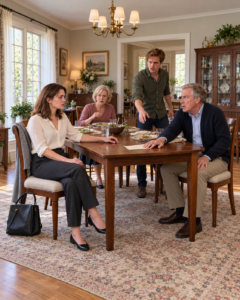
My father demanded my house. I already knew the dinner had nothing to do with family. We were sitting around his walnut dining table, the same one he used whenever he wanted a conversation to feel official.
My younger brother, Ethan, barely looked at me. Dad folded his hands.
“Your brother needs stability. You have that five-bedroom house sitting there with more space than you need.”
I stared at him. “You want me to give Ethan my house?”
“Transfer it,” he said. “He has children. You don’t.”
There it was, the familiar math. Ethan’s needs counted. Mine were negotiable.
My mother kept her eyes on her plate. Ethan shifted uncomfortably but said nothing.
Dad continued. “You can buy another place. Family helps family.”
I almost laughed.
That house wasn’t some lucky purchase. I had spent 9 years building my design firm, sleeping 4 hours a night, surviving two failed partnerships, and putting every spare dollar into that mortgage.
Dad knew that. He simply believed what belonged to me could still be reassigned if Ethan wanted it badly enough.
So, I set down my glass.
“Don’t worry about your golden boy,” I said calmly.
Dad frowned.
“Especially since he isn’t even your son.”
The room died. My mother’s fork slipped from her hand. Ethan looked at Dad.
Dad didn’t look confused. That was the part everyone noticed. He looked terrified.
His face turned pale so quickly that Ethan stood.
“What does she mean?”
Dad opened his mouth. Nothing came out.
I reached into my handbag and placed a sealed envelope on the table. Inside was the DNA report Dad had spent 28 years praying nobody would ever see.
Ethan reached for the envelope, but Dad grabbed it first. Too late.
My mother finally looked up. “Robert, let him read it.”
Dad turned on her. “You knew.”
Her expression hardened. “I knew there was a possibility.”
Ethan stared between them. “A possibility of what?”
I hated the way his voice cracked. For all my anger, he had not created the lie. He had simply benefited from it.
Dad sank back into his chair. 29 years earlier, during a six-month separation nobody had ever told us about, Mom had been involved with another man. She became pregnant shortly before she and Dad reconciled.
Dad knew the timing was uncertain. He chose not to test—not because he loved Ethan unconditionally, because his father, my grandfather, was dying and the family business was supposed to pass through a male heir.
If Ethan wasn’t biologically Dad’s son, that inheritant structure could become complicated. So, Dad buried the question, then spent nearly three decades building his identity around the boy he needed to be his.
Ethan opened the report. The probability of paternity was effectively zero. He sat down slowly.
“You tested me?”
“No,” I said. “I tested Dad.”
He looked at me sharply. I explained that after my grandmother died, I found an old medical file containing Ethan’s blood type and a handwritten note questioning paternity.
I didn’t believe it. So, I asked Dad for a sample under the excuse of Ancestry Research. He gave it willingly.
The result came last week.
Dad’s eyes burned into me. “You had no right.”
I almost laughed. “No right to learn the truth?”
His fist hit the table. “This changes nothing.”
But Mom whispered something that changed everything.
“Yes, Robert, it does.” She looked at Ethan. “Because your biological father is still alive.”
Ethan stared at Mom as though the room had tilted. “Who?”
She didn’t answer immediately. Dad did.
“No.”
One word, sharp enough to sound like fear.
Mom turned toward him. “You don’t get to control this anymore.”
That sentence told me the secret was bigger than an affair.
She looked at Ethan. “His name is Daniel Mercer.”
Ethan went still. I knew the name. Everyone in our town did.
Daniel Mercer had been Dad’s business partner before their spectacular falling out 27 years earlier. He had also founded Mercer Development, the company that now owned half the commercial property downtown.
Ethan whispered, “That Daniel Mercer?”
Mom nodded.
Dad stood. “This conversation is over.”
Ethan laughed once, hollow and disbelieving. “You let me grow up hating him.”
Dad had called Daniel dishonest, predatory, disloyal. Every family story made him the villain. Now I understood why.
Mom admitted Daniel knew she was pregnant. He had asked for a paternity test. Dad threatened to destroy him financially if he came near our family again.
Then Dad bought out Daniel’s share of their first company for almost nothing during the breakup. That became the foundation of Dad’s fortune.
Ethan looked sick. “So my whole life was built on this.”
Dad snapped. “I raised you. That makes me your father.”
“No,” Ethan said quietly. “It makes you the man who lied to me.”
Mom crossed to the sideboard and pulled out an old envelope.
“I kept one thing.”
Inside was a letter from Daniel. The final line was still readable.
“If the child is mine, I am not walking away.”
Ethan looked at Mom. “Did you answer him?”
She shook her head. “No.”
Dad whispered, “Because I made sure he never got the chance.”
Dad’s confession landed harder than the DNA report.
Mom stared at him. “What did you do?”
He looked older, suddenly. Daniel had tried to contact Mom after Ethan was born. Letters, calls—once he even came to the hospital.
Dad intercepted everything. Then he used company records to accuse Daniel of misusing funds. The accusation never became a criminal case, but it destroyed Daniel’s position with investors long enough for Dad to force him out.
Years later, Daniel rebuilt from nothing. Dad kept the story alive anyway: the disgraced partner, the dangerous man, the person we were never supposed to trust.
Ethan pushed away from the table. “I need air.”
Dad grabbed his arm. “Don’t you dare go to him.”
Ethan looked down until Dad released him. That moment told me the hierarchy had broken.
Dad turned his anger toward me. “This is because of the house.”
“No,” I said. “The house is why you finally heard the truth.”
He accused me of using Ethan’s paternity as revenge. Maybe part of me had chosen the timing because I was tired of being treated like the spare daughter.
But the truth existed before my anger did, and there was still something Dad didn’t know.
I opened my phone. 3 days earlier, after receiving the DNA result, I had contacted Daniel. I only asked whether he remembered my mother.
His response came 11 minutes later.
“I have remembered her everyday for 29 years.”
Then he asked one question.
“Does Ethan know?”
I showed the message to my brother. Dad saw it too.
“You contacted him?”
“Yes.”
His face changed again. Panic.
Because Daniel had sent a second message.
“If Robert is asking you to transfer property, do not sign anything. There is something you need to know about that house.”
The house suddenly felt like the center of a trap I hadn’t known existed. Dad demanded to see the message. I refused.
For once, Ethan backed me.
“Sit down.”
Dad did.
I called Daniel on speaker. He answered after two rings. His voice was calm.
When Ethan said, “Hello,” Daniel stopped breathing for a moment.
Then he said, “I’ve wanted to hear your voice for years.”
Ethan covered his mouth. But I had called for another reason.
“The house,” I said. “What do you know?”
Daniel explained that the land beneath my home had once belonged to the original partnership between him and Dad. When Dad forced him out, several parcels were transferred under disputed paperwork.
Most were later sold. One remained. Mine.
I had bought the house from a family holding company 7 years earlier. Daniel said he never challenged the property because he believed it had gone to an unrelated buyer. Then he learned my name was on the deed.
“Why does that matter now?” I asked.
“Because Robert contacted me last month.”
Everyone turned toward Dad.
Daniel continued. Dad had offered to settle the property dispute if Daniel signed away any remaining claim. In return, Dad promised to transfer the house to Ethan.
My brother stood. “You were using her house to pay off your old mess.”
Dad insisted the claim was worthless.
Daniel answered quietly. “Then why did you offer me $3 million to release it?”
Silence.
The demand had never been generosity. Dad needed my signature to move the property into a structure he could use without exposing the history.
Then Daniel added one more thing.
“Robert didn’t tell you the most important part.”
I gripped my phone. “What part?”
“The company that sold you the house never had clear title to begin with.”
For the first time, I was afraid—not of losing the house, of realizing how many decisions in my life had been built on Dad’s hidden machinery.
Daniel explained that the title problem did not mean someone could simply throw me out. I had purchased in good faith. Years of payments, improvements, taxes, and records protected my position.
But Dad knew litigation could expose how the property had been acquired. That was what he feared. Discovery: lawyers digging through old partnership records, bank transfers, signatures, the original buyout.
Dad finally admitted he wanted the house moved into Ethan’s name because he believed Daniel would be less likely to challenge property owned by his biological son.
Ethan stared at him. “You were going to use me, too.”
Dad said nothing. Mom began crying quietly, like someone finally seeing the cost of a decision made decades earlier.
I asked Dad one question.
“If I had signed the transfer, would you ever have told me any of this?”
“No.”
At least that answer was honest.
I stood. “The house stays mine.”
Dad snapped that I was destroying the family.
“No, I’m refusing to keep paying for the version of it you created.”
Then Ethan did something I never expected. He slid the transfer papers toward Dad.
“I don’t want her house.”
Dad looked stunned. “I was doing this for you.”
“No,” Ethan said. “You were doing it through me.”
Then he picked up Daniel’s old letter.
“I’m going to meet him.”
Dad’s face hardened. “If you walk out that door—”
Ethan waited. Dad never finished.
As Ethan reached the hallway, Mom spoke.
“Wait.”
She looked at both of us.
“There’s another reason your father never wanted Daniel near you.”
Dad closed his eyes.
Mom whispered, “The inheritance was never supposed to be Robert’s.”
Mom’s words changed everything. My grandfather had created an early succession agreement for the original company. If Dad and Daniel remained partners, ownership would eventually be divided.
But after Ethan was born, my grandfather drafted a new provision. A portion of the family holdings would pass into trust for Dad’s first male child.
Dad knew there was a chance Ethan wasn’t biologically his. If that became public, the provision could fail. Worse, Daniel could challenge the old buyout and reopen the company settlement.
So, Dad spent decades protecting two things: his fortune and the story that Ethan was unquestionably his son.
Ethan seemed exhausted. None of this felt like winning.
Daniel arrived the next morning. We met at my house because I refused to return to Dad’s.
When Ethan opened the door, Daniel didn’t rush him. He just stood there.
Then Ethan said, “You look like me.”
Daniel laughed through tears. “So I’ve been told.”
They talked for hours. No instant father-son miracle, just questions, careful answers, and grief for time neither could recover.
Meanwhile, my attorney reviewed the title records Daniel provided. The good news: my ownership was far stronger than Dad had implied. The bad news: the old partnership transfers showed signatures that deserved scrutiny.
One belonged to Daniel. He said he had never signed it. Another belonged to a witness who had been dead for 6 months when the document was dated.
My attorney looked at me. “This could become serious.”
That afternoon, Dad arrived. He demanded we handle everything privately.
I asked why.
His answer surprised me. “Because if those records are examined, you won’t just lose respect for me.” He swallowed. “You’ll find out what your mother did, too.”
Behind me, Mom had just entered the hallway. She heard every word.
Mom did not defend herself. That frightened me more than Dad’s accusation.
At my kitchen table, she told us the final truth. She had known Dad used questionable documents to remove Daniel from the company.
She did not create them, but she signed a statement supporting Dad’s version because she was terrified Daniel would take Ethan away if paternity was confirmed. That statement helped Dad win the civil dispute that forced Daniel out.
For 29 years, both of my parents had called their choices protection. Now we could see what they really protected: fear, money, reputation.
Ethan did not forgive them that day. Neither did I. We stopped pretending forgiveness had a schedule.
Daniel turned the disputed records over to his attorneys. My lawyer filed the action needed to clear my title completely because I had purchased the house in good faith and maintained it independently.
Dad could not simply take it, transfer it, or use it to settle his past. The five-bedroom house stayed mine. It stopped being the symbol Dad had made it: a prize for the favored child, a bargaining chip, a debt.
Months later, Ethan came over carrying pizza. He had started building a relationship with Daniel slowly.
Before dinner, Ethan stood in my kitchen and said, “I’m sorry I let him treat you like you mattered less.”
I hugged him. “You didn’t create that.”
“No,” he said, “but I benefited from it.”
That was the first apology anyone in my family had given without an excuse attached.
That evening, we ate on the back porch. No inheritance talk, no golden child, no secrets controlling the room.
Dad had demanded my house because he thought ownership meant power. He was wrong. The most valuable thing I kept was the right to stop carrying his lies.