My Parents Claimed the Property Was Gifted—Then the Recorder s Office Sent the Real File
My mother called it a misunderstanding.
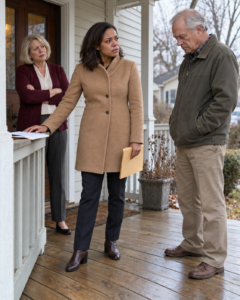
She was standing on the porch when I pulled up to the house on Carver Street, arms crossed, already positioned as though she had been waiting for me to arrive so she could begin explaining before I got out of the car.
The porch itself was level and solid beneath her feet, the boards flush and even along the whole front run. And I noticed that the way she was standing, weight balanced, shifting slightly, she did not seem to register what she was standing on.
I had paid to have that porch leveled.
I got out of the car and walked up the front path. The morning was cold, the kind of flat gray Columbus cold that gets into the back of your hands, and I had my coat buttoned to the collar.
Inside the left pocket, folded inside a manila envelope with a red certified stamp pressed slightly crooked across the upper right corner, was a copy of the real property file from the Franklin County Recorder’s Office. I had not opened the envelope yet. Not in front of her.
“I’ve been trying to reach you,” my mother said.
“I know,” I said.
“This whole thing has been taken out of context,” she said.
Something pulled tight across my shoulders. Not defensiveness, not the thing that comes before an argument. Something quieter and more settled, like a door closing on its own.
“Let’s go inside,” I said.
She did not move from the porch.
My name is Cladette. I was 38 when this happened. I worked as a logistics manager for a regional distribution company outside Columbus, and I had spent the better part of 12 years organizing systems that other people depended on to function without drama or failure.
I say that not to position myself as someone exceptional, but because it explains the part of me that, when confronted with something that did not add up, went immediately and instinctively to documentation.
The house on Carver Street had been in my family for 26 years. My parents, Gerald and Norma, bought it the year I was in fifth grade, the year my younger brother, Calvin, was born.
My maternal grandparents had helped with the down payment, a fact my mother mentioned periodically, not as a point of gratitude, but as a kind of ownership claim on the property’s history.
The neighborhood had changed around it in the years since, some blocks improving, some not, and the house itself had appreciated considerably. The Franklin County appraiser’s current estimate, which I had looked up the evening before I drove there, was $784,000.
My parents had always been careful with money in the way that people are careful when they have just enough and know it. They paid their bills. They did not ask for help with small things, but over the years, there had been a pattern with larger ones.
Not dishonest exactly, but blurry. A shared account that got used more by one party than the other. A loan that was described as temporary and then never mentioned again.
An arrangement about the house that was discussed at a dinner table and then quietly reinterpreted when circumstances changed. I had learned over time to document.
Calvin had moved to Phoenix 4 years earlier and was largely outside the day-to-day of the family. He called on holidays. He sent birthday cards.
The house was not something he had strong feelings about. He told me once on the phone that he trusted me to handle whatever came up with Mom and Dad. I had not asked him to say that, and I was not sure it was a gift.
The porch had been the first significant thing. Two winters before all of this, the front porch of the house on Carver Street had developed a lean.
Not dramatic, not dangerous in the immediate sense, but visible once you knew to look. A slight tilt toward the left side. The boards no longer quite flush at the seam where the porch met the foundation.
My father pointed it out to me on a Sunday afternoon in February. The way he pointed out most things that needed doing, as though the observation itself was a form of delegation.
“Something’s going on with the porch,” he said.
“I can see that,” I said.
“Might need a look,” he said.
I found a contractor through a colleague at work, a man named Tibido who did structural foundation work and came with references. I checked.
He came out, evaluated the porch, told me the issue was in two of the support joists beneath the decking—wood that had been borderline for a few years and had finally given. He gave me a quote.
I called my father and told him the number. There was a pause on the line.
“That’s a fair bit,” my father said.
“It is,” I said.
Another pause.
“We’re a little tight right now,” he said.
I said I would cover it. I did not make a production of it. I called Tibido back, confirmed the job, arranged access for the crew on two consecutive Saturdays, and wrote the checks.
The total came to $11,620, including the permit fees and the cost of replacing the two boards on the decking surface that had cupped in the lean. When the job was done, the porch was level, has been level since.
I kept the carbon copy receipt. Three pages, the contractor’s copy on white, mine on yellow, the file copy on blue, all still clipped together in the folder I kept for things related to my parents’ house.
I did not tell my parents the exact amount I had paid. I did not want it to become a weight between us. What I wanted was for the porch to be fixed, and it was fixed, and that was supposed to be the end of it.
Beyond the porch, there were other things. I was the one who arranged for the gutters to be cleaned and resecured after a stretch of storms the following spring.
I was the one who called the gas company when my mother noticed a smell near the furnace and waited there for the technician who found a hairline issue at a valve fitting and fixed it on the spot.
I was the one who drove my father to his cardiology follow-up twice when he was not supposed to drive after a procedure. Waiting in the parking structure with a book for 3 hours each time.
None of that was exceptional. It was just what I did. And I did it because the house and the people in it mattered to me, and because being the one who showed up had always been, for me, the most direct form of caring available.
My parents had dinner at my house on Weller Road the previous Thanksgiving. And afterward, over coffee, my father had said something that I had taken at the time as a statement of intent.
He said the house on Carver Street was going to come to me eventually, that it made sense given everything, that Calvin was settled in Phoenix and that I was the one who had been present. My mother had nodded. She had said that was right.
I did not press for details. I did not ask for anything in writing. I believed the conversation was a conversation, not a contract.
But I had believed the porch repair was a repair between family members, too. And I was about to discover what my parents had decided those things were worth.
The letter came on a Tuesday. It was addressed to my parents’ house on Carver Street, but had been forwarded to me because I had arranged years earlier to receive copies of any property-related correspondence as a precaution.
The envelope had the return address of Tidewater Title Company, East Columbus Branch. Inside was a routine confirmation of a completed transaction.
The property at the Carver Street address had been transferred as a gift to a third party. The paperwork finalized, the recording submitted.
The third party was not me.
I sat at my kitchen table on Weller Road at 6:52 a.m. on a Tuesday morning, the letter in one hand and my coffee going cold beside me. The light was still gray outside.
I read the letter twice. Then I called my father. He answered on the third ring, which told me he had been awake.
“I got a letter from Tidewater Title,” I said.
“Oh,” he said.
“I need you to explain it to me,” I said.
“Could it?” he said. “It’s a complicated situation.”
“Who is the property transferred to?” I asked.
“Oh, it’s a trust,” he said. “It’s still in the family.”
“Whose trust?” I asked.
“It’s set up for expenses,” he said. “For care down the line. Your mother and I wanted to have something in place.”
“You told me at Thanksgiving it was coming to me,” I said.
“We talked about a lot of things at Thanksgiving,” he said.
Something tightened across the top of my sternum. Not the thing before crying, not the thing before shouting. Something more like the feeling of watching a date on a calendar arrive that you had hoped would move.
“Dad,” I said, “who controls the trust?”
A longer pause.
“Your cousin Reev is the administrator,” he said.
Reev, who lived in Westerville, who had not set foot on Carver Street in 6 years.
“You transferred a $784,000 house into a trust administered by Reev,” I said, “without telling me.”
“You would have made it complicated,” he said.
“I paid to have the porch leveled,” I said.
“We’re grateful for that,” he said. “We’ve always been grateful.”
“The porch I paid $11,000 to fix,” I said, “is now sitting on property that belongs to a trust one knew nothing about.”
“Clict,” he said, and his voice dropped into the tone I had grown up hearing when he wanted a conversation to stop. “You’ve always had trouble seeing the bigger picture.”
“Walk me through the bigger picture,” I said.
“The trust protects the asset,” he said. “For the whole family.”
“For Reev,” I said.
“Rev is capable,” he said.
“I’m not questioning Reev’s capability,” I said. “I’m questioning why a trust was set up on a property I was told would come to me, administered by someone who doesn’t know the house, without a single conversation.”
“We didn’t want the conflict,” he said.
“So instead, you created it,” I said.
“You’re being ungrateful,” he said. “You’ve always had a roof over your head. You’ve always been provided for. The fact that you would turn this into an accusation—”
I stopped writing on the notepad I had been holding. The line was quiet.
“I’m not accusing anyone of anything,” I said. “Not yet.”
I thanked him for picking up. I ended the call.
That evening, I sat at the desk in my home office. I pulled up the Franklin County auditor’s property search. I wrote down the transfer date, the recorded instrument number, and the listed grantee.
I called the Franklin County Recorder Office and asked what I needed to request a certified copy of the instrument on file. I wrote down the fee and the office hours. I went to bed.
I got up at 6:52 a.m. the next morning. I made coffee and drank half of it. I found the folder where I kept the carbon copy contractor receipts and confirmed the porch repair paperwork was still clipped inside.
I drove to the Franklin County Recorder’s office when it opened and submitted the request form at the front counter. 40 minutes later, I walked out with the certified copy in a manila envelope. A red certified stamp pressed slightly crooked across the upper right corner.
Then I drove to Carver Street.
My mother was on the porch when I got there, which told me my father had called her after we hung up. She had her arms crossed and her weight shifted to one side, and she was already talking before I reached the front path.
“Your father told me you were upset,” she said.
“I’m not upset,” I said. I stopped at the bottom of the porch steps. “I have some questions.”
“This was a planning decision,” she said. “It had nothing to do with you.”
“It had to do with the house,” I said.
“We’re allowed to make decisions about our own property,” she said.
I reached into my coat pocket. I took out the manila envelope. I turned back the flap and slid out the certified copy of the transfer instrument.
I unfolded it and held the screen of my phone next to it, where I had pulled up the auditor’s digital record. Then I laid the certified copy on the porch railing between us, flat, so she could see the instrument number, the transfer date, the grantee name.
She looked at it. She stopped talking.
“The title company letter said this was a gift transfer,” I said. “The recorder’s file shows it was recorded as a sale to a family trust. Those are two different representations of the same transaction.”
She looked up from the page.
“Your father handled the details,” she said.
“I know,” I said. “I’d like to talk to him.”
He arrived 20 minutes later, which meant he had been close. He came up the front walk with his hands in his jacket pockets, not hurrying, the way he moved when he had decided in advance to be reasonable.
“Could it?” he said.
“Come look at this,” I said.
He came up onto the porch and looked at the document on the railing.
“The title company told me it was a gift transfer,” I said. “The recorder’s office has it recorded differently. I need to understand which version is accurate, because they cannot both be.”
“There are different categories of transfer,” he said.
“I know that,” I said. “Which category applies here?”
“The attorney handled the classification,” he said.
“Did the attorney know about the Thanksgiving conversation?” I asked.
“That was a conversation,” he said. “Not a commitment.”
“You told me the house would come to me,” I said.
“We said we wanted to keep it in the family,” he said. “The trust does that.”
“Administered by Reev,” I said.
“Revivous family,” he said.
“You said at Thanksgiving that I was the one who had been present,” I said. “Those were your words.”
“K,” my mother said from where she was standing by the door. “You do so much for us, and we love you for it, but you’ve always treated generosity like it comes with a contract.”
“I paid $11,000 to level the porch you’re standing on,” I said.
Neither of them said anything.
“I didn’t pay it to acquire an interest in the property,” I said. “I paid it because it needed doing and because I thought we were family who helped each other.
“But I would like to understand how a house I was told would come to me was transferred to a trust without my knowledge, and how the title company and the recorder’s office have two different descriptions of that transfer.”
My father looked at the document on the railing. Something moved across his face. Something that was not quite embarrassment and not quite resolution.
“You’ve always had trouble accepting how things work,” he said. “We made a decision about our property. That’s all right. Acting like this is something that was done to you. It’s ungrateful, Cludet, after everything this family has given you.”
I looked at him. I picked up the certified copy from the railing. I folded it along the original crease. I put it back in the envelope.
“You told me the house was coming to me,” I said. “I documented what I spent on it. The recorder’s file and the title company’s letter describe the same transaction in two different ways. I’m going to find out which description is accurate.”
I put the envelope back in my coat pocket.
“I’ll be in touch,” I said.
I walked down the porch steps. I did not look back.
The Franklin County Recorder’s Office referred the discrepancy to the county’s title fraud unit, which contacted Tidewater Title Company directly. What they found was that the transfer had been recorded as a gift for the purpose of avoiding certain transfer taxes, while the trust instrument itself described a sale arrangement under which Reev, as administrator, held controlling interest.
The two documents were inconsistent in a way that was not ambiguous to the investigators who reviewed them. My parents were not charged.
What happened instead was a civil correction process, the kind that requires attorneys on both sides, a reviewed filing, a renegotiated instrument, and, in this case, a family mediation that Reef declined to attend.
The house on Carver Street was re-recorded. The trust was restructured with oversight terms. I was not made the sole beneficiary.
That was not what I had asked for. What I asked for was accuracy, and accuracy was what the process produced.
That was 16 months ago. I still have the carbon copy receipt from Tibido’s crew. I filed it in the same folder where I keep the certified copy from the recorder’s office.
They sat together then, paperclipipped, the blue contractor copy still faintly readable underneath the others.
Last spring, I was at the house on Carver Street for a different reason, helping my mother schedule a plumbing inspection, and I stood on the porch for a moment before I knocked. It was still level. The boards were still flush.
My father sent me an email 6 months after the mediation. It said he hoped we could move forward and that he had not intended for things to go the way they did. I read it twice. I did not reply.
My mother called on Sundays. We talked about ordinary things. I did not bring up Carver Street, and neither did she.
There was a version of this story where I was the villain, where I was the ungrateful daughter who turned a family planning decision into a legal process because she felt overlooked.
I had thought about that version. I did not think it was the accurate one, but I understood why it existed.
What I knew was that I paid for the porch because it needed to be paid for. I kept the receipts because I keep receipts. And when two documents described the same transaction in two different ways, I asked which one was true.
That was not in gratitude. That was just how I had always operated.
If any part of this sounds familiar to you, if you know someone navigating something like this, share this story. Sometimes it helps people to see that they are not the first one to find themselves holding a certified document and realizing the conversation they thought they’d had was never what they thought it was.
I keep the contractor receipt in the top right drawer of my desk on Weller Road. It has been there since the job was finished. Same folder, same paper clip.
Some things you keep, not because you plan to use them, but because they are true, and being true is enough.