My Parents Disowned Me, I Returned 12 Years Later And Left Them In Ruins…
“If you don’t help us, we are reporting you for data theft. Your career as a fraud investigator will be over before the wedding cake is cut.”
Gregory didn’t even say hello. He just slid a thick envelope across the table containing an old non-disclosure agreement I signed as an intern.
“We need you to validate Susan’s medical credentials to the investor,” he said, his eyes cold. “Do it or we destroy your reputation.”
I looked at my mother, who pretended to be busy with her pearls, and my sister Susan, who was checking her makeup, completely unbothered. I realized then that I wasn’t a daughter to them. I was a hostage.
I stared at the document. My thumb brushed the signature line. 5 years ago, I was a naive intern, desperate for approval.
Now, looking at that paper, I didn’t see a legal threat; I saw desperation. They were playing their last card because they were out of money.
A lawsuit would take months. A suspension from the fraud board would be instant. I had three active investigations open, including a massive insurance ring in Chicago.
If I went down, those cases died. They knew exactly how to hurt me.
I looked at Susan. She was applying lip gloss, checking her reflection in her phone screen. She looked bored.
She had no idea she was the anchor, dragging this whole family into the abyss.
“Fine,” I said. My voice was steady. “I’ll do it.”
Gregory let out a breath he didn’t know he was holding. He reached for the agreement, but I put my hand over it.
“On one condition.”
“You aren’t in a position to negotiate,” Patricia snapped.
“I’m not negotiating,” I said. “I’m quality control. If I’m going to vouch for Susan to a major investor, I need to see the paperwork. I won’t let amateur mistakes ruin my reputation. If we’re doing this, we do it right.”
They exchanged glances. They saw what they wanted to see.
Submission.
They thought I was trying to cling to some shred of professional dignity. Gregory pushed a stack of papers toward me.
“Make it fast. They’re here.”
I flipped through the investment agreement. It was a mess: private equity, high interest, personal guarantees that were loose enough to contest in bankruptcy court.
It was amateur hour. If I wanted to trap them, I needed something tighter.
The glass door opened. Trevor walked in first, looking like he was about to vomit. He adjusted his bow tie, his eyes darting around the room.
Behind him was Lucas.
Lucas didn’t look nervous. He looked like a shark entering a seal tank. He wore a charcoal suit that cost more than my first car.
His eyes scanned the room, landing on me. He paused—a micro expression of surprise, then recognition.
We had worked a case together in Boston 2 years ago. He knew exactly what I did for a living.
“Sorry to interrupt,” Trevor said, forcing a smile. “Myra, is that you? Susan said you might not make it.”
“I wouldn’t miss it for the world,” I said, standing up.
I extended a hand.
“It’s good to see you, Trevor.”
“And this is Lucas, my fund manager,” Trevor said.
Lucas took my hand. His grip was firm.
“We’ve met,” he said, his eyes locked on mine. “Briefly.”
“Small world,” I said.
“Lucas helps manage the family trust,” Trevor explained, oblivious to the tension. “He’s the one cutting the check today.”
Gregory stepped forward, turning on the charm like a light switch.
“Lucas, wonderful to meet you. We’re all very excited about this partnership. Susan is ready to take the clinic to the next level.”
“I’ve heard great things,” Lucas said, his voice neutral.
He looked at Susan.
“Trevor tells me you were top of your class.”
Susan pined. She actually tossed her hair.
“It was a lot of work, but natural talent helps.”
“Yes,” I interrupted, my voice dripping with sugary poison. “Susan’s academic performance was truly unbelievable. I’ve never seen a student quite like her.”
My parents beamed. They heard praise. Lucas heard the warning.
He looked at me. One eyebrow raised slightly.
“Shall we?” Lucas asked, gesturing to the table.
“Please,” Gregory said. “We’re ready to sign.”
I sat back down. My parents were practically vibrating with greed. They were so focused on the check.
They didn’t notice the look Lucas gave me. The look of a man waiting for the other shoe to drop.
They thought they had won. They thought they had forced me into line.
They didn’t realize they had just locked themselves in a room with two people who dismantled frauds for a living.
Lucas pulled a thin laptop from his briefcase.
“I need to verify the entity structure before we draft the final terms. Give me 5 minutes.”
“Take your time,” Gregory said, his voice thick with false casualness.
He turned to Susan, smoothing a stray hair from her forehead.
“You ready, sweetheart? This is the big leagues.”
Susan rolled her eyes, swatting his hand away.
“Obviously. Just get the money so we can go.”
I watched them. It was fascinating in a clinical way. Most people would see a loving father doting on his daughter.
I saw a gambler polishing a slot machine that had already eaten his life savings.
For years, I asked myself the question every discarded child asks: “Why her and not me?”
I used to think it was my personality, my face, my grades. Then I found the receipts.
I was born when Gregory and Patricia were exhausted residents drowning in student loans. I was the accident, the budget error, the child raised on ramen noodles and resentment.
I cost them sleep they couldn’t afford and money they didn’t have. I was the sunk cost of their early failures.
Susan was different. Susan was a project.
By the time they were ready for a second child, the clinic was profitable. But they didn’t just want a baby. They wanted a legacy.
They wanted a guarantee. Nature was too messy for them.
So they bought perfection.
In vitro fertilization, $50,000 sperm selected from a genius donor catalog. Some Ivy League athlete with a perfect jawline and a high IQ.
They didn’t give birth to a daughter. They purchased a luxury asset.
I looked at my mother, who was currently holding a water bottle for Susan like a servant. That was the root of the rot.
It’s the sunk cost fallacy on a biological level.
They poured 50 grand and 20 years of ego into the Susan project. To admit she is lazy, incompetent, or average would be to admit they made a bad investment.
It would mean their designer baby was a lemon.
And me? I’m the control group. I’m the zerocost natural-born baseline.
Every time I succeed without their help, without their money, without their genetic engineering, I prove that their entire thesis is wrong. My success is an insult to their investment strategy.
They hate me not because I failed, but because I prove they wasted their money on her.
I leaned back in the leather chair, memories sharp as broken glass surfacing in my mind.
I remember the day I left home. I wasn’t a rebellious teenager running away. I was 17, and I had walked into my father’s study to drop off the mail.
I saw the envelope on his desk: Susan’s SAT results. They were abysmal.
Bottom 30th percentile, but the acceptance letter on the fridge from the state university said she was an honors candidate.
I made the mistake of asking.
“Did you pay someone to take the test for her?”
I didn’t get an answer. I got a suitcase on the front lawn.
They didn’t kick me out for being difficult. They excommunicated me because I was the auditor they never wanted.
I saw the fraud in the ledger, and they liquidated me to hide the debt.
“Myra.”
Lucas’s voice cut through the noise.
“I’m ready for the next step.”
I blinked, bringing the room back into focus. Gregory was looking at me, his eyes hard, a silent warning to behave.
He thought he had neutralized the threat. He didn’t realize that I never stopped being that 17-year-old girl with the evidence in her hand.
I just learned to wait until the stakes were higher.
“We’re ready,” I said.
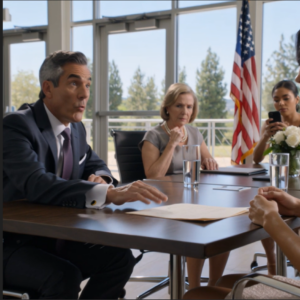
The air in the glass conference room was getting stale, recycled through vents that couldn’t handle the heat of $300,000 on the line.
I excused myself to the restroom. I needed water. I needed a moment to recalibrate the trap.
I didn’t get a moment. I got Patricia.
The heavy door swung shut behind me. The restroom was all marble and gold sconces, a monument to excess.
I was washing my hands when my mother appeared in the mirror’s reflection. She didn’t look at me. She pulled a tube of lipstick from her clutch and began reapplying a shade of red that looked like a fresh wound.
“You look tired,” she said to the mirror. “And that suit? It’s drab. You look like an IRS agent.”
“I am an agent,” I said, drying my hands. “Just not for the IRS.”
She capped the lipstick with a sharp click. She finally turned to me.
There was no gratitude in her eyes for my compliance back in the conference room. There was only the cold appraisal of a manager inspecting a faulty employee.
“Once the money hits the account,” she said, “you leave. We don’t want your energy souring the reception. Susan has important people to impress.”
“The investment covers the clinic’s debt,” I said. “Why does she need to impress anyone else?”
Patricia smiled. It was the smile of someone who believes they are destined for greatness.
“Trevor’s money isn’t just for the clinic, Myra. We’re buying Susan a seat on the regional hospital board. With her credentials in his capital, she’ll be the youngest director in state history.”
My stomach turned over. This wasn’t just about paying off a mortgage or leasing a new Mercedes anymore.
They were planning to put an unlicensed, unqualified dropout in charge of hospital policy. They were going to let a fraud make decisions about patient care.
“She isn’t a doctor,” I said, my voice low. “She’s going to kill someone.”
“She has us,” Patricia snapped. “We guide her. She’s the face. We’re the brains. That’s how dynasties work. Now fix your hair. You look messy.”
She walked out. I stood there for a count of five.
They weren’t just thieves. They were a public safety hazard.
The hesitation I might have felt—the tiny biological tug of loyalty to the people who gave me life—evaporated.
I walked back into the glass box. Trevor was laughing at something Gregory had said. The atmosphere was lighter.
They thought the hard part was over.
“We were just talking about a case I saw last week,” Trevor said as I sat down.
He looked at Susan with puppy dog admiration.
“A classic presentation of Kawasaki disease in a three-year-old. High fever, strawberry tongue. I was worried about coronary aneurysms.”
He turned to Susan.
“What’s your protocol for that at the clinic? Do you go straight to IVIG or start with highdose aspirin?”
It was a softball question. Basic pediatrics, firstear resident stuff.
Susan froze. Her eyes darted to Gregory. She took a sip of water, buying time.
“Well,” she stammered, flashing a bright, empty smile. “Every patient is different. Obviously, we like to take a holistic approach. You know, treat the whole child, not just the symptoms. Hydration is key.”
Trevor blinked. He looked confused.
“Hydration for Kawasaki?”
“Of course,” Susan said, her voice pitching higher. “And observation. Close observation.”
“Did you check the CRP levels?” I asked.
My voice was casual, curious.
“Or the sedimentation rate?”
Susan glared at me. She had no idea what those words meant.
“Myra!” Gregory barked, slamming his hand on the table. “Stop interrupting. Susan is trying to explain that their clinic prioritizes patient comfort. We don’t need a lecture on labs. We need to sign these papers so Trevor can get back to his wedding.”
He turned his back on me, physically blocking Trevor from seeing Susan’s panic.
“Trevor, ignore her. Myra isn’t a clinician. She pushes paper. She doesn’t understand the nuance of care.”
Trevor nodded slowly, but the shine was gone from his eyes. He looked unsettled.
“Right,” Trevor said. “The papers.”
“Let’s get this done,” Gregory said, checking his watch. “Lucas?”
I looked at Lucas. He gave a microscopic nod.
It was time to close the gate.
Lucas picked up the private investment contract I had rejected. He adjusted his glasses, flipping through the pages with the air of a man finding mold in a luxury apartment.
“Gregory, I’ve got to be honest,” Lucas said, his tone apologetic but firm. “I’m looking at these terms, and they’re aggressive. The interest rate on this private equity deal is nearly 12%. And the tax implications for the trust are complicated.
“We might get hit with a significant capital gains tax if we structure it as a direct injection.”
Gregor’s face fell.
“We agreed on the amount. The structure shouldn’t matter.”
“It matters to the IRS,” Lucas said.
He glanced at his watch.
“I can’t sign off on this today. I’d need my legal team to reddraft the entire liability section. That could take weeks.”
“Weeks?” Patricia’s voice cracked. “We don’t have weeks. We have vendors to pay, equipment to order.”
Panic. It was thick in the room now. They needed that money to keep the lights on, not just for upgrades.
“There is another way,” I said.
I spoke softly, as if I were reluctant to intervene. Everyone looked at me.
“You could structure this as an SBA backed loan,” I said. “The Small Business Administration has a program for medical facility upgrades. The interest rate is capped at 6%. And since Trevor’s trust would be acting as the collateral guarantor rather than the direct lender, the tax liability disappears.”
I looked at Lucas.
“Does the trust allow for collateralized lending?”
Lucas pretended to think.
“Actually, yes. That would solve the tax issue. And the lower interest rate would save the clinic about 40,000 a year.”
Gregory’s eyes lit up.
“40,000? That’s significant.”
“It’s smart business,” I said. “Why pay double the interest if you don’t have to?”
“But government loans take forever,” Patricia said, suspicious.
“Not with the new FastTrack program.” I lied smoothly. “I use it all the time for clients. Since Susan has such impeccable credentials and the clinic has a 20-year history, we can get provisional approval in 48 hours. We just need to submit the application today.”
I pulled my laptop from my bag.
“I have the portal access. We can fill it out right now. It takes 10 minutes.”
Gregory looked at Trevor. Trevor looked at Lucas.
“If Myra says it’s faster and cheaper,” Trevor said, shrugging, “I’m all for it. I trust her.”
“It seems like the best move,” Lucas agreed. “It protects Trevor’s capital and saves you money.”
Gregory didn’t hesitate. He saw the savings. He saw the speed.
He didn’t see the federal seal on the digital form I was opening.
“Let’s do it,” Gregory said. “Pull it up.”
I opened the laptop. I navigated to the secure portal.
I wasn’t just helping them with paperwork. I was moving them from a private contract, where lies are a civil dispute, into a federal application, where lies are a felony.
“Okay,” I said, typing in the clinic’s tax ID. “Let’s make you rich.”
The laptop screen glowed, a blue square of light in the dimming room. I angled it so everyone could see.
“Standard corporate data first,” I said, my fingers flying across the keys. “Clinic address, tax ID, revenue projections.”
I filled in the easy parts quickly. The rhythm of my typing was hypnotic. It was designed to be.
I wanted them to feel like this was just administrative hurdles, just boxes to check on the way to the bank.
Then I scrolled down to section 4: medical director qualifications.
“Okay, Susan,” I said, keeping my eyes on the screen. “Since you’re listed as the primary clinical officer, I need your state medical license number.”
The room went quiet. The only sound was the hum of the air conditioning.
Susan froze. Her hand went to her throat. She looked at Patricia.
In the private sector, you can fudge a bio on a website. You can lie at a cocktail party, but a federal form demands a specific sequence of digits that corresponds to a living, breathing database.
Susan said she didn’t remember her license number. Trevor pointed out it was on her badge or her prescription pad.
She froze.
Patricia rushed in, whispering that Susan had switched purses and should use her old intern number. I warned it had expired 2 years earlier.
Patricia insisted. She rattled it off anyway—the provisional ID Susan had received before failing pharmarmacology and dropping out.
I typed it in: 104992.
I didn’t press enter. That number was the lie. Putting it on a federal loan was the crime.
Allowed, I said, “License entered.”
Then I scrolled to the guarantor section and told my parents they had to cosign, certifying everything was true. Gregory read the clauses and stopped at joint and several liability and personal asset attachment.
“Our house? Retirement?” he asked.
I told him that was standard for Small Business Administration loans and reminded him the private equity deal protected his assets but would bleed the clinic dry.
Trevor looked bored. Lucas mentioned Trevor’s flight left in an hour.
Gregory hesitated, then panicked. Losing this deal meant admitting Susan wasn’t perfect.
“Fine,” he said. “We sign.”
He and Patricia clicked “I agree” right above the warning about prison time and million-dollar fines.
I submitted. The portal refreshed.
Submission ID 99382. Status: pending review. NPI flagged.
I closed the laptop.
When they demanded answers, I explained to the system cross-checked credentials with the National Practitioner Data Bank. The number Susan used was an expired intern permit that triggered an automatic fraud alert and locked the file with the Office of Inspector General.
Gregory told me to fix it.
“I can’t,” I said. “It’s already escalated.”
Then I showed them my email sent to the OIG fraud hotline. As a certified fraud examiner, I was required to report what I’d witnessed.
Patricia screamed.
I reminded her they had just signed a federal document falsely claiming Susan was a licensed physician and pledged personal assets to support it. That was bank fraud.
Next came audits, medical board notifications, and license revocations.
Gregory threatened lawsuits and non-disclosure agreements. I laughed.
“You can’t use contracts to hide felonies.”
They went silent.
Trevor stood, walked to Susan, and stared at her.
“You aren’t a doctor,” he said.
She tried to grab him. He stepped back, removed the engagement ring, and dropped it on the table.
“You’re not a partner,” he said. “You’re a liability.”
He ordered Lucas to kill the deal and walked out.
I told my father, “You bet everything on a lie. You lost,” and left, while Patricia screamed for me to fix it.
Outside, guests drank champagne to string music, unaware the family financing it was finished.
I drove to a small coffee shop, ordered black coffee, and ignored the calls flooding my phone. Then I deleted the entire family contact group.
An email from my directo