My Parents Transferred the House to My Brother Without Telling Me — Then I Showed Them My Own D
My name is Nora Callahan. I was 31 years old and working as a project coordinator for a midsize construction management firm in Dayton, Ohio, when my mother told me over lunch that my childhood home now belonged to my brother.
She said it the way you mentioned a change in the weather. She was refilling her water glass, and she set the picture down, and she said, “We went ahead and put the house in Dererick’s name. We thought it made more sense.”
Then she looked at the window, at the neighbor’s dog crossing the yard. Like the sentence was already finished.
I had been sending them $614 a month for 4 years. I didn’t raise my voice. I put my fork down.
Something went still in my chest. Not anger, not yet—just a flat geometric fact settling into place.
The soup was still warm. The afternoon light was coming through the side window the same way it always had, laying a pale rectangle across the lenolium floor. I looked at my mother’s face and recognized the expression she wore when she believed something had been handled correctly.
I drove home that afternoon and pulled up the Montgomery County Recorder website. I typed in the parcel number for Crestfield Drive. The transfer had been recorded 11 days earlier.
My brother’s name was on it. Mine was not. It had never been.
I sat with that for a long time before I did anything else.
I grew up in that house on Crestfield Drive. Three bedrooms, a finished basement my father did himself over two summers in the late ’9s. A backyard that flooded every April until someone finally regraded the drainage in 2019.
I was the one who called the contractor for that. I found the guy, got two other quotes, coordinated the schedule around my father’s work calendar. The project took 3 days.
My father drove past the finished grading on his way home from physical therapy and said it looked good. That was the whole of it. That was not unusual.
That was just how things worked in our family.
My brother Derek was four years older than me. He was the kind of person who filled a room when he entered it. Loud in the good way at holidays, generous with bare hugs, the one who gave the toast at every birthday.
He lived 40 minutes away in Centerville in a house he bought with his wife before the market moved. He was not a bad person. I want to be careful about that.
He was not a villain in any movie sense. He just never showed up when things needed doing, and no one ever noted his absence because I was already there.
Our parents were Gerald and Patrice Callahan. My father had worked 31 years at a stamping plant before his knee gave out. My mother managed the household with the kind of precision that looks effortless from the outside.
They were people who believed the family holds together when the older child carries it forward. Derek was the older child. That logic was baked in long before I understood it.
The $614 a month started four years ago after my father’s second knee surgery. It was framed as temporary—“just until we adjust,” my mother said.
I set up the transfer the same week. I never asked for an accounting of where it went. I figured it covered the property taxes, the utility spikes in winter, whatever came up.
It was family. You don’t invoice family.
I had my own finances in order by then, or I was building them. I had opened a separate savings account 2 years earlier and started moving money into it every month after expenses. Not a dramatic amount—enough to be deliberate.
I had started reading about property, about what a single rental unit could do over a decade if you were patient. I didn’t tell anyone about it. It wasn’t a secret.
It just wasn’t anyone else’s business yet.
The years between my father’s surgery and that lunch on Crestfield Drive were not dramatic from the outside. Nothing exploded. There was no single event I could point to and say, “That was when the imbalance became impossible to ignore.”
It was the accumulation of ordinary things.
I was the one who renewed the homeowner’s insurance when it lapsed. My mother had missed the notice, and I caught it 3 days before the grace period ended. I called the agent, got the reinstatement paperwork overnight, the check.
No one mentioned it afterward. It just got done.
I was the one who managed the furnace replacement the winter after my father’s surgery. I found the HVAC company, sat in on the estimate, pushed back on the scope because they were recommending a unit larger than the house required, and got them down to a model that fit the square footage and the budget.
My parents paid for it. I coordinated it.
When Derek called to check in that weekend, my mother told him the furnace had been handled. He said, “Good, good,” and asked if there was anything left over from Thanksgiving.
There was a period about 2 and 1/2 years in when my parents’ property taxes came in higher than expected, a reassessment tied to a neighborhoodwide adjustment. I noticed the number when I helped my mother sort the mail that fall.
I sat at the kitchen table with her and walked her through the appeal process step by step, and she nodded along with the patience of someone who had already decided she trusted the outcome. I filled out the form, submitted it to the county assessor’s office with the supporting comparables.
The appeal was partially granted. Their bill came down by a few hundred. My father nodded when I told him.
My mother said, “Derek would have figured it out, too, eventually.”
That sentence is the one I think about most when I look back.
There was a family gathering this spring after my father came home from his second surgery. Not a formal meeting, just everyone around the kitchen table. Derek was there with his wife, Carol.
I had organized the meal, coordinated the follow-up appointments my father needed with the orthopedic group, and printed out a folder of postsurgery care instructions that his discharge nurse had emailed over. I put it on the counter.
Derek arrived late, set a six-pack on the counter next to the folder, and started telling a story about a wrong turn he’d taken on 75. Nobody picked up the folder while I was there.
When I called the following Tuesday to check in, my mother told me Dererick had gone through it with Dad over the weekend. She said it like he had done something thoughtful.
I let it go. I was used to letting things go. The work still got done.
That was the part that mattered, I told myself.
Dererick did not pay for any of this. He was not asked to. The $614 a month came from my account on the 5th of every month without exception.
I do not think Dererick knew about it. I’m still not certain my parents told him.
I kept my own records of all of it. Not out of suspicion, just habit. A spreadsheet saved to a folder on my desktop, one row per month, balance noted.
It was the same impulse that made me keep the contractor’s receipts from the drainage job, the HVAC estimate with my margin notes, the assessor’s appeal confirmation with the partial grant letter clipped behind it.
You document things not because you expect to need the evidence, but because the act of documenting keeps you honest about what is actually happening.
The lunch was on a Thursday. I know because I had taken a half day from work, which I almost never do, because my mother had called and said she wanted to have me over, that there was something they wanted to talk about.
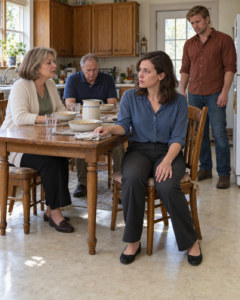
It was 11:14 in the morning when I sat down at that kitchen table. My father was already seated. My mother served soup she had made from scratch, which she does when she wants the conversation to feel ordinary.
She told me about the transfer after the soup was mostly finished.
“We went ahead and put the house in Dererick’s name,” she said. “We thought it made more sense. He has Carol, and they might want to do something with it eventually. You’re independent. You’ve always been fine on your own.”
I looked at my father. He was looking at his bowl.
“When did you do this?” I asked.
“A few weeks ago,” she said. “We didn’t want to make it into a thing.”
“I’ve been sending you money every month for 4 years,” I said. “That wasn’t a thing?”
“That was different,” she said. “That was you helping out. This is about the family home.”
“I’m part of the family,” I said.
She looked at me with an expression I can only describe as patient.
“Of course you are, but Dererick is the oldest. It made sense to keep it in his line.”
Something tightened across my shoulders. Not rage, not hurt, just a pressure, like a door closing on a room I hadn’t known I was still standing in.
“You could have told me,” I said.
“We’re telling you now,” my father said.
It was the first thing he’d said since I sat down.
“After it was done,” I said.
“We didn’t think you’d make it a whole situation,” my mother said. “You’ve always been the practical one.”
The back door opened, and Dererick came in. He had not been there when I arrived, and I understood then that he had either been told to come or had been waiting somewhere nearby.
“Hey,” he said.
He looked at me the way you look at someone when you already know what the conversation has been.
“You okay?”
“Fine,” I said.
“It’s really not a big deal,” he said. “It’s just a house. You’ve got your own thing going.”
“I’ve been contributing to this house every month for 4 years,” I said.
“Right,” he said. “And we appreciate that. We really do.”
“Mom,” I said, “did you tell Derek about the transfers?”
She looked at her soup bowl.
“I didn’t know the details,” Derek said, which was not an answer.
“The details are $614 a month for 48 months,” I said.
No one said anything.
“You’re being ungrateful,” my mother said finally.
Her voice was still warm. That was the part that stayed with me, the warmth.
“We raised both of you the same. We’re just trying to do what’s fair for the family.”
The room held that for a moment. I picked up my napkin from my lap and set it on the table, folded next to my bowl.
“I’m going to go,” I said.
“Nora,” my father said.
“I’m not upset,” I said. “I just need to go.”
I took my coat from the hook by the door and left without saying anything else. Derek did not follow me out.
I drove back to my apartment on Route 48 and parked in the lot and sat in the car for a few minutes without moving. The radio had been off the whole drive. I became aware of that only once I turned the engine off.
I went inside. I set my bag on the kitchen counter and stood at the window for a moment, looking at nothing in particular. Then I sat down at the table and opened my laptop.
I pulled up the Montgomery County Recorder’s website and confirmed the parcel transfer on Crestfield Drive. I read the recorded date twice.
I opened a second tab and navigated to my own property file: the parcel on Weller Street that I had purchased 14 months earlier for $187,400, in my name alone, with a conventional loan I had qualified for without a co-signer.
I opened the folder on my desktop labeled Weller and found the purchase agreement. I printed two copies, one to keep in the file cabinet in my bedroom, one to put in the manila folder I kept with the Weller Street documents in my work bag.
The purchase agreement was three pages. The notary stamp on the last page, my signature on the signature line above my printed name.
I called my real estate attorney’s office and left a message asking her to confirm the current recorded status of the Weller Street parcel. I made a cup of coffee and waited.
My parents called a second family meeting the following week. My mother framed it as a chance to clear the air. I said I would be there.
The meeting was at the kitchen table again. Derek and Carol came. My father sat at the head of the table.
My mother had made coffee and set out a plate of cookies, which I noticed and did not touch. My father opened by saying they had been thinking about the conversation from Thursday and they wanted to make sure everyone understood the reasoning.
He looked like a man who had spent several days assembling the right sentences.
“We’ve always tried to be fair,” he said. “Dererick has a family to think about. You’ve built something on your own. We thought that was the right division.”
“What I’ve built,” I said, “I built while also funding this house.”
“We said thank you for that,” my mother said. “More than once.”
“I’m not asking for thanks,” I said.
“Then what are you asking for?” Derek said.
“An explanation,” I said. “A real one.”
“The house goes to the family line,” my father said. “That’s how it’s done.”
“You keep saying family,” I said. “I’m your daughter.”
“You don’t need it,” my mother said. “You’ve always landed on your feet. That’s something to be proud of.”
Carol was quiet. She had been quiet since they arrived. I noticed that she didn’t look at Derek when my mother said it.
“Nora,” Derek said, not unkindly, “what would you even do with a house you don’t live in?”
I let the question sit for a moment. It was the right question, actually. Or it would have been if they had known what they were asking.
I reached into the bag I had set beside my chair. I took out the manila folder, not thick, just a few pages. The way real documents look when they are not trying to impress anyone.
I opened my phone to the county recorder parcel search and pulled up the Weller Street listing. I turned the screen so it faced the table.
Then I laid the purchase agreement flat on the table in front of me, the one with my name and the address and the price and the date and the notary stamp in the corner. No one spoke.
“I own a property on Weller Street,” I said. “I purchased it 14 months ago. I qualified for the loan on my own income. I’ve been managing it as a rental since last spring.”
My mother looked at the page. My father looked at the page. Derrick looked at Carol, then back at me.
“You never said anything,” my mother said.
“You didn’t ask,” I said.
“Why didn’t you tell us?” my father asked.
“Because it wasn’t relevant to anyone here,” I said. “Until today.”
The room was quiet.
“You keep saying I don’t need things,” I said. “What you meant was that I wouldn’t notice. I noticed everything. I just didn’t make it a whole situation.”
I let that sit for one beat.
“What you called me being practical was me carrying things you didn’t want to carry. That’s not the same as not needing.”
I slid the purchase agreement back toward myself.
“I’m not asking you to reverse the transfer,” I said. “That’s done. I just wanted you to know what I’ve been doing with the money I wasn’t spending on things you assumed I didn’t need.”
I put the folder back in my bag and stood up.
Derek said, “Nora, come on.”
“I’m not angry,” I said. “I mean that.”
And I did.
“I just don’t have anything else to add.”
I said goodbye to Carol, who was the only one who looked genuinely uncomfortable, and I let myself out.
14 months after that meeting, I was on Weller Street on a Saturday morning replacing the threshold strip on the front door of the rental unit between tenants.
It is a small thing, a rubber and aluminum strip that costs $11 at the hardware store, but the previous tenant had mentioned the draft, and I had written it down, and I was there.
I have a tool box I bought myself the year I got my first apartment. It is a matte red Stanley box, dented on one corner from the time I dropped it moving out of my second place. I keep it in the back of my car.
I used it that morning on Weller Street the way I use it every time something needs doing, without ceremony, without an audience. The street was quiet. A few houses down, someone was running a leaf blower, the sound rising and fading in intervals.
My father left a voicemail sometime that spring. I listened to it once, standing in the kitchen with my coffee going cold on the counter.
He said they had been thinking that maybe they had handled things poorly, that Dererick agreed the situation deserved another conversation. His voice was careful in the way voices get when someone has rehearsed.
He did not mention the transfers. He did not mention the $614. He said he hoped I was well.
I didn’t call back. It wasn’t a decision I agonized over. It was just the next thing, or the absence of the next thing, which is sometimes the same.
The Weller Street property is fully occupied. I redirected the $614 a month, the transfer I had been sending to Crestfield Drive, into a second savings account the month after that family meeting. It has been sitting there compounding quietly for over a year now.
I have been looking at a duplex two neighborhoods over. I have run the numbers twice, and I think the numbers are right.
There are people who believe that family loyalty means absorbing whatever the family decides. That asking for an accounting makes you difficult. I used to believe a version of that.
I don’t anymore.
What I believe now is simpler. The people who told me I didn’t need things were the people who needed me to not need them.
I finished the threshold strip that morning on Weller Street and packed the toolbox back into my car. The door fit flush when I tested it. No draft.
That was enough.
If any part of this story stayed with you, if you’ve carried something similar or watched someone you know carry it, share it with someone who needs to hear it. Not every story like this one makes it out of the family kitchen.