My Son Called: “We Moved-forgot To Tell You.” So I Cancelled Everything. That Stunned Him.
Uh, the call came at 11 minutes 3 on a Thursday afternoon, right in the middle of watering my tomato plants. I was 71 years old, retired 8 years from the school district, and I had learned that phone calls at odd hours rarely brought good news. I set down the hose and wiped my hands on my apron before answering.
“Hi, sweetie.”
My son’s voice came through fast, almost breathless, like he’d rehearsed the words in the car.
“Hey, Ma. So, listen. Don’t be mad, but we’re already about 2 hours outside of Phoenix. We’re heading to Arizona for good.”
I stood very still.
“You’re heading where?”
“We moved, Ma, yesterday. Well, this morning, really, of Trisha’s cousin got us a place near Scottsdale, and the timing just worked out, so we packed up and went.”
I looked at the hose still running into the flower bed, water pulling around the roses I’d planted the spring my husband died.
“You moved with the boys?”
“Yeah, obviously with the boys, Ma, there are kids.”
He laughed, but it came out thin.
“Look, everything happened fast. Trisha’s cousin had a house sitting empty, rentree for 6 months if we took it now. We didn’t want to lose the opportunity.”
Behind him, I could hear my daughter-in-law’s voice, muffled, saying something about a rest stop.
2,000 m. My son, Robert, had just told me almost as an afterthought that he’d taken my two grandsons 2,000 m away and hadn’t said a single word until they were already halfway across Texas.
“Robert,” I said, keeping my voice level. “How long have you known about this?”
A pause. Longer than it should have been.
“A few weeks.”
There it was. Not forgetfulness. A choice.
He had looked at me across the dinner table three Sundays running, eaten my pot roast, let my grandsons climb into my lap for bedtime stories, and said nothing because he had already decided I didn’t need to know.
“I see,” I said quietly.
“Ma, don’t do that voice.”
“I’m not doing a voice.”
“You’re upset.”
I wasn’t upset. Upset would have been easier. What I felt was colder than that and much more cleareyed.
For six years since my husband passed and left me comfortable enough to be generous, I had quietly held up more of my son’s life than either of us liked to admit out loud. I had expected at minimum a phone call before the fact instead of after.
“Drive safe,” I told him, and I hung up before he could answer.
The kitchen went silent except for the drip of the faucet I’d forgotten to shut all the way. I—I stood there for a long moment, phone still in my hand, and then I did something I hadn’t done in longer than I could remember. Opened my laptop.
I opened my laptop. If Robert believed he was grown enough to move his family across the country without so much as a conversation, then he was grown enough to carry that family on his own two feet.
Ah, for 4 years I had been paying for things so routine to both of us that neither of us called them what they were—a safety net stretched tight under people who never once looked—looked down to check if it was there.
I covered their grocery delivery every other week. I paid for the family cell plan, all four lines, because Robert said the boys needed phones for school safety.
I had added him as an authorized user on one of my credit cards back when my first grandson was born for formula and diapers, and I had simply never taken him off. The car they drove, a decent, dependable SUV, had my name still on the insurance because Trish had two speeding tickets, and the premium under her own policy had been, in Robert’s words, insane.
I logged into the bank’s website first. Robert’s name still sat there under authorized users, same as it had for 6 years.
The last three months of statements told their own story. A weekend at a resort in Sedona, a new gaming console, a steakhouse downtown—none of it groceries, none of it emergencies.
I clicked “Remove authorized user.” A little box popped up asking if I was sure.
I was.
Next came the phone plan. Ah, four lines, mine included, all to my out, because it had been cheaper that way years ago, and nobody had ever bothered to separate it since.
The billing cycle renewed in 3 days. I scheduled Robert’s line and Trish’s line for cancellation the moment it did, leaving the boys’ two lines running because whatever quarrel I had, it wasn’t with two children who hadn’t asked to be uprooted.
I closed the laptop and sat back in my kitchen chair, waiting to feel guilty. It didn’t come.
What came instead was something I hadn’t expected at all. Relief, plain and simple, spreading through my chest like warm tea.
That evening, my daughter Carol came by after her shift at the hospital, still in her scrubs, carrying a rotisserie chicken from the grocery store because she knew I hadn’t been eating much lately. One look at my face and she set the bag down slowly.
“What happened?”
“Your brother moved.”
“Moved where?”
“Arizona.”
Her eyebrows went up somewhere near her hairline.
“When?”
“Yesterday. He called me from the road.”
“He didn’t tell you before he left?”
I shook my head. Carol sat down across from me, quiet for a moment.
“He didn’t tell me either. I found out an hour ago because Trish posted a picture of a cactus.”
Neither of us said anything for a while. Then she asked gently, the way she’d learned to ask things since becoming a nurse.
“Are you okay, Mom?”
“I think I might be, actually.”
A thought crossed my mind then, and I stood up before I’d fully decided to.
“I want to check something.”
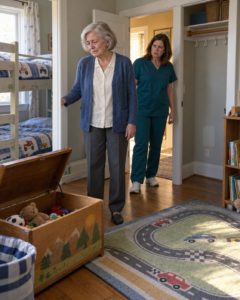
I walked down the hallway to the back bedroom, the one everybody in the family still called the boy’s room, even though it was technically mine. Bunk beds I’d bought secondhand and painted myself. A toy chest, a shelf of picture books.
Ah. A rug shaped like a racetrack that my youngest grandson, Mason, loved so much he refused to walk on any other part of the floor.
I pushed the door open and stopped in the doorway. The toy chest sat half empty, its lid propped open like something had been grabbed in a hurry.
Huh? The good winter coats, the ones I bought them just last fall, were gone from the closet. So was the double stroller I kept folded behind the door for when I took both boys to the park.
Even the nightlight shaped like a moon had been unscrewed from the wall socket, leaving a small dark rectangle where the paint hadn’t faded. Carol appeared in the doorway behind me, and I heard her breath catch.
“They’ve been taking things,” she said. “For weeks.”
I nodded slowly, understanding now why every Sunday visit over the past month had ended with Robert lingering a little longer in this room or carrying an extra bag out to his car that I’d assumed was laundry.
“They planned this the whole time,” Carol said, and there was an edge in her voice I rarely heard.
I felt the sadness I expected finally arrive and then just as quickly watched it turn into something else, something steadier.
“Would you help me with something tomorrow?” I asked her.
“With what?”
“What?”
I looked around the half-stripped room one more time.
“I’m going to take my house back.”
I woke the next morning before the sun, which hadn’t happened naturally in years. I lay there for a moment, simply noticing the quiet.
No notification chime asking for gas money. No missed call from Robert with a particular ringtone that always meant trouble. No text that started with, “Mom, so this is embarrassing, but…”
Just birds outside the window and the hum of the refrigerator.
Are Carol arrived around 8 with coffee and a box of donuts, ready to work.
“You sure about this?” she asked.
“More sure than I’ve been about anything in a while.”
I didn’t start with the locks. I started with the boy’s room because it felt important to face that first.
Together, Carol and I packed away what remained. A few stray toy cars, a stuffed dinosaur missing an eye, a stack of coloring books.
We folded the bunk bed frame down and leaned it against the wall. The rug shaped like a racetrack I kept rolled up carefully in the closet because some things you don’t donate even after everything.
“You’ve talked about wanting a craft room for years,” Carol said, watching shut a box of stuffed animal.
“I kept telling myself the boys would need this space.”
“They still might visit.”
“They’ll always be welcome,” I said, “but they don’t need an entire room sitting empty and waiting 360 days a year on the off chance.”
By early afternoon, the room looked different already. Bare walls, sunlight falling across bare floor, a kind of blank possibility I hadn’t let myself imagine in a long time. I could already picture where my sewing table would go and a good chair by the window for reading.
Ah, Carol was loading the last box into her car when my phone buzzed on the counter. A fraud alert from my bank.
Attempted charge declined: $340.
A gas station outside Amarillo, Texas. I stared at the screen and felt something close to a smile pull at my mouth.
They’d reached for the card out of habit, the way you reach for a light switch in a dark room you’ve walked through a thousand times, and found nothing there. I dismissed the alert and went back to peeling tape off a cardboard box.
Less than an hour later, my phone rang. Robert’s name on the screen.
“Hello.”
His voice came through tight and fast.
“Ma, my card just got declined at a gas station in the middle of nowhere.”
“I removed you from it yesterday.”
“You what?”
“It isn’t your card anymore, Robert. It never really was.”
Silence. And then I heard the phone change hands and Trish’s voice, sharper than I’d ever heard it.
“Diane, what is wrong with you? We’re stranded.”
But once in 9 years had Trish called me anything but Mom, or occasionally Miss Diane when she was trying to be polite in front of her own mother. Diane meant she wanted something and was already annoyed she might not get it.
“I doubt you’re actually stranded,” I said. “There are other ways to pay for gas.”
“We’re low on cash because of the move.”
“That’s unfortunate.”
“You’ve always helped before.”
“I also expected to hear about a cross-country move from my son before he was already in another state,” I said. “Funny how that works.”
Robert’s voice came back on, louder now.
“This isn’t the time for a lecture, Ma.”
“No,” I agreed. “Uh, it’s the time for two grown adults to manage a decision they made without me.”
“So, you’re just going to abandon your grandkids?”
There it was, right on schedule, the way it always came whenever they wanted something and had run out of other arguments. My grandsons turned into a shield.
“I’m not abandoning anyone,” I said evenly. “I’m allowing two capable adults to handle the consequences of their own choice.”
Trisha’s voice again, softer now, wounded.
“We’ll pay you back, Diane. I promise.”
I closed my eyes. I had heard that sentence more times than I could count over the years, and precious little of it had ever come true.
“I wish you both the best,” I said. “But this isn’t my responsibility anymore.”
I hung up before either of them could say more, and the kitchen went quiet again. The good kind of quiet. The kind that used to scare me and now felt like company.
R. That evening, I sat on my back porch with a glass of sweet tea, watching the fireflies come up out of the grass the way they had every summer of my life in that house. I couldn’t remember the last evening I’d spent without a knot in my stomach over somebody else’s overdraft notice.
The next morning, there was still the matter of the SUV up. Four years earlier, I’d bought Robert and Trish that vehicle outright after their old car finally gave out.
And though the title had gone into Robert’s name, I had continued paying the insurance because Trish’s driving record made the premium nearly $200 more expensive under her own name. I called my agent, a woman named Sandra I’d known since before Robert was born.
“Morning, Sandra. I need to remove a vehicle from my policy today.”
“Sure thing, Diane. Everything all right?”
“Getting there,” I said.
Within 20 minutes, it was done. I sent Robert a short text afterward.
“The insurance on the SUV ended this morning. You’ll want to arrange your own coverage before you drive it again.”
Whether he read it right away or not, I couldn’t say. And for the first time in longer than I could remember, that wasn’t my problem to solve.
Carol’s husband stopped by that afternoon carrying a small paper bag from the hardware store.
“What’s that?” I asked.
He grinned.
“New deadbolts.”
I studied him.
“You think they’re coming back?”
“I don’t think they’ll ask first,” he said. “I think they’ll expect.”
I looked at my front door for a long moment, then stepped aside and let him work. By the time the sun went down, Mark had tested every lock twice and pressed a fresh set of keys into my palm.
“There,” he said. “Ah, now it’s only the people you actually trust.”
It wasn’t just new hardware. It felt like the first page of something.
After Mark left, I wandered out to the garage, where for 2 years half the space had been swallowed by Robert’s things. A table saw he swore he’d move any week now. Boxes of old fishing gear.
A broken lawn mower he kept meaning to fix. Camping equipment gathering dust since before the pandemic. That week had never come.
I stood there looking at all of it and decided enough was enough. I photographed everything first, every box and tool for my own records, and then I posted it piece by piece on the neighborhood app.
Within the hour, my phone was buzzing with messages. The following afternoon, a parade of strangers had come through—a young man who bought the table saw for his new workshop, a retired fisherman thrilled to find gear at half price. A family who took the camping equipment for their first trip together.
What was left, the truly broken and worthless, I set out by the curb for pickup. A when the garage finally stood empty, dust moes drifting in the afternoon light, both of my cars fit inside for the first time in 2 years.
I stood in the doorway and felt something unclench in my chest that I hadn’t realized was still tight.
That night, an unfamiliar number lit up my phone. I almost let it go to voicemail, then answered.
“Diane, it’s Trish. I borrowed Robert’s aunt’s phone.”
Straight to business. No hello from Robert himself.
“Why did you cancel everything?”
“I didn’t cancel everything. I removed what was mine to remove.”
“Our phones don’t work.”
“I told you the plan was ending. You had 3 days notice.”
I heard Robert in the background, his voice rising, and then Trish’s, lower, tired.
“We’re staying with his aunt right now. It’s her back bedroom. There isn’t really room for four of us.”
“I’m sorry to hear that.”
“You could fix this so easily.”
“How?”
“Turn the phones back on. Maybe send something to help until Robert finds work.”
There it was. The true reason for the call laid bare at last. Not an apology. Not a question about how I was holding up. Money.
“Trish,” I said gently. “Did you call to ask how I’m doing?”
Silence.
“Did you wonder even once how I felt finding out my grandsons had been moved 2,000 m away after the fact?”
Nothing.
“Did anyone plan to apologize for quietly emptying out a bedroom in my house over the course of a month while pretending nothing was happening?”
A long pause and then, very small, “No.”
“I didn’t think so.”
Her voice sharpened suddenly.
“You’ve changed, Diane.”
“Yes.”
“I don’t even know who you are right now.”
“I’m starting to know who I am again,” I said.
Robert grabbed the phone.
“This is unbelievable. You’re treating us like strangers.”
“No,” I said calmly. “I’ve stopped treating grown adults like children.”
“You owe us, Ma. After everything.”
I almost laughed.
“I owe you? I helped because I loved you. Where? That was never supposed to be a contract with a repayment schedule.”
“The boys don’t have enough to eat properly right now.”
“I hope their parents figure that out quickly,” I said, and I meant it.
And it still hurts to say. Before he could say anything else, I ended the call and set the phone face down on the table.
Three quiet weeks went by. My sewing table arrived, and I spent an entire Saturday setting up my machine by the window where the light was best.
I joined a Tuesday morning walking group with three other women from the neighborhood, and I had lunch twice with an old friend from my teaching days without once glancing at my phone, waiting for it to ruin the afternoon.
A then one Saturday, Carol stopped by with coffee and a look on her face that told me she had news.
“You won’t believe this,” she said.
“Try me.”
“Trisha’s cousin sold the house out from under them. Turns out he needed the money and never mentioned it. It was only ever going to be temporary.”
I stirred my coffee slowly.
“Where are they now?”
“A motel. Robert’s still looking for work. Nobody in Arizona seems to want an assistant manager with no local references.”
I felt something complicated pass through me. Not satisfaction exactly, but something close to recognition. Reality arriving right on schedule, the way it always eventually does.
A over the following weeks, my days settled into a rhythm I hadn’t felt in years. Mornings began with the walking group, then coffee on the porch, then an hour or two at my sewing machine in the room that used to belong to two little boys and their toys.
The walls I’d repainted a warm, buttery yellow, and sunlight came through the curtains I’d sewn myself, that’s landing across shelves of fabric instead of plastic dinosaurs.
Whenever I sat there with my coffee, I noticed something I hadn’t realized had gone missing years earlier. Peace. Not the silence of an empty house, but the specific hard one quiet of a woman who has finally stopped bracing for the next emergency call.
One afternoon, Carol arrived with a box of pastries from the Good Bakery downtown.
“I heard from Robert,” she said, sitting across from me.
“How’s he doing?”
“Tired. He finally found something. Stocking shelves at a warehouse overnight. Trish is doing hostess shifts at a diner near the motel.”
I nodded slowly. I felt relief rather than pity. They weren’t failing. They were, for the first time in a long while, standing entirely on their own.
Carol hesitated.
“She asked me to talk to you.”
“About what?”
“They want to borrow money for a deposit on an apartment. $2,000.”
I folded the dish towel in my lap before answering.
“And what did you tell her?”
“That it wasn’t my place to ask you.”
“Thank you,” I said, and I meant it.
“I don’t think she’s angry at you anymore,” Carol said. “I think she’s scared.”
“Fear has a way of showing up right when the safety net disappears,” I said.
For years, every poor decision had been cushioned by somebody else’s sacrifice. Now, every choice they made carried its own actual weight. That wasn’t cruelty. That was simply what it meant to be an adult.
The following week, I made a decision of my own. Instead of wiring money across the country the way I once might have without a second thought, I opened my savings account and looked, really looked, at the number sitting there.
For the first time in years, it was climbing instead of shrinking. There was enough finally to do something I had put off for over a decade.
I booked a two-week trip to visit the national parks out west—Zion, Bryce Canyon, the Grand Canyon at sunrise. The kind of trip my late husband and I had always talked about and never, Ming White, managed to take.
I clicked confirm on the booking and felt for once not a single flicker of guilt.
A few days later, Carol called.
“They’re coming back.”
I set down the suitcase I’d been packing.
“What do you mean, back?”
“Robert called me. They’re driving home. Should be here by tomorrow evening.”
“What happened?”
“The warehouse let him go. Not enough hours. And I guess the motel finally caught up with what little money they had left.”
I sat down slowly on the edge of my bed.
“All right.”
The next evening, right around dusk, my doorbell rang. I already knew somehow before I even looked through the peepphole.
Robert stood on the porch, thinner than I remembered, his shirt wrinkled from two days in the car. Beside him, Trish held Mason on her hip, and my older grandson, Ethan, stood quietly on the top step, looking at his shoes.
I opened the wooden door, but left the security screen locked between us.
“Mom,” Robert said. “Hi.”
“Hello, Robert.”
He managed a tired smile.
“It’s been a rough couple of months.”
“I’m sorry to hear that.”
Trish shifted Mason on her hip.
“We just need somewhere to stay. A few weeks until we can save up for another place.”
Off. Before I could answer, Robert stepped closer to the screen.
“I also need to get into the garage. My tools.”
I looked at him steadily through the mesh.
“You won’t find them there.”
His forehead creased.
“What do you mean?”
“I sold them. All of it. Months ago.”
The color went out of his face.
“You sold my things?”
“You left them sitting in my garage for 2 years, Robert, taking up space I needed. I gave you plenty of chances to come get them.”
Trish stared at me, stunned.
“You actually sold everything?”
“Yes.”
Nobody spoke for a moment, and in that silence, I watched something shift in both their faces. The slow realization that the woman standing behind that locked screen door wasn’t the same one who used to hand over her credit card without asking a single question.
Trish’s eyes filled with tears.
“Diane, please. We don’t have anywhere else to go.”
I looked past her at my grandsons, exhausted after what had clearly been a long drive. Ethan still not lifting his eyes from his shoes.
My heart achd in a way that had nothing to do with the argument in front of me. None of this had ever choosing.
“I’m sorry you’re all going through this,” I said quietly. “But this isn’t a decision I made for you, and I won’t unmake the consequences for you either.”
Robert’s jaw tightened.
“They are your grandsons. You’re really going to leave them standing on a porch?”
I held his gaze without raising my voice.
“I’m not leaving them anywhere. Their parents are responsible for finding them somewhere safe to sleep tonight.”
“So, that’s it? After everything I’ve—after everything you’ve done for us?”
“Let’s actually talk about everything,” I said. “I spent years helping the two of you because I wanted my grandsons to have a stable life. I paid your phone bills, your insurance.
“I gave you a vehicle and stored the belongings you never came back for and opened my home to you every single time you needed rescuing. And when you decided to move 2,000 m away, you didn’t tell me.
“You quietly emptied a bedroom in my house over the course of a month, letting me believe nothing had changed and only called once you were already gone.”
Trish lowered her head, wiping at her eyes.
“I know.”
“No,” I said gently. “I don’t think you fully did. Not until right now.”
She looked up at me.
“I was afraid you’d try to talk us out of it.”
I nodded slowly.
“Maybe I would have asked a lot of questions, but I never would have stopped you from building your own life, Trish. I only ever wanted to be told.”
Robert shifted his weight, uncomfortable.
“I made it worse,” he admitted. “I kept telling her we’d figure it out.”
“And did you?”
He let out a long breath.
“No, we depended on everybody but ourselves.”
For a moment, the only sound was the sicatas starting up in the trees, and I could see on both their faces the particular exhaustion of people who have finally run headlong into the truth.
Trish glanced back at the boys.
“Can we come in just for tonight?”
Every instinct in me wanted to unlatch that screened door immediately, but another steadier voice reminded me exactly why it was locked in the first place. Boundaries only mean something if they hold when it’s hardest to hold them.
“I’m afraid the answer is no,” I said. “But there’s a motel about 10 minutes from here, off the interstate, and it’s clean and reasonable. I’ll text you the address.”
Trisha’s shoulders sagged, but she nodded. No argument left in her.
“I’d also like to take the boys to the park tomorrow,” I added. “You two can spend the day looking for work and a place to live. I’ll keep them fed and happy in the meantime.”
Something in Trisha’s face loosened just slightly.
“You’d really do that?”
“My relationship with those two boys was never the problem,” I said.
Robert reached his hand through the gap in the screen door.
“I’m sorry, Mom. I really am.”
I studied his face for a long moment before I shook it.
“I hope you mean that.”
“I do.”
Without another word, they gathered their bags, and the boys climbed sleepily into the back seat. Ethan lifted his hand and gave me a small wave through the car window as they pulled away.
I stood on the porch and waved back until the tail lights disappeared around the corner, and I felt strangely not triumphant at all, just quiet, just steady.
The next afternoon, I met my grandsons at the park exactly as I’d promised. We fed the ducks by the little pond, pushed each other on the swings until Mason declared himself dizzy, and ate peanut butter sandwiches on a blanket in the shade, while Robert and Trish spent the day filling out applications across town.
A week later, Carol called with an update.
“They found a small place. Nothing fancy, but it’s theirs.”
“That’s wonderful.”
“Robert got on fulltime at a distribution center. Trish is keeping her hostess. At least until things settle.”
“That they’ll be all right,” I said.
“They will now,” Carol agreed.
A few months after that, I boarded a plane for Arizona myself, not to rescue anyone this time, but to finally see the Grand Canyon at sunrise, the way my husband and I had always talked about doing.
As the desert rolled by beneath the wing, red and endless, I thought about everything that had happened since that first phone call on a quiet Thursday afternoon.
Love was never meant to be an unlimited line of credit. Helping the people you love should never mean letting yourself be quietly used until there’s nothing left of your own life to speak of.
Sometimes the kindest thing a mother can do is step back and let the people she loves most feel the full weight of their own choices are.
Robert and I found our way back to each other eventually. Not because I bailed him out again, but because we finally learned how to talk to one another as two adults instead of one adult and one child who never quite grew up.
My grandsons still visit most weekends, and the sewing room stays exactly as it is, sunlit and mine. And every night when I turn the lock on my front door, I remind myself that protecting my own piece was never selfish.
It was all along simply necessary.