My Son-in-law Said, “We’re Moving Into Your House Next Week” — He Had No Idea What I’d Already Done
Phân cảnh 1: The ultimatum
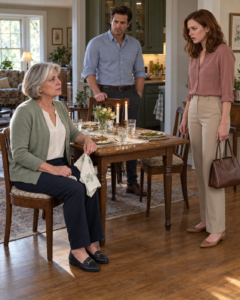
My son-in-law stood up at my kitchen table, tapped his fork against his glass like he was about to give a wedding toast, and smiled at everyone in the room except me.
“We talked it over,” he said. “And we’re moving into your place next week.”
My daughter Renee reached for my hand like she was comforting me. I looked at both of them for a long moment. Then I set down my napkin and said, “That’s wonderful timing. The movers come for the new owners on Friday.”
Rene’s fork froze halfway to her mouth. What neither of them understood was that the home they had already started dividing in their heads didn’t belong to me anymore. Not one square foot of it.
But before I explain how that happened, let me start from the beginning. My name is Patricia Coleman.
Phân cảnh 2: Roots of a home
I’m 61 years old. And until about 4 months ago, I lived a life most people would call unremarkable in the best possible way. Quiet mornings. A garden I actually kept alive. A little blue house on Wisteria Lane in a town outside Columbus, Ohio, where I’d raised my daughter and buried my husband within the same set of walls.
Tom passed six years ago. Heart attack, no warning, gone before the ambulance even turned onto our street.
Grief has a strange way of settling into a house. It doesn’t scream; it just sits in the corners. I kept his reading chair by the window, even though nobody sat in it anymore. I kept two coffee mugs in the cabinet, even though I only ever used one.
That house was never just a house. It was where Renee took her first steps in the hallway, where we measured her height on the pantry door frame every birthday until she was 17 and told us to stop because it was embarrassing.
It was where Tom and I refinished the back porch ourselves one humid August, sweating through three weekends because we couldn’t afford to hire it out. It held 31 years of a life. Every wall had a memory pressed into it like a fingerprint in wet cement.
Phân cảnh 3: Erosion of boundaries
Renee married Derek four years ago. I liked him well enough at the wedding. He was charming in that easy, confident way some men have. The kind of charm that makes a room feel like it’s on his side before he said much of anything.
For the first year or two, he was polite to me, maybe even warm. He’d fix things around my house without being asked, compliment my cooking, call me “Mom” a little too quickly for my taste, but I let it go.
Then, slowly, something shifted. It started small. Little comments dropped into conversation like pebbles.
“This house is a lot for one person, Patricia. You know, with three bedrooms empty, it just seems like a waste.”
At first, I laughed it off. I told him I managed just fine, thank you. Then Renee started saying similar things, gentler, but the same idea underneath.
“Mom, wouldn’t it be nice to have some company around here? You get lonely. I know you do.”
I told her I was fine. I was, mostly. Loneliness and solitude are not the same thing, and I’d made peace with the difference.
Then the visits changed shape. Dererick and Renee started coming by on Sundays with takeout, sitting a little too long after dinner, steering conversation toward real estate.
“Housing prices in this neighborhood are actually insane right now,” Derek said one evening, scrolling through his phone like it was casual. “Insane. You could probably get 440,450 for this place easy.”
I remember thinking, “Why does he know that number off the top of his head?”
Phân cảnh 4: Financial pressure
Then came the announcement dressed up like good news. They’d been renting an apartment in the city, paying more than they could comfortably afford, and Dererick had lost hours at his job.
“We’ve been talking,” Renee said one Sunday, not quite meeting my eyes. “And we think it makes sense for us to move in here for a while, just temporarily. We’d help you out, split some bills, and honestly, it’d be good for you not to be alone all the time.”
I told them I appreciated the thought, but I wasn’t looking for roommates. Dererick’s smile tightened just slightly.
“It’s not really about what you’re looking for, Patricia. It’s about what makes sense for the family.”
I remember that sentence landing somewhere in my chest like a small stone. What makes sense for the family. Not what I wanted. What made sense.
Two weeks later, Derek showed up with a manila folder thick with printouts, property comparisons, a spreadsheet of estimated home equity, a page titled in his own handwriting, “Options moving forward.”
He walked me through it like a financial adviser pitching a client, explaining that if I sold the house and moved into something smaller, I’d free up a significant amount of capital that could, quote, “help stabilize things for the whole family.”
I asked him directly, “Stabilize things. How?”
He said, “It could go toward a down payment on a bigger place for all of us to share going forward.”
All of us. As if that had already been decided somewhere without me in the room. I closed the folder and slid it back across the table.
“I’m not selling my house, Derek.”
He leaned back in his chair, arms crossed, and said the words that I would replay in my head for weeks afterward.
“You’re being really stubborn about this. You know, we’re trying to help you.”
Phân cảnh 5: Choosing control
Stubborn. As if protecting 31 years of my life was an inconvenience I needed to get over.
A few days after that, Renee sent me a text message. Not a question, a statement.
“We’re planning to move some of our stuff in this weekend just to get started. Should be easy since you have the extra rooms already cleared out.”
Should be easy. Nobody had asked me if this weekend worked. Nobody had asked me anything at all.
I called Renee that night.
“You cannot just decide to move into my home without asking me first,” I said, trying to keep my voice steady.
There was a pause, and then Dererick’s voice came through because apparently he’d taken the phone from her.
“We’re family, Patricia. Family helps family. If you can’t understand that right now, I don’t know what to tell you.”
Then he added, almost like an afterthought, almost like a threat wrapped in casual disappointment.
“Just don’t be surprised later if we’re not around much, if this is how you’re going to treat us.”
I sat in my kitchen after that call for a long time, staring at nothing. I ran my hand along the edge of the counter, the same counter Tom and I picked out from a discontinued display because it was the only one we could afford at the time, and we loved it anyway.
And for the first time, something in me went very, very still. Not angry, not panicked. Still.
I understood clearly that this had stopped being about needing a place to stay. This was about control. And I had spent too many years building a life of my own to hand the keys of it over because somebody else had decided my boundaries were an obstacle.
I didn’t argue that night. I didn’t call back and yell. I didn’t send an angry text demanding an apology.
Instead, I sat down at my kitchen table with a legal pad. And for the first time in longer than I could remember, I started making a plan that didn’t depend on anyone else’s approval.
That weekend came and went. No moving boxes appeared on my porch. No truck showed up in my driveway.
Silence, actually, from both of them, which I recognized for exactly what it was: a waiting game. They were letting the pressure sit, letting loneliness do the convincing for them. But something in me had already changed, and they didn’t know it yet.
Phân cảnh 6: Seeking clarity
The following Tuesday, I opened the hallway closet and found one of Tom’s old flannel jackets still hanging there, soft at the elbows from where, smelling faintly, impossibly, still like him after all these years.
I held it against my chest for a moment. Then I folded it gently and placed it into a donation box along with some other things I’d been holding on to without quite knowing why.
It wasn’t an act of anger or letting go of him. It was something else. A quiet realization that I had spent years keeping space open for other people. And somewhere along the way, other people had stopped keeping space open for me.
I called my brother Walter that week. He picked up on the second ring the way he always does.
“Patty, what’s going on?”
I told him everything: the folder, the spreadsheet, the text message, the phone call, all of it, in one long, unbroken breath. He was quiet on the other end for a while after I finished.
Then he said, “They’re not asking you for help, Patty. They’re asking you for access.”
I sat with that sentence. Access to my house, access to my savings, access to 31 years of stability I had built brick by brick, mostly on my own since Tom died.
“I don’t want to lose Renee,” I whispered into the phone.
Walter’s voice softened. “You might already be losing yourself.”
I didn’t have an answer for that because I knew he was right.
Over the next several days, I did something I hadn’t done in years. I sat down with every financial document I owned. My pension statements, my savings account, the modest rental income I got from a small storage unit business Tom and I had built up on the side of our property years ago.
Something Renee and Derek didn’t even know still existed because I’d never mentioned it. I calculated everything slowly, carefully, for the first time thinking not about what my daughter and son-in-law wanted from me, but about what I actually needed for myself.
The numbers surprised me. I wasn’t as fragile or dependent as I think Dererick assumed. I had options, and that realization gave me a kind of quiet confidence no argument ever could have.
Phân cảnh 7: The request for money
A few evenings later, Dererick showed up at my door alone, looking tired in a way that seemed almost rehearsed.
“Patricia, we need to talk. Things have gotten tight.”
I let him in. He told me about a business opportunity he wanted to invest in, some logistics company a friend of his was starting, and how he needed $40,000 to buy in as a partner.
“It would set us up for real,” he said. “We’d finally be able to get ahead instead of just scraping by every month.”
I asked him one simple question.
“If I give you $40,000, what exactly changes about how you’re living?”
He blinked like the question confused him. He talked about opportunity and timing and getting a head start, but he never once mentioned cutting any expenses. He never mentioned changing anything about how they were spending money. He never mentioned a plan that didn’t run straight through me.
I told him I’d think about it. He left looking relieved. The way people look when they believe they’ve already won.
He thought “I’ll think about it” meant I was leaning toward yes. It didn’t. It meant I hadn’t decided anything yet, and I wasn’t going to decide anything until I understood exactly what I wanted.
Phân cảnh 8: The secret sale
The next morning, I made an appointment with an attorney two towns over, someone completely unconnected to Renee, to Derek, to any of our family friends. I brought the deed, my will, my insurance documents, every piece of paper that mattered.
The attorney, a calm older woman named Miss Ferris, listened to the entire situation without interrupting once. When I finished, she said something I’ve thought about nearly every day since.
“You don’t owe anyone an explanation for protecting yourself, Patricia. That’s not selfish. That’s just wise.”
We went through the deed first. The house was entirely in my name. No co-owners, nothing shared, nothing that gave Derek or Renee any legal claim whatsoever. That alone eased something tight in my chest.
Then we reviewed my will and my estate plan, and I realized how much I’d left assuming my family would simply respect my wishes when the time came. Assumptions, I was learning, are not protection.
I spent the next week updating everything properly. My will, my financial directives, all of it, with copies secured somewhere Derek would never think to look. I hadn’t told either of them anything yet.
But somewhere in the middle of all that paperwork, a bigger idea started forming. What if I simply removed the house from the equation entirely? Not fought over it, not defended it, just made it unavailable to negotiate over permanently.
I reached out quietly to a real estate agent named Donna Okafor, someone I found through a friend from church, someone with no connection to my family whatsoever.
I told her clearly, “No sign in the yard, no open house, no neighborhood gossip. I wanted this handled privately.”
Donna understood immediately.
“There are absolutely buyers who prefer discretion,” she told me. “We can make this quiet.”
That was exactly what I needed. She walked through the house with me one afternoon, running her hand along the porch railing Tom and I had rebuilt ourselves, admiring the built-in bookshelves in the living room.
“You’ve taken beautiful care of this place,” she said.
I told her I’d loved it for a long time. She gave me an estimated value of $460,000.
I stood there staring at that number for a long moment, thinking about how, for 31 years, I had never once thought of this house in terms of dollars. Now, suddenly, I understood exactly what Derek had been seeing every time he walked through my front door.
Not memories, not the pantry door frame with Rene’s height marked in pencil. A number, an asset, something he believed somewhere in his mind was already halfway his.
Donna found a buyer within 9 days, a young couple expecting twins, over the moon about the quiet street and the big backyard. They offered the full asking price in cash with a 3-week closing.
I read that offer twice at my kitchen table. Then I signed it. My hand was steady.
There was no dramatic rush of victory in that moment. Just a deep, settled certainty. The house was sold, and Renee and Derek had no idea.
Phân cảnh 9: A new beginning
Meanwhile, they kept planning their future in a home that no longer belonged to me. Renee texted one afternoon.
“Have you thought more about everything we talked about?”
I replied simply, “Yes, I’ve been thinking about it very carefully.”
She had no idea what that actually meant. A few days later, Derek called about the $40,000.
“So, can we count on you, Patricia?”
I looked around my living room, already picturing strangers’ furniture where mine currently sat.
“Yes,” I said quietly.
“You will?” he asked, and I could hear the relief creeping into his voice already.
“I can count on myself,” I said.
He didn’t understand what that meant yet, and before he could ask, I changed the subject. That evening, I called Walter.
“I found a place,” I told him.
“Where?”
“Arizona. Near Sedona.”
He went quiet for a second, then laughed, disbelieving.
“You’re serious?”
“Very.”
He’d mentioned once, years ago, how much he loved the desert light out there, how peaceful it felt, and the idea had stuck somewhere in the back of my mind ever since without me realizing it.
I found a small adobe-style house with a view of the red rock formations. One-story, lowmaintenance, a little cassita out back that could be a guest room or a studio. The price was around $210,000.
It wasn’t smaller because someone decided I needed less space. It was different because, for the first time in a long time, I was choosing something for myself.
I flew out 2 days later to see it in person. Standing in that backyard at sunset, watching the rock formations turn a deep burnt orange, I didn’t think about Renee. I didn’t think about Derek. I didn’t think about the folder, the spreadsheet, any of it.
I just stood there in the quiet and thought, “This is where I want to be.”
I made an offer that same evening. It was accepted within a day.
Back home, Dererick and Renee kept preparing for a move into a house that legally belonged to somebody else entirely. Renee even mentioned, almost in passing, that she was thinking of turning the guest bedroom into a home office.
“That room gets such good light in the mornings,” she said.
I just smiled and said, “It really does.”
I let them keep imagining it, not out of cruelty, but because I had finally learned that some truths land heavier when they arrive at exactly the right moment instead of the moment somebody else demands them.
Phân cảnh 10: The final revelation
I invited them both to dinner on a Saturday. I texted Renee, “7:00, my place. I have something important to share.”
Dererick’s response came back almost instantly.
“Finally.”
One word, and it told me everything about what he still believed was coming.
That Saturday, I cooked slowly and deliberately. Pot roast, mashed potatoes, green beans with butter, the exact meal Renee used to request for every birthday growing up. I wasn’t cooking it to soften anything. I was cooking it because I wanted my last dinner in that house to feel like mine.
I set the table with the good china, lit two candles, and waited. They arrived at 7 sharp. Renee wore a new outfit and had the kind of relaxed confidence of someone expecting good news.
Dererick hugged me at the door like nothing had ever been strained between us. We made small talk through dinner: work, traffic, nothing that mattered, until Renee finally couldn’t hold back any longer.
“So,” she said, smiling, setting down her fork. “What’s this big announcement?”
I took a sip of water, set the glass down carefully, and looked at both of them directly.
“I’ve decided to sell the house.”
Dererick leaned back in his chair, and I watched relief spread across his whole face.
“I knew you’d come around eventually,” he said.
Renee smiled, satisfied, already halfway to saying something about logistics. I raised one hand.
“I’m not finished.”
Their smiles both faded at the same moment.
“I’ve decided to sell the house,” I repeated. “And I already have.”
The silence that followed was immediate and complete. Derek blinked.
“What?”
“The house has been sold,” I said. “The closing happened 2 weeks ago.”
Renee stared at me.
“When? You never said anything.”
“No,” I said calmly. “I didn’t. You assumed I would ask permission for a decision that was entirely mine to make.”
Dererick looked at Renee. And Renee looked back at him. And for the first time since they’d walked through my door that evening, neither one of them had anything to say.
Phân cảnh 11: The confrontation
Then Renee asked the question I’d been expecting.
“How much did you sell it for?”
I answered honestly. “$460,000.”
Her expression shifted instantly. Some quick mental math happening behind her eyes.
“So you could easily—”
“Know,” I said before she could finish. “I’m not giving you any of it. Not the 40,000 for Derek’s business. Not for a down payment on a new house for the three of us. Not a dollar of it.”
Dererick’s jaw tightened.
“You sold it just like that, without telling us?”
I held his gaze steadily.
“Why would I tell you about a decision you had already made for me?”
He opened his mouth, then closed it again, nothing coming out. Renee wasn’t finished yet.
“You knew we were planning to move in here.”
“I knew you were planning to,” I said. “You never once asked if you could.”
Her expression hardened.
“We’re family, Mom.”
“Family still asks,” I said quietly. “Family doesn’t just decide.”
Dererick pulled his chair back in and sat down heavily.
“This isn’t fair, Patricia.”
I almost laughed.
“Fair? That’s an interesting word coming from someone who never once asked whether I agreed with any of this.”
I looked at both of them.
“I’ve spent 31 years maintaining that house. I paid every bill, fixed every leak, replaced that roof twice with my own money. I don’t owe access to it to anyone simply because we’re related.”
Derek looked down at the table.
“We needed help.”
“I know,” I said. “And I could have helped you in ways that didn’t require me giving up my home.”
His eyes came back up.
“Then why didn’t you?”
“Because helping you and surrendering my entire life are two very different things.”
Renee crossed her arms tightly.
“You’re choosing money over your own daughter.”
I shook my head slowly.
“No, I’m choosing stability over pressure.”
She let out a short, bitter laugh.
“That’s convenient.”
“It is convenient,” I said. “Peace usually is.”
That seemed to quiet her for a moment. Then I told them about Arizona.
“I’ve already bought a place near Sedona.”
Dererick’s head snapped up.
“You’re leaving Ohio entirely?”
“Yes.”
“When?”
“In about 3 weeks.”
Rene’s chair scraped hard against the floor as she stood.
“You’ve lived in this house your entire adult life?”
“Not my entire life,” I said gently. “31 years of it.”
“You’re just going to walk away from everything?”
I looked around the dining room at the photographs on the walls, at Tom’s old clock still ticking on the mantle, at the cabinet we’d bought together the year we got married.
“I’m not walking away from my life,” I said. “I’m choosing what the next part of it looks like.”
Dererick’s voice dropped. Quieter now.
“We built our whole plan around this house.”
I nodded. “I know you did.”
He stared at me.
“You knew, and you let us keep planning anyway?”
“Yes.”
“How could you do that to us?”
I answered with a question of my own.
“How could you plan your entire future around a house that was never yours without ever once asking me?”
He didn’t have an answer for that either. Renee picked up her purse from the back of her chair.
“This is selfish, Mom.”
I stayed calm.
“No. Selfish would have been expecting me to give up everything I’ve built because you wanted a shortcut through your own problems.”
She stood there a moment, then said, “We’re your family. I love you.”
“Then prove it,” I said, echoing words that had once been used against me.
That sentence landed harder than I expected, not because it was clever, but because it reminded me how many times love had quietly been turned into a transaction I was supposed to keep paying into.
“I don’t need to prove that I love my daughter,” I said finally. “I’ve spent 31 years proving it.”
Dererick’s frustration was plain on his face now.
“So, what happens now?”
“Now,” I said, “you two build your own life on your own terms.”
He stood slowly.
“Don’t expect us to be there for you when you’re older.”
Then, I nodded once.
“I won’t.”
That answer seemed to unsettle him more than anything I’d said all night. He’d expected tears, maybe guilt, maybe a last-minute change of heart. Instead, he found only quiet certainty.
They left shortly after that.
Phân cảnh 12: Releasing the past
I sat alone at the table for a long while, the candles still burning low, the food gone cold on everyone’s plates but mine. I felt a wave of sadness, not because I regretted anything, but because I wished, quietly, that things could have gone differently.
I wished Derek had once walked through that door and simply asked, “Mom, how can I help you?” I wished Renee had asked what I actually wanted even once. Instead, they’d both arrived expecting an answer they’d already written for me in advance.
The next morning, I woke before sunrise, and for the first time in months, I didn’t feel that familiar tightness, waiting to see if my phone would buzz with another demand. I made coffee and sat on my back porch, listening to the birds, watching the light come up slowly over the yard.
None of my memories with Tom, with Renee as a little girl, disappeared just because the house itself would soon belong to someone else. That was something I finally understood clearly. Memories don’t live inside walls. They live inside us.
Three weeks later, the young couple with the twins on the way arrived to collect the keys. The wife stood in the backyard and smiled at the old maple tree near the fence.
“We love this place already,” she said.
“I’m glad,” I told her, and I meant it completely.
Her husband asked if he could keep the windchimes hanging by the porch. I told him, of course, that they belong to the house now.
I handed over the keys. I looked at the front door one last time, 31 years pressed behind it. Then I turned around and didn’t look back.
As the car pulled out of the driveway and the house disappeared behind me, I realized something important. I wasn’t losing my home. I was releasing it.
And those two things feel entirely different. One comes from defeat. The other comes from choice.
The airport was loud and crowded, but I barely noticed any of it. I had one suitcase, a carry-on bag, and the keys to my new house tucked safely inside my purse. Everything that truly mattered to me was already coming along.
Everything else could be replaced eventually. The memories couldn’t be, and those, thankfully, weren’t staying behind in Ohio.
When I landed in Arizona, Walter was waiting just past security, grinning before I’d even reached him. He wrapped me in a hug.
“You actually did it, Patty.”
“I did,” I said, smiling into his shoulder.
During the drive to Sedona, he talked about the local farmers market, the hiking trails nearby, a little pottery studio down the road he thought I might like. I listened, and for once, my mind wasn’t drifting back to Wisteria Lane every few minutes.
When we pulled up to the new house, I let myself in alone. The light through the windows was warm and golden, and beyond the back patio, the red rocks stretched out against the sky like something out of a postcard.
I stood there for a long moment with my eyes closed, just breathing. No one was calculating what my new home was worth. No one was planning which room they’d take over.
There was just quiet. I had almost forgotten what that felt like.
That first night, I made a single cup of coffee and carried it out to the patio. One mug. I smiled a little at that because for years I’d made two out of pure habit, an old grief I hadn’t quite let go of.
Now I understood that one mug wasn’t a symbol of being alone. It was simply one mug made for one woman who was finally fully enjoying her own company.
Phân cảnh 13: Healing and forgiveness
The following weeks were surprisingly ordinary in the best way. I unpacked slowly. I found a little farmers market on Saturdays. I joined a watercolor class at the community center where nobody knew a single thing about my old life.
I wasn’t somebody’s mother there or somebody’s financial solution. I was just Patricia, and I liked her quite a bit.
Then one afternoon, my phone rang. Renee. I stared at the screen for a moment before answering.
“Hello.”
There was a pause on the other end.
“Mom.”
Her voice sounded different, softer, less certain than before.
“How are you?”
“I’m doing well,” I said.
Another pause.
“Are you settled in okay?”
“Yes.”
“Do you like it there?”
I looked out toward the red rocks glowing in the late afternoon sun.
“I love it here, Renee.”
She exhaled slowly.
“Good. I’m glad.”
The call only lasted a few minutes. Neither of us brought up the money. Neither of us mentioned Derek by name.
Before hanging up, she said something I hadn’t expected.
“I’ve been thinking a lot.”
I waited.
“I know we handled things badly.”
I didn’t say anything right away, so she kept going.
“I think we assumed that because you were my mom, you’d just help us no matter what we asked for.”
I looked down at my coffee.
“That was exactly the problem,” I said gently.
Her voice wavered slightly.
“I’m sorry, Mom.”
Two words. Not enough to undo everything that had happened, but I hadn’t been expecting them to be.
“I appreciate you saying that,” I told her honestly.
“Do you forgive me?” she asked quietly.
I closed my eyes for a moment.
“Yes,” I said. “I do.”
I could hear the relief in her breathing, but I added carefully.
“Forgiveness doesn’t mean things go back to exactly how they were before, though.”
“I understand,” she said.
And I hoped genuinely that she did, because I wasn’t looking for revenge. I never wanted Renee to suffer. I wanted her to learn how to stand on her own two feet. Those are two very different things.
Phân cảnh 14: Living on new terms
Over the following months, Renee called every so often. Sometimes we talked for 10 minutes, sometimes closer to 30. The conversations got easier over time, but there were boundaries now that hadn’t existed before.
She didn’t ask about money. I didn’t offer any. She didn’t ask about my finances or my house, and I didn’t bring either up either. We were slowly learning how to have a relationship that wasn’t built on transactions.
Dererick never once called to apologize. For a while, I wondered if that would bother me more than it did. Eventually, I realized it simply didn’t anymore.
Not everyone recognizes the boundary they crossed. And I’ve learned that a boundary doesn’t stop being real just because somebody refuses to acknowledge it.
One morning, I hiked a little trail near my house before the sun got too hot. And I sat down on a flat rock to watch the light spread slowly across the canyon.
I thought about the woman who had once sat at her kitchen table back in Ohio with a legal pad. Terrified of disappointing her daughter. Terrified of being called selfish. Terrified of starting completely over at 61 years old.
I wished I could reach back and tell her something. You are not selfish. You are not cold. You are not abandoning anyone by choosing peace for yourself.
At 61, I discovered something I probably should have understood decades earlier. Starting over doesn’t come with an age limit. Neither does saying no. Neither does finally choosing yourself.
I still miss Tom every single day. I still miss certain corners of that old house on Wisteria Lane. The porch we built together, the pantry door with all those pencil marks tracking Rene’s height.
I still, every once in a while, miss the little girl Renee used to be before all of this. But missing the past has never meant I have to go back and live inside it.
My new life out here isn’t flawless. It was never supposed to be. It’s simply mine, entirely and completely. For maybe the first time in my adult life.
Phân cảnh 15: Reflecting on growth
One evening, a few months later, Renee called again.
“Mom, can I come visit sometime? I’d really like to see the new place.”
I smiled into the phone.
“I would really like that.”
She laughed softly, sounding almost like herself again from years ago.
“Maybe I’ll bring dinner.”
“That sounds perfect,” I told her.
After we hung up, I walked out onto the patio and watched the sunset paint the rock formations in shades of gold and deep orange. I thought about everything that had led me here. The pressure, the assumptions, that final dinner, the keys changing hands, the long flight.
None of it had unfolded the way Renee and Derek expected it to. But maybe the most important part of this whole story was never really about what happened to them. It was about what finally happened inside me.
I had stopped measuring my own worth by how much of myself I was willing to give away. And that one shift changed absolutely everything that came after it.
Months passed, and the desert slowly became part of my everyday rhythm. I’d wake before sunrise, step outside with my coffee, and watch the light climb over the rocks.
Sometimes I laughed quietly at myself, thinking about how for years I believed an empty chair at my table meant something was missing. Now I understood that an empty chair could simply mean there was finally room to breathe.
Renee and I kept talking. Not every single day, not even every week, but enough. Our conversations felt different now, lighter somehow, with none of that old hidden pressure buried underneath her questions.
No mention of property, no requests for money. She told me about her job. I told her about my little watercolor paintings, most of which weren’t very good. And we laughed about that together.
Slowly, carefully, something between us started to heal. Not the old relationship exactly, a new one built on something steadier.
One afternoon, she called and asked if I still had the old porch swing from the backyard. I told her I did. That I’d had it shipped out here in the very first move and that it was sitting right on my new patio.
“I thought you would have gotten rid of everything,” she said quietly.
“I didn’t get rid of my memories, Renee. I just built them a new home.”
She went quiet for a moment, then softly.
“I miss that house sometimes.”
“I do too,” I told her honestly.
“I wish we’d handled all of it so differently.”
“So do I,” I said, and neither of us needed to say much more than that. We both understood exactly what the other meant.
I spent years believing that love meant always saying yes. Yes to family, yes to every request, yes to inconvenience, yes to endless sacrifice again and again without ever asking what it was costing me.
I used to think that saying no to the people I loved most made me a bad mother, a bad person somehow. But none of that was true.
Love without any boundaries eventually curdles into resentment. Giving without any limits eventually becomes exhaustion. And sometimes helping someone who refuses to change anything about themselves only stops them from ever learning how to stand on their own.
I didn’t sell that house to hurt my daughter or to punish Derek or to prove some kind of point. I sold it because I finally understood my home could not keep being used as a bargaining chip in somebody else’s plans for their own future.
That distinction mattered to me more than anything else in this whole story. Some people might say I should have simply given them the money. Others might say I should have confronted Derek the very first time he mentioned equity like it was already his.
Maybe they’re right about some of it. Maybe they’re not. But none of them were sitting at my kitchen table that night.
None of them heard the words I heard or carried 31 years of memory pressed into every wall of that house. I did. And in the end, I was the only one who had to live with whatever I decided.
Phân cảnh 16: Finding true peace
One evening, sitting out on my patio, watching the last light fade behind the rocks, my phone rang. It was Renee.
“Mom.”
“Yes, honey.”
“I just wanted to say thank you.”
I smiled, a little surprised.
“For what exactly?”
“For making me figure things out on my own,” she said.
I honestly didn’t expect that.
“What happened?” I asked.
“We cut back on a lot of expenses. Dererick picked up a second job for a while. We found a smaller apartment that actually fits our budget. It’s not glamorous, but we’re managing it ourselves now.”
“That’s really good to hear,” I told her. And I meant every word of it.
“It is good,” she said. And then, after a small pause, “Dererick finally understands it too, I think.”
I raised an eyebrow even though she couldn’t see it through the phone.
“He does?”
“He said you were right about one thing in particular.”
“Which thing was that?”
“That being family doesn’t mean automatic access to everything somebody else has spent their whole life building.”
I smiled quietly into the darkening evening.
“That’s a good lesson to learn.”
“It was an expensive one,” she said, and we both ended up laughing at that gently. The first time that terrible dinner had ever felt more like an old story than an open wound.
After we hung up, I stayed out on the patio a long while. The sky had gone fully dark by then, stars just beginning to appear over the silhouette of the rocks.
I thought back to the exact moment Derek had stood up at my kitchen table with that fork raised like he was toasting to good news, announcing so confidently that they were simply moving in. He had genuinely believed the decision was already made, mistaking his own assumption for some kind of authority he never actually had.
But I had learned something important through all of it, too. Sometimes you don’t need to argue with people who’ve already convinced themselves of your answer. You simply need to quietly, calmly, legally make your own decision instead, and then let reality speak for itself in its own time.
I didn’t need to embarrass either of them. I didn’t need some dramatic final speech to prove I was right. I simply sold my house, moved across the country, and chose peace for myself.
That alone turned out to be more than enough.
If there’s one thing I hope you take away from my story, it’s this. You are allowed to protect what you spent your whole life building. You are allowed to say no, even to the people you love the most.
You are allowed to change your mind and to change your entire life at 60, at 70, or well beyond that. And you are absolutely allowed to love your family deeply without ever handing them unlimited control over your future.
Forgiveness doesn’t require surrender. Love doesn’t require unlimited access. And being family never erases the right to have boundaries.
I still love my daughter. I always will. But I no longer believe that loving her means disappearing myself in the process.
My life out here in the desert isn’t perfect. There are still quiet mornings when I feel the old ache of missing Tom so sharply it catches me off guard. There are still moments when I miss that little blue house on Wisteria Lane more than I expect to.
But when the sun comes up over those red rocks and I step outside with my coffee, nobody is waiting to tell me what I should sell or calculating what I’m worth or deciding where I ought to live next. I made that choice for myself entirely on my own terms, and I get to keep making it every single morning.
And maybe that’s the real ending to this whole story. Not that I sold a house. Not that I refused to hand over $40,000. Not even that I packed one suitcase and moved 2,000 miles away to start over.
The real ending is that I finally understood my own worth fully without needing anyone else’s permission to believe it.
For years, I thought peace was something other people gave you if you were patient enough or good enough or quiet enough about what you needed. Now I know better than that.
Sometimes peace is something you simply choose for yourself. Sometimes it starts with one honest boundary. Sometimes it starts with a door closing gently behind you.