My Son Uninvited Me From His Restaurant Launch—then Demanded I Cover The Losses
Phân cảnh 1: The ultimatum
I never thought my son’s business launch would be the night I finally stopped being his safety net. For 31 years, I had been the person he called whenever the ground shifted under him.
When he needed first and last month’s rent for his first apartment, I found it. When his car broke down on the highway, I drove 2 hours to get him. When he decided to open his own restaurant, I signed the loan papers right alongside him because that’s what mothers do. Or so I always told myself.
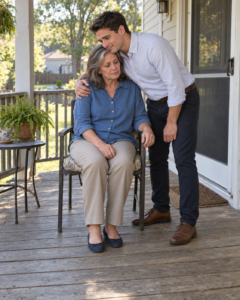
Then, 4 weeks before the grand opening, my son Marcus asked me to sit down with him on the back porch. He wouldn’t look at me at first. He kept turning his phone over and over in his hands like it might tell him what to say.
“Mom, there’s something we need to talk about.”
I knew before he said another word that it wasn’t going to be good news.
Marcus’s fiance, Vanessa, came from money. Her father owned three car dealerships across two counties, and her mother sat on the board of some charity gayla committee that got written up in the local paper every spring.
I’d met them at Thanksgiving the year before. They’d shaken my hand, complimented my sweet potato pie, and never once asked me a single question about myself.
Marcus took a breath.
“Vanessa’s parents are putting up the rest of the money for the restaurant, the part we still needed.”
“That’s wonderful,” I said, and I meant it.
“There’s a condition.”
He finally looked at me.
“They want it to be a family business. They’re family on paper, on the sign, in the press release. They don’t want your name attached to it at all. They think it’ll look better if it seems like their money built this from scratch.”
For a moment, I genuinely thought I’d misunderstood him.
“I’m sorry. What does that mean exactly?”
“It means…” He rubbed the back of his neck. “It means I need you to sign over your share of the loan. Let them buy you out. And, Mom, they also think it would be easier if you weren’t at the opening—just for the launch event. The cameras, the reporters, they wanted to look a certain way.”
There it was. After three decades of being the one who showed up, my own son was asking me to disappear so his future in-laws could take credit for what I’d helped build.
I looked down at his hands. The same hands I’d taught to tie his shoes. The same hands that had gripped mine so tight in the emergency room the night he broke his arm falling off his bike. The same hands I’d watched sign his very first lease with me standing right behind him.
And now those hands were asking me to step aside so I wouldn’t embarrass anyone.
“I understand,” I said quietly.
His shoulders dropped with relief.
“Really? You’re not upset?”
I said, “I understand. That’s different from being fine with it.”
He didn’t seem to hear the distinction.
“Thank you, Mom. I knew you’d get it. This is such a big deal for us. Vanessa’s parents just want everything to look professional.”
I almost laughed, not because anything was funny, but because I finally understood what professional meant in that sentence. It meant polished. It meant the kind of mother who wore blazers and sat on charity boards. Not the kind who’d worked double shifts at the hospital cafeteria for 11 years to keep a roof over her son’s head.
Marcus stood up to hug me. I let him, but I didn’t hug him back the way I normally would have.
“I’ve got some things to finish up,” I told him.
He lingered by the door.
“You sure you’re okay?”
“I’ll be fine.”
He left, and I sat alone on that porch until the sun went down completely. Then I made myself a cup of tea and made a decision.
I wasn’t going to cry in front of him. I wasn’t going to beg for a seat at his opening night, and I certainly wasn’t going to keep pouring money into a restaurant that didn’t want my name anywhere near it.
18 months earlier, Marcus and I had co-signed a business loan together. And beyond the loan, I’d—
Phân cảnh 2: Choosing herself
—personally put in $40,000 of my own savings, money I’d set aside from selling the little rental property my late husband, Robert, had left me. Money that was supposed to be my cushion for retirement.
I told myself it was an investment in my son’s future. But an investment still requires being wanted, and Marcus had just made it clear I wasn’t.
I opened my laptop and found the paperwork. As a named investor with equal signing authority on the business account, I had every legal right to withdraw my capital contribution before the restaurant officially opened its doors.
It took me most of the evening, reading through the agreement twice to be sure. But by midnight, I had transferred every dollar of my 40,000 back into my own account and removed my name as a co-signer on the equipment lease, which was still within the cancellation window.
I closed the laptop and sat in the quiet kitchen for a long time. I expected to feel guilty. Instead, I felt lighter than I had in months.
The next morning, I pulled my old suitcase down from the closet shelf and packed it slowly, deliberately. Comfortable walking shoes, my reading glasses, three paperback mysteries I’d been meaning to get to, and the wide-brimmed hat my sister had given me for my 60th birthday that I never had an occasion to wear.
I had spent so many years arranging my life around everyone else’s emergencies. It was time I took a trip without asking a single person’s permission first.
By noon, my phone showed a text from Marcus.
“Mom, the equipment company called saying our lease got cancelled. Do you know anything about that?”
I looked at the screen for a long moment before I answered.
“Nothing is wrong. I withdrew my investment and my name from the lease. I won’t be attending the launch since Vanessa’s family prefers it that way, and it didn’t feel right to keep funding something I’m not welcome to be part of. I hope it goes well.”
Then I turned my phone off completely and called a cab to the airport. I didn’t know what waited on the other side of that decision, but for the first time in years, I wasn’t afraid to find out.
By the time I landed in Charleston, Marcus had called nine times. I let everyone go—
Phân cảnh 3: The fallout begins
—to voicemail.
I’d booked a small bed and breakfast near the water, the kind of place with a wraparound porch and rocking chairs and no televisions in the rooms. It wasn’t fancy, but it was quiet, and quiet was exactly what my nerves needed.
For the first two days, I walked along the harbor in the mornings, ate shrimp and grits at a little cafe that didn’t care what my son thought of me, and read until the humidity chased me indoors every afternoon. I tried not to think about Marcus. I mostly failed.
On the third morning, I finally turned my phone back on. The notifications came flooding in all at once: 11 missed calls, four voicemails, and a string of texts that got progressively more frantic.
I sat on the porch with my coffee and listened to the first voicemail.
“Mom, call me back. The equipment company won’t reinstall the walk-in freezer without a new lease, and the bank froze the dispersement because your name got pulled off. What did you do?”
The second voicemail had an edge to it I rarely heard from him.
“You can’t just disappear 4 weeks before opening night. Vanessa’s parents are asking questions.”
The third one wasn’t really a voicemail at all, just heavy breathing. And then:
“Please, Mom, please call me back.”
I typed one message back.
“I told you I wouldn’t stand in the way of the restaurant. I also decided I wasn’t going to keep financing something I was asked to hide from. My investment has been returned to my own account. You and Vanessa’s family will need to work out the rest.”
I sent it and set the phone face down on the table. I expected another explosion. Instead, my daughter—
Phân cảnh 4: The failed opening
—Priya called.
Unlike her brother, Priya had never asked me for a dime in her life. Not because she didn’t need help sometimes, but because she’d always found her own way.
“Mom, where in the world are you?”
“Charleston.”
“Are you safe?”
I smiled at the water.
“Yes, sweetheart. I’m fine.”
She exhaled hard.
“Marcus is losing his mind. Apparently, Vanessa’s parents are refusing to put in another scent until the original financing gets sorted, and the restaurant can’t open without that freezer.”
“That sounds like something he and Vanessa need to work through.”
Priya was quiet for a second.
“For what it’s worth, I don’t blame you at all.”
“Thank you, honey.”
“I just hate that it had to get to this.”
“So do I.”
After we hung up, I sat with my coffee going cold and realized something that felt like it had been waiting years to surface. I wasn’t obligated to absorb every consequence of decisions I hadn’t been part of making.
Three and a half weeks passed quickly after that. Then came the night of the grand opening, the one Marcus and Vanessa had spent nearly a year planning down to the napkin folds.
While he was greeting a room full of Vanessa’s family’s friends and the local news crew they’d invited to cover it, I was sitting on a bench along the Charleston waterfront with a paper cup of shear soup, watching the boats come in for the evening.
The sky was doing that pink and orange thing it does right before dark. And for a moment, I let myself simply enjoy it without guilt.
Then my phone rang. Priya.
“Mom.”
Her voice had a strange, careful quality to it.
“What’s happened?”
“The opening. It fell apart.”
I set the soup down.
“What do you mean, fell apart?”
She explained, piece by piece, what Marcus had told her an hour earlier in a panic. The walk-in freezer, the one whose lease I’d pulled, had never actually gotten reinstalled in time because Vanessa’s father had refused to sign off on new terms until he’d reviewed everything personally, which meant it sat empty through the entire event.
Half the menu couldn’t be served. Vanessa’s mother, mortified in front of the news crew, had said something cutting to Marcus in the kitchen doorway that several guests overheard. Marcus, humiliated and exhausted, snapped back at her.
Vanessa’s father called the whole thing an embarrassment to his family’s name and pulled every remaining dollar of promised funding on the spot, in front of the reporter. Vanessa, caught in the middle, had gone home with her parents rather than stay with Marcus.
“She left with them?” I asked.
“Yes.”
I closed my eyes and let the ocean air settle around me. I felt for my son, genuinely, but I didn’t feel the old pull to fix it.
“Is he okay?”
“He’s a mess. He keeps asking where you are.”
“I’m not flying home tonight, Priya.”
“I figured.”
A few minutes after we hung up, my phone rang again. This time it was Marcus. I stared at his name for a long moment before answering.
“Mom.”
His voice cracked on the single word. I said nothing.
“Everything’s ruined. Vanessa’s family pulled out. The vendors are demanding payment for tonight, and I don’t have it. The freezer company is threatening to sue over the broken lease agreement. I need almost $32,000 by the end of the month, or they’re taking the equipment and coming after me for the difference.”
I waited.
“Mom, you have the money. You need to send it to me.”
I nearly dropped the phone.
“You’re asking me to bail out the exact opening you asked me to disappear—
Phân cảnh 5: Defining new boundaries
—from.”
“That’s not what I meant.”
“You told me Vanessa’s parents didn’t want my name near this business. You told me it would look better if I wasn’t there at all.”
“I was under pressure, Mom. They were pressuring me.”
“And now you’re under pressure again, and I’m the solution.”
“Please, Mom. I don’t know what else to do.”
I looked out at the dark water.
“I’m not paying those bills, Marcus.”
The line went quiet.
“What?”
“You and Vanessa’s family signed those contracts, not me. You need to deal with them.”
“But I’m broke. I put everything into this place.”
“That isn’t my responsibility to fix.”
“I quit my job at the distribution center 8 months ago because this restaurant was supposed to be it. This was supposed to be my whole future.”
I closed my eyes, and then he said the thing I somehow already knew was coming.
“I’m going to need to stay with you for a while. I can’t afford my apartment once this loan default hits my credit.”
Silence stretched between us.
“Mom, I’ve still got a key.”
“Not for long, you don’t.”
I ended the call and sat there with the phone in my lap for a long time. Marcus had just casually mentioned letting himself into my house as though nothing between us had shifted at all, as though I hadn’t just spent the last month learning what it felt like to matter to myself.
That night, I made one more phone call, this time to a locksmith back home. Because if my son had decided I wasn’t polished enough to stand in the room when his restaurant opened, he was about to learn that my home wasn’t a fallback plan either.
I barely slept that night, not out of fear of Marcus, but because I understood exactly what kind of trouble followed him when he felt cornered. For years, my house had—
Phân cảnh 6: Securing her home
—functioned as his emergency exit.
Every time a job fell through, every time a relationship went sideways, every time his spending outpaced his income, he knew my door would open without question.
I had told myself for years that this was simply what love looked like. But love without any boundary at all had slowly turned me into something closer to a resource than a mother.
I called Denny, a locksmith I’d used years ago when I first moved into the house alone after Robert passed.
“Denny, I need every exterior lock on my property changed. Today, if you can manage it.”
“Everything all right, Miss Gloria?”
“It will be. Front door, back door, the door off the carport, all of it.”
He said he could be there by early afternoon. Then I called Priya.
“Honey, I need you to let Denny in and be there when he changes the locks.”
She didn’t ask a single unnecessary question.
“Is Marcus trying to come back?”
“He mentioned it.”
“He doesn’t live there anymore, Mom.”
“I know that. I need him to know it, too.”
A few hours later, a photo came through from Priya. A brand new set of keys sitting on my kitchen counter, catching the afternoon light.
I stared at that picture longer than I probably needed to. Those small pieces of brass weren’t really about locks at all. They were about a line I had finally decided to draw and hold.
That evening, I ordered a proper dinner from a restaurant on the water, shrimp over grits with a side of collards, and let myself actually taste it instead of eating out of habit.
I thought about all the years I had spent managing everyone’s crisis but my own. My children, my late husband’s family, my neighbors, my church committee—everyone but Gloria.
I understood, sitting there with my fork halfway to my mouth, that piece was never going to be handed to me by somebody else’s good behavior. I was going to have to build it myself, brick by brick, lock by lock.
The next afternoon, I flew home. Priya picked me up from the airport, and neither of us said much on the drive.
Phân cảnh 7: The confrontation
When we turned onto my street, I saw Marcus’s truck parked crooked against the curb, the tailgate down, three duffel bags and a cardboard box of kitchen supplies sitting scattered across my front lawn.
Marcus sat on the porch steps with his elbows on his knees, staring at nothing. His chef’s jacket, the one he’d had monogrammed for opening night, was wrinkled and stained.
He looked up the moment my car door opened.
“Finally.”
He stood.
“I’ve been out here for 2 hours. My key doesn’t work.”
“I changed the locks.”
His mouth actually fell open.
“You changed the locks on me?”
“I told you not to come here expecting to move in.”
“I’m your son. And this used to be my home, too.”
“It’s my home, Marcus. It always has been.”
He threw his hands up.
“I just lost everything I built. My fiance left with her parents. And you’re treating me like some stranger off the street.”
“I didn’t create this situation.”
“You’re my mother. You’re supposed to help me.”
“I did help you. For 31 years, I helped you.”
His face twisted.
“You pulled the investment. You started this whole collapse.”
“I took back money I put into a business I was told to hide from. That’s not the same thing. And you know it.”
“You know what I meant.”
“No, I know exactly what you said to me on that porch a month ago.”
Priya stood near the car, arms crossed, watching quietly. Marcus turned toward her.
“Are you seriously not going to back me up here?”
She shook her head.
“I’m not on anyone’s side, Marcus. I’m just telling you the truth. You did this to yourself and to her.”
His anger seemed to drain out of him all at once, replaced by something closer to desperation.
“Mom, please. I don’t have anywhere else to go.”
“You’ll find somewhere.”
“I can’t afford a motel for more than a couple of nights.”
“I can’t solve that for you.”
He wiped a hand down his face.
“The equipment company’s lawyer already called me twice today. They’re threatening to sue for the full balance.”
“Then you’ll need to talk to them.”
“I need money, Mom. You have savings. You could take a loan against the house.”
“I won’t be doing that.”
He kept going like he hadn’t heard me at all.
“You’re 61. You don’t need all that equity just sitting there doing nothing.”
Something in me went very still and very quiet. He wasn’t asking because he loved me. He wasn’t apologizing for any of it. He wanted my house because he had already run through every other option he had.
I walked past him toward the porch steps.
“Listen to me carefully, Marcus.”
He followed me with his eyes.
“I will not take a loan against this house. I will not touch my retirement accounts, and I will not spend the rest of my life protecting you from consequences that belong entirely to you.”
His eyes filled, but I kept going before he could—
Phân cảnh 8: Learning hard lessons
—interrupt.
“There’s something else you should know. Priya and I set up a protective family trust for this property eight months ago, after the loan papers for the restaurant first got signed. This house cannot be used as collateral for anyone’s debts, including yours.”
He went pale.
“You did this without even telling me.”
“I didn’t need your permission to protect what’s mine.”
He stared at the new deadbolt gleaming on the door, then back at me, and for the first time, I think he really saw the woman standing in front of him instead of the mother who had always eventually said yes.
Marcus sat back down on the steps like his legs had simply stopped working.
“A trust,” he repeated. “You actually did that.”
“I did.”
His eyes cut toward Priya.
“You knew about this?”
She nodded.
“I helped set it up.”
“Unbelievable. Both of you.”
“No,” Priya said evenly. “We’re just done acting like Mom’s house is a backup plan for your bad decisions.”
Marcus dropped his head into his hands. After a long minute, he looked up.
“So, what am I supposed to do?”
“Find a solution,” I said. “The same way I’ve had to.”
He laughed, short and bitter.
“Easy for you to say.”
“It wasn’t easy for me to learn either.”
He sat there a while longer before pulling out his phone and starting to make calls, one after another. I stood by quietly and didn’t interfere.
A call to the equipment company, a call to a friend from culinary school, a call to somebody I didn’t recognize. Every single one ended the same way, with no one able to conjure $32,000 out of thin air.
Eventually, he set the phone down, all the fight gone out of him.
“Vanessa hasn’t texted me back once,” he said quietly.
I didn’t respond.
“She said her family would take care of everything. I actually believe that.”
“I know.”
He lowered his head.
“I thought this restaurant, this whole life with her family behind it, was going to be everything I’d worked toward.”
I almost told him he never needed someone else’s money to build a life worth having. But I stopped myself. He wasn’t ready to hear it yet. Some lessons simply can’t be handed down from a parent. They have to be lived through first.
“Mom,” he said finally, barely above a whisper. “Do you hate me?”
The question caught me off guard more than anything else he’d said all day.
“No.”
“Then why won’t you help me?”
“Because helping you doesn’t always mean handing you money.”
He wiped his face with the back of his hand.
“You’ve always helped me before.”
“Yes, and this time I won’t. Not the way you’re asking.”
He glanced toward the front door.
“Can I at least stay tonight? Just tonight?”
I shook my head.
“Please, Mom.”
“No.”
The word cost me something to say, but I knew if I bent now, nothing would actually change.
Eventually, Marcus gathered his bags. Priya helped him load them back into his truck without a word. Before he climbed in, he turned back toward me.
“I hope you’re happy with this.”
“I am,” I said.
And I meant it more than I expected to. He looked surprised, almost hurt by how steady my voice was.
Then he drove off, and I watched his tail lights disappear around the corner before I let myself sit down on the porch steps and cry. Not because I regretted a single decision I’d made, but because I wished none of it had needed to happen this way.
The following week stayed strangely quiet. Then Vanessa’s father showed up at my door. He arrived in a suit that—
Phân cảnh 9: Rejecting external pressure
—probably cost more than my first car, radiating the particular confidence of a man who had never once been told no and meant it.
I opened the door but left the chain latched.
“Where’s Marcus?” he asked, like I owed him an itinerary.
“He doesn’t live here.”
“I need to discuss the financial fallout from the launch.”
I almost smiled at the phrasing.
“There is no launch anymore, as far as I understand.”
His jaw tightened.
“Your son is responsible for half the losses from that event.”
“Then I’d suggest discussing that with him directly.”
“Your family contributed capital to this business.”
“I contributed capital. I never signed a single contract with the equipment company or the venue. That’s between you, your daughter, and my son.”
He stepped closer. Close enough that the chain rattled slightly.
“We’re trying to protect the reputation of two families here.”
“Your daughter left him standing in a restaurant with no freezer and reporters in the room. That’s not a reputation problem I created.”
His face reened.
“That’s not your concern.”
“You made it my concern the moment you drove over here expecting me to solve it.”
He glanced past me into the house like he might spot something worth mentioning.
“You clearly have resources. That car in your driveway. This house.”
I looked at him steadily.
“Sell your boat, then, if money’s the concern. I hear those aren’t cheap either.”
He looked genuinely stunned that I’d spoken to him that way.
“I can’t believe this is how you’re choosing to handle a family crisis.”
“I can’t believe you drove here asking a woman you’ve met exactly twice for money.”
He muttered something under his breath I chose not to catch and walked back to his car. I shut the door and stood there a moment, steadying my breathing.
That evening, the messages started arriving from extended family: an aunt of Robert’s, a cousin from church, an old neighbor who apparently still had my number.
Word travels fast in a small community, and everyone seemed to have heard some version of events where I was the villain who’d abandoned my son during his darkest hour.
One message read, “Family is supposed to show up for each other, Gloria, no matter what.”
I read it twice, then deleted it without responding. I had spent too many years trying to explain myself to people who had already made up their minds.
I muted the group chat entirely and sat on my back porch with a glass of sweet tea instead. The quiet felt like something I’d earned.
No more emergency calls, no more contracts I hadn’t signed. No more relatives asking me to sacrifice something on someone else’s behalf. Just cicas, the smell of my gardinia bush, and the sound of the wind moving through the pines.
For years, I had confused being needed with being loved. Sitting there that evening, I finally understood the difference clearly.
Being needed had worn me down to nothing. Being respected, even by just myself, gave me something closer to peace.
Weeks passed.
Phân cảnh 10: Building a new life
Priya mentioned that Marcus had found a temporary room to rent above a hardware store downtown and picked up work managing the kitchen at a diner near the highway, a long way down from owning his own restaurant.
I didn’t ask for details, and I didn’t chase them. I was too busy rebuilding my own life.
I signed up for a watercolor class at the community center. I started walking the Greenway Trail every morning before the heat set in. I even booked a second trip, this time to the mountains, just for myself.
My days were becoming mine again, no longer shaped entirely around whatever crisis Marcus happened to be living through.
Then one ordinary afternoon, while I was deadheading roses in the front bed, my phone buzzed in my back pocket. A text from Marcus. I stood up, wiped my hands on my apron, and read it.
Just one line.
“Mom, I know you’re still upset with me, but I really need you right now.”
I read it twice. For the first time, I didn’t feel the old pull of obligation tighten in my chest.
I simply slid the phone back into my pocket and went back to my roses. I wasn’t ready to answer, and for once, I didn’t feel guilty about that either.
Nearly 4 months passed after the restaurant collapsed. The neighborhood, as neighborhoods do, eventually moved on to gossip about something else entirely. A scandal at the elementary school involving the PTA treasurer, if I remember right.
What had felt like the center of the universe for weeks slowly faded into old news for everyone except the people who’d actually lived through it.
Marcus’ circumstances had shifted, too. According to Priya, he’d sold his truck to cover part of the equipment settlement and moved into a smaller apartment above that same hardware store.
I never asked how much he was making at the diner. I never asked whether Vanessa had reached out again. Those details didn’t belong to me anymore, and I found I could genuinely live without knowing them.
My own life, meanwhile, had grown quietly full. I’d planted a new row of hydrangeas along the walkway. I’d finally repainted the guest bathroom a color I actually liked instead of the beige Robert had picked out decades ago.
On Sunday evenings, Priya came over for dinner, and sometimes we talked for hours, and sometimes we simply ate in comfortable silence.
One afternoon, while I was watering the hydrangeas, my phone buzzed again. Marcus. His message was short.
“Mom, things have been really hard. I know you’re still angry, but I need you. Can we talk sometime? I missed the house.”
I read it once, then again. The old version of me would have felt her chest cave in with guilt reading those words. This version of me noticed something else entirely.
Not, “I miss you.” Not, “I’m sorry.” Not, “I wish I’d treated you differently.”
He missed the house, the place where he’d always been shielded from the weight of his own choices.
I turned the phone over in my palm. Years earlier, a message like that would have had me in my car within the hour, offering him a spare room and whatever cash I had on hand.
But I had learned something important in these last few months. Answering every single call for help sometimes only teaches a person that calling works.
I slipped the phone back into my apron pocket and finished watering the flowers.
That night, Priya came for dinner, and we ate roasted chicken and green beans at the kitchen table. Halfway through the meal, she set her fork down.
“Did Marcus text you?”
I looked up.
“How did you know that?”
“He called me first. He wants to come back home, Mom.”
I set my own fork down slowly.
“This will always be his home in one sense,” I said. “But it isn’t his residence anymore.”
She nodded.
“He says he’s different now.”
“Maybe he is.”
“You don’t sound convinced.”
“I hope he has changed.”
“But you’re still not letting him move back in.”
“No,” I said simply.
She didn’t push back. After dinner, we washed the dishes side by side, and I realized that holding a boundary didn’t require me to hate my own son.
I could love Marcus completely and still refuse to let him run my life the way he once had. That understanding had taken me most of my 61 years to reach.
About a—
Phân cảnh 11: A path toward reconciliation
—week later, another message arrived, longer this time.
Marcus apologized for asking me to disappear from his own launch night. He apologized for prioritizing Vanessa’s family’s comfort over my presence. He admitted he’d cared far too much about how things looked to people who never really cared about him at all.
He said he’d made choice after choice he wasn’t proud of. I read every word twice.
For the first time, something in the message felt different. No request for money, no mention of the house, no pressure, only what looked like genuine regret.
I still didn’t answer right away. An apology, I’d learned, could be entirely sincere and still be an attempt to walk back through an old familiar door.
I needed time to figure out whether my son wanted his mother back or simply wanted his old safety net restored under a different name.
A few days after that, an unfamiliar number called my cell phone. It was Marcus calling from a coworker’s phone because his own had been shut off.
I answered. Neither of us spoke for several seconds. Finally, he said:
“Mom?”
“Yes?”
“I don’t really know what to say to you.”
“Then don’t force it.”
He started crying quietly.
“I was terrible to you. I really was.”
I closed my eyes.
“Yes,” I said gently. “You were.”
He seemed almost startled that I didn’t argue the point or soften it.
“I thought if I became part of Vanessa’s world, everything in my life would finally click into place. I think I was ashamed of where I actually came from, Mom. Of you working double shifts, of the trailer we lived in when I was a kid before you and Dad bought this house.”
That landed harder than I expected.
“I know.”
Neither of us said anything for a moment. Then he asked:
“Can I see you?”
I considered it carefully.
“Yes.”
His breath caught audibly.
“But we meet somewhere neutral,” I added. “And we are not discussing money.”
“Okay.”
“And you are not moving back into this house.”
Another pause.
“Okay.”
For the first time in months, I heard something in his voice that sounded like acceptance instead of desperation.
We agreed to meet the following Saturday at a diner downtown. Not the one he worked at, a different one.
When I hung up, I didn’t feel triumphant exactly. I felt cautious. The way you feel testing ice you’re not entirely sure will hold your weight.
The door I’d closed wasn’t swinging wide open again. But maybe it didn’t need to. Maybe forgiving him didn’t mean handing him a key.
I looked around my quiet, sunlit kitchen. The new locks were still exactly where Denny had installed them months earlier. And this time, I understood exactly why they mattered.
They weren’t there to punish Marcus. They were there to remind me, every single time I turned that key, that my life belonged to me and no one else.
Phân cảnh 12: The new dynamic
That Saturday, I arrived at the diner 10 minutes early and took a booth by the window, ordering coffee while I waited.
When Marcus walked in, I almost didn’t recognize him at first. No expensive watch, no styled hair, none of the polish he’d worn like armor for the past year.
He looked tired in a way that had nothing to do with a bad night’s sleep. He also looked somehow more like the son I remembered from before any of this began.
He slid into the booth across from me.
“Hey, Mom.”
“Hello, Marcus.”
For a few seconds, neither of us said a word. Then he spoke.
“Thank you for coming.”
“You’re welcome.”
He wrapped both hands around his coffee mug.
“I’ve had a lot of time to think about everything.”
“So have I.”
“I was wrong about all of it.”
I nodded slowly.
“You were.”
He gave a small, tired smile.
“I know I deserve to hear that plainly.”
“I’m not saying it to hurt you.”
“I know that now.”
He took a breath.
“I treated you like you were something to hide. I let Vanessa’s family convince me you weren’t good enough to be seen next to, and I forgot, somewhere along the way, who actually showed up for me my whole life.”
I looked out the window at the parking lot.
“I never forgot,” I said quietly.
He lowered his eyes.
“I know you didn’t.”
We sat there a moment in silence. Then he said something I hadn’t expected at all.
“I don’t want your money.”
I looked back at him.
“I don’t want the house. I don’t want you to fix any of this for me. I don’t even want you to make it easier.”
I stayed quiet, waiting.
“I just want my mother back. That’s all I actually want.”
Those words reached somewhere deep and tender inside me. But I’d learned by now not to confuse a feeling with proof.
“Then we start slow,” I said.
He nodded.
“I understand.”
“You’re going to have to rebuild trust with me, Marcus. That doesn’t happen in one lunch.”
“I know.”
“I don’t expect things to go back to how they were before.”
He hesitated.
“Because of the locks?”
“Because of everything,” I said. “The locks are just a small part of it.”
He looked down at the table.
“That’s fair.”
I reached across and covered his hand with mine.
“I love you. That never stopped. Not for one single day.”
Tears filled his eyes.
“But loving you,” I continued, “doesn’t mean I destroy myself to make your life easier. Not anymore.”
“I understand that now. I really do.”
“And if you ever need advice, real advice, you can always ask me for that.”
He nodded, wiping his eyes with his sleeve.
“But if you make a mistake,” I added, “you’re the one who has to stand there and face it. Not me.”
“I will. I promise you that.”
We stayed in that booth for almost 2 hours, talking about smaller, ordinary things after that. His new job at the diner, my watercolor class, Priya’s upcoming promotion, nothing dramatic at all.
And somehow that plain, unremarkable conversation meant more to me than every dramatic phone call from the past 4 months combined.
When we finally stood to leave, Marcus hugged me, and this time I hugged him back fully, without holding anything in reserve.
But when he asked, almost shily, whether he could come by the house sometime just to visit, I smiled at him.
“Of course you can.”
He looked genuinely relieved.
“Thank you, Mom.”
“Just call first.”
He laughed softly, the first real laugh I’d heard from him in months.
“I will. I promise.”
We walked out to the parking lot together into bright afternoon sunlight. And for the first time in what felt like a very long time, I didn’t feel like I was carrying the entire weight of my son’s choices on my own shoulders.
I had spent decades believing a good mother was one who was endlessly, unconditionally available for whatever came next. I finally understood that boundaries were never a punishment. They were protection, both for him and, just as importantly, for me.
I could forgive Marcus without handing him control over my finances. I could love him fully without surrendering my home. I could listen to his troubles without automatically becoming the one who fixed them.
And most of all, I could finally live my life without feeling guilty for choosing myself for once.
That evening, back home, I stood on my porch and looked at the new lock on my front door, glinting faintly in the porch light. Just a simple piece of hardware, but to me, it represented something far larger.
It reminded me that this house was mine, that my savings belong to my own future, and that my choices were, at last, entirely my own to make.
I went inside, watered my ferns, and opened the kitchen window to let the cool evening air move through the house. For the first time in years, I felt completely at home in my own life.
I hadn’t abandoned my son. I had simply stopped abandoning myself in order to keep rescuing him.
People sometimes misunderstand boundaries. They call them cold. They call them unforgiving. They tell you that real family forgives everything and sacrifices everything, no matter the cost to yourself.
But forgiveness was never supposed to require surrender. Love was never supposed to mean allowing someone to keep hurting you simply because you share blood.
And family was never meant to be an endless, bottomless well of money, shelter, and rescue that never runs dry, no matter how much gets drawn from it.
Everyone deserves the chance to face what their own choices actually cost. Marcus had made his. I had finally made mine, too.
He had once asked me to step out of his life so it would look better to people who never truly wanted me there in the first place. I hadn’t fought him on it. I had simply let him have exactly what he’d asked for.
And when he pushed me out of that one part of his life, I finally understood I no longer had to carry the weight of every other part along with it.
I closed my front door that night and turned the deadbolt. The click sounded exactly the way it had the day Denny installed it months before.
But this time, I didn’t hear rejection in that small metallic sound. I heard something closer to freedom.
And I smiled because that door was never locked against my son. It was locked around the life I had finally, after 61 years, learned how to protect.