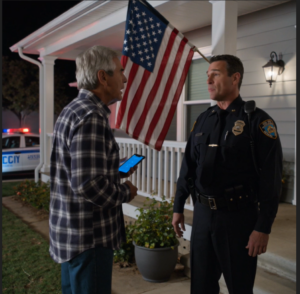
My Wife Called 33 Times. When I Got Home, Police Cars Had Surrounded Our House—And What Happened…
Phân cảnh 1: The unexpected call
At 4:01 a.m., my phone lit up with 33 missed calls from my wife. The last thing she sent was just four words.
“Don’t come home tonight.”
I called back again and again, but no one answered.
When I finally reached my street, police cars surrounded my house. An officer looked at me and quietly said, “Sir, you have no idea what your wife just did.”
I thought she was the victim of a home invasion. I had no idea that before sunrise, my entire family would become the center of a nightmare I never saw coming.
Thank you for being here. It means more than you know. Before this story goes any further, where in the world are you watching from? Leave your city or country below. You’d be surprised how many people sitting exactly where you are have felt exactly what this story is about.
This is Revenge Dad. Some elements in this story are fictional, included for storytelling and educational value. Any resemblance to actual names or places is coincidental. The message, however, is real.
33 missed calls. That’s what I find when I open my eyes at 4:01 in the morning in a hotel room in Westchester, New York.
Phân cảnh 2: Racing home
I don’t move at first. I lie there on a mattress that smells like industrial detergent and stare at the ceiling while the number on my screen burns itself into the back of my eyes.
-
All from the same number. All from Maggie. The time stamps run from 2:17 in the morning to 3:54, and then they stop. 33 attempts in 1 hour and 37 minutes.
And then nothing.
I sit up. My chest is doing something it hasn’t done in years. A tight pulling sensation. Like a cable under too much load. Like a joint that’s been stressed past its rated capacity.
I have been in construction for 40 years. I know exactly what a structure sounds like when it’s about to give.
I scroll up past the missed calls. There is one text message, sent at 1:47 in the morning. Four words.
“Don’t come home tonight.”
No explanation, no followup. Just those four words sitting on my screen like a door that someone has closed and locked from the inside.
I call her back. It rings three times and goes to voicemail. Her voice on the recording is calm, the voice she recorded on a Sunday afternoon years ago when she had no idea her husband would someday hear it at 4:01 in the morning with his hands starting to shake.
“You’ve reached Maggie Callaway. Please leave a message.”
I call again. Voicemail. A third time. Voicemail.
I press the phone against my ear after the beep and I say, “Maggie, call me back right now, please.”
My voice comes out steadier than I feel, which is something I have learned over 65 years: that the voice is the last thing to go.
I call my son Ryan next. The line doesn’t even ring. Go straight to a recording telling me the phone is unavailable.
I call my daughter Diana. Four rings, then voicemail. Her voice professional and practiced even on a recording, the voice she has used since she passed the bar exam and decided she was someone who needed to sound a certain way.
Three phones, zero answers.
I am out of bed before I make a conscious decision to get up. That’s how the body works when the brain stops cooperating. It takes over, runs on whatever backup system kicks in when the primary one shuts down from overload.
I pull on the same jeans I wore yesterday on the job site. The same flannel shirt. My boots are by the door, and my hands are shaking enough that the first eyelet gives me trouble.
And I stop and press both palms flat against my thighs and breathe the way I used to breathe before difficult pores, before negotiations with men who wanted to bury me. In. Hold. Out.
My name is Frank Callaway. I am 65 years old. I have run Callaway Construction Group out of Queens, New York, for four decades.
I have poured foundations in January ice and negotiated contracts with men twice my size, who had twice my money and half my patience. I built the first thing with borrowed equipment and a crew of four guys who weren’t sure I was going to make payroll.
I have not been afraid of much in 65 years. I am afraid right now.
I grabbed my keys off the nightstand. The contract on the desk, the last one before retirement, a commercial renovation in White Plains that I came up to Westchester to finalize—I don’t look at it. It can wait. Everything can wait.
The hotel parking lot is empty at 4:09 in the morning. My truck is the only thing moving when I back out. The I678 South is dark and nearly clear at this hour.
Just a few long haul rigs, running lights in the distance. And I merge onto the highway and point the truck toward Queens. And I do not turn on the radio.
I do not turn on the radio because I need to think, and I need to hear myself think. And I need the particular silence of a man alone in a truck at 4 in the morning when the thing he has built his whole life around—the home, the family, the 40 years of showing up—might be broken in some way he doesn’t understand yet.
I call Maggie four more times on I678. Each call goes to voicemail. Each time I hear her recorded voice, I feel the cable in my chest pull a little tighter.
I try Ryan again. Still unavailable. Diana again. Four rings, voicemail. Her professional voice telling me she isn’t available.
“Diana,” I say after the beep, and my voice is not steady this time. “Pick up the phone. Something is wrong with your mother. Pick up.”
She doesn’t pick up.
I have driven this road a thousand times. Westchester to Queens. The job sites change, the contracts change, but the highway stays the same. The lights of the Bronx off to the left. The bridges, the burrow rising up ahead of you in the dark.
Tonight, the 35 mi feel like something I am measuring in heartbeats instead of miles. And my heart is not beating at a construction foreman’s pace. It is beating at the pace of a man who knows something is wrong and cannot make the truck go any faster than the speed limit allows.
At 4:39, I cross into Queens.
Phân cảnh 3: The crime scene
At 4:44, I turn onto our street, and I stop the truck in the middle of Maple Street because there are too many lights on my block for 4:4 in the morning. Blue and red lights cycling, painting the fronts of the houses in alternating color.
Four police cars parked at angles. An ambulance in the driveway. Crime scene tape. The yellow kind. The kind you see on the news, stretched across the porch I built two summers ago with my own hands.
The porch where Maggie drinks her coffee on Saturday mornings. Yellow tape across my porch.
I sit in the truck for 3 seconds that feel like 3 hours. Then I put it in park, open the door, and step out onto the street where I have lived for 22 years.
And my legs are doing the work of walking without any input from me whatsoever, carrying me toward the house, toward the lights, toward whatever has happened in the hours I spent sleeping in a hotel room in Westchester, while my phone sat in my jacket pocket and rang 33 times and went unanswered.
I count four police cars before I stopped counting. They are parked at angles the way patrol cars park when the situation is already contained. Not the frantic diagonal of an active scene, but the settled, deliberate positioning of vehicles that arrived hours ago and have been here long enough to belong.
Blue and red light cycles across the fronts of every house on Maple Street, turning my neighbors’ windows into something out of a fever dream.
A small crowd has gathered on the sidewalk across the street. Seven, maybe eight people in coats pulled over pajamas. The particular posture of people who have been woken by something they couldn’t sleep through and came outside because standing in the cold felt better than lying in bed wondering.
Carol Marchetti is on her porch. She has lived three houses down from us for 20 years. She is standing with both arms crossed over her chest, and she is looking at our house with an expression I cannot read from here.
Something between grief and relief, something complicated that I do not have the language for at 4:44 in the morning. I will not understand that expression until much later.
I leave my truck in the middle of the street. I don’t park it. I just stop it and get out because the part of my brain that handles things like parking has gone offline completely.
And the part that remains is focused on a single point: the front door of the house I have lived in for 22 years. Behind the yellow tape, behind the police cars, behind whatever happened here tonight while I was sleeping 40 minutes north.
“Sir.”
A uniformed officer steps into my path. Young, maybe 28, 29, with the careful posture of someone who has been standing outside in the October cold for hours and is running on coffee and adrenaline and the particular alertness that crime scenes produce in young officers who haven’t yet learned how to let it wash off them.
“Sir, you can’t go any further.”
“That’s my house.”
My voice comes out harder than I intend. Not angry, just strip down to the essential. The way your voice gets when you’ve been awake for an hour with your heart hammering and your hands won’t stop shaking.
The officer looks at me.
“Are you the homeowner?”
“I’m the homeowner. I’m the husband. Where is my wife? Where is Maggie?”
He turns his head slightly. A small, almost involuntary movement toward a female officer standing by the front door.
She is older, mid-40s, with the kind of steady eyes that come from working enough crime scenes to know that the person in front of her right now needs information more than he needs protocol.
They exchange something, not words, just a look. And then the young officer turns back to me and says quietly enough that he probably thinks I can’t hear, “He has no idea what she just did.”
Six words. I am 3 ft away from him. My ears are working perfectly.
And those six words hit me somewhere behind the sternum, in the same place the cable has been pulling tight since I first saw that number on my phone screen. And for a moment, my vision goes slightly wrong at the edges, the way it does when the body receives information the brain hasn’t processed yet.
He has no idea what she just did.
“What did she do?”
My voice cracks on the last word, just slightly, just enough for me to hear it.
“Is she hurt? Where is she? Is she—”
“Mr. Callaway.”
Phân cảnh 4: Reunion with Maggie
The female officer is beside me now, moving with the quiet efficiency of someone who has done this before. Her name tag reads Reyes.
“I’m Detective Sandra Reyes, Queen’s PD. Your wife is safe. She is inside. She is not injured.”
I feel my knees do something they have never done before. A brief, involuntary softening, like the moment before a structure settles. I lock them.
“Tell me what happened.”
“At approximately 2007 this morning, two men forced entry through your rear door. Your wife was in the house. She contacted us, and officers were already positioned on the perimeter. Both men are in custody.”
Reyes pauses, watching my face.
“Your wife is being interviewed by detectives right now. She is cooperative. She is not under arrest. She is being treated as the victim.”
I stare at her.
“Two men broke into my house.”
“Yes, sir.”
“While Maggie was inside.”
“Yes, sir.”
“And she called you.”
“She did. She handled the situation with considerable presence of mind, Mr. Callaway.”
Something moves across Reyes’s face. Not quite admiration, but something adjacent to it. The expression of a professional who has seen a lot and is making room for the fact that this particular situation surprised her.
“I’d like to take you inside now.”
She walks me through, past the crime scene tape. I have to duck under it. And the action feels surreal.
The yellow plastic against my hands. The fact that this is my porch, my front door. The welcome mat Maggie bought at a street fair in Atoria four summers ago that says “home” in block letters that are starting to wear off.
I step over the threshold. The kitchen stops me cold.
The back door, the one I installed myself in 2019—solid core, good hardware, the one I told Maggie would outlast both of us—has been forced. The frame is splintered from the crowbar they used. Wood fibers spled outward, the door itself hanging at a slight angle.
Evidence markers dot the kitchen floor in a trail that tells a story I am reading backward. Marker one near the broken door frame. Marker two on the kitchen tiles closer to the island. Marker three near the far wall, where a folding knife lies open inside a small plastic evidence bag.
A knife. One of them had a knife in my kitchen.
My chest tightens so severely I put one hand on the wall to steady myself. The kitchen where Maggie makes coffee every morning. Where she stands at the counter reading the news on her phone while the percolator runs, where we have eaten 22 years of ordinary dinners.
This room is a crime scene. There are numbered markers on the floor and a knife in an evidence bag and strangers moving through it with clipboards and latex gloves.
“Mr. Callaway.” Reyes touches my arm lightly. “Your wife is in the living room.”
I make myself move, and then I hear her. Before I see her, I hear her voice from the living room, low and even, answering a question from the detective interviewing her.
That voice, the voice that has been going to voicemail for the past hour and a half. The voice that told me, “Don’t come home tonight,” and then called me 33 times and then went quiet. That voice, steady and present and alive in my living room.
I come around the corner. Maggie is sitting on the couch with a blanket around her shoulders and a cup of tea on the cushion beside her that she clearly hasn’t touched.
She is wearing the gray cardigan she puts on when she’s cold, the one with the frayed left cuff she keeps meaning to repair. And her hair is loose around her face, and she looks—the word that comes to me is depleted.
Not broken, not frightened, just emptied out the way a person looks when they have spent every reserve they had and are now running on something below empty, something I don’t have a name for.
She sees me in the doorway, and her face breaks open like a fault line giving way.
“Oh, I—Frank.”
Her voice fractures on my name, just that one syllable, but it contains everything.
She is up off the couch before I reach her, the blanket falling to the floor, crossing the room with her arms already reaching, and she slams into my chest with a force that staggers me half a step.
Both arms locked around my ribs, her face pressed against my neck, and she is shaking. Her whole body shaking with the kind of tremors that come after adrenaline leaves, when the body finally gets the news that it’s over and doesn’t know what to do with that information.
“I’ve got you,” I say into her hair.
My own voice is gone now. Completely gone, scraped down to something raw.
“I’ve got you. I’m right here.”
“They came for you,” she says against my shirt, her voice muffled and trembling. “They came for you, and you weren’t here. And I couldn’t let them. Just—I couldn’t let them.”
“I know.”
I hold her tighter. My hands are gripping her the way you grip something you thought you might lose, something that turns out to still be there when you reach for it.
“I know. I’m here. I’m right here.”
She pulls back just enough to look at my face. Her eyes are red, the rims swollen, and there are tear tracks on both her cheeks that she hasn’t bothered to wipe away.
She reaches up and puts one hand against the side of my face, and her palm is cold, and she is still shaking, but her eyes are focused and clear.
“There was a man at our door last night,” she says. “He knew your name. He knew your schedule. He knew you wouldn’t be home.”
Her hand presses harder against my cheek like she is confirming I am solid, that I am real, that I am standing in front of her and not somewhere else.
“Someone told him, Frank. Someone who knows this family.”
Outside, the blue and red lights keep cycling. Somewhere in my kitchen, a detective photographs evidence markers on my floor, and my wife stands in front of me with cold hands and red eyes, shaking and steady at the same time, trying to tell me something I am not yet ready to understand.
Phân cảnh 5: The trap is revealed
She is still shaking when I walk her back to the couch. Not the violent shaking of someone in shock. Maggie has worked 25 years in emergency medicine. She knows what shock looks like from the inside, and she has too much training to let her body go that far.
This is something different. This is the particular trembling that comes after the adrenaline burns off, and the muscles that have been locked and loaded for hours finally get the signal that they can stand down.
Her hands are trembling against my forearm as I guide her back to the couch. And when she sits, she presses both palms flat against her thighs, the way I pressed mine against my legs in that hotel room an hour ago.
And I understand that we have both been doing the same thing tonight, trying to hold ourselves together with nothing but pressure and will.
I sit down beside her, close enough that our knees are touching. I pick up the blanket from the floor where it fell, and I put it back around her shoulders, and she pulls it tight with both fists. Knuckles white, like she is ringing something out.
“Talk to me,” I say. “Tell me what happened.”
“I will.”
Her voice is horsearo, scraped thin the way voices get after a long shift, after hours of giving everything out and having nothing left to give.
“I will tell you everything, but first I need to know you’re really here. I need to—”
She stops, presses her lips together hard. Her eyes fill again, the rims going red, and she tips her head back slightly, the way people do when they are trying to use gravity to keep the tears from falling.
It doesn’t work. Two of them track down her cheeks anyway, and she wipes them away with the back of her wrist in a quick, almost impatient gesture. Maggie has never been a woman who cries easily, and when she does, she treats it like a problem to be solved.
“I’m here,” I tell her. “I’m right here. I’m not going anywhere.”
She nods, takes one long breath in through her nose, lets it out slowly. Then she looks at me, really looks at me the way she looked at me on our wedding day 31 years ago, like she is taking inventory of something precious that she was afraid she might not get to keep.
“They came through the back door,” she says. “Two of them, just after 2 in the morning.”
“The door I built.”
“The door you built.”
A sound comes out of her that is almost a laugh, but isn’t quite, something caught between grief and dark humor. The sound of a woman who has been through something enormous and hasn’t fully processed it yet.
“I heard them on the deck first. The boards. You always said those two boards near the railing needed to be replaced.”
“I should have replaced them.”
“A—Frank.”
She puts her hand over mine on the couch cushion, and her fingers are still cold. Ice cold and still trembling slightly.
“Don’t do that. Don’t make this about the boards.”
I turn my hand over and hold hers. Grip it.
“Tell me the rest.”
She tells me about the man who came to our door at 6:20 the previous evening. A man she had never seen before. A man who stood on our porch, the porch I built, and told her that people were coming tonight and that those people were coming because of something I had done, something involving paperwork, something that had made someone very angry.
She tells me he said if she called the police in any obvious way, the danger would find me instead at the job site in Westchester, where I would be alone and unprotected.
While she talks, I watch her face. I have been watching this face for 31 years. I know every version of it. The morning face, the tired face, the face she makes when she is laughing at something she thinks she shouldn’t find funny.
I have never seen the face she is wearing right now. It is the face of someone who made a decision that could have gone very wrong and didn’t, and is still not entirely sure how to feel about that.
“Why didn’t you call me?” I ask.
My chest is aching in a way that has nothing to do with construction cables and everything to do with the image of Maggie alone in this house, knowing what was coming, not calling.
“You could have called me, Maggie. You should have called me.”
Her eyes sharpen.
“And what would you have done?”
“I would have come home.”
“Exactly.”
She squeezes my hands so hard the bones shift.
“You would have driven home 40 minutes on the highway at 2:00 in the morning, alone, and you would have walked through that front door directly into whatever was waiting. And then there are two of us in this house, and I can’t control the variables anymore. I can’t predict what happens.
“If I’m alone, I know exactly what I’m working with. If you’re here—”
She stops. Her voice is starting to fracture again, and she steadies it with visible effort, swallowing hard, lifting her chin.
“If you’re here, they have two targets, and I only have two hands.”
I stare at her. My wife, the woman who makes coffee at 6:30 every morning and reads the news on her phone and reminds me to take my blood pressure medication and has never, not once in 31 years, given me any reason to think she was someone who could sit across from danger and calculate variables.
“Maggie.”
I say her name carefully, like it is something I need to handle with both hands.
“What did you do?”
“I called Detective Reyes.”
She says it simply, matter-of-factly, the way she used to give me status reports from the ER when I called her on shift. The tone of someone reporting information, not confessing to something.
“I had her number from that break-in on Henderson Street 2 years ago. I called her. I told her what the man at the door said, and I asked her to position officers outside without any visible police presence. No patrol cars on the street. Nothing that would tell someone watching the house that the situation had changed.”
I absorbed this.
“You set a trap.”
“I created conditions.” She meets my eyes steadily. “There’s a difference.”
“Maggie.”
“Frank.”
Her free hand comes up and presses flat against my chest, right over the place where the cable has been pulling tight all night. She can feel my heart beating under her palm.
I can tell by the way her expression shifts, something softening in it, some of the careful steadiness she has been maintaining all night giving way just slightly.
“I need to tell you something. There’s something you need to know about tonight, about how I was able to do what I did. But first…”
She pauses, glances toward the doorway, then back at me.
“Ryan isn’t here. Diana isn’t here. I called them both when the police arrived. Neither of them answered.”
I know this. I noticed it the moment I walked in, the absence of my son and my daughter in a house surrounded by police cars at 5 in the morning. The particular shape of that absence.
I noticed it, and I felt something cold and nameless move through me, and I set it aside because I wasn’t ready to pick it up yet.
“I know,” I say.
“They should be here.”
Her voice does something complicated on those four words. Not accusation, not quite, but something that carries the weight of a mother who has been sitting in a dark house for hours and reached for her children and found nothing there.
Her eyes fill again, and this time she doesn’t tip her head back. She lets the tears come, to three tracking down her face, and she looks at me with an expression that breaks something open in my own chest.
“They should be here, Frank.”
“I know.”
My voice is barely above a whisper. I put my arm around her shoulders and pull her against my side, and she comes, pressing her face against my shoulder, and I feel her breath against my neck, shaky and warm and alive.
And I hold on to that. I hold on to that with everything I have.
From the kitchen, I can hear detectives moving, the quiet, professional sounds of people doing their jobs. Outside, the blue and red lights are still cycling, still painting my street in alternating color.
And somewhere in the back of my mind, in the place where I put the things I am not ready to look at yet, there is a question I am not asking. A question with two names attached to it. A question that will have to be asked eventually.
But not yet.
Detective Reyes appears in the doorway. She looks at us—Frank with his arm around Maggie, Maggie with her face against his shoulder—and her expression is careful, professional, giving nothing away.
“Mr. Callaway,” she says quietly. “When you’re ready, I have some things I need to go over with you about the investigation, about what we found.”
She pauses.
“There’s no rush. Take the time you need.”
Maggie lifts her head from my shoulder. Her eyes are dry now. She has used them up, spent everything she had in that brief moment, and now she is back to the steady, stripped down version of herself that has been running this whole night.
She looks at Reyes, then back at me.
“Go,” she says. “I’m not going anywhere.”
I stand. My legs feel unreliable, like scaffolding that hasn’t been fully secured, like something that might hold or might not depending on the next load it has to bear.
I look down at my wife, at this woman I have shared a bed with for 31 years. This woman who set a trap in our kitchen and sat in a dark house and sent me 33 calls because she needed to hear my voice after it was over.
And I think, I have no idea who you are.
Not in the way that frightens me, in the way that makes me want to sit back down and ask her every question I have never thought to ask. But Reyes is waiting, and something tells me the questions are coming whether I am ready for them or not.
Phân cảnh 6: Planning the response
Let me take you back 22 hours, because before the crime scene tape and the evidence markers and the 33 missed calls, there was a Wednesday evening in October that started the same way every Wednesday evening starts in our house.
Maggie in the kitchen. Something on the stove, the particular domestic quiet of a home where two people have lived long enough that the silences between them have texture and weight.
At 6:20 in the evening, someone rang our doorbell.
Maggie told me this 3 days later, sitting at the kitchen table with fresh coffee between us and the replace back door behind her, telling it the way she tells everything: precisely, without drama, in the order it happened.
I am going to tell it to you the way she told it to me.
The man on the porch was mid-30s, medium height, workclo, a face she had never seen before. He was not aggressive. He was not nervous. He had the particular stillness of a man who has rehearsed what he is going to say and is now delivering it, calm the way a performance is calm, not the way a person is calm.
Maggie opened the door but did not open the screen. 25 years in emergency medicine teaches you things about doorways and distance without you ever consciously deciding to learn them.
“Mrs. Callaway,” the man said.
“Who’s asking?”
“My name doesn’t matter.”
He said it without apology, without aggression, just a statement of fact.
“What matters is what I’m about to tell you. Your husband has paperwork. Important paperwork. Someone wants it back. And tonight after midnight, two men are going to come to this house to get it.”
Maggie felt the cold move through her then. Not fear exactly, but the specific alertness that precedes fear, the clinical spike of attention that 25 years in the ER had trained her to recognize as: pay attention. Something is wrong here.
“If you call the police,” the man continued, “and patrol cars show up on this street, the people who sent me will know the plan has changed, and they will find your husband instead at his job site in Westchester. Tonight, tomorrow, whenever. He will not be safe there. No security, no cameras. You understand what I’m telling you?”
“I understand,” Maggie said.
Her voice was steady. She told me later her voice is always steady when she is most afraid, that the training runs so deep that fear and composure have learned to exist in the same body at the same time without interfering with each other.
“Leave the house,” the man said. “Take what you need and go somewhere else tonight. If the house is empty when they arrive, they take the paperwork and leave. Nobody gets hurt.”
He turned to go.
“Wait.”
Maggie’s voice stopped him on the porch step. He turned back. She looked at him. Really look, the way she looks at patients when she is reading something the chart isn’t telling her.
The tightness around his eyes, the way his jaw was set, the particular anger of a man who has been wronged by someone and has found an indirect way to respond to it.
“Why are you telling me this?”
The man held her gaze for 3 seconds. Then he walked to his car, a dark sedan with no visible plates, and drove away without answering.
He didn’t need to answer. Maggie already knew.
She told me, “He wasn’t there to protect us, Frank. He was there to burn someone down. He just needed us to be the match.”
This is what 25 years of reading people in crisis looks like. In the 90 seconds that Derek Moss—because that was his name, as we would learn later, a former employee terminated by Marcus Webb 6 months prior under circumstances that left him with a lawsuit in one hand and a grudge in the other—stood on our porch, my wife had read him completely.
His agenda, his anger, the fact that his information was real, even if his motives were not pure. She knew he had been wronged by whoever had sent those men. She knew he wanted that person exposed. She knew that made him useful, even if it didn’t make him good.
She stood at the front door for 90 seconds after his car disappeared around the corner. Carol Marchett’s camera recorded at 90 seconds of Maggie standing perfectly still in the October evening light, not moving, not reaching for her phone, just thinking.
In those 90 seconds, my wife made every decision that mattered.
Here is what my wife did in the 90 seconds she stood at that front door. She did not panic. She did not cry. She did not reach for her phone and call me.
Even though every instinct she had as a wife, 31 years of marriage, 31 years of reaching for the same person when things went wrong, was pulling her hand toward that phone like a current pulls a swimmer.
She stood at the door and she thought, and when she was finished thinking, she had a plan. The first thing she did was call me, not to tell me what had happened, to confirm I was still in Westchester.
At 6:15 in the evening, 5 minutes before Derek Moss ever rang our doorbell, because this is the order it actually happened. The call before the visit, the ordinary before the extraordinary.
My phone rang, and I answered it on the second ring. The way I always answer when it’s Maggie.
“Hey,” she said. “You staying up there tonight?”
“Yeah, probably. The Harmon contract ran long. I’ll sleep at the hotel and finish in the morning.”
“Good.”
A pause, short, barely there, the length of a breath.
“Don’t drive tired, Frank.”
“I won’t.”
“I love you.”
“Love you, too.”
She hung up. I went back to reviewing contract terms at a desk in Westchester, completely unaware that my wife had just confirmed I was 40 minutes away and not coming home and had filed that information away like a nurse files a chart: cleanly, efficiently, without letting it show on her face.
After Derek Moss left and the 90 seconds were up, Maggie went to the kitchen and called Detective Reyes. She told me later that her hands were trembling when she dialed.
Not enough to drop the phone, but enough that she had to concentrate on the numbers, pressing each one deliberately, the way you focus on small mechanical tasks when the larger situation is trying to overwhelm you.
25 years in the ER had taught her that trembling hands are not a problem as long as you know they are trembling and account for it. Reyes picked up on the third ring.
“Detective Reyes, this is Maggie Callaway. You gave me your card two years ago, the Henderson Street break-in. I need your help, and I need you to listen to all of it before you respond.”
Reyes listened. Maggie laid it out. The man at the door, the warning, the threat about Westchester, the timeline.
When she was finished, Reyes asked two questions.
“Do you want to leave the house? And do you want them caught?”
“I want them caught,” Maggie said.
Reyes was quiet for 4 seconds. Then:
“Here’s what we’re going to do. I’m going to coordinate with my supervisor, and we’re going to position officers around the perimeter of your block. No patrol cars visible on your street. Nothing that signals a change. They will not move until you give me the signal. Can you do that?”
“Tell me what the signal is,” Maggie said.
“IPhone emergency SOS. Hold the side button and volume button together. It sends your GPS location to the number you’ve designated. I need you to add my number to your emergency contacts right now while I’m on the line.”
Maggie did it while Rey has waited, navigating to the settings, adding the number, confirming it. Her trembling fingers steadier now because they had a task.
The body calms when the mind gives it something specific to do. She had learned that in her first year at Belleview, holding a flashlight steady over a trauma patient at 2:00 in the morning while her own heart was hammering so hard she could feel it in her back teeth.
By 10:00 p.m., the perimeter was in place. Officers positioned at every exit point on the block, the alley behind our yard, the side street, the main road. All in plain clothes, all in unmarked vehicles.
Anyone watching the house from outside would have seen nothing unusual. Just a quiet street in Queens on a Wednesday night in October.
Maggie turned off every light in the house, every lamp, every overhead, every nightlight in the hallway. Total darkness.
She sat in the kitchen chair she had moved behind the island, the granite island I installed in 2020. The one she complained was too large for the space and then quietly came to love. And she waited.
She told me later that the hardest part of the waiting was not the fear. Fear she could manage. Fear had a shape she recognized.
The hardest part was the ordinary sounds of the house: the refrigerator cycling, the heat clicking on, the specific creeks of a structure settling into the cold, and having to process each one as either threat or not threat, over and over for 4 hours, while her body wanted desperately to stand up and move and do something, anything other than sit.
At 1:47 in the morning, she picked up her phone and typed four words.
“Don’t come home tonight.”
Not because she thought I was coming. She had confirmed I was in Westchester. She sent it as a final layer of protection because she knows me, because she knows that Frank Callaway does not sleep easily when something feels wrong.
And she needed to make sure that if I woke up at 3:00 in the morning with my stomach in a knot, I would have a reason to stay where I was.
She set the phone face down on the counter. She folded her hands in her lap. And at 2:07 in the morning, she heard a two sets of footsteps on the back deck, heavy and deliberate.
The sound of men who believe the house in front of them is empty and have stopped trying to be quiet about it.
Her hands stop trembling entirely.
Phân cảnh 7: The night of the break-in
Two men come through my back door at 2:07 in the morning. They use a crowbar on the frame I built myself in 2019. Solid core door. Good hardware. The kind of installation I told Maggie would outlast both of us.
It takes them 40 seconds.
I know this because the timestamp on Reyes’s body camera footage, which she showed me later, runs from the first sound of metal on wood to the moment the frame gives way. 40 seconds to destroy something that took me 4 hours to build.
They don’t turn on the lights. They move through the kitchen with small flashlights, two narrow beams cutting through the dark.
And Maggie watches from the top of the staircase with her back pressed against the wall and her phone gripped in her right hand and her thumb resting on the side button. Ready.
Here is what she notices first. They are not searching.
A burglar searches. A burglar opens drawers and checks cabinets and moves through a space the way water moves, finding the path of least resistance, following opportunity. These two men do not do that.
The taller one, Danny Ror, 34 years old, as Reyes would tell me 2 days later, walks directly to the hallway and goes straight to the alarm panel on the wall. He raises his hand. He punches in four digits.
The alarm does not trigger.
Maggie told me her stomach dropped so hard she had to grip the staircase railing to keep herself from moving. Not fear, something colder and more specific than fear. The particular dread of a suspicion becoming a certainty, because that alarm code existed in exactly three heads in the world.
Hers, mine, and our son Ryan’s.
She had not given it to anyone. I had been in Westchester since Tuesday morning, which meant Ryan had.
She does not let herself think about what that means. Not yet. There is no room for it yet. There is only the phone in her hand and the 4-count breathing she learned at Belleview and the two men moving through her house like they have a floor plan, because they do.
Ror moves to my office.
The shorter one, Pat Salvagio, 29 years old, first offense, deeply and over his head in ways he will not fully understand until he is sitting in a Queen’s PD holding cell at 3:00 in the morning, goes to the living room and opens the cabinet where I keep financial files.
Not the main cabinet, the side one, the one tucked behind the bookshelf that you would not find on your first visit or your fifth or your 20th unless someone had sat across from you and said, “There is a cabinet behind the bookshelf on the left wall. That is where he keeps the company files.”
Maggie watches Seagio go directly to it without hesitating. She presses herself flatter against the wall. Her breathing stays controlled.
Four counts in, four counts out, the rhythm she used during difficult procedures when her hands needed to be steadier than her nerves.
In the dark below her, Svagio rifles through the cabinet. She can hear the folders sliding, the soft percussion of papers being moved by someone who knows what they are looking for.
Ror is in my office. She can hear him moving the chair away from the desk. Not randomly, directly, the way you move a specific chair to reach a specific thing.
And then the soft scrape of wood on drywall as he pulls the panel aside. The wooden panel I built and fitted and painted to match the wall when I expanded the office 5 years ago.
The panel that conceals the safe I bolted into the wall studs while Ryan stood beside me and watched and said, “Nice, Dad. Nobody’s finding that.”
Nobody except the people Ryan told.
Savagio closes the cabinet. His footsteps cross back toward the office doorway.
“Not in there,” he says, his voice low and flat. The voice of a man who has moved past being nervous and arrives somewhere colder.
“Check the safe,” Ror says from inside the office. “Behind the panel.”
Svagio moves. As he passes the foot of the staircase, his flashlight swings upward in a casual arc. Not deliberate, the habitual movement of a man checking his environment. The kind of sweep you do without thinking.
The beam finds Maggie on the staircase.
She does not flinch. She does not pull back. 25 years of emergency medicine have taught her that the moment you show a person they have startled you, they have information they didn’t have before.
She stands on the fourth step from the bottom and looks directly into the light with the same expression she uses when a trauma patient’s family is falling apart in a waiting room, and she needs them to hold it together for 30 more seconds.
Steady, present, giving nothing away.
Svagio’s flashlight holds on her. From the office doorway, Ror’s voice comes without urgency, without surprise.
“There she is.”
Three words. No alarm in them, no adjustment, just the flat acknowledgement of a man whose plan has encountered a variable he was already prepared for. The way you say, “There it is,” when you find something you were told to expect.
He was not surprised to find her there. That is the detail that stops Maggie’s breath for exactly one second.
Not the crowbar by the back door. Not the men in her house at 2 in the morning. Not even the alarm code they already knew.
It is those three words and the complete absence of surprise in them, because it means someone had told them about her too. Someone had described her habits, her schedule, the fact that she would be in this house alone.
Someone had given them not just a floor plan but a profile.
Her thumb presses against the side button of the phone. The folding knife is clipped to Sagio’s belt. She can see it now, the clip catching the edge of his flashlight beam.
A small gleam of metal that has not moved, but is there, that is present, that changes the nature of everything in this hallway.
Not yet. She needs four more seconds. 3. Two.
She comes down the stairs slowly. Not because she is afraid. Because slow is controlled, and controlled is the only thing she has right now.
Every step deliberate, both hands visible, her face arranged into the expression she has worn 10,000 times in emergency rooms. The expression that says, “I am calm. And because I am calm, you can be calm. And because we are both calm, we can handle whatever this is.”
Ror is in the office doorway. Sylvvagio is at the foot of the stairs. Flashlights still raise the beam, cutting across Maggie’s face as she descends.
She does not squint away from it. She looks directly into it the way you look directly at the thing that is trying to intimidate you, because looking away is the first concession, and she has no concessions to give tonight.
“Mrs. Callaway,” says he.
Has a flat, uninflected voice, the voice of a man doing a job.
“We don’t want any trouble.”
“Then you should have stayed home,” Maggie says.
She reaches the bottom of the stairs. Svagio takes a half step back, involuntary. She told me later: the movement of a man whose body is less committed to this than he is.
She files that away. Svagio is the weaker point. Svagio is the one whose nerve is going to go first if she can keep this going long enough.
“The safe,” Ror says, moving out of the office doorway into the hallway. “Open it.”
“I don’t know the combination.”
She says it evenly, without hesitation, because it is the truth. And the truth is always easier to sell than a lie.
“Frank doesn’t share that with me. He never has.”
Ror looks at her for a long moment. His jaw is tight. His eyes are doing the calculation. Is she telling the truth? Is she stalling? What does he do if she’s telling the truth?
“Then call him,” he says finally. “Get him on the phone.”
Sylvvagio produces her phone from his jacket pocket—he took it from the kitchen counter when they came in, she realizes, which means they knew it would be there, which means someone told them her habits too, not just the layout of the house—and holds it out to her.
Her hand does not tremble when she takes it.
“Okay,” she says. “Okay, I’ll call him.”
She looks down at the screen. Frank’s contact photo looks up at her. A picture she took three summers ago at a job site in the Bronx. Him squinting into the sun, hard hat pushed back on his head, grinning at something off camera.
The face of a man who has no idea what is happening in his own kitchen right now.
She thinks, “If I call him, he gets in his truck. He drives 40 minutes south. He walks through the front door into this, and then I lose every variable I have spent 8 hours managing.”
She thinks, “I have held a man’s hand while the monitor went flat and kept my voice steady for the family in the doorway. I have worked at trauma bay on New Year’s Eve with four critical patients and one resident and told every single one of them that everything was going to be fine. I can do this.”
She types a text message instead of calling. Four words. She has already sent them once tonight, hours ago, as insurance.
She sends them again now, not because Frank will see them—he is asleep, she is certain of that—but because the act of sending them feels like the act of pushing him further away from this room and everything in it.
“Don’t come home tonight.”
She looks up at Ror.
“It’s ringing,” she says.
It is not ringing. But Ror cannot see her screen from where he is standing. And Svagio is watching her face, not her hands. And her face is giving them absolutely nothing.
“How long?” Svagio asks.
His voice has an edge in it now, a thinness, a tightening. He is starting to feel the time.
“He doesn’t always pick up right away,” Maggie says. “He sleeps heavy after long days.”
She shifts her weight slightly. Her right thumb moves to the side of the phone, finds the button, the volume button and the side button together, held for 3 seconds.
That is all it takes. 3 seconds, and a GPS signal fires into the dark and lands on Detective Ray as his phone two blocks away.
She holds them for 3 seconds. The signal goes out.
“He’s not picking up,” she says, lowering the phone. “Let me try again.”
Two blocks away, Reyes looks at her screen. She reads the signal. She keys her radio and says two words to the officers on the perimeter. Two words that mean move in all positions now.
And then she starts walking toward Maple Street at a pace that is not quite running, but is the fastest thing before running.
She has told her team to wait 90 seconds from her signal before breaching. 90 seconds to let every officer reach every exit simultaneously. 90 seconds so there is no direction left for Danny Ror and Pat Svagio to run.
In the kitchen of my house, my wife says, “Let me try again,” for the third time.
Her voice is steady as the granite countertop above her, her thumb ready on the side button if she needs a second signal. Her eyes moving between the two men in her hallway with the calm, assessing patience of a woman who has spent her entire adult life making critical decisions in the dark and waiting for the situation to resolve itself in the direction she has aimed it.
The 90 seconds pass.
The front door comes open. The back door, the replaced frame, the temporary repair, comes open. The side window lifts.
Three points of entry. Simultaneous officers moving through each one with the particular efficiency of people who have been waiting in the cold for 4 hours and are very ready to be done waiting.
Ror drops to the floor without being told. Svagio puts his hands up so fast he almost loses his balance, stumbling sideways into the wall, his flashlight clattering to the tile.
And Maggie Callaway stands in the hallway of her own house with her phone in her hand and her breathing still at four counts and four counts out and watches two men be placed in handcuffs on the floor she mops every Sunday morning.
“Ma’am.”
The first officer through the front door looks at her.
“Are you injured, Dan?”
“No,” she says.
Her voice does not shake. It is not shaken once tonight.
But when the officer steps toward her and puts a hand briefly on her shoulder, just a touch, just the physical confirmation that another person is present and the situation is controlled, her eyes fill so suddenly and so completely that she has to tip her head back and press her lips together and breathe through her nose for a long moment before she can trust herself to speak again.
She is not crying because she was afraid. She is crying because it is over, and because somewhere 40 minutes north her husband is asleep in a hotel room, and he is safe, and that was the whole point.
Before I reveal what was on those phones, comment “still here,” so I know you made it this far, because the next detail is the one that broke me. The one I wish I could unknow. And once you hear it, you’ll understand why I said 33 missed calls was just the beginning.
Some elements ahead are fictional, shaped for reflection and impact. If you’d rather not continue, this is your exit, and it’s a good one.
Danny Ror and Pat Sagio are in custody by 2:21 in the morning.
Phân cảnh 8: Uncovering family betrayal
It takes Detective Reyes 48 hours to tell me what she found on their phones.
48 hours of me sitting in my own house, in the rooms where it happened, watching Maggie move through the kitchen with the careful deliberateness of a woman reclaiming a space that was briefly taken from her.
Wiping down the counter that the evidence team had dusted, replacing the dish towel that had been bagged as a precaution, standing at the new back door with both hands on the frame and pressing it gently, testing its solidness, making sure it holds.
She does not ask me to stay home from the job site. I stay anyway.
Eddie Caruso shows up the morning after. He drives over from Woodside at 7 in the morning with two coffees and a paper bag from the diner on Junction Boulevard, the one we have been going to since 1987.
And he sits at my kitchen table and puts the bag down and looks at me with the eyes of a man who spent 30 years as an NYPD detective and has seen enough to know when something is worse than it looks.
Eddie is 67 years old. He is the kind of friend that most people do not get in a lifetime. The kind who shows up without being called, who brings coffee instead of questions, who sits across from you and waits because he understands that some things have to come out at their own pace.
We have been friends since we were 25 years old, working the same block in Woodside before I had a company and before he had a badge, back when we were just two guys trying to figure out what kind of men we were going to be.
He already knows what happened. He heard it from a contact at Queen’s PD the same morning I drove home to find the crime scene tape. He has not said anything about it yet. He is waiting for me.
“Talk,” he says finally, when the coffees are half gone.
So I talk. I tell him about the 33 calls and the drive down the 678 and the crime scene tape across my porch. I tell him about Maggie, about what she did, about the 90 seconds at the door and the call to Reyes and the 4 hours in the dark and the SOS signal and the two men in handcuffs on my kitchen floor.
I tell him all of it, and while I talk, my hands are wrapped around the coffee cup so tightly that the cardboard sleeve crumples, and I don’t notice until I am finished.
Eddie listens without interrupting. When I am done, he says, “She’s something, Frank.”
“She is,” I say.
And then, because it is Eddie and there is no version of anything I cannot say to this man:
“Ryan and Diana didn’t come. Not that night, not the next morning. Neither of them came.”
Eddie looks at me. Something moves behind his eyes. Not surprise. Recognition.
“I know,” he says carefully.
“You know?”
“I’ve been watching some things for about 6 months. I didn’t have enough to bring to you. I’m not sure I have enough now, but I’m working on it.”
Before I can ask him what that means, my phone rings. Reyes. She asks me to come to the precinct. She says she has something to show me, and she would rather do it in person.
Eddie drives me.
The Queen’s PD precinct on Queens Boulevard smells like burnt coffee and floor cleaner and the particular staleness of a building where people work around the clock and the ventilation has never quite kept up.
Reyes meets us at the front desk and takes us to a room with a table and three chairs and a folder that she does not open immediately. She opens it when we are all seated.
“The phones we recovered from Ror and Sagio,” she begins, “gave us several pieces of significant evidence. The first is this.”
She removes a folded knife from an evidence bag and sets it on the table.
“Recovered from Ror’s belt. This elevates the charge to burglary in the first degree under New York Penal Law section 140.30, armed with a deadly weapon in an occupied dwelling. Class B felony. We are looking at 5 to 25 years.”
I stare at the knife. A folding knife, ordinary looking, the kind you can buy at any hardware store, the kind that was in my kitchen near my wife. My jaw tightens until I can feel it in my back teeth.
“The second piece,” Reyes continues, “is this.”
She removes a printed call log and places it on the table.
“Svagio’s phone received four incoming calls between 2007 and 2:19 in the morning, all from the same number. Whoever made those calls was checking on the status of the break-in while it was in progress.”
She slides the paper across the table toward me.
“Do you recognize this number, Mr. Callaway?”
I look down. The number is there in black ink on white paper. 10 digits I have known for 35 years.
10 digits that have been in my phone under a name I gave her the day she got her first cell phone, the day she was 16 years old. And I programmed it in myself because she couldn’t figure out the menu.
3 seconds pass.
My daughter called those men four times while they were standing in my kitchen, while Maggie was downstairs with them in the dark, while my wife was pressing her thumb against a phone button and counting to three and trying to save her own life.
Diana called to ask how it was going.
“Mr. Callaway.”
Reyes’s voice is careful, professional, the voice of a woman who has delivered bad information before and knows that the delivery matters.
“Do you recognize the number?”
“Yes,” I say.
My own voice comes from somewhere far away, from the bottom of something deep and cold.
“Yes, I recognize it.”
Eddie puts his hand on my forearm. Firm, solid. The hand of a man who has been here before, who has sat across from people receiving the worst information of their lives, and knows that sometimes all you can do is be a point of contact, something warm and real in a room that has gone very cold.
“It belongs to my daughter,” I say.
The words sit on the table between us like something that cannot be taken back, because they can’t. Because I have said them out loud now, in a room with a detective and a folder full of evidence. And the world has reorganized itself around those words in a way that nothing is going to undo.
Reyes nods. She does not look surprised. She looks like a woman who already knew the answer and needed to hear me confirm it.
“There’s more,” she says. “When you’re ready.”
I look at Eddie. He is watching me with the steady, grieving eyes of a man who has known for six months that something was wrong and is sorry, deeply sorry, that he was right.
“Tell me,” I say.
I tell Rey as I need some air. She nods. She has seen enough people receive enough bad news to know that “some air” means I need to stop sitting in this room before something in me gives way that I cannot put back together in front of strangers.
She closes the folder and tells me she will be here when I am ready. No pressure, no timeline.
Eddie drives me to the waterfront. Not because we talked about going there. He just drives, and that is where we end up.
The parking area off the boulevard where you can see the water and the bridge and the skyline of Manhattan sitting on the horizon like something that doesn’t belong to either of us anymore.
He cuts the engine, and we sit there, and outside the windshield the October sky is the color of old concrete, flat and low, and the water is dark.
“Say it,” Eddie says.
“Say what?”
“Whatever’s sitting on your chest right now, say it out loud. It doesn’t leave this car.”
I look at the water for a long moment. My hands are in my lap, and they are not shaking anymore. They have passed through shaking and come out the other side into something heavier, something that doesn’t move.
“I taught Ryan how to hold a pen,” I say finally.
My voice comes out rough, worn down at the edges.
“Did I ever tell you that? When he was in first grade, he held it wrong, in his fist the way little kids do before anyone corrects them. I sat with him at the kitchen table for an hour one Saturday morning and taught him the right way.
“He was 6 years old. He cried because he kept getting it wrong, and I told him it didn’t matter, that we would sit there until he got it, as long as it took.”
Eddie doesn’t say anything. He is good at that, at knowing when the point of talking is not to receive a response, but to release something that has been building pressure for too long.
“That’s his handwriting on those papers,” I say. “The ones Thomas filed to have me declared incompetent. The ones that say I can’t manage my own affairs. That’s Ryan’s handwriting. I taught him how to make those letters.”
The thing in my chest cracks open then. Not all the way, not completely, but enough that I have to press the back of my hand against my mouth for a moment and breathe through my nose and look hard at the water until the burning behind my eyes recedes.
I am 65 years old. I have buried my parents and survived two recessions and built something out of nothing with my bare hands for 40 years. I do not cry easily, but this is not easy.
“Ryan was 8 years old,” I say when I can talk again, “the first time I took him to a job site. Jamaica Avenue, the foundation poor. He sat on a stack of lumber for 4 hours and watched me work without complaining once. 4 hours, Eddie, an 8-year-old.
“When we drove home, he said, ‘Dad, I want to do what you do.’ I thought that was the best thing anyone had ever said to me in my life.”
“Frank—”
“I built that company for 40 years, thinking it was going to matter to someone, thinking the people I was building it for were—”
I stop. The sentence doesn’t have an ending that I can say out loud.
“He was used,” Eddie says carefully. “That’s what I believe. I think someone got their hands on Ryan when he was already in trouble, and they used what they found. That doesn’t make what he did right, but it means the story isn’t as simple as you’re telling it to yourself right now.”
I look at him.
“And Diana?”
Eddie’s jaw tightens slightly. He looks at the water.
“Diana’s a lawyer,” he says. “Diana knew what she was reading when she signed.”
That lands differently. Ryan as a man who was broken down and used, I can hold that. I can turn it over. I can find something in it that is not purely destruction.
Diana as a lawyer who read and understood and chose—that is a different kind of thing entirely. That is a door I am not ready to walk through yet.
“How long have you known something was wrong?” I ask.
“6 months,” Eddie says. “I didn’t know what. I just knew the way you know when the ground under a building has shifted. You can’t see it yet, but you can feel it if you know what you’re feeling for.”
We sit with that for a while. The skyline sits on the water. The October light is thin and flat and going nowhere fast.
My phone buzzes. I look at the screen. Thomas Hail, my lawyer of 30 years, a man who communicates by email and scheduled calls and has never once in three decades called me without warning.
“Thomas,” I answer.
“Frank.”
His voice is careful in a way that makes my stomach drop all over again.
“I need you to come to my office today, if possible. There’s something you need to see. Something that was filed with the court 3 weeks ago that I should have caught sooner, and I didn’t. And I am sorry for that, but you need to know about it now.”
“What kind of something?” I ask.
“The kind,” Thomas says, “that tells you this did not start with a break-in.”
Thomas Hail has been reading other people’s documents for 30 years. In all that time, I have never seen him open a folder the way he opens this one: slowly, deliberately, like a man who has rehearsed what comes next and still isn’t sure how to begin.
He is 66 years old, thin, with the particular precision of a man who has spent his entire professional life reading documents that other people signed without reading.
His office is on the 14th floor of a building on Lexington Avenue. The same office, the same view, the same dark wood desk since 1994.
I have sat across that desk for three decades of contracts and filings and the ordinary legal machinery of building a business. I have never sat across it feeling the way I feel right now.
He opens a folder without preamble.
Phân cảnh 9: Legal maneuverings
“3 weeks before the break-in,” he says, “two documents were filed with Queen surrogates court.”
He slides the first one across the desk. It is a petition, 11 pages, dense, formal, the language of someone who knows exactly what they are doing with legal terminology.
I read the heading: “In the matter of the guardianship of Frank Joseph Callaway.”
“Someone filed to have you placed under guardianship,” Thomas says. “The stated basis is cognitive decline, memory lapses, confusion regarding financial decisions, inability to manage your own affairs.”
The words sit on the page, and I read them twice because the first time my brain refuses to process them.
Cognitive decline. Inability to manage.
Words that describe a different man. A diminished man. A man someone has decided to replace.
“Who filed it?” I say.
Not a question. I already know it is not a question.
Thomas turns to the signature page. Two signatures. Ryan Callaway. Diana Callaway Web.
My son’s handwriting. My daughter’s signature, the one with the looping D she developed in law school because she thought it looked professional.
I stare at them until they stop looking like signatures and start looking like something else entirely, like two people stepping forward to claim something before I have finished with it.
“The second document,” Thomas says, sliding another page across, “is a power of attorney. Broad authority: financial decisions, property management, business operations. It bears your signature, Frank.”
I look at the signature. It is close. Someone studied my handwriting and practiced it and got it close enough to pass a quick review. But I know my own signature the way I know my own hands, and this is not it.
“I didn’t sign that,” I say.
“I know,” Thomas says. “That’s forgery in the second degree under New York Penal Law section 170.10, a class D felony.”
He folds his hands on the desk.
“Frank, someone prepared both of these documents with significant legal expertise. The article 81 petition cites specific statutory language correctly. The power of attorney is structured to withstand a basic legal challenge. This was not your son’s work.”
“Marcus,” I say.
The name comes out flat and certain.
Marcus Webb, Diana’s husband, 40 years old, a real estate attorney who has been sitting at my kitchen table for seven years at holiday dinners, asking me questions about the company with the attentive interest of a man who cares about his father-in-law’s legacy.
I thought it was interest. It was reconnaissance.
“The court,” Thomas continues, “is required under article 81 to appoint an independent court evaluator, someone who meets with you separately and reports to the judge. That evaluator contacted my office last week. His preliminary conclusion is that you show no signs of cognitive impairment whatsoever. The petition has no medical foundation.”
“So, the break-in,” I say slowly, working it out as I speak, “was one option. Get into the safe, get the original company documents, use the forged POA to move assets. And if that failed, the guardianship petition was already in motion.”
Thomas says, “If the court appointed Ryan and Diana as your guardians, they would have legal authority over your finances, over the company, over everything you own.”
He pauses.
“Two, Frank. They built two doors into your life. The break-in was one. The courtroom was the other.”
I look at my children’s signatures on the petition page. Ryan’s handwriting hasn’t changed since I taught him to hold a pen at my kitchen table when he was 6 years old.
“I need to make a phone call,” I say.
Thomas nods and stands and walks out, closing the door behind him.
I sit alone in his office on the 14th floor on Lexington Avenue, the Manhattan skyline spread out behind the glass, and I pick up my phone and dial my daughter’s number.
She picks up on the fifth ring.
“Dad.”
Her voice is steady. That steadiness, the particular practice steadiness of a woman who has been waiting for this call and has prepared for it the way she prepares for everything, methodically, with notes, tells me more than anything she is going to say.
“Tell me what you thought was going to happen,” I say.
My voice comes out quieter than I intend. Not gentle, just stripped of everything except the question.
A pause. 3 seconds. 4. Then:
“Dad, you were going to retire. The company was going to be sold or broken up or handed off to people who don’t know what it is. We were trying to make sure it stayed in the family.”
“We?” I say.
“Marcus and I.”
“By filing to have me declared mentally incompetent?”
Another pause, shorter this time.
“That was Marcus’s idea. I didn’t think it would—”
“You signed it, Diana.”
My voice cracks on her name, just slightly, just enough that I hear it.
“I taught you to write your name. I remember the afternoon. You were 5 years old, and you kept making the D too small, and you got so frustrated you threw the pencil across the room. I picked it up and handed it back and told you we weren’t stopping until you got it. That’s your signature on those papers.”
She doesn’t answer immediately. I can hear her breathing on the other end of the line. Controlled, measured, the breathing of a woman who will not let me hear her come apart.
“Were two men supposed to be in my house that night?” I ask.
“I didn’t know it would go that far.”
“But you called them four times while they were inside.”
My chest is burning now. A deep structural heat. The kind that doesn’t come from anger, but from something worse than anger, from grief.
From the specific grief of a parent who has just understood that the child they raised into the world used that upbringing as a blueprint for something like this.
“Four times, Diana, while your mother was alone in that house with them.”
The line is quiet for a moment that stretches too long. Then:
“Dad, I’m sorry it happened this way.”
Not sorry for what she did. Sorry for how it landed.
The difference between those two things opens up in my chest like a fault line, and I sit in Thomas Hail’s office on the 14th floor and feel it open and do not know what to do with the space it leaves.
“She could have been hurt,” I say.
My voice breaks completely on the last word. I do not try to hold it together.
“Your mother was alone in that house, and she could have been hurt. And you called those men four times to ask how it was going.”
“Dad—”
“I’m going to hang up now,” I say. “My lawyer will be in touch.”
I end the call. I set the phone face down on Thomas’s desk.
I press both hands flat on the desktop, and I breathe in through the nose, out through the mouth, the way Maggie breathes when she needs her hands to be steadier than her nerves. And I look at the Manhattan skyline through the window until the burning behind my eyes either passes or becomes something I can carry.
It becomes something I can carry.
3 days later, after the crime scene tape is gone and the new back door has been fitted and the evidence markers are a memory on the kitchen tile, Maggie and I sit at the kitchen table with fresh coffee and have the conversation we have been circling for days.
“Tell me why,” I say. “All of it. Why you didn’t leave? Why you didn’t call me? All of it.”
She wraps both hands around her mug. Her knuckles are still faintly bruised from where she gripped the phone so hard that night, small yellowish marks on the right hand that she hasn’t mentioned and I haven’t brought up until now.
“I know why you didn’t call me,” I say. “I’ve had 3 days to work that out.”
“Then you know,” she says.
“I know, and I’m asking anyway because I need to hear you say it.”
Maggie looks at her mug for a moment.
“I needed you 40 minutes away. That was the only version of that night where I could control what happened. You being here would have changed every variable. I couldn’t afford that.”
I look at her hands on the mug now. Steady. The bruised knuckles. 31 years of this woman. And I did not know she could do what she did last week.
And the weight of that, not shame exactly, but something adjacent to it, the weight of having underestimated the person sitting across from you for 31 years, settles on me like a load I didn’t see coming.
“Maggie,” I say, “I need to ask you something, and I need you to answer it straight.”
“Always.”
“Were you scared?”
She considers the question seriously, the way she considers everything, turning it over, looking at all sides.
“Yes,” she says finally. “But scared and capable are not opposites, Frank. I learned that my first year at Belleview. You can be terrified down to the bone and still do the thing that needs doing. The fear doesn’t go away. You just do it anyway.”
I reach across the table. I put my hand over hers, over the bruised knuckles, over the hands that held a phone in a dark hallway and counted to three and sent a signal that brought 12 officers through three doors simultaneously.
She turns her hand over and holds mine back, and her grip is firm and warm and completely steady.
“I’ve been holding things together for a long time,” she says quietly. “I just never needed you to see it before.”
The coffee goes cold between us. Neither of us moves to reheat it. Outside, a Queen’s October morning is doing what October mornings do, gray and flat and indifferent.
And inside my kitchen, the woman I married 31 years ago is looking at me with the eyes of someone who has just shown me a room in herself she kept closed for decades, and I am trying to understand how I lived in this house for 22 years and never found the door.
Phân cảnh 10: The betrayal timeline
That afternoon, Eddie calls.
“Frank,” he says, “I need to show you everything I found on Marcus Web. You need to hear how long this has really been going on.”
Eddie arrives at 7:00 in the evening with a legal pad covered in his handwriting and a manila folder thick enough that it makes a sound when he sets it on my kitchen table.
The sound it makes is the sound of something that has been building for a long time finally arriving at the place it was always going to land.
Maggie makes coffee without being asked. She moves through the kitchen the way she moves through everything: efficiently, without announcement.
And she sets three mugs on the table and sits down across from Eddie and folds her hands around her mug and looks at him with the clear, level eyes of a woman who has already been through the worst night of the past year and has decided that whatever comes next, she is going to receive it sitting up straight.
She has the right to hear this. She earned that right in a dark hallway three nights ago. Neither Eddie nor I suggest otherwise.
“How long,” I say, “did this take you to put together?”
“That’s 6 months to notice the pieces.”
Eddie opens the folder.
“48 hours to connect them. Everything in here is public record: court filings, business registrations, property records, corporate documents through the New York Secretary of State. I’m a private citizen with a library card and 30 years of knowing where to look. Nothing here required a badge.”
He turns the legal pad so I can read it. At the top, in Eddie’s careful block printing, underlined twice: “Marcus Webb timeline.”
“18 months ago,” he begins, “Marcus Webb made contact with your son.”
The number lands in my chest like something dropped from a significant height. Not an explosion. Just wait, the specific weight of a timeline that tells you the thing you thought was random was never random.
That the night two men came through your back door was not an impulsive act of greed, but the final step in a plan that had been running quietly and deliberately for a year and a half.
18 months while I was signing contracts and running crews and thinking about retirement. 18 months.
“Ryan had a gambling problem,” Eddie continues. “Not catastrophic yet, manageable. The kind of man tells himself he has under control because he has been managing it long enough that managing it feels like controlling it. Marcus found out through a contact in the real estate bar. Lawyers talk, Frank, especially when they think they’re talking to someone on the same side.”
“How bad was the debt?” Maggie says.
Her voice is level, the voice she uses when she needs information and will not let her feelings about that information interfere with receiving it. I have heard that voice across emergency room waiting rooms and difficult dinners. And one very hard conversation about Ryan 3 years ago that I told myself meant nothing.
“At the point Marcus made contact, around $60,000. Manageable. Embarrassing, but manageable.”
Eddie pauses. He pulls a document from the folder. A New York Secretary of State filing, stamped and dated.
“Marcus introduced Ryan to a poker operation in Flushing. Private games, high-stakes, invitation only. The kind of place that doesn’t exist on paper because it doesn’t exist legally.”
He places the filing on the table and turns it toward me.
“This LLC, registered 18 months ago, lists a holding company as part owner. Two layers removed, that holding company connects to Marcus Web.”
I look at the document. The names on it mean nothing to me. Shell company names, registered agent addresses, the deliberately opaque language of something designed to be difficult to trace.
But Eddie has traced it. Eddie, with his library card and 30 years of knowing where to look, has followed it all the way back to the man who sat at my holiday table and asked me about my retirement plans with the attentive interest of a man who cared deeply about the answer.
“He owned part of the operation,” I say.
“He had a financial interest in it. Ryan didn’t know that. Ryan thought Marcus was doing him a favor, getting him access to a better game, a chance to win back what he’d already lost.”
Eddie’s voice is careful, precise, the voice of a man delivering information he wishes he didn’t have.
“Instead—”
“Instead, the house always wins,” Maggie says quietly.
Her coffee mug is halfway to her mouth, and she stops it there.
“Because Marcus was the house.”
Eddie knots.
“By 6 months ago, Ryan’s debt had reached $340,000. At that point, Marcus came to him with an offer. He would make the entire debt disappear, every dollar, in exchange for some assistance with what he called a family matter.”
I press both palms flat on the table. The wood is solid under my hands, and I focus on that. The grain, the weight, the fact that I built this table myself 20 years ago from reclaimed lumber off a job site in the Bronx, and it has held everything I have ever put on it without complaint.
I need something solid right now. I need to feel that something in this room was built by me and has not been compromised.
“What kind of assistance?” I say.
“Information about the house.”
Eddie’s jaw tightens slightly. A small movement, barely visible. But I have known this man for 40 years, and I know what it means when his jaw does that. It means what he is about to say costs him something to say.
“The layout, the alarm code, the location of the safe, your schedule, when you would be away, for how long, which job sites you would be working.”
He pauses.
“Ryan provided all of it. He signed the power of attorney and the article 81 consent forms because Marcus told him they were standard administrative paperwork for the retirement transition. He gave them your schedule for the night of the break-in because you had told him that morning you were staying in Westchester.”
“He didn’t read what he signed,” I say.
“He trusted his brother-in-law,” Eddie says, “which is not the same as innocence. He gave them everything they needed. But, Frank…”
He looks at me steadily, and his eyes are the eyes of a man who has spent 30 years delivering hard information to people who needed to hear it and has never once made it easier than it is.
“He did not know two men were going to come through your back door. Marcus kept that from him, specifically and deliberately. Ryan believed he was facilitating a document review. He did not know he was drawing a map for a break-in.”
Maggie sets her coffee cup down on the table. The sound it makes is sharp and deliberate. The sound of a woman placing punctuation at the end of something.
“So Marcus built the trap,” she says.
Her voice has the particular quiet of a person who is not calm but has decided to be precise.
“He put Ryan inside it. Kept him ignorant enough to be useful and guilty enough to be controlled.”
She looks at me directly.
“And Diana walked in with her eyes open.”
“Diana reviewed both documents before she signed,” Eddie says. “She is a lawyer. She knew what Article 81 meant. She knew exactly what a broad power of attorney does to a person’s autonomy and their ability to make decisions about their own life and property.”
He closes the folder. The sound it makes is the same sound it made when he set it down. Final, weighted, the sound of something arrived at the end of its journey.
“I’m sorry, Frank.”
I look at the legal pad, at the timeline Eddie has built from public records and 30 years of knowing where to look. I look at the name at the top, underlined twice, and I think about 18 months of holiday dinners and past bread baskets and questions about the company that I answered fully and honestly because I thought he was asking because he cared.
I think about what caring actually looks like. I think about Maggie across this table, making coffee without being asked and sitting down to hear things she did not cause and does not deserve.
I think about Eddie with his folder and his library card and 6 months of watching and waiting until he had enough to bring to me. Caring looks like that. Not like questions over a holiday table.
“What do we do?” I say.
“We give everything to Reyes,” Eddie says. “And then we go to court.”
My phone buzzes on the counter. A text from Thomas Hail. Three sentences. No preamble.
“Hearing scheduled. Queen’s surrogates court, 4 weeks. Be ready.”
I look at Maggie. She is looking back at me with the level, clear eyes of a woman who sat in a dark house for 4 hours and held everything together and is prepared, if necessary, to do it again.
Her coffee has gone slightly cold. She has not moved to reheat it. She is waiting for me.
“4 weeks,” I say.
“Then we have 4 weeks,” she says.
She picks up her mug. She takes a sip of the cold coffee without making a face.
And in that small, unremarkable gesture, in the way she receives what is in front of her without flinching, without complaint, without asking for the thing to be different than it is, I see the same woman who stood at a front door for 90 seconds and made every decision that mattered.
I married someone who has always known how to face what is coming. I am only now learning to see it.
Phân cảnh 11: Securing the legacy
The next morning, I drive alone to Jamaica Avenue. No radio, no phone calls. Just the Queen Streets in the early morning, the delivery trucks and the shop owners pulling up their gates and the particular smell of a burrow waking up that I have known for 40 years and never once taken for granted, because I grew up with nothing, and I know exactly what it cost to earn the right to drive these streets and call them mine.
The building on the corner of Jamaica Avenue and 163rd Street is 40 years old. I know because I poured the foundation myself in the spring of 1985 with borrowed equipment and a crew of four men who weren’t entirely sure I was going to make payroll.
Five stories, commercial, nothing remarkable to look at. But I know every inch of what’s inside those walls because I put it there.
I know where the rebar runs and where the concrete thickened and where we had to improvise on a Tuesday afternoon because the delivery came in wrong and we didn’t have time to send it back.
I park and get out and stand on the sidewalk and look at it. 40 years.
I think about the 200 men and women who work for Callaway Construction right now. People like Dom Ferrara, who has been running my electrical crews for 22 years and whose daughter I helped put through college.
People like Sandra Okonquo in the office on Merrick Boulevard, who has answered my phones for 16 years and who sends me a birthday card every October without fail. People who showed up every morning for decades and trusted me with their livelihoods the same way I trusted my children with my name.
One of those trusts held.
I think about what happens to those 200 people if Marcus Webb and Diana succeed. If the guardianship petition goes through, if a court decides Frank Callaway can no longer manage his own affairs and hands the keys to the people who tried to take them by force first.
The company gets liquidated. The assets get distributed.
200 people find out on a Tuesday morning that the thing they built their working lives around has been handed off to someone who sees it as a line item on a balance sheet.
I pull out my phone. I call Thomas Hail. He picks up on the second ring.
“Frank.”
“I want to convert the company to an ESOP,” I say. “Employee stock ownership plan. The 200 people who built Callaway Construction, I want them to own it. All of it.”
A pause.
“Frank, that’s permanent. Once you file the intent—”
“I know it’s permanent. That’s why I’m doing it.”
Another pause, shorter. Thomas has known me for 30 years. He knows when I have made a decision and when I am still making one, and he knows which one this is.
“Under E R I S A, as sole owner, you have full authority. Ryan and Diana have no standing to contest it. They’re not shareholders.”
His voice shifts into the precise, careful register of a lawyer working through implications in real time.
“Full transfer will take 6 to 12 months. We need an independent valuation, trust documentation, IRS approval, but I can file a declaration of intent today that establishes your intent on the public record immediately.”
“File it today,” I say.
“Done.”
A beat.
“Frank, this means if they win at the hearing, if the court somehow appoints them as guardians, the company is already in transfer. They can’t touch it.”
“I know,” I say.
“That’s why you’re doing it today.”
“That’s one reason,” I say. “The other reason is that those 200 people deserve to own what they built. That’s been true for 40 years. I just needed to be reminded of it.”
I hang up.
I stand on the sidewalk in front of the first building I ever constructed. And I look at it for a long time, at the facade that has weathered 40 Queens winters, at the windows I know the dimensions of by heart, at the ordinary, unremarkable solidity of a thing that was built to last and has.
I did not build this for Ryan and Diana. I built it because I had nothing and I needed to build something and this is what I knew how to do. The people inside it every day, they are what it became.
I get back in my truck. I have 4 weeks before the hearing.
Thomas calls back 20 minutes later.
“Intent filed. And, Frank, Maggie called me this morning. She has something planned for the hearing. She asked me not to tell you the details. She said to tell you, ‘Trust me one more time.’”
I look at the building in my rear view mirror as I pull away.
One more time, I think. Yes.
Phân cảnh 12: The court hearing
What I’m about to show you happened inside a courtroom in Queens on a Tuesday morning in November, and it changed everything for Marcus, for Ryan, for Diana, and for me.
Before I take you inside that room, comment, “I’m still here,” because I built this whole story for the people who stayed until this moment.
Note: portions of this story are fictional, included to bring the message to life. If you feel this isn’t for you, it’s okay to step away here. But if you’ve come this far, I think you’ll want to see how it ends.
Queen surrogates court on a Tuesday morning in November looks exactly like what it is. A room where families come apart in front of a judge.
The ceiling is high, and the wood paneling is dark, and the fluorescent lights overhead have the particular flatness of institutional lighting that makes everyone look slightly worse than they are. Slightly older, slightly more tired, slightly more diminished.
I have been in courtrooms before. Contract disputes, a zoning hearing in 2009. The kind of legal proceedings that feel bureaucratic even when the stakes are real.
This does not feel bureaucratic. This feels like the inside of something that has been building for 18 months and has finally found its room.
Thomas sits on my left. Maggie sits on my right.
Across the aisle, Ryan sits with his attorney, a man I have never met, younger than I expected, with the focused stillness of someone who has been briefed thoroughly and is waiting to see which direction the morning goes.
Ryan is wearing a suit I don’t recognize. He has lost weight. He is staring at the table in front of him with the fixed, inward expression of a man who has been living inside a mistake for long enough that the mistake has started to feel like his permanent address.
He has not looked at me once since I walked in.
Diana is not present. Her attorney filed a notice of appearance on her behalf. She has chosen not to be in this room, which tells me everything I need to know about how confident she is in the outcome.
The petitioner’s attorney opens. He presents the article 81 filing, the cognitive decline allegations, the supporting declarations, the argument that Frank Callaway requires court-appointed guardians to protect his interests and assets.
He speaks for 11 minutes. He uses the word “vulnerable” four times. Each time he says it, I feel Maggie’s hand tightened slightly on the armrest between us.
Thomas responds. He places before the court Frank’s financial records for the past three years. Contracts negotiated, decisions made, a company run with the same competence it has demonstrated for four decades.
He presents the declaration of intent for the ESP conversion, filed four weeks ago, as evidence of a man in full command of his affairs making a significant and legally sophisticated business decision.
Then the court evaluator stands.
Under New York Mental Hygiene Law Article 81, the court is required to appoint an independent evaluator, someone with no connection to either party, to assess the person named in the petition and report directly to the judge.
The evaluator in this case is a retired social worker named Gerald Marsh, 61 years old, appointed by the court 6 weeks ago when the petition was first filed.
He met with Frank twice. He reviewed three years of medical records. His report to the court is four pages long, and his conclusion is two sentences.
“Mr. Callaway demonstrates full cognitive capacity and the ability to manage his personal and financial affairs. This petition has no evidentiary basis.”
The petitioner’s attorney objects. The judge overrules him with a particular brevity of a judge who has already read the evaluator’s report and has formed an opinion.
Thomas calls Maggie’s witness next. A physician from NYU Langon. Dr. Patricia Sloan, a neurossychologist who examined Frank 10 days ago at Maggie’s request, takes the stand and presents the results of a comprehensive cognitive assessment.
Processing speed, executive function, and memory, judgment. She speaks for 7 minutes. Her conclusion matches Marshes in every particular.
Then Thomas says, “Your honor, I’d like to call one additional witness.”
Thomas had filed Carol Marchett’s security footage as exhibit C in our pre-trial submission 3 days prior. Properly authenticated, chain of custody documented, approved for admission by the court.
He calls Carol Marchetti.
She walks in from the hallway in a gray coat, 60 years old, carrying a USB drive in her right hand with the careful deliberateness of someone who understands exactly what they are holding.
She has lived three houses down from us for 20 years. She has watched our kids grow up. She accepted the homemade jam Maggie left on her porch every Christmas without ever asking why Maggie made it.
And she has never once asked us for anything in return until this morning, when Thomas asked her to walk into a courtroom and hand a judge a USB drive containing footage from the security camera above her front door.
She does it without hesitation.
The footage plays on a screen at the front of the courtroom. The timestamp reads 14 days before the break-in. The location is Maple Street, our block, our house, clearly identifiable by the porch I built two summers ago.
A car pulls up. Two men get out. One of them is Marcus Webb, in a suit, carrying a briefcase. The other is Ryan.
Ryan carries a bag. He goes inside. Marcus waits by the car, checks his phone, walks to the door, and goes in after him.
They are inside for 22 minutes. Ryan comes out first, without the bag. Marcus comes out after him, carrying it.
I watched my son walk out of my house carrying nothing where he walked in carrying something. And the thing he left behind was a map of everything I owned and everything I had built. And he left it for a man who was going to use it to take all of it away.
Ryan is watching the screen. I can see his face from across the aisle, the color draining out of it slowly, the way color drains out of a wall when the paint underneath starts to fail.
His hands are flat on the table and very still. His attorney leans toward him and says something quietly, and Ryan doesn’t respond. He is watching the footage. He is watching himself walk out of my house without the bag.
And I watch him understand in real time, in a courtroom in Queens with a judge and a stenographer and his father sitting 10 ft away, that Marcus Webb had a camera recording when he walked in.
That Marcus had planned the meeting, that the invitation to help with the family transition was not an invitation. It was a scene that was already written, and Ryan had been cast in it without being told what the play was.
Ryan’s attorney touches his arm. Ryan stands up.
“Your honor.”
His voice cracks on the second word, just slightly, and he clears his throat and tries again.
“Your honor, I want to withdraw my name from this petition.”
The room does something rooms do when something unexpected happens in them. A collective shift, a held breath, the particular suspension of a space full of people who have just recalibrated what they thought they knew about the next 10 minutes.
Ryan’s attorney pulls at his sleeve. Ryan does not sit down.
“I also want to speak with the district attorney’s office,” Ryan says. “I have information about how this petition was prepared and by whom. I want to provide that information voluntarily.”
I look at my son standing in that courtroom. He is 38 years old. He looks the way he did at 8 years old, sitting on that stack of lumber on Jamaica Avenue, like someone who has just understood something important and is not sure yet what to do with the weight of it.
My chest hurts in a way I cannot name. Not anger, not forgiveness, something that does not have a word yet, something that lives in the space between what a father hopes for and what a father gets.
The judge grants the withdrawal. She schedules a follow-up hearing. She thanks the court evaluator and dismisses the petition.
Outside in the hallway, Thomas shakes my hand. Maggie takes my arm.
Carol Marchetti walks past us toward the elevator, and I say, “Carol.”
And she turns, and I don’t have the words yet. So I just put my hand out, and she takes it and squeezes it once, firmly, and nods and walks on.
20 years of homemade jam. That is what it looks like when a neighbor decides you are worth showing up for.
Phân cảnh 13: Facing the consequences
My son cooperates with the Queen’s District Attorney’s Office for 11 hours over two days. I know this because Detective Reyes tells me. Ryan does not call.
Reyes reaches out the morning after the hearing, not to deliver information, but to ask me to come in. She says there are details she needs me to confirm, background on the company structure and the family history that will help her team contextualize what Ryan is providing.
She says I don’t have to stay long. She says I don’t have to see him.
I go anyway. Eddie drives me.
The DA’s office is three blocks from the courthouse, a building that smells like the courthouse and looks like the courthouse and has the same fluorescent light that makes everyone look like they haven’t slept.
Reyes meets me at the elevator and takes me down a hallway and stops outside a room with a window. The kind of window that is a mirror on one side and a window on the other. The kind that exists specifically so that people can observe without being observed.
“He’s been in there since 8 this morning,” she says. “He’s been cooperative, detailed. His attorney negotiated a cooperation agreement. He provides full testimony about Marcus Webb’s role in planning and executing the scheme, and in exchange, the DA recommends leniency at sentencing.”
“What does leniency look like?” I say.
“Criminal facilitation in the fourth degree under New York Penal Law, section 115. He assisted in the commission of a felony without sharing the criminal intent. Given his cooperation and the lack of prior record, we’re looking at three years probation, no incarceration.”
Three years probation. My son will not go to prison.
I stand in the hallway and absorb that and try to understand what I feel about it. And what I feel is complicated in a way I do not have the language for yet. Relief and grief braided together so tightly I cannot separate one from the other.
“He didn’t know about the break-in,” Reyes says.
She is watching my face carefully, the way she has watched my face in every room we have sat in together over the past four weeks, reading something in it that I am not always aware I am showing.
“He genuinely believed he was providing information for a legitimate asset assessment. Marcus kept him isolated from the operational side of the plan. That is consistent with how Marcus Webb operates. Give people just enough to make them complicit and not enough to make them dangerous.”
“Do you want to look?” she asks.
I look through the window.
Ryan is sitting at a table with his attorney and two members of the DA’s team. He is in the same suit he wore to the hearing yesterday. Slightly wrinkled now. The jacket draped over the back of his chair.
He is talking. I can see his mouth moving. His hands making small gestures on the tabletop. The particular body language of a man trying to be precise, trying to get the details right, trying to give them everything they need.
He looks smaller than I remember. Not physically smaller, but diminished in some way. I struggle to name the particular diminishment that comes when a person has been carrying something they should have put down a long time ago and has finally, in a room with fluorescent lights and a stenographer, set it on the table.
“He looks tired,” I say.
“He’s been awake since 5,” Reyes says. “He asked me this morning if you were going to be here.”
Something tightens in my throat.
“What did you tell him?”
“I told him I didn’t know.”
I watch my son through the glass for a long time. I watch him talk and gesture and lean forward and pull back and do the difficult, unglamorous work of undoing something that cannot be fully undone.
I think about the boy on the lumber stack. I think about the pen he held wrong and the Saturday morning we sat at the kitchen table until he got it right.
I think about 18 months of Marcus Webb, of a man who found my son at his lowest and made him lower, who built a staircase out of Ryan’s desperation and climbed it.
I think Ryan is not innocent. I think Ryan was used. I think both of those things are true at the same time. And I do not know yet what to do with that.
Reyes steps away to take a phone call. I stand alone at the window.
And then the door to the interview room opens, and Ryan steps out into the hallway. A break. His attorney said something. He needs water. And he looks up and sees me standing there.
We are 12 ft apart.
He looks at me with the red-rimmed eyes of a man who has been talking for 3 hours and crying for longer than that. And his jaw works for a moment like he is trying to find something to say, some arrangement of words that covers the distance between us.
And I watch him try and fail and try again. I do not help him. I cannot help him yet. But I do not look away.
Finally, Ryan nods once, slowly. The nod of a man who is not asking for forgiveness, who understands he has not earned the right to ask for it, but who needs to acknowledge that the person across from him is real, is present, is still standing.
I nod back.
He goes back inside. The door closes.
I stand in the hallway of the Queen’s DA’s office and press the back of my wrist against my mouth and breathe through my nose and look at the ceiling until the burning behind my eyes either passes or becomes something I can carry.
It becomes something I can carry.
Eddie finds me two minutes later. He doesn’t say anything. He just stands beside me in the hallway the way he has been standing beside me for 40 years. Close enough that I know he is there, far enough that I have room to be whatever I need to be.
“Reyes called,” he says finally. “Marcus Webb was arrested at his apartment in Forest Hills this morning at 6:47. She says there’s something you need to hear before it becomes public, something he said when they put the cuffs on him.”
He pauses.
“She wants you there.”
I look at the closed door of the interview room.
Phân cảnh 14: The aftermath of betrayal
“Let’s go,” I say.
Marcus Webb is brought into the Queen’s District Attorney’s office at 8:15 in the morning. I am standing in the hallway with Eddie and Detective Reyes when they bring him through.
Two officers, one on each side, and Marcus between them in the particular configuration of a man who has not yet decided how he wants to play this, whether to be dignified or indignant, whether to look at people or through them.
He is wearing a charcoal suit. His hair is combed. He looks like a man who was arrested at 6:47 in the morning and took the time to put himself together before they took him out of his apartment.
Which tells you something about Marcus Webb, about the version of himself he has decided to present to the world even now.
He sees me across the hallway. Something moves across his face. Not surprise, not quite. Something more like calculation, the rapid internal adjustment of a man who has been caught but has not yet decided to behave like it.
Diana’s attorney had been notified of Marcus’ arrest that morning. Standard procedure when codefendants’ cases move forward simultaneously through the same office. That is why she is here.
Then he sees Diana.
She is standing near the far end of the hallway with her attorney, a woman in a charcoal blazer who has the careful, contained posture of a lawyer who has been retained for a situation like this and knows exactly what her client should and should not do in a hallway in a government building.
Diana’s face is turned slightly away. Her arms are crossed over her chest. She has the particular stillness of a person who came here because she had to and is managing her presence in this space the way you manage something expensive and fragile with both hands. Very carefully.
Marcus stops walking. The officers slow but do not stop him for long. Maybe 4 seconds, maybe five. Enough.
“Diana.”
His voice carries in the hallway. Flat and clear, the voice of a man who has been talking in rooms for 20 years and knows exactly how to fill one.
She turns. Her eyes find his. Her attorney puts a hand on her arm.
“You told me he’d never figure it out,” Marcus says.
His voice does not rise. It does not shake. It is the voice of a man delivering a verdict. And the verdict is that if he is going down, he is not going down carrying weight that belongs to someone else.
“You said your father was just an old man who didn’t know what his company was worth.”
Diana does not move. Her face does something complicated, a tightening around the eyes, a slight compression of the lips, the micro expressions of a person absorbing a blow in public and refusing to let it show.
Her attorney says something low and urgent in her ear. Diana does not respond.
“You were wrong,” Marcus says.
The officers move him forward. He goes. He does not look back.
I am standing 6 feet from my daughter. I heard every word.
I look at Diana. She is looking at the floor now, the gray institutional tile of a government hallway. The same tile you find in every building like this. The tile that has heard everything and records nothing.
Her jaw is set. Her shoulders are rigid. She is holding herself together with the same careful, constructed composure she has held together her entire professional life.
And right now, standing 6 feet from her father in a hallway in Queens after a man she married just said what he said, it is costing her everything she has.
She does not look at me. I do not say anything to her.
Not because I have nothing to say. Because there are too many things to say, and none of them are right for a hallway in a government building at 8:15 in the morning. And because what Marcus just said has done something to the air between us that words are not going to fix today or tomorrow or possibly ever.
Your father was just an old man.
I turn away from Diana. I walk to the window at the end of the hallway. A narrow window looking out onto Queen’s Boulevard. The traffic moving below in the gray November morning. The ordinary machinery of the burrow continuing without acknowledgement of what has just happened 20 ft above it.
And I cry.
Not the burning behind the eyes of the past 4 weeks. Not the swallowed grief of the DA’s office hallway yesterday. This is something different. Something that comes from deeper down. From a place I did not know was open until Marcus Webb reached into a hallway and cracked it with seven words.
Your father was just an old man.
My daughter sat across from that man and described me that way. Not as someone to be protected, not as someone to be considered, as a problem with assets attached to it, as something past its useful life that needed to be managed by people who understood its value better than it understood itself.
I am 65 years old. I have poured concrete in January. I have made payroll during recessions. I have built things that are still standing 40 years later. And my daughter looked at me and saw an old man who didn’t know what he had.
Eddie puts his hand on my shoulder. He doesn’t say anything. He stands there at the window with me while the traffic moves on Queens Boulevard, and the November light comes through the glass, gray and flat.
And I cry in the way that men cry when they have held it together for as long as they can hold it, and the thing that finally breaks them is not the worst thing that happened, but the truest.
I don’t know how long we stand there. When it passes, not completely, not cleanly, but enough, I wipe my face with the back of my hand and breathe and look out at the boulevard.
“Take me home,” I say.
Eddie nods. We walk to the elevator. We do not pass Diana on the way.
Maggie is in the kitchen when I get home. She is standing at the counter with a mug of coffee, still in her robe, and she looks at my face when I come through the door, and she does not ask me how it went.
She does not say anything at all. She sets her mug down and comes to me and puts both arms around me. And I put my face against her shoulder.
And I stand there in my kitchen, in the kitchen where two men came through the back door 6 weeks ago, in the kitchen where my wife sat in the dark for 4 hours and held everything together.
And I let her hold me.
Her arms are around my ribs. Her chin is against the top of my head. She is warm and solid and completely present. And she smells like coffee and the particular soap she has used for 20 years.
And she holds me the way she held me in this same room 6 weeks ago. The way you hold something that was almost taken from you and wasn’t.
“She said I was just an old man,” I say into her shoulder.
My voice comes out broken and small, and I do not try to make it bigger.
“She said it to him before any of this started. That’s what she thought of me.”
Maggie’s arms tighten.
“I know,” she says quietly.
“How do you come back from that?”
She is quiet for a moment. Her hand moves to the back of my head. The way you hold a person when you want them to feel the weight of your attention. All of it. Nothing held back.
“I don’t know,” she says. “But you don’t have to figure that out today.”
We stand in the kitchen for a long time. The coffee goes cold on the counter. The November light comes through the window above the sink, gray and thin.
Outside, Queens is doing what Queens does, moving, building, continuing. And inside, in a kitchen with a new back door and a granite island and 22 years of ordinary life built into the walls, a man who is 65 years old and has poured concrete and made payroll and built things that last stands in his wife’s arms and lets himself be held.
That is what 40 years of marriage looks like when it matters most. Not the grand gesture, not the dramatic rescue, though there was one of those two 6 weeks ago in the dark.
Just this. Just her arms. Just the coffee going cold and neither of us moving and the world outside continuing without us for a little while.
It is October 2025, one year since the night of the 33 missed calls.
Phân cảnh 15: Reflection and legacy
I am sitting at a kitchen table that is not the kitchen table I sat at for 22 years. The window in front of me looks out onto a street I am still learning, a quieter street, fewer trucks, a maple tree on the corner that has gone full red this week.
And the way that maple trees and Queens go red in October, suddenly and completely, as if they have been waiting all year for the permission to be that color.
We didn’t leave because we were afraid. I want to be clear about that.
We left because that house, the one on Maple Street with the porch I built and the kitchen island I installed and the back door I replaced twice, stopped being home the night two men came through it with a map my son had drawn for them.
You can repaint walls. You can replace doors. You cannot replace the feeling of a place that has kept you safe. And once that feeling is gone, you are not living in a home anymore. You are living in a location.
So we found a new location, and we are making it a home.
Let me tell you what happened to everyone.
Callaway Construction Group completed its conversion to an employee stock ownership plan in February 2025. The process took four months. The independent valuation, the trust documentation, the IRS approval, all of it moving through the machinery of law and finance at the pace those things move.
On the day the transfer was finalized, I received 47 cards in the mail, handwritten, most of them. Dom Ferrara sent one that said, “Frank, I’ve worked for a lot of men. You’re the only one who ever made me feel like I worked with one.”
I keep it in the drawer of the new kitchen table.
Ryan is living in Hackinack, New Jersey. He is working for a small commercial construction outfit. Three crews, residential and light commercial. Nothing like what Callaway was, but honest work done with his hands.
He received 3 years probation under the criminal facilitation plea. No incarceration.
In March, he sent me a text message, one sentence.
“I’m sorry, Dad.”
I have not responded yet. Not because I won’t, because I am still working out what response is true. And I would rather say nothing than say something that isn’t.
Ryan knows this about me. He has known it since he was 6 years old and sat at a kitchen table and cried over a pencil and learned that some things take as long as they take, and there is no shortcut through them.
He will wait. I think he understands now what waiting costs and what it means.
Diana is in the process of negotiating a plea agreement with the Queen’s District Attorney’s Office. Her attorney and the DA have been in discussions since January 2025.
The charges against her—conspiracy, facilitation, four counts of calling men actively committing a felony in an occupied dwelling—are serious enough that a trial would be damaging, and a plea is the practical path.
Thomas Hail tells me the agreement will likely involve a suspended sentence, community service, and the surrender of her law license for a minimum of 3 years.
She has not contacted me. I have not contacted her.
That door is not closed, but it is not open either. It is somewhere in between, in the particular liinal space that exists between a wound and a scar. And I have learned in 65 years that you cannot rush that passage.
You can only make sure you are still standing when it resolves.
Marcus Webb is awaiting trial on four counts: burglary in the first degree, forgery in the second degree, conspiracy in the third degree, and coercion in the first degree.
His attorney has filed two motions to suppress evidence. Both were denied. The trial date is set for spring 2026.
Thomas tells me the prosecution’s case is, in his words, “the kind of case that makes district attorneys sleep well at night.” Marcus faces a sentencing range of 8 to 15 years if convicted on all counts.
Diana’s cooperation with the prosecution, which she provided as part of her plea negotiation, has strengthened the case considerably. I find a particular, complicated satisfaction in that.
The thing Marcus built to use against my family has become the thing being used to dismantle him. I do not feel good about it exactly, but I feel something.
Eddie Caruso still calls me every Monday morning. He has done this for 40 years, and the move to a new apartment has not changed it.
He calls at 8, and we talk for 20 minutes about nothing important. The Mets, the weather, a building he drove past that reminded him of a job site we worked together in 1987.
And those 20 minutes are, in their way, the most reliable thing in my life outside of the woman sitting across from me.
Detective Sandra Reyes was promoted to sergeant in August. I sent her a card.
She sent one back that said, “Your wife is the most composed person I have ever worked with under pressure. Please tell her that.”
I told Maggie. Maggie said, “Tell her it’s just nursing.”
Carol Marchetti still lives three houses down from our old address on Maple Street. She still makes the homemade jam. She sent us a jar when we move—strawberry, the good kind, with the handwritten label she makes every year.
It is in our new refrigerator right now, next to the coffee creamer and the leftover pasta from Tuesday.
Maggie is across the table from me as I write this. She is reading something on her phone, her coffee mug halfway to her mouth, her reading glasses pushed up into her hair the way they always are when she forgets she put them there.
The morning light is coming through the window at the angle it comes through in October, low and golden. The light that makes everything look like it is being seen for the last time or the first time, depending on how you choose to receive it.
I choose to receive it as the first time.
I have spent 65 years building things. Foundations, loadbearing walls, structures engineered to hold weight across decades. I was good at it. I am still good at it.
But I understand now, sitting at this table in the October light, that the most important thing I ever built is not on Jamaica Avenue or anywhere in this city that has a street address.
It is this: this woman, this table, this cup of coffee going lukewarm while I try to find words for something that does not require words because it has been demonstrating itself for 40 years in ways that do not need to be said to be understood.
She sat in a dark kitchen with a phone in her hand and held everything together. She sent me 33 calls because she needed to hear my voice when it was over. She made my voice sound normal on a 6:00 phone call when her hands were shaking so hard she held the phone with both of them.
She said, “Trust me one more time.”
And I did. And she was right.
She has always been right in the way that people who do not need to announce what they know are always right: quietly, completely, without asking for anything in return except to be trusted when it matters.
“What are you thinking about?” Maggie says without looking up from her phone.
“You,” I say.
She lowers the phone. She looks at me over the top of her reading glasses, which she has just now noticed are on her head. And she gives me the look she has been giving me for 31 years.
The look that says she is not sure whether to believe me or tease me and has decided to do neither and simply receive the statement as offered.
“Good answer,” she says.
She goes back to her phone. I go back to this.
I have been thinking about four words. Not the four words you might expect. Not the ones from the contracts I have signed or the arguments I have won or the things I have said to my children over 65 years that I wish I could take back or say again differently.
Four specific words sent at once 47 in the morning on a Thursday in October by a woman who had been sitting alone in a dark kitchen for 4 hours and had decided, in the 90 seconds she stood at a front door watching a man walk to his car, that she was not going to let the night go any other way than the way she had planned it.
“Don’t come home tonight.”
I missed them. I was asleep. My phone was on the nightstand, and my body had shut down the way bodies shut down after 14 hours of work.
And the message sat there unread while my wife was in the dark with a phone in her hand and two men in her kitchen and 33 reasons to need me to answer.
I didn’t answer.
And I have thought about that, about what it means to be the person someone reaches for 33 times and does not find, about the particular helplessness of being the reason someone is in danger and the last person to know about it and the one who slept through all of it in a hotel room 40 minutes away.
But here is what I have come to understand in the years since that night. She didn’t need me to answer. She had already handled it.
Those 33 calls were not a cry for help.
They were Maggie Callaway at 2:17 in the morning, after two men had been taken out of her kitchen in handcuffs, and the adrenaline was metabolizing, and the stillness she had maintained for 8 hours was finally leaving her body, reaching for the person she had spent the whole night protecting.
Not because she needed to be rescued, because the thing was done, and the danger was contained, and she wanted to hear my voice. She wanted to know I was still there.
That is the thing I did not understand about those 33 calls until much later. I thought they were distress. They were the opposite of distress. They were a woman who had just done the hardest thing she had ever done, reaching toward the reason she did it.
I slept through 33 reasons, and somehow, inexplicably, she forgave me for that before I even knew there was anything to forgive.
I have been building things my whole life. I know what makes a structure last. I know the difference between something built to code and something built to endure.
The extra rebar in the foundation. The quality of the concrete mix. The attention to the joints where different materials meet, because that is where failure begins.
Always at the joints, always where two things are trying to hold each other together.
I thought I understood what I had built. I did not understand it until the night it was tested.
The company I built, that 40 years of concrete and steel and contracts and payroll and men trusting me with their livelihoods, that is gone now in the best way a thing can be gone. Distributed, shared, owned by the people who made it what it was.
It was the right thing to do. I would do it again.
The family I thought I built, that too. I thought I was the foundation, the loadbearing wall, the structure that held everything in place.
I was wrong about that. Maggie was the foundation. Maggie has always been the foundation. I was just the person who got to live in the building and take credit for the way it stood.
She did not need me to know that. She did not need me to say it or acknowledge it or carve it into anything permanent. She just needed to be trusted when it mattered.
And when it mattered most, she was trusted by me, by Reyes, by the perimeter of officers who positioned themselves around our block at 10:00 in the evening and waited because a woman they had spoken to for 11 minutes on the phone had asked them to.
People trust Maggie Callaway. People have always trusted Maggie Callaway. I was the last to understand why.
She is in the other room now. I can hear her. The specific sound of Maggie in a space, the deliberate way she moves, the particular rhythm of a person who has spent 25 years in environments where moving efficiently is the difference between a good outcome and a bad one.
She is making coffee, which she does every morning at this time, which she has done every morning for 31 years, which she will do tomorrow morning and the morning after that in the same methodical, unhurried way she does everything that matters.
I could call to her. I could say her name, and she would answer from the kitchen, the way she always answers, a small sound, a word or two, the vocal equivalent of, “I hear you. I’m here. I’m not going anywhere.”
I have been hearing that sound for 31 years, and I have never once had to wonder what it meant.
I do not call to her. I sit here instead, and I listen to the sound of her in the next room, and I think about 33 missed calls in a dark kitchen and 90 seconds at a front door and a woman who made a decision that could have gone wrong in a 100 ways and went right because she is the kind of person for whom that type of decision tends to go right.
I think about the four words she sent me.
“Don’t come home tonight.”
I have said it to people since, mentioned the story the way you mention something that has rearranged the way you see things. And people always respond to those four words the same way I responded when I first read them in a hotel room at 4:01 in the morning: with alarm, with confusion, with the instinct that those words mean rejection, danger, distance.
They do not mean any of those things.
They mean: I see what is coming, and I am going to stand between you and it, and I need you to stay where you are so I can do that without worrying about you.
They mean: the safest place for you tonight is 40 minutes away, and I am going to make sure you stay there.
They mean: I have this.
31 years of marriage, 40 years of friendship with Eddie Caruso. 200 people who came to work every morning because they trusted me to have something worth showing up for.
A daughter named Diana who looked at me and saw an old man. A son named Ryan who is learning slowly, in a small company in New Jersey, what it costs to be used by someone who doesn’t care what the using does to you.
A neighbor named Carol who sent Strawberry Jam and walked into a courtroom with a USB drive and did not make a production of either. A wife named Maggie who sat in the dark and handled it.
This is what 65 years looks like when you add them up honestly. Not a highlight reel, not a series of victories. A collection of mournings and decisions and people who showed up and people who didn’t, and the slow, accumulating understanding of which is which and what it means.
The most important thing I ever built is not on Jamaica Avenue. It is in the next room making coffee.
From the kitchen, Maggie calls, “Frank. Coffee’s ready.”
Two words, the most ordinary sentence in the English language. The sentence that has started more than I can count in more kitchens than I currently have, spoken by the same voice that said, “I love you,” at 6:15 on a Wednesday evening while her hands were shaking and her mind was already three steps ahead of the danger that was coming for her family.
“Coming,” I call back.
I close this, and I go to her.
And if you have someone in your life, someone who shows up quietly, who handles things without announcing it, who has been holding your world together in ways you have not thought to look for, I want to ask you something.
Do you know what they are capable of?
Not the daily version, not the coffee and the reading glasses and the ordinary morning. The other version, the one that comes out at 2007 in the morning when the back door splinters and the only thing standing between your family and what is coming is a person who has been preparing for this moment since long before you met them.
Do you know that person? Because they are there. They have always been there. You just might not find out until the night they have to show you.
Drop your answer in the comments. I read everyone.
If this story reached you somewhere, if the 33 calls, the dark kitchen, the 40 years, share it with someone who needs to hear it. And if you have someone at home who has been quietly, completely holding your life together, go tell them you know.
Don’t wait for the 33 missed calls to figure it out.
This is my family story. And like every real family story, it doesn’t end perfectly. It ends honestly.
I am not a man of many words about faith. But I will say this once: I believe God places the right person beside you before you ever know you’ll need them.
He placed Maggie beside me 31 years ago. I didn’t know what I was being given. I know now.
Here is where I failed. And I say this so you don’t make the same mistake. I thought silence was protection.
I carried everything alone, told my children nothing, and left a door open that the wrong people walked through. That is where the family betrayal started. Not with a crowbar, with my own pride.
Don’t be like me. Talk to the people who have earned it.
Because family betrayal doesn’t always come from strangers. It comes from the ones who watched you build everything and decided they deserved it before you were finished.
My honest opinion: the people who show up without being called are always worth showing up for. And if you are carrying secrets the way I did, believing that silence protects your family, know that silence is also where a family betrayal finds its opening.
If this family story stayed with you, drop a comment. Share it with someone who needs it and subscribe so you never miss what comes next.
Thank you for staying until the end. It means everything.
A note going forward: some stories on this channel include fictional elements built for reflection and life lessons. If that’s not for you, no judgment. Choose what serves you.
But if you’re staying, welcome. The next story is already waiting.