When My Daughter Called My Life Worthless, I Gave Her Exactly What She Asked For. | Dad at Midnight
Văn bản gốc dài hơn giới hạn của một tin nhắn, nên tôi sẽ chia thành các phần liên tiếp để giữ nguyên nội dung, không tóm tắt hay cắt bỏ. Dưới đây là phần 1, đã bỏ timestamp, chỉnh dấu câu và chia đoạn, giữ nguyên tiếng Anh của bản gốc.
PHẦN 1
My daughter looked at me across the white linen tablecloth, her eyes cold and hard as diamonds, and sneered. “Your life is nothing to be proud of, Dad. So do us both a favor and do not show up to the wedding. I just want the check, not the embarrassment of your presence.”
I nodded slowly, feeling the weight of the black Centurion card tucked inside my old leather wallet, a card that could buy this entire restaurant without a credit check. I rose without a word, mentally struck every pending payment from the ledger, and left that table certain that within forty-eight hours, she would discover precisely what she thought was a worthless life was genuinely worth.
The name’s Conrad Vance. Seventy-one years old. Four decades spent putting half of Portland’s bridges and tunnels into the ground. Oil and concrete have lived under my fingernails so long I stopped noticing. My spine carries the memory of countless nights curled up in truck cabs, and the Pacific Northwest weather has had forty years to carve itself into my face.
A stranger sizing me up would peg me as a retired tradesman, maybe a guy scraping by on a union pension, rattling around in a ten-year-old Chevy Silverado that I kept running out of stubbornness, watching the heating bill like it owed him something. That stranger would have it completely wrong. I sold Vance Infrastructure five years ago for $18 million. My habits never shifted an inch after that. No yachts, no penthouses, because what I wanted my kids to respect was the value of a dollar, not the shine of an image.
Welcome to Dad at Midnight. I’m glad you found your way here tonight. If these stories stay with you long after they’re over, I’d be grateful if you’d subscribe and give this one a like. It helps more than you know. Before we go further, drop a comment and tell me where in the world you’re listening from and what time it is there. Something tells me this story will hit differently depending on where you’re sitting.
A quick note: some elements of this story have been fictionalized for storytelling purposes, and any resemblance to real people or events is purely coincidental. But the message at the heart of it—that part is very real.
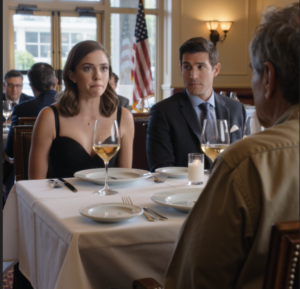
But sitting there in the Carver Room, the most pretentious restaurant in downtown Portland, I understood that somewhere along the road, I had failed completely. The place was kept deliberately dim, the darkness doing double duty: hiding the embarrassingly small portions while justifying the prices on the menu. Black velvet lined every wall, and the only light dropped from crystal chandeliers that probably set someone back more than my first house.
That old familiar itch crept up my spine, the feeling of a man who has no business being somewhere and knows it. My canvas work shirt was tucked in, but I caught the waiter’s eyes snagging on my frayed collar, sizing me up, finding me wanting.
Across the table sat Lacy, my youngest, twenty-six years old and beautiful in a way that required serious financial maintenance. Her highlights were flawless. Her skin glowed from treatments I couldn’t pronounce, and her fingers were flying across her phone screen, the menu untouched. I had raised her on my own after her mother, Naen, died when she was ten. I had spent my whole life trying to hand her the things I never had. But somewhere between giving her everything and today, she had stopped receiving gifts and started issuing demands.
Beside her sat Derek, her fiancé. Thirty years old, not a callus on his hands, never broken a real sweat in his life. His suit was a size too small, his watch was a size too big, and his smile had never once been genuine. He was currently swirling a glass of wine that ran forty dollars a sip, acting like he was a sommelier.
“So, the wedding planner said the ice sculptures need to be imported from Norway,” Lacy announced, eyes still anchored to Instagram. She was scrolling through other people’s weddings, harvesting ideas. “It is going to run an extra eight thousand dollars, but it is nonnegotiable. Dad, the theme is fire and ice, and domestic ice just looks cloudy.”
I cleared my throat and kept my voice level. “Eight thousand dollars for frozen water that is going to melt on the floor?”
Lacy finally dragged her gaze up, rolling her eyes with a sigh that said I was the greatest inconvenience of her existence. “It is artisan water, Dad. It is about the aesthetic. You would not understand. You are used to drinking from a hose.”
I worried it was something. Derek let out a low, condescending chuckle that made my knuckles go white.
“Con, you have to appreciate the vision,” he said, tilting back in his chair. “The Crystal Bluff is a premier venue. We cannot have low-quality decor. It reflects on us, on my family.”
I studied Derek. His family, the Falsams, were what I privately called credit-card aristocrats: leased BMWs, a mortgaged mansion, and a talent for looking down on anyone who actually earned something. They had not put a single dollar toward this wedding, yet they had opinions stacked to the ceiling about how mine should be spent.
I turned to the menu. It was a tasting menu, two dollars per person for eight courses that read like science-fair projects: foam, essence, deconstructed soil. I wanted a steak and a quiet table. The waiter drifted over, young, with a sneer that matched the room’s whole personality.
“May I start you with a bottle of the Opus One?” he asked, directing the question squarely at Derek, having already decided who held the card.
Derek brightened. “Oh, absolutely. Excellent choice.”
I raised a hand. “Wait.” The waiter turned to me with the expression of a man who had found something unpleasant on his shoe. “How much is the bottle?”
“It is twelve hundred dollars,” he answered, his voice glacial.
I shook my head. “We will have water. Tap water. And I will have the house bread.”
The silence that fell was thick enough to choke on. Derek shot the waiter an apologetic grimace, mouthing sorry behind my back. Lacy brought her phone down hard against the silverware, the screen cracking on impact.
“Oh my God, Dad,” she hissed, her face flooding red, equal parts fury and humiliation. “You are embarrassing me. You are actually embarrassing me in public.”
“It is twelve hundred dollars for fermented grapes, Lacy,” I said, keeping my voice even. “It is wasteful.”
“It is a celebration,” Lacy snapped, her volume climbing. Heads at surrounding tables began to rotate. “It is a tasting menu. You pair it with good wine. You do not pair it with tap water like some hobo. This is exactly what I was afraid of. You just do not get it. You do not fit in.”
I looked at her then. Really looked. I saw the little girl I used to carry on my shoulders across job sites, the one who made mud pies at the edge of foundations I was pouring. Where had that girl gone? When had she been replaced by someone who measured love in line items?
“I am paying for the dinner, Lacy. I am paying for the wedding. I am paying for your apartment. I think that earns me a say in the wine.”
Derek leaned in and laid a manicured hand on Lacy’s arm, soothing her the way you would a wronged stranger. “Babe, babe, calm down. He is just—he is from a different generation,” Derek said, cutting a patient smile at me, the kind reserved for toddlers and the very old. “Con, look, we appreciate the help, truly, but the Falsams are going to be at this wedding. My parents are accustomed to a certain standard. We cannot be trimming costs on ice and wine. It just reads as cheap.”
“Cheap.” I repeated the word under my breath like it tasted wrong. “I built a company from a single pickup truck and a shovel. I employed three hundred men. I built the bridge you crossed to reach this restaurant. Do not lecture me about cheap, son.”
Lacy laughed, sharp and cruel, cutting right through the ambient jazz. “Oh, here we go again,” she said, flinging her hands up. “The great Conrad Vance and his shovel. We know, Dad. You dug holes for a living. You played in the dirt. Congratulations. You are a glorified sewer rat.”
The air went out of me. She had mocked my work before, but never with this much genuine contempt, this much disgust behind it.
“I dug those holes to pay for your private school,” I said, my voice dropping to barely a whisper. “I poured that concrete to fund your art history degree, the one you have never once used.”
“Yeah, and look at you.” Lacy sneered, jabbing a finger at my chest. “Still wearing that canvas work shirt. Still driving that truck that smells like wet dog and sawdust. You have no class, Dad. Money, sure, but zero class. You are just a wallet with a pulse. And honestly, having you at the venue is going to ruin the whole vibe.”
I sat motionless. The waiter had melted back into the shadows to watch. I glanced at Derek, waiting for him to step in, to say that had gone too far. Derek took a sip of water and shrugged.
“She has a point, Con,” he said smoothly. “We were going over the seating chart at the head table. It is going to be my parents and a few investors, and honestly, you do not really fit the aesthetic. We were thinking you could say you are under the weather.”
“Under the weather?” I repeated, my voice flat.
“Yeah.” Lacy jumped in, her eyes brightening at her own solution. “It is perfect. We say you have a bad flu or a back injury from all the manual labor. You stay home. No tuxedo. No discomfort. And we do not have to explain why the bride’s father looks like he just walked off a job site. Everybody wins.”
I stared at them. The daughter I had adored. The daughter I had grieved alongside when her mother died. She was ashamed of me. Not just after my money. She wanted my money and my disappearance, the check without the father attached to it.
“So let me be clear about what you are proposing,” I said slowly, leaning forward. My hands rested flat on the table, scarred and calloused, hands that had bled for this family more times than I could count. “You want me to pay for the wedding, the venue, the flowers from Norway, the wine, but I am not invited to attend?”
Lacy sighed and picked up her menu as if the topic had already exhausted its usefulness. “Basically, yeah. It is for the best, Dad. You would hate it anyway. It is high society, not a union meeting. Just transfer the final fifty thousand to the venue coordinator tomorrow morning. They need it by noon to lock in the catering. And wire the honeymoon money, too. Derek found this amazing resort in the Maldives.”
I looked at Derek. He was smirking at his own reflection in a spoon. “The Maldives,” I said.
“Five-star,” Derek replied, winking. “It is the least she deserves, right?”
The waiter reappeared and set a small plate in front of me, a single oyster on a bed of green foam. I stared at it. In my head, I was running a different kind of calculation: $150 to $1,000 for the wedding, ten thousand dollars for the dress, five thousand a month for their rent, plus the credit-card statements I settled every month without ever asking what was on them.
I reached into my back pocket, felt the leather of my wallet, and tucked behind a photograph of my late wife, Naen, was the black Centurion card. The card I received the day I sold the company. The card with no ceiling on it. I could pull it out right now. Buy the $120 bottle. Buy the whole restaurant. Show them precisely who they were dealing with. My fingers grazed the cool metal edge. It would take nothing. Drop it on the table. Watch their jaws go slack. Watch Derek choke on his tap water.
But then I glanced at Lacy’s face. She wasn’t looking at me. She was angling her phone to capture the oyster, tilting the shot so her diamond ring caught the light just right. The ring I had paid for. She hadn’t earned the right to know. She didn’t deserve the satisfaction of discovering my worth. As far as she was concerned, I was a pension-scraping old man handing over his life savings, and she couldn’t care less. She would drain me to the last drop and step over the body on her way to the open bar.
I let go of the card. Instead, my fingers closed around a single folded fifty-dollar bill I kept for emergencies. I stood up. The chair scraped hard against the floor. Lacy didn’t so much as glance up.
“Where are you going? The bathroom is that way.”
“I am leaving,” I said.
Derek laughed. “Leaving? We haven’t even had the main course. Con, sit down. Stop being dramatic.”
“I am not being dramatic,” I said, my voice finding the iron resonance it used to carry when I ran job sites. “I am being practical. You told me my life is nothing to be proud of. You called me a sewer rat. You said I should not show up.”
Lacy rolled her eyes. “Oh my God, Dad. I was just being honest. Do not throw a tantrum.”
“I am not throwing a tantrum, Lacy. I am giving you exactly what you asked for.” I took the folded fifty-dollar bill and set it down on the pristine white tablecloth. It landed squarely on her plate, right in the center of her composition, ruining the photo.
“What is this?” she demanded, staring at it like it carried a disease.
“That is for my portion of the oyster,” I said. “For a taxi home. You can settle the rest of the bill. You are high society, after all.”
Lacy let out a nervous laugh. “You are joking. This dinner is going to be six hundred dollars. We don’t carry cash, Dad. Put your card down.”
I patted my pocket. “No,” I said simply. “My money has no class, remember? It smells like concrete. You wouldn’t want it near you.”
I turned my back on her for the first time in her life. I walked away while she was still talking. Lacy’s voice climbed behind me, sharp and shrill.
“Dad, come back here. You have to transfer that fifty thousand dollars tomorrow morning. The venue will cancel if you don’t. Dad!”
I kept walking, past the startled waiter, past the hostess stand, and out through the heavy glass doors into the cool Portland rain. The valet extended his hand for a ticket.
“No ticket, son,” I said, moving past him toward the street. “My truck is three blocks away. I saved the parking money.”
I walked through the drizzle, the rain cooling the heat rising off my face. My heart was hammering, not from the walk, but from a strange, cold kind of clarity I hadn’t felt in years. For a long time, I had constructed excuses on her behalf. She is still grieving her mother. She is young. She is under pressure. Tonight, all of those excuses finally gave out.
I reached my truck, a beat-up Chevy Silverado that I kept running out of stubbornness. I hauled myself up into the cab. The familiar smell of old coffee and dust greeted me like something honest. I sat there in the dark, listening to rain tap against the roof. My phone buzzed. A text from Lacy.
You are being childish. Transfer the money by 9 a.m. or don’t bother talking to me again. And don’t forget the honeymoon deposit. Derek is really stressed.
I read it. The glow of the screen mapped every crease on my face, lines bought with years of worrying about her. I set the phone on the passenger seat. I turned the key. The old diesel woke up with a rough, loud, unrefined roar. I drove out of the city, the glittering towers of downtown falling away behind me. I didn’t head home. Not yet. I drove toward the one place where I could actually think.
I pulled into the lot of a twenty-four-hour diner near the docks, the kind of place with laminated menus and coffee that tasted like it had been brewed sometime last week. I took a booth in the back, watching container ships work in the distance. I ordered a black coffee and a slice of peach cobbler. The waitress, Dot—she’d been working that counter since I was laying foundations across town—poured the cup without being asked.
“Rough night, Con?” she said, reading my face.
“You could say that, Dot,” I replied, taking a sip. The heat hit my throat, and it felt earned. “My daughter is getting married on Saturday.”
Dot smiled. “Oh, that is lovely. You must be proud.”
I looked at the cobbler. I thought about buying Lacy her first bicycle, holding her hand at the dentist, paying for her first car, her second, her third, after she wrapped the others around something.
“She told me not to come,” I said quietly.
Dot stopped wiping the counter. “Well, wait.”
“She says I am an embarrassment. A sewer rat. She wants the check, but not the father.”
Dot shook her head and put the rag down hard. “That is shameful, Con. After everything you gave that girl, that is shameful.”
“It is,” I agreed.
“So what are you going to do?” she asked, leaning on the counter.
I took a bite of the cobbler. Sweet, simple, honest. No foam, no liquid nitrogen. “I am going to give her what she wants,” I said.
Dot looked puzzled. “You are going to stay home?”
I smiled, slow and cold, the kind of smile that stays far from the eyes. “Dot, she asked for a wedding. She asked for a lifestyle she cannot bankroll herself. She asked for me to be an invisible wallet.”
I got my phone back out and opened the banking app. The balance looked back at me, a number loaded with zeros, enough to raise cities or level them. I tapped through to my private banker at Chase Wealth Management. It was late, but for that kind of balance, he would pick up.
“I am going to make sure she gets precisely the wedding she paid for,” I told Dot.
I hit call.
“Hello, Mr. Vance.” The banker’s voice was smooth, professional, and fully awake.
“Alton,” I said, keeping my voice even. “I need to make some changes to my accounts. Immediate changes.”
“Of course, Mr. Vance. What do you need?”
“Block the secondary card ending in 4598, the one Lacy holds. Don’t report it lost. Report it compromised. Freeze it entirely.”
A pause. “Very well, sir.”
“And the transfer scheduled for the Crystal Bluff tomorrow morning, fifty thousand. Cancel it.”
“Sir?”
“Cancel it. And, Alton?”
“Yes, Mr. Vance?”
“Pull every transaction on that supplementary card going back five years. I want a full itemized record. Every coffee, every dress, every flight. I want to see exactly where that money went.”
“I can have that ready by morning, sir. Is everything all right?”
“Everything is finally clear, Alton. Just do it.”
I ended the call. Dot was watching me, eyes wide.
“You are cutting her off,” she whispered.
I finished the last of my coffee. “I am not just cutting her off, Dot. I am pulling the foundation out from under the house and letting gravity handle the rest.”
I left twenty dollars on a five-dollar check and walked out into the night. The rain had moved on. The air was sharp and clean. I climbed back into the truck and drove home to my modest three-bedroom house in the suburbs, the house Lacy called a shack.
I went straight to the home office. I opened the safe behind the bookshelf. Inside were the deeds to the apartment where Lacy and Derek lived, the title to Derek’s car, and the trust documents I’d had drawn up, leaving them everything. I laid it all out across the desk. I sat down beneath the quiet hum of the desk lamp and got to work.
I wasn’t a contractor anymore. Tonight, I was a demolition expert. I picked up a red pen and began circling clauses in the lease for the apartment. The apartment I owned. The apartment where they lived rent-free, mocking the man who kept the roof over their heads.
My phone buzzed again. Another text from Lacy.
Dad, I am serious. If that money isn’t there by 9 a.m., I am telling everyone you are senile. Derek says we should look into power of attorney. Do not test me.
I laughed, a dry, quiet sound in the empty house. Power of attorney? She wanted to play legal games. She wanted to threaten the man who had spent his career reading contracts before breakfast.
I checked the calendar. Wednesday. The wedding was Saturday. Three days. Three days to dismantle a lifetime of entitlement. Three days to prepare the lesson. I didn’t sleep. I spent the night combing through bank statements, highlighting charges, running numbers. By sunrise, I had a spreadsheet that told a story of greed so complete it turned my stomach.
Lacy and Derek weren’t simply spending my money. They were hemorrhaging it and doing worse things on top of it. They were leveraging assets that weren’t theirs to touch. There were loans taken out in my name. Crypto positions I had never heard of, all gone to zero. Gambling debts attached to Derek’s name, cleared out of the joint account. They weren’t just ungrateful. They were stealing from me.
At eight a.m., I called my lawyer, Pruel. He answered with a voice as gravelly as mine.
“You are up early.”
“I need you at the house, Pruel,” I said. “I have a job for you.”
“What kind of job?”
“Forensic accounting. Eviction. Possibly criminal fraud.”
Pruel gave a low whistle. “I will be there in twenty minutes. Coffee?”
“Black.”
Pruel arrived at eight-thirty. He was a shark in a cheap suit, the only attorney I trusted because he had no use for anyone, equally. He took one look at the pile on my desk and raised an eyebrow.
“This is your daughter we are talking about, Conrad.”
“Not anymore,” I said, sliding him the spreadsheet. “This is a parasite. I am the host, and I am done.”
Pruel worked through the documents, his eyes moving fast across the numbers. “Good God, Conrad. Do you know she took out a second mortgage on the condo? You co-signed the original, but she forged your signature on the equity line.”
A cold rage settled deep in my chest.
“Yeah,” Pruel said, tapping the page. “Look at the date. You were in Denver for the conference. She signed it here, notarized by a friend. This is a felony.”
I studied the signature, a trembling imitation of mine, a child’s clumsy reach into someone else’s pocket.
“I want everything documented,” I said. “Every debt, every lie, every dollar that was taken.”
“And then what?” Pruel asked, peering at me over his glasses. “You want her charged?”
I looked out the window at the garden Naen had planted. The roses were still blooming despite years of neglect.
“I don’t want jail,” I said. “Jail is too easy. Three meals a day and a roof is not a consequence.”
“Then what?”
I turned back to Pruel. “The wedding is Saturday. Her whole circle will be there. Derek’s family, the influencers, the society crowd, everyone she spends her life trying to impress.”
Pruel smiled, a cold, sharklike smile. “You are going to the wedding.”
It wasn’t a question.
“Oh, I am going,” I said. “But I will not be sitting in the back, staying invisible.” I picked up the black Centurion card and tapped it once against the desk. “I am going to be the center of attention.”
My phone rang. Lacy, calling to chase the transfer. I let it ring. Let the dread build.
“We have work to do,” I told Pruel.
While Lacy was presumably screaming at a venue coordinator about a missing payment, I was liquidating the trust fund, rewriting the will, assembling a presentation. By noon, my phone had fifty missed calls. By one p.m., Derek left a voicemail threatening to show up. By two p.m., I was at the tailor’s getting fitted for a tuxedo. Not a rental—a bespoke Brioni tuxedo that cost six thousand dollars. Because if I was going to take their world apart, I was going to be dressed like the man who built it.
I stood before the mirror while the tailor pinned the trouser hem and looked at the man in the glass. The canvas work shirt was gone. The work boots were gone. In their place stood someone with power, with weight behind him.
“I am sorry, sir,” the tailor said, reading my expression. “Is the fit uncomfortable?”
“No,” I said, squaring my shoulders. “The fit is perfect. Just haven’t seen this man in a long time.”
I stepped out into the afternoon light. My phone buzzed. A text from Lacy.
Fine, you win. I will let you sit at the family table. Just send the money, please, Dad. The venue is threatening to lock the doors.
I read it and typed my first reply in twenty-four hours.
Handling it. See you at the wedding.
I hit send and dropped the phone onto the passenger seat. The trap was set. I drove to the bank to sit down with the wealth management team. As I came through the lobby, the branch manager crossed the floor to meet me.
“Mr. Vance, we received your instructions. Everything is frozen. The supplementary cards are canceled. The checks have been stopped.”
“Good,” I said.
“And, sir, regarding the wedding venue, they called trying to run the card on file. We declined it, per your instruction.”
“Did they say anything?”
“They said the bride was in tears, sir. She offered a personal check. It bounced.”
I nodded, my face giving nothing away. “Let it bounce,” I said.
I walked out of that bank feeling lighter than I had in years. The guilt had cleared. The obligation had lifted. All that remained was the lesson, and class was nearly in session.
[Hết phần 1. Phần tiếp theo bắt đầu từ đoạn “The rain hammered a steady beat against the metal roof of my Chevy Silverado…”]