“Your Daughter Is Weak!” My Mother-in-Law Mocked—Then She Learned Who My Dad Was…
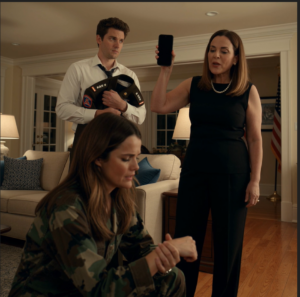
My mother-in-law held the phone out like a trophy and told my father to come collect his weak little soldier. I was still on the hardwood floor, my left palm burning, my husband standing over me with my dress uniform crumpled in his fist. Everyone in that room was smiling.
Then my father spoke, and I heard something in his voice I had never heard in 31 years: a calm so complete it frightened me. The smiles began to die right there. They just didn’t know it yet.
Let me take you back a few hours. I had come home from nine days of field training at Fort Belvoir with red clay in my boot treads and a sunburn across my nose, the kind of tired that settles into your bones and feels almost honest.
The house was quiet. Ethan’s father had bought it for us as a wedding gift—five bedrooms in a Virginia suburb where every lawn looked combed—and I had never once felt like I lived there. I felt like I was being allowed to stay. I set my duffel by the door and carried my dress uniform to the armchair in the den, running my thumb along the seam where the ribbons sat. A small ritual. It made me feel like myself.
Ethan found me there, still in his work shirt, tie loosened, a glass of bourbon sweating in his hand. I knew from the way he filled the doorway that the evening had been decided without me.
“You didn’t answer my texts.”
“Field exercise. No phones.”
“The Hartwell dinner was Tuesday. My father put you at the head table.”
I breathed in slowly. “I told you three weeks ago I had a command briefing that couldn’t move. You said you understood.”
“I said what I had to so you’d stop talking.” He laughed, short and ugly. “Do you know how that looked? Richard Whitmore’s daughter-in-law a no-show because the Army needed her to sit in a meeting?”
I reached for the uniform. I should have known better. He got there first, tore it off the chair, and held it up between us like something he’d caught crawling across the carpet.
“Always the Army. Always the uniform. Do you remember you’re my wife?”
“Give it back.” My voice stayed level. Eleven years of training will do that, even when your pulse is pounding in your ears. “Ethan, give it back.”
“Or what? You’ll salute me?”
He stepped closer, and I smelled the bourbon and saw something behind his eyes that I had watched flicker before and always explained away. I took hold of the collar. He pulled. Then both his hands were on my shoulders, and the room tilted. My hips struck the edge of the coffee table. The hardwood rose to meet my palm. And for a moment, there was no sound at all.
I didn’t cry, not out of pride, but because crying requires feeling safe enough to fall apart, and my body knew better. I lay there taking inventory. Wrist bruised, not broken. Hip purple by morning. Husband breathing hard, staring at his own hands as if they belonged to a stranger.
For one suspended second, I saw real horror on his face, and I thought, Here comes the apology. He opened his mouth. Then heels clicked down the hallway, and the horror folded itself away.
Carol Whitmore swept in wearing pearls at eight o’clock at night. She had a key to our house, of course. She had a key to everything. She took in her son, the uniform, me on the floor, and I watched her choose a side in under two seconds. It wasn’t mine.
“For heaven’s sake, Ethan, what did she say to you?”
She never looked at my wrist. She looked at the jacket.
“A United States Army officer,” she said, tilting her head. “And she goes down like a porcelain doll. Is this what they teach you out there?”
Richard appeared behind her, reading glasses in hand. He glanced at me, then at the ceiling, with the weary patience of a man whose staff had spilled something. I got to my feet on my own. Carol was already scrolling her phone, and I knew whose name she wanted. She had waited years for the excuse.
“Your father always says to call if there’s a problem,” she said, pleased with herself. “Let’s see how eager he is.”
The call connected on speaker.
“Thomas, it’s Carol. Your daughter’s being dramatic again.” She let it hang. “Why don’t you come get your weak little soldier and take her home? We’ve been patient long enough.”
The line went silent. Five seconds. Ten. I could almost hear the clock in his Annapolis kitchen, the one he wound by hand every Sunday. When my father spoke, his voice was quiet, almost gentle.
“Is my daughter hurt?”
“She took a little tumble.”
“Carol, is she hurt?”
“She’s fine.”
“Then listen carefully. If my child has so much as a scratch, your whole family will pay for it.”
Carol laughed, a real, delighted laugh. Richard chuckled into his collar, and Ethan let out a breath that sounded almost like relief, because to them, my father had just become a retired old man making threats from a recliner. I was the only person in that room not laughing, and I couldn’t have told you why.
Then my father said, “You think this is funny?”
It wasn’t a question. There was no heat in it, none of the thunder I’d braced for since childhood.
“Carol, you’ve just made a mistake you won’t be able to take back.”
He hung up. Her smile lingered a moment longer than her amusement.
I stood there cradling my wrist, hearing my father’s voice and not recognizing it. It wasn’t the voice that had read me bedtime stories. It was older, something that had given orders and watched them obeyed.
What none of us knew was that he hadn’t gone to pour a drink or pace his kitchen. He had set that phone down, picked up another, and dialed a number he hadn’t used in nearly a decade, reaching a man who once answered directly to him.
The bathroom lock clicked, and I stood with my back against the door until my breathing slowed. Then I ran the faucet, not for the water, but for the noise. Through the floor, I could hear Carol’s voice rising and falling like a woman planning a luncheon. Ethan’s was lower. Richard said nothing, which was how Richard said most things.
The woman in the mirror still had a smear of red clay at her hairline. I studied her the way I’d study a soldier reporting for inspection. Bruise darkening on the left wrist. A graze along the jaw I didn’t remember getting. Eyes dry. I pressed two fingers into the swelling and watched her not flinch.
It wasn’t the wrist that undid me. It was how ordinary the moment felt. Not a shock, only a familiar stair I had been missing for years and had finally put my full weight on.
I met Ethan at a charity gala in Georgetown when I was 27. He was the only man in that ballroom who asked what I did and then asked a second question. He said I was the least performative person he’d ever met. For eight months, he showed up at my ceremonies, held my coat, and learned to say “oh-six-hundred” without smirking. I thought I had found someone who saw the whole of me.
The change arrived the way weather does, so gradually that you only notice when you’re already wet. First came the jokes. At our first Christmas, Carol introduced me to her bridge club as “Paige, who plays soldier,” and the table laughed, and Ethan squeezed my knee under the linen as if the squeeze were an apology.
Richard liked to say that government work was steady, that somebody had to do it, and then he’d turn to the men who had real money and ask about their boats. Then came the quieter things. Ethan sighed when my phone buzzed during dinner. He sulked for two days when I was put on duty over his cousin’s engagement party. He asked me to turn down a posting in Germany because it would be hard on us. And when I declined to turn it down, he stopped speaking to me until I found a reason to be sorry.
My paychecks landed in a joint account that his father’s accountant reviewed every quarter, for our convenience, of course. I told myself that marriage was a negotiation and I was a good negotiator. I conceded the small ground so I would never lose the large.
I never told my father. People assume it was shame, and some of it was, but mostly I knew exactly what he would do. Thomas Bailey ironed his own shirts, drove a Buick older than my career, and wound the kitchen clock every Sunday evening. He had retired when I was in college after more than 30 years of service.
I knew he had served and that it had cost him. I did not know the shape of it, because the door to his study stayed locked, and in all my life he had answered questions about his work with the same sentence: “Long hours. Mostly paperwork.”
But I knew the way he loved me, which was thoroughly and without noise. If I had said one sentence about Ethan, he would have been on my porch by dawn, and I would never have learned whether I could hold up the life I’d chosen on my own two feet.
I turned off the faucet. Downstairs, the front door opened and closed, Carol’s heels fading down the walk, and then a knock sounded on the bathroom door, soft and practiced.
“Paige, come on.” Ethan’s voice had gone warm, the way it did when he wanted something. “Mom’s gone. Don’t make this a thing.”
“I’ll be in the guest room.”
“You know I didn’t mean it.”
You know. I turned the phrase over in my head. He had never once said, “I’m sorry.” He always said, “You know,” as if my knowing were the apology, as if forgiveness were something I already owed him in advance.
“Good night, Ethan.”
I made the bed in the guest room with hospital corners out of pure habit and sat on its edge in the dark. Then I did what I had been trained to do after anything that mattered. I took the small notebook from my duffel and wrote an after-action report. Date, time, location, who was present. What was said, as close to verbatim as I could manage.
The hand that held the pen was steady. The hand that held the notebook shook, so I pressed it flat to my knee until it stopped. I had never written one of those about my own marriage. When I finished, I read it back, and it looked like a stranger’s life. I realized with a slow chill that it was simply mine, set down in order.
I packed a go bag, too, the same way I’d pack for a deployment: essentials only. Documents, charger, a change of clothes, my grandmother’s ring. I zipped it and slid it under the bed.
I didn’t sleep. I watched the ceiling go from black to charcoal to the color of dishwater. At a quarter to seven, I heard tires on gravel. I went to the window. A dark sedan had stopped at the curb, and the driver’s door was already opening. Even from the second floor, I knew the set of those shoulders, the unhurried way he stepped out and buttoned his jacket as though the morning were a formal occasion and he intended to meet it properly.
My father wore a plain gray suit. No hat, no hurry, and nothing in his hands. That was the first thing that struck me, because I’d braced for anger, and what stood on that sidewalk was something far more disciplined.
The passenger door opened. A tall man in his sixties unfolded himself from the car, silver at the temples, a leather folio tucked beneath his arm. He looked up at the house and then, impossibly, directly at my window, as if he had known which one.
I met them at the door before Ethan could. My father’s eyes went first to my wrist, then to my jaw, and he did not touch me. His hand stayed at his side, and I saw what it cost him.
“Hello, Paige,” he said.
I could not make my voice work, so I nodded. The silver-haired man stepped forward, folio against his chest, and spoke with a courtesy so precise it could have been a salute.
“Ma’am, my name is Daniel Reyes. If you’re willing, we need to talk about what happened last night.”
Daniel Reyes took the stool at the end of the kitchen island, the one Carol had chosen from a catalog in Milan, and set his folio on the marble without opening it. He asked whether he could record our conversation and told me I was free to say no. He had spent 22 years as a JAG officer, he said, and the last nine in private practice, and nothing I told him would leave that room without my consent.
Then he began asking questions in the flat, unhurried order of a man who knew the truth likes to be approached sideways.
“Who was in the house last night?”
“Carol, Richard, Ethan, and me.”
Had anyone sent messages afterward? Ethan had texted from the living room, and I’d left them unanswered. Were there cameras? I hesitated. The doorbell camera covered the front walk, I said, and Richard had installed one in the upstairs hallway after a break-in two years ago. Reyes wrote that down without looking up.
“Has Mr. Whitmore ever threatened you, restrained you, taken your phone, or prevented you from leaving a room?”
I opened my mouth to say no, and the word wouldn’t come out clean. So I told him about the joint account his father’s accountant reviewed every quarter. About the night Ethan pocketed my car keys as a joke and held them over his head until I laughed to end it. About a restaurant parking lot last spring, a grip on my upper arm that left four faint ovals I hid under a long sleeve for a week.
Every answer sounded smaller out loud than it had felt while I was living it. Reyes never reacted. He kept writing, and somehow his pen made the whole thing real. I glanced at my father. He sat across from me with his hands folded on the counter, silent. I understood then that he hadn’t brought Reyes to fight. He had brought him to listen, and I had never been listened to like that.
At eight, the front door opened without a knock. Carol came first in a cream blazer, composed as if last night had been a dress rehearsal and now the real performance could begin. Richard followed with his reading glasses already in hand. Ethan lingered on the stairs in yesterday’s shirt, unshaven, one hand gripping the banister.
“Thomas.”
Richard crossed the kitchen with his palm extended. My father looked at it and did not take it. Richard let it fall smoothly, like a man who had learned to lose small things in public.
“I’d hoped we could handle this the way adults do. Let me save everyone some time. What happens between a husband and wife is a private matter. It has nothing to do with the Army. And if you’ve come here to lean on someone with a uniform—”
“You’re right,” my father said. “It has nothing to do with the Army, and I haven’t come as that.”
Richard’s shoulders loosened half an inch. I watched it happen.
“I’m here as her father.”
“Oh, Thomas, please.” Carol sank onto a stool as if the whole business exhausted her. “A shove. That’s what we’re discussing. She’s an officer. She’s taken harder knocks in training than a tumble on a rug. You’re making a mountain out of a very small hill.”
“That’s what I thought, too.” He said it kindly, which was somehow worse. “Last night on the phone, I thought, A bad evening. A husband who lost his temper. It happens. And I told myself so for about 40 minutes.” He paused. “Then I learned it wasn’t the first time.”
The kitchen went still. Ethan came off the stairs.
“Who told you that?”
“Someone who loves your wife.” My father turned to me, and his eyes were wet in a way I had never once seen. “Lena Okafor called me three days ago.”
Lena. Major Lena Okafor, who had shared a tent with me in Kuwait and held my hair back after bad MREs, and I thought only half believed my excuses. Twice in the last four months, I had filed for short-notice leave citing family matters and then spent the days parked in a motel off Route One just to sit in a room where nobody needed me to be cheerful.
Lena had noticed. Lena had said nothing to me and everything to him.
“She didn’t want to break your confidence,” he said. “She said you’d stopped laughing at your own jokes. I didn’t know what that meant until last night.”
The back of my throat closed. I looked at the marble.
“I hid it, Dad. I told her it was nothing. I told myself it was nothing. I didn’t want you to…” I stopped. “I wanted to be able to handle it.”
“Paige.” He leaned across the counter and finally covered my good hand with his. His palm was dry and warm and smelled like the cedar of his study. “You don’t have to be strong with me. You have never had to be strong with me.”
Something loosened under my ribs, a knot I had carried so long I’d mistaken it for posture. I didn’t cry, but I breathed all the way to the bottom of my lungs for the first time in a year.
Richard cleared his throat, and the sound was brittle now.
“This is very touching, but if you believe your wife’s service gives you leverage, Thomas, I’d advise you to remember who you’re dealing with. I know people in this town. I know where the real money sits and who answers my calls. A retired colonel—”
“Ah,” my father said softly. “There it is.”
“What?”
“You still don’t understand what you’re looking at.”
He nodded once to Reyes. The folio opened with a soft, leathery sigh, and Reyes slid a single sheet across the marble, squaring it with two fingers so it faced the Whitmores.
I read it upside down. It was a printed biography, the official kind, with a photograph of a man in dress blues I recognized only by the eyes. At the top, in plain black type: Thomas A. Bailey, Lieutenant General, United States Army, Retired.
Carol read the first line, and the color left her face a section at a time, as though someone were drawing a curtain. Her smile did not fade so much as get set down carefully on the marble, like something she suddenly feared would break.
Nobody spoke for what felt like a full minute. The refrigerator hummed. Upstairs, a pipe ticked as the heat came on, and Richard Whitmore, who had never in my hearing run out of words, read the first paragraph of that page three times. I know, because I watched his eyes keep returning to the top.
“Three stars,” Ethan said at last, to no one in particular. “You told us you did logistics.”
“I told you it was paperwork,” my father said. “Both were true on certain days.”
I almost laughed, and that almost surprised me. At every Thanksgiving, Carol had patted his sleeve and asked whether his pension was holding up. Richard had once explained to him, slowly, what a battalion was, and my father had nodded and passed the cranberries. He hadn’t been hiding. He simply never needed their opinion to know who he was.
I braced for the thunder I had feared my whole life. It never came. He slid his hands into his pockets and looked at the Whitmores with an expression I can only call patient.
“Let me be plain, because I can see where your minds have gone. I’m not calling anyone. Nobody in uniform will hear about this from me, and you won’t find a single favor in this matter with my name on it. That rank belongs to the Army. My daughter’s marriage belongs to her.”
He let it settle.
“What I will do is stand beside her while she uses the same laws that protect everyone else. I’d suggest you take that seriously.”
Carol found her voice first, thin and high.
“Daniel, surely we can all be reasonable.”
“Mrs. Whitmore,” Reyes said, not unkindly, “I was Tom’s staff judge advocate for six years. He called me last night because he needed a lawyer, not a general. I’m here because I’m good at it.”
So that was who my father had dialed after hanging up on Carol. Not a favor, not a threat. A man who knew where the lines ran and had spent his career making sure no one crossed them, including the people he worked for.
Richard recovered the way rich men do: by making a phone call. Within the hour, a lawyer named Gordon Puit arrived in a charcoal suit, kissed Carol on the cheek, and spent ten minutes reframing the previous evening as a heated, mutual disagreement between spouses under stress. He used the word “mutual” four times. Ethan nodded along, relief creeping back into his posture like color returning to a hand.
Reyes waited until Puit had finished, then opened the folio and laid out his pages one at a time, as precisely as a man setting a table. The first was a still from our doorbell camera, timestamped 8:02 p.m., showing Carol on the front walk with her key already in her hand a full minute before anyone could have called her.
The second was a transcript of the hallway footage Richard himself had installed, with audio. You could hear the thud. You could hear Ethan say, “Always the Army. Always the uniform.” And Carol say, “A porcelain doll.”
Then came a text from Ethan to me in February that I had forgotten: “You make me look small in front of everyone. Keep it up and see what happens.”
Then an email to his cousin Brett, three weeks old: “She’ll fold. She always does. Soldiers are trained to take orders.”
Then the account statements. Then a short, signed note from the valet at the restaurant parking lot, who remembered a woman rubbing her arm and a man who wouldn’t let go of the car door.
“I haven’t discovered anything,” Reyes said quietly. “I’ve only asked for what already exists.”
Puit reached for the pages and read in silence. Ethan didn’t reach for anything. He stood by the counter with his mouth slightly open, listening to his own voice describe me from a dozen different directions.
My father turned his chair so he faced only me.
“Paige.”
He had dropped the voice from the phone, the one I’d never heard before. This was the voice from my childhood, the one that smelled like cedar.
“I’m not going to decide this for you. I’ve never decided anything for you, and I’m not going to start today. So I’m asking: What do you want to do?”
The kitchen waited. I felt Carol’s stare against my cheek and Ethan’s against my hands, and I thought of the go bag under the guest bed, zipped and ready. For a single heartbeat, I considered every softer answer. Counseling, a trial separation, a better version of the same marriage.
“I want to leave,” I said. My voice shook on the second word and held on the third. “I want out of this marriage.”
“Then I’ll help you do it.”
Ethan made a sound that was half laugh, half something wetter. He came around the island with both hands out, palms open, the way you approach a horse that has already bolted.
“Paige, baby, I was drunk. I’d had a day. I swear to you, I’ve never touched you like that before. And I swear on my life I never will again. Tell them. Tell them it’s a misunderstanding. I’ll go to a program. I’ll do whatever you say.”
I looked at him, really looked at the face I had once believed held the whole of a quiet future. He was crying, and I think the tears were real. That was the terrible part. He was sorry. I simply couldn’t tell what he was sorry about.
“Ethan,” I said, “answer me one thing. If my father weren’t a lieutenant general, if he were exactly what you thought he was, a retired man in a Buick, would you be standing here apologizing?”
He opened his mouth, closed it. His eyes slid to Richard, then to the page on the counter, then back to me, and I watched him search for the right answer the way you search a pocket for keys. He didn’t find it. The silence stretched long enough to answer the question for both of us.
I didn’t know it yet, but while I stood in that kitchen, the first quiet door was already swinging open somewhere else.
That afternoon, across town, Richard Whitmore took a private lunch with an old golfing friend in a dark-paneled club and asked, very politely, whether anyone owed him a favor in the Pentagon. He had no idea the man across the table had spent 20 years inside the very system he wanted to bend and had a long memory for names like Bailey.
The first call came on a Thursday, nine days after I moved into my father’s spare room in Annapolis. Colonel Marcus Hail, my battalion commander, asked if I had a moment in the careful tone of a man who has already read something he’d rather not have.
“Captain Bailey, an inquiry came through this morning. Congressional liaison office, forwarded from a constituent.” He paused. “It alleges you have a volatile temperament, that you’ve made threats against civilians, and that you’ve leveraged a family connection to intimidate your husband’s relatives. It’s anonymous, but it’s detailed.”
I stood at the window of the room I’d slept in as a girl and watched my father’s neighbor prune a hydrangea. I felt the old reflex rise, the one that wanted to explain, to defend, to talk fast enough that the accusation would lose its footing. I let it pass through me the way you let a wave pass when you’re standing in surf.
“Sir, I’d like to come in and make a statement in person today, if you’re available.”
“I am.”
“And, sir, I want to be clear. I’m not asking for any consideration because of who my father is. If there’s a process, I’d like to follow it exactly.”
There was a short silence.
“Understood, Captain. That’s the right instinct.”
I drove to Fort Me with a binder on the passenger seat, and I’ll admit, my hands were not entirely calm on the wheel. I understood perfectly what Richard was doing. He wasn’t trying to win. He was trying to make me spend what I’d spent my whole adult life building—a clean name—so that the person who walked into the divorce proceedings would be diminished before she sat down. Carol would have supplied the colorful details. Ethan would have supplied the dates.
My father had not wanted me to drive alone. He didn’t say so. He simply stood at the front door that morning, holding my keys a second too long before he handed them over.
“If you want me there,” he said, “I’ll be there. If you want to do it yourself, I’ll be at the kitchen table.”
“I want to do it myself.”
“Then I’ll be at the kitchen table.”
In Colonel Hail’s office, I kept my statement to four pages. Dates, times, sources. I gave him the after-action notes I’d written that first night in the guest room. The doorbell still, the hallway audio. I told him I’d retained a civilian attorney, Mr. Reyes, to handle the divorce, and that my father had not contacted a single person in my chain of command.
I could say that with complete confidence, because Hail himself had never heard the name Bailey in connection with me until the day I filed my security paperwork years ago, and had not thought to ask. I watched him turn the pages. When he reached the screenshot of Ethan’s text—“Keep it up and see what happens”—his jaw moved once.
“Captain, is this the full extent?”
“No, sir. It’s what I can document.”
He closed the binder.
“We’ll open a formal preliminary inquiry. It’s required, and frankly, it’s better for you. Go home. Do your job. Don’t discuss this with anyone.”
I followed that instruction to the letter. I went to work. I ran my formation at six every morning, and I sat through briefings and signed memos and said nothing. It was the hardest discipline I have ever practiced, harder than any march. Somewhere in a Virginia house with five bedrooms, three people were telling a story about me, and I had to let the story exist without feeding it.
On the second night, I cracked. I came into the kitchen after midnight and found my father at the table with the lamp on and a cup of tea gone cold, doing nothing at all, just keeping watch.
“I keep wanting to call Carol,” I said. “I want to make her listen. I want to say it all out loud, every single thing.”
“What would that get you?”
“The satisfaction of it.”
“And then?”
I thought about it. “Then she’d have something to quote.”
He nodded slowly. “Honey, you don’t have to prove you’re strong by hitting back. You only have to let the truth stand still. It’s heavier than any story they can build. It just takes longer to arrive.”
It took 19 days. The inquiry officer, a major from another brigade I had never met, reviewed everything. He interviewed Lena, who told him calmly and without embellishment what she had seen in me over 18 months. He interviewed Ethan’s cousin, Brett, who turned out to be rather less loyal than the email suggested.
And he reviewed the original complaint, comparing its dates and its phrasing against the documents Puit’s office had filed in the divorce, and discovered that several sentences matched word for word. The anonymous constituent had been drafted by the same lawyer who was representing my husband.
The finding was two paragraphs long. The allegations were unsubstantiated. The record showed, it said, “a pattern of documented professional conduct and appropriate restraint.” There was a footnote about the origin of the complaint that I read three times, because a footnote can be a kind of mercy.
Nobody was arrested. Nobody came to my door with flowers or an apology. The Army simply looked at the facts, found them in order, and closed the file, which is exactly what it should do.
Ethan caught me that Friday outside Reyes’s office, where I’d gone to sign the next set of papers. He looked thinner. His shirt was wrinkled in a way it would never have been a month earlier.
“They told me the complaint didn’t go anywhere,” he said. “Dad said it was only meant to slow things down.”
“I know what it was meant to do.”
“Paige.” His voice cracked on my name. “Are you really going to leave me after everything?”
I thought of the hardwood floor and the porcelain doll and the key in Carol’s hand a full minute before anyone called her.
“No,” I said. “You left this marriage a long time ago, Ethan. I’m just the one finally walking out.”
That evening, I came home to the kitchen smelling of toast and pipe tobacco, the one vice my father permitted himself, and found him standing by the wall phone with his back to me. He was listening to a voice on the other end, and he did not turn around.
The voice was young and hurried, and I caught only fragments.
“General Bailey, sir, forgive the call. I think you should know about something I came across. Richard Whitmore signed several contracts years ago that touch on—”
My father said nothing for a long time. Then, very quietly, he asked the man to say the last part again.
My father didn’t tell me what that phone call was about. He hung up, stood very still, and wound the kitchen clock a day early. Then he said he needed to think, and I let him. Over the past weeks, I had learned that some silences are not secrets. They are preparation.
Three mornings later, he set a mug of coffee in front of me, sat down across the table, and laid his hands flat on the wood.
“I need to tell you something, and I need you to hear all of it before you decide how to feel.”
The caller, he explained, was a former aide of his, now an auditor with Army Contracting Command. While reviewing subcontract records for an unrelated matter, the young man kept running into the same company, Whitmore Logistics Group. Facilities maintenance at three installations. The same approving official signed every award, a man who had been a groomsman at Richard’s first wedding. The winning bids always came in a hair under the next one. Then came the change orders, which nearly doubled the cost of each job.
“I want to be exact about what I did,” my father said. “I told him to take every page to the inspector general, through the front door, with his own name on it. I wrote one letter stating what I’d been told and that I had no firsthand knowledge, and I recused myself from everything after. I didn’t investigate, and I didn’t pull a single string. Those aren’t mine to pull anymore.”
“You said everything after.” I wrapped both hands around the mug. “After what?”
He took a moment.
“Not about the contracts, Paige. About Richard. I’ve known the shape of the man since before you married Ethan.”
The kitchen clock ticked. I heard it very clearly.
“Years ago, at a retirement dinner, I heard his name from two different men in two different tones. Nothing you could write down. A reputation for winning things he shouldn’t. I asked Daniel to look quietly, and he found a story, but no evidence.”
He turned his cup a quarter turn on the saucer.
“I’m told you remember the night before the wedding.”
I did. He had walked me out to the garden behind this very house, and under the string lights, he had asked, “Are you sure?” Only that. I had said yes with all the certainty of a woman who believed love would outlast an unwelcoming family.
“Why didn’t you stop me?” It came out smaller than I intended. “You could have said something. You could have said anything.”
“And what would you have heard?” He met my eyes. “A general telling his officer who she was permitted to marry. You’d have obeyed or rebelled, and either way, the decision would have been mine, not yours.”
His voice thinned.
“You are my daughter, Paige. You were never my subordinate. I decided that the day you were born, and it was the hardest order I ever followed.”
I wanted to be angry. For a moment, I held the anger in both hands, turning it over, looking for the edge. But it kept dissolving, because what lay beneath it was not betrayal. It was a man who had stood in a garden and bitten his tongue for my sake, and carried the weight of it alone for six years.
“Next time,” I said, “you can tell me what you’re afraid of. I might surprise you.”
He laughed, and it cracked in the middle. “I’m counting on it.”
What followed took weeks, and none of it was dramatic. Reyes described it to me over the phone in his dry, precise way. The inspector general opened a review. Payments on the Whitmore contracts were suspended while it ran. The bank that held Richard’s credit line asked for updated disclosures. Two members of his board resigned within the same week. The Hartwell family, whose dinner I had once missed, quietly withdrew from a development deal.
Nobody had to threaten anyone. People simply did the arithmetic, and the arithmetic had changed.
“Your father hasn’t touched any of it,” Reyes said. “I want you to know that. This is what happens when the light finally falls on a house built in the dark.”
Puit’s tone shifted in the settlement meetings from clipped to careful. He no longer used the word “mutual.”
Carol came to Annapolis on a gray Tuesday in November. I saw her through the front window, standing on the porch without her pearls, her coat buttoned wrong, as if she had dressed in the car. She looked, for the first time since I’d known her, her actual age. I opened the door, but not the screen. She didn’t ask to come in.
“I have spent a great deal of this week,” she said, “thinking about a sentence I said into a telephone.”
I waited.
“I called you weak because I was afraid of you.” Her hands twisted the strap of her purse. “You had a whole life that didn’t need me. A rank, a purpose, a spine. And I decided that if I called it a costume, I wouldn’t have to admit I’d spent 40 years being someone’s decoration.”
Her voice broke.
“I’m sorry. I don’t expect that to be enough.”
Something in me wanted to say it was. Another part, the part that had written the after-action report, knew better.
“Carol, I don’t need you on your knees.” I said it gently, since gentleness was the only thing I owned that she couldn’t take apart. “I need you to never again call a hurt woman weak. Not me, not anyone. If you can do that, I’ll count it as an apology.”
She nodded. She stood there a moment longer, and then she walked back down the path without looking at the house.
Ethan signed on a Friday afternoon in Reyes’s conference room, under a window that looked out on bare maples. He asked for nothing. I asked for my savings, my grandmother’s ring, and my name on nothing that carried his. His pen hesitated over the final signature page. Then it moved, and it was done.
In the hallway, he caught up with me, hands in his pockets, the way he’d stood in a ballroom years ago when he first asked me a second question.
“Can I ask you one thing?” His voice was almost inaudible. “If your father weren’t who he is, would you have had the nerve to leave me?”
I thought of the zipped bag under the guest bed, of the hospital corners on a bed I’d made while my husband slept three doors away.
“Ethan,” I said, “I packed that bag the night you pushed me. My father’s car didn’t turn onto our street until morning. I’d already dared. He only arrived in time to see it.”
The spring air in Annapolis arrived without asking anyone’s permission. By April, the decree had been entered, the last page in a folder Daniel Reyes slid across his desk with a small nod, as if handing me a medal. I didn’t feel triumphant. I felt like someone setting down a rucksack after a 20-mile march, surprised by how much lighter the air was without it.
In May, I moved out of my father’s spare room and into a brick rowhouse ten minutes away, with a porch too narrow for two chairs and a kitchen window that caught the morning. The first night, I woke at three out of habit, listening for footsteps in the hall. Nothing, only the refrigerator and, somewhere, a neighbor’s wind chime. I lay there until the hour passed and understood that the silence wasn’t empty. It was mine.
I heard about the Whitmores the way you hear about weather in another state. Reyes mentioned that the inspector general’s review had ended in a referral and that Richard’s company had agreed to repay a sum I won’t repeat, accept a multi-year bar from federal work, and let its lawyers do the talking. The approving official took early retirement. The house in Virginia, the one with the combed lawn, went on the market in June.
Someone told me Carol had begun volunteering in a hospital gift shop, folding scarves for strangers. I felt no pleasure in any of it, though I had braced for some. It was closer to the quiet after a long siren stops. Consequences had arrived the ordinary way, through paperwork and arithmetic, and I hadn’t raised my voice. I had only declined to stand in their way.
Ethan wrote to me once in July on plain paper with no monogram. He said he had started seeing a counselor and was trying, for the first time, to understand what he had been so afraid of. He didn’t ask me to forgive him.
I read the letter twice at the kitchen table, then folded it into my grandmother’s jewelry box beside the ring. I wished him well, and I meant it in the small, clear way you can when you no longer need anything from the person. I didn’t write back. Some doors you close gently and leave closed.
Work took me back without ceremony, which was exactly what I wanted. Colonel Hail shook my hand when the inquiry closed and never mentioned it again, though I noticed he began handing me the briefings that mattered. Lena turned up at my door one Saturday with a case of terrible beer and a bag of wings, and we sat on the porch steps until she cried first, which gave me permission.
“You should have told me,” she said.
“I know.”
“I’d have driven all night.”
“I know that, too. That’s why I couldn’t.”
We laughed until it hurt. My father came for breakfast every Sunday after winding his clock. One morning in September, he brought eggs from a farm stand and burned the first batch while insisting he knew what he was doing. We ate on the porch, shoulder to shoulder, passing the salt without asking. A mockingbird worked through its entire repertoire in the maple.
“For a long time,” I said, “I thought you saved me.”
“Did I?”
“That’s what I’m asking. That kitchen. Reyes. The folder. It all started the minute you walked in.”
He considered it with the seriousness he gave everything.
“Paige, you wrote the report. You packed the bag. You walked into Colonel Hail’s office and kept quiet when every nerve told you to scream. You decided to leave before my car ever turned onto that street. I didn’t do any of that.”
“Then what did you do?”
He smiled, and the lines deepened around his eyes.
“I stood close enough that you’d know you weren’t alone. That’s all a father really gets to do. Stand close and keep his hands to himself.”
I looked out at the street and thought about the sentence that had started it all. Carol’s voice, delighted and cruel: “Come get your weak little soldier.”
For months, it had looped in my head like a song I couldn’t switch off. Now I turned it over and found it lighter. I had spent half my life believing strength meant absorbing everything—the jokes, the grip on my arm, the sighs at dinner—and calling it endurance.
It wasn’t. Strength was a bag zipped in the dark. It was the morning I said, “I want out,” with my voice shaking on the second word. Sometimes it’s the quietest thing in the room.
On a Monday in October, I walked the long corridor at Fort Me in uniform, ribbons straight, coffee still too hot in my hand. My boots echoed off the floor. A young lieutenant held the door for me, and Lena, coming the other way, slowed to study my face.
“You okay?”
I thought about it honestly before I answered.
“I am now.”
Later that week, I stopped at my father’s house to return a casserole dish and found his study door open for the first time in my life. He stood at the shelf with his back to me, holding the framed photograph of me at seven, gap-toothed in an Army cap three sizes too big, saluting the camera with absolute ferocity.
He didn’t hear me. He traced the edge of the frame with his thumb and said to no one, “She was never weak.”
I backed out quietly and let him have the moment. People say revenge means watching those who hurt you fall. I used to wonder about that myself, but I’ve come to believe the truest revenge is walking away, rebuilding your life one brick at a time, and becoming someone they can no longer control.
If this story stayed with you, I’d love to know where you’re watching from. Leave a comment and tell me what you would have done in Paige’s place. And if you know someone who needs to hear that leaving is not weakness, share this with them.
We bring you stories like this every day, so subscribe and don’t miss the next one. Until then, stand tall and look out for each—